The Rebellion of Túpac Amaru
John R. Fisher describes how, in 1780, a descendant of the Incas launched a revolt against the Spanish Empire in Peru.
For Spain, and for her empire in America, the seventeenth century was an era of stagnation and decline. On all fronts— military, political, economic and administrative— the century was disastrous. The death, in 1700, of Spain’s last Habsburg monarch, Charles II, saw the country, in the words of José de Gálvez, ‘hardly less defunct than its dead master.’ Yet, the long War of the Spanish Succession, into which the country was plunged by Charles’ decision to leave his throne to the Bourbon Philip V, marked, not the beginning of a further stage in the decline, but the beginning of a century of reform, in which the Spanish Bourbons stimulated and revived first the mother country and then the Empire. The Bourbons, in particular Charles III (1759-1787), the Spanish representative in the usual list of enlightened despots, strove to give the Empire a more centralized system of government, an improved commercial, economic and financial machinery, increased imperial security, and, underlying all of these aims, a remedy for the corruption and disregard for the laws that existed at all levels of administration.
Charles Ill’s reign brought to a peak a gradual liberalization of the commercial structure of the Empire, which in turn led to increased trade and economic development. It brought territorial reorganization, with the creation of a fourth viceroyalty—the viceroyalty of the River Plate— centred on Buenos Aires, and territorial expansion into California in the north, and Patagonia in the south. Within these boundaries, administrative reform saw the introduction of a more efficient and centralized system of administration by intendants, modelled, in part, on the better-known French model. In short, at the end of the reign, the Empire, stretching from California to Cape Horn, was stronger, better-defended, richer, more productive and more centralized than at any previous time in its history.
Like most paternalistic monarchs, Charles III felt a genuine concern for the happiness and wellbeing of his subjects. In particular, he felt a responsibility for the welfare of the Indians of the Empire, traditionally dependent on the monarch for aid and protection. It is impossible to state precisely how many Indians the Spanish Empire contained. The most reliable figures are those of Humboldt, who estimated that, in the first years of the nineteenth century, out of a total population of seventeen million, seven million were Indian and a further five and a half million of mixed Indian and Spanish blood. This total of seven million, at best a reasonable guess, covered Indians at all levels of civilization, from the nomadic tribes of the Pampa to the highly civilised Indians of Mexico and Peru. The Indians who came into contact with Spanish government and society were those in settled communities, which were to be found largely in the two old viceroyalties of Peru and New Spain, based on present-day Mexico, built in the sixteenth century upon the ruins of the Aztec and Inca Empires. In Peru, where sixty per cent of the total population was pure Indian (608,694 out of 1,076,122, according to a detailed census taken in 1792), discontent with the oppressive nature of Spanish rule, and with the impossibility of obtaining legal redress for grievances suffered at the hands of Spanish officials, led to frequent risings and rebellions in the eighteenth century. For example, the rebellion of Juan Santos Atahualpa, which broke out in the northern provinces of Tarma and Jauja in 1742, lasted until 1756. After that, hardly a year passed without disturbances in one or more of the provinces, which usually involved attacks upon district officials. The outbursts were violent and disturbing, but unplanned and unsystematic, and easily suppressed. In 1780, however, a new type of rebellion took place, led by José Gabriel Túpac Amaru, an Indian chief claiming descent from the Inca royal family. He led a rising, supported by thousands of Indians, with the declared aim of obtaining better government for Peru. Spanish authority was seriously challenged, as the rebellion spread through the interior provinces of Peru and into the northern provinces of the viceroyalty of the River Plate, and it was only with the arrival of reinforcements from Europe that the rebellion was finally suppressed. It provided the impetus for the general reform of administration in Peru, and its suppression was followed by a genuine attempt from the Crown to redress Indian grievances.
Before the outbreak of the rebellion, the need for reform in Peru, the former centre of Spanish glory and opulence, had been clearly established and the Crown was already attempting to deal with it, before the eruption of Indian frustration accelerated the process. One of the most damning contemporary indictments of government in the viceroyalty was the Noticias Secretas de América, written by two Spanish naval officers, Juan and Ulloa, in the 1740’s. Their report is particularly valuable, since it was a secret document, prepared on royal instructions and, therefore, likely to be frank and honest, rather than merely sensational. They complained that the central problem in Peru was the failure to put into practice legislation prejudicial to the private interests of administrators. All groups and individuals in position of authority—the viceroy, judges, exchequer and district officials—simply ignored royal orders which they found inconvenient, secure in the knowledge that the wheels of administration turned so slowly that there was little chance of an effective reprimand.
The problem was at its worst outside of the cities, at a provincial level, where royal authority was exercised by district officials, or corregidores. The head of government in the viceroyalty was the viceroy, resident in Lima. His powers were largely political and administrative, while judicial authority for the viceroyalty was exercised by an audiencia, or high court, also situated in the capital. Beneath in each of the fifty provinces were the corregidores, exercising a mixture of administrative, military and judicial authority. Their corruption and maladministration were almost proverbial. One viceroy, writing in 1776, described Peru as ‘a kingdom governed by the caprice of an insatiable greed of those who command the provinces,’, while a special inspector, Antonio de Areche, sent to Peru in 1777 to undertake preliminary investigations for administrative reform, reported:
‘The corregidores are concerned solely with their own interests ... how close we are to losing everything here, unless these disgusting abuses are corrected, for they have remained for too many years, and we are close to a tragic end unless a remedy is provided. Here everything is private interest, nothing public.’
Chief among the ‘disgusting abuses’ referred to by Areche was the system whereby the corregidores, in order to supplement their meagre official salaries, were allowed to distribute merchandise forcibly to the Indians in their provinces. The system, known as repartimiento, was not officially legalized until 1756, but was tolerated long before then. In 1756, official lists were approved, defining the quantity, quality and prices of goods which each official should be allowed to distribute to the Indians during his five-year term of office. In theory, each corregidor would undertake one repartimiento, distributing essential items, such as tools, cloth and mules; in practice, he usually undertook several, distributing useless items, and charging exorbitant prices. One Baltasar de Arandia, corregidor of the province of Chichas in the period immediately before the Túpac Amaru rising, found in the warehouse of his predecessor, for distribution to the Indians, a number of books, including eleven volumes of The Christian Year, six of the Dominicas, two of The Spiritual Discourses, The Devout Life of Sales, the fourteen books of the Benedictine Feijóo, and two volumes of an economic dictionary.
The corregidor was in a virtually impregnable position, as far as the Indians were concerned, since he not only distributed merchandise, but disposed of the public force necessary for the collection of his debts, and acted as the judge who dealt with the complaints of the Indians against his commercial activities. In theory, the Indians had the right to appeal to the audiencia in Lima, but that involved a journey of two or three hundred miles, and legal expenses which few could afford. In any case, the audiencia was inevitably inclined to uphold the authority of its local judge, rather than to take seriously the complaints of mere Indians. Thus, the only recourse for aggrieved Indians was armed revolt. Like the repartimiento, there were other institutions for which an economic case could be made, which in theory were carefully regulated, but which in practice provided further means of exploiting the Indians. Into this category falls the mita, or the assignation of work to the Indians.
The mita had been operated in Peru by the Incas, and the Spaniards retained it in an attempt to keep a labour supply for public works, mines and estates, without resorting to outright slavery. It was a system whereby in the provinces Indian villages were required to provide specific numbers of workers, on a rotation basis, for limited periods. In Peru, the most notorious area for the operation of the system was in the provinces around the great silver mine of Potosi—in present-day Bolivia. After its discovery in the mid-sixteenth century, it had been established that one seventh of the able-bodied men from all the villages in the seventeen provinces around Potosi should be available for work—in theory, a man would be required to work a six-month term every seven years, and would then be free to return; in practice many died from accidents and overwork, and a contemporary observer reports that those sent to Potosi left their villages to the sound of funeral music. In other provinces, where there were few or no mines, the Indians were assigned to estates, sugar mills, or to small, privately-owned textile workshops, known as obrajes. In all cases, regulations carefully prescribed the number of Indians to be sent, the length of service, the maximum distance to be travelled, the wage rates and similar details. These laws, however, were frequently ignored, because those entrusted with their application, the corregidores, were often financially associated with the various enterprises using Indian labour. Another abuse was to encourage Indians to accept money or goods in advance of their wages. An Indian in debt could not return to his village until its redemption, but his wages were never sufficient to permit him to achieve this, and he gradually fell into a state of debt-peonage. On his death, the debt would be passed on to his heir, who would be likewise tied to the estate, or the workshop or the mine. When the Túpac Amaru rising began, Indian resentment at this situation was demonstrated by the destruction of much property, especially the obrajes, owned by the small class of whites.
It would be possible to continue, at length, with details of maladministration by the corregidores. A further well-known abuse was associated with the collection of tribute, a tax paid by Indians. Again, the laws governing liability to and collection of tribute were not, in themselves, oppressive—women, men over fifty-five, blind, insane and crippled were exempt—but these safeguards were ignored by some corregidores, who prepared and applied double tribute lists. One, for their own use, included the names of Indians legally exempt, while another, much smaller, was the one presented to the treasury officials. Indians who failed to pay would be sent by the corregidor to local obrajes. The corregidor, then, was the key to Indian grievances and discontent. Indians rebelled against his abuse of institutions which, in themselves, could be defended. The repartimiento was the most oppressive aspect of Spanish rule, especially as the possibility of judicial control of those who abused it seemed very remote. The central government, in Madrid, was aware of the deficiencies of government in Peru—thanks to reports such as that of Juan and Ulloa—and its special inspector, Antonio de Areche, went to Peru in 1777 to examine the possibility of reforming the whole structure. In fact, the repartimientos were abolished in 1780, by a decree of the viceroy, later approved by the Crown, the corregidores were replaced by intendants in 1784, and a new audiencia was created in Cuzco, in 1787, to bring the aid of justice closer to the Indian masses in the Andes. The reforms came too late, however, to prevent the general Indian rising long predicted by many observers. In fact, the abolition of the repartimientos, declared in December 1780, was an attempt to prevent the spread of the Túpac Amaru rebellion which had broken out in the previous month, and the removal of the corregidores and the creation of the audiencia of Cuzco were direct attempts by the Crown to improve the conditions of the Indians, and prevent a second general rising.
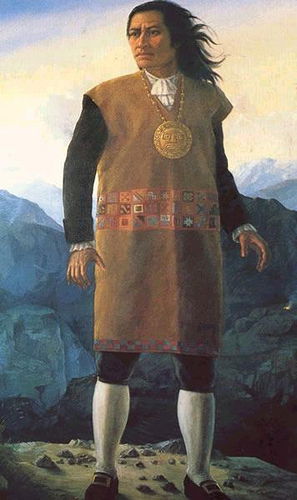
Jose Gabriel Túpac Amaru, the chief, or cacique, of the Indians of the province of Tinta, had attempted for several years to obtain reforms in the operation of the mita in his province, and to check the abuses of the repartimiento by its corregidor, Antonio de Arriaga, who, since his arrival in 1776, had conducted the operation three times, distributing goods worth three times the official figure. When complaints to the authorities in Lima proved ineffective, Túpac Amaru took the law into his own hands. On November 4th, 1780, Arriaga was ambushed, and was hanged on November 10th. By then, Indians and half-castes from neighbouring provinces had rushed to the chief’s headquarters in the town of Tungasuca, and, as arms and money were collected, the rebellion spread rapidly to neighbouring provinces. Within a week, Túpac Amaru’s army was 6,000 strong, and he began to prepare for a march on the ancient Inca capital of Cuzco, fifty miles to the north. As his forces advanced, corregidores and other officials were everywhere the objects of attack. Edicts were issued calling upon the local population to support the rising. That sent to Tungasuca on November 15th explained clearly that Túpac Amaru, as the most distinguished Indian of Inca blood, had been forced to act because of the misdeeds of the corregidores. It added: ‘Although complaints have been made to the various tribunals, no remedy was found to stop them.’
In Cuzco, the Spaniards made a stand, but forces sent out to intercept Túpac Amaru were destroyed, and the Indians reached the outskirts of the city by the end of December. At that point, Túpac Amaru made a tactical mistake. A direct attack would probably have captured the confused city. Instead, he tried to obtain its submission peacefully, by sending messages to the city council explaining the positive aims of his movement, hoping to attract the city to his side by force of reason, rather than force of arms. Thus, he explained, on January 3rd, that he sought the removal of the corregidores, the end of the repartimientos, and the creation of an audiencia in the city. He emphasized that he hoped to be able to achieve this within the framework of Spanish rule, ‘leaving to the King of Spain the direct dominion ... ’ Túpac Amaru, like most Indians, held the somewhat naive belief that all that was needed to improve their conditions was to make the King of Spain aware of their problems. As their cry of ‘Down with bad government, Long live Charles III!’ indicated, they saw the monarch as a benevolent figure, unaware that his wise laws were being ignored by evil corregidores. He frequently complained that he was not rebelling against Charles III, but acting in his name to keep the Indians loyal to the Crown, in spite of their bad treatment at the hands of immoral officials. Such blind faith in the efficacy of royal justice was touching to the King’s ministers in Madrid, who were as concerned as Túpac Amaru with the problem of reforming government in Peru. It was clear, however, that they could not uphold a rising of the masses that murdered royal judges. The reaction of the Spanish authorities was, in fact, mixed. On the one hand, it was fully recognized that the causes of the trouble were to be found in the bad social conditions that resulted from a defective system of administration; but, on the other, for political reasons, it was decided that the rebellion should be decisively crushed by military force. If it were allowed to succeed, it would set an unfortunate precedent, which might encourage malcontents in other parts of the Empire to take the law into their own hands.
In this context, the reaction to the crisis of the viceroy in Lima was strongly criticized by the authorities in Madrid. When news of the capture of Arriaga first reached Lima, the viceroy thought the movement one of the minor uprisings to which he was accustomed. When, by the beginning of December, he saw that the situation was more serious, he attempted a policy of conciliation, decreeing the abolition of the repartimientos and offering an amnesty to those who returned to their homes. These measures proved ineffective, however, and by the end of the month a more aggressive attitude had been adopted, with the decision to send to Cuzco strong forces of regular troops and well-trained militia. The first Spanish force, two-hundred strong, reached the city at the beginning of January. Although the main army did not arrive until the end of February, the Indians were by then already in retreat, following severe encounters with the city’s defenders. Despite the righteousness of his cause, and the early enthusiasm of his supporters, Túpac Amaru recognized that his disorganized, untrained, and ill-supplied masses were no match for regular forces, and he was forced to fall back on his Tinta stronghold. As he did so, the Spaniards went over to the offensive, and marched out of Cuzco in pursuit. After defeating Túpac Amaru’s army, they captured him and other members of his family early in April. Some of Túpac Amaru’s family—his brother, Diego, his son, Mariano, his nephew, Andres Mendagure, and his wife’s nephew, Miguel Bastidas, escaped to continue the struggle, but José, his wife, and his remaining sons were taken to Cuzco, with a host of other prisoners.
The retinue reached Cuzco on April 14th. Eventually a trial was held, and sentence pronounced on May 15th. In the square of Cuzco, Túpac Amaru was to witness the execution of his family and allies. Then, his tongue would be cut out, and he would be tied to four horses, which would be driven in different directions, to dismember his body, of which various parts would be distributed throughout the viceroyalty, to warn others of the consequences of rebellion. The sentences were carried out on May 18th, as prescribed, except that the four horses failed to dismember Túpac Amaru. He remained suspended in the air, as they pulled four ways, until it was ordered that the process be brought to an end by beheading him.
The executions did not end the revolt—in fact, it seems that the remaining rebels, in their turn, began to commit atrocities against Spaniards. Diego and Mariano Túpac Amaru continued to lead the Indians in inaccessible highland areas, especially in the northern provinces of the viceroyalty of the River Plate, into which the movement had spread. Inevitably, time was on the side of the Spaniards, once they were able to organize their resources, and once the Indian masses had lost the advantage of surprise. In September, 1781, the viceroy in Lima again attempted conciliation, as a means of finally ending the movement, by offering a pardon to the rebels who returned to their homes, and promising punishment to those who persisted in their rebellion. At first, the leaders were excluded from the pardon, but were later included in view of the reluctance of their followers to abandon them. In December, Diego finally accepted, and, early in 1782, together with his nephews, Mariano Túpac Amaru and Andres Mendagure, was allowed to return to Tungasuca. Trouble continued until 1783 in the viceroyalty of the River Plate, but Peru was finally pacified in 1782.
This policy of moderation towards the surviving members of the Túpac Amaru family did not please a number of influential Spaniards, who still held the belief that there could be no permanent security for Peru as long as Diego and his nephews remained free. Early in 1783, the commander of the army in Peru, Gabriel de Aviles, complained to the Minister of the Indies in Madrid that all his efforts to quell the rising would prove to have been in vain unless firm measures were taken to improve administration, and unless the surviving members of the Túpac Amaru family were removed from the scene. He found the situation particularly dangerous, since with the restoration of order, corregidores were returning to their provinces, and, despite the prohibition of the repartimiento, were again distributing merchandise, and attempting to collect old debts, for goods distributed before the rising.
The Minister of the Indies in Madrid, Jose de Galvez, took this advice to heart. He adopted a double-edged policy, by deciding to break the undertaking given to the rebel leaders that they would be left in peace, while determining to alter radically the system of provincial administration in Peru, in the hope that reformed government, by removing the causes of Indian grievances, would ensure peace in the future. Thus, in April 1783, about a hundred Indians, including sixty-three members of the Túpac Amaru family, were arrested, without resistance being offered. One of the family, a cousin of Diego, managed to escape. His attempt to start a new rising was unsuccessful, but it provided the excuse for harsh measures against the others. In July 1783 a further series of executions was carried out in Cuzco, with the same cruel refinements as those of 1781. Diego Túpac Amaru was tortured, before being hanged and quartered, and his body and limbs distributed to various provinces. Andres and Mariano escaped death, or at least formal execution. They were condemned to banishment, and nothing firm about their fate was heard after they were put on a ship for Spain.
While the remaining members of the Túpac Amaru family were being dealt with in Peru, wheels had already begun to turn in Spain to deal with the more positive aspect of the problem, namely the need to ensure better government for the future. In March 1783, a new viceroy was commissioned to go to Peru, entrusted with, among other things, the task of assisting with the removal of the corregidores, and their replacement by intendants. The viceroy, Teodoro de Croix, arrived in Lima in April 1784, to find that much preparatory work had already been accomplished in readiness for the installation of the new system. The formal change-over took place in July 1784, when the fifty corregidores were succeeded by seven intendants, well-paid, professional civil servants, responsible directly to the Minister of the Indies in Madrid. In their administration, they were to be controlled by a comprehensive Ordinance, or set of instructions, one of which abolished the repartimiento. Thus, by 1784, two of Túpac Amaru’s three aims had been achieved, and a new era had begun in the government of Peru. There remained the question of making justice more accessible for the Indians. In 1783, Galvez had committed himself to this, the third of Túpac Amaru’s aims, and the first intendant of Cuzco showed enthusiasm for the idea of creating an audiencia in the city, in the hope that it would help to bring about its general renaissance. The establishment of the high court was formally ordered in 1787, and it began to operate in the following year.
Thus, the rebellion of Túpac Amaru, although a military failure, was, in the long run, successful. Its outbreak drew attention to the problems of the Indians of Peru, to their oppression by the provincial officials, and to their inability to obtain legal redress. It emphasized to the Crown that, in practice, royal benevolence toward the Indians was ineffective, and accelerated a process of reform upon which the Crown had already embarked. Unfortunately for the leader of the movement, and for his family, rebellious Indians were too dangerous to be left alive, but they received posthumous vindication with the removal of the corregidores, the final prohibition of the repartimiento, and the creation of the audiencia in Cuzco.