David Livingstone: Humanitarian or Hypocrite?
Michelle Liebst looks at how the career of the great explorer of Africa reflects the wider failings of Victorian imperialism.
2013 marks the bicentenary of the birth of David Livingstone, the Scottish missionary, doctor, explorer, agent of empire and anti-slavery activist, who travelled extensively through southern equatorial Africa. His memory will be celebrated with a series of events taking place mainly in Britain, Zambia and Malawi. The Livingstone story has inspired a complex range of emotional responses since his death in 1873, from triumphalism and admiration to regret and suspicion, sometimes all at the same time.
After his death Livingstone was revered in Britain for his rise from humble beginnings to saintly status. Today, the ‘hypocrite’ angle is generally thought more enticing than the well-worn ‘humanitarian’ one. Still, most interpretations confirm his legendary status and well-meaning motives. For instance, Tim Jeal, a prominent biographer of famous Victorians, presents an enormous list of failings but nevertheless concludes he was ‘a very great man’ and ultimately successful in his contribution to British knowledge about Africa. A similar impression was made in Neil Oliver’s BBC TV series, The Last Explorers, which depicted him as obsessive, idealistic, dishonest and unrealistic but nonetheless deserving credit for his determination to end the slave trade.
Although it is clear that Livingsone’s role as a missionary co-existed with his role as an agent of empire, today he is mainly remembered for his travels and for his calls for slavery to be abolished. He is still packaged to the public, often with children as the main intended audience, as an adventurer. The fact that the British sought to abolish the slave trade and slavery in parts of east and central Africa has also helped to condone his flaws.
Loyalty to Livingstone’s enduring reputation as a charitable and humanitarian figure is even more prevalent in Zambia and Malawi than in Britain, particularly among older Christians, who credit him with ending the slave trade and providing medical development. They are also proud of the African contribution personified by Livingstone’s closest African allies, his servants Chuma and Susi. Partly given his death and the martyr-like journey of his corpse to Westminster, he has long occupied a saintly position in Zambian and Malawian Christian public memory. This has all been cited as evidence of successful black and white co-operation, but it is difficult to sustain this view when reading the substantial amount of material Livingstone left behind concerning the employment and treatment of his workers.
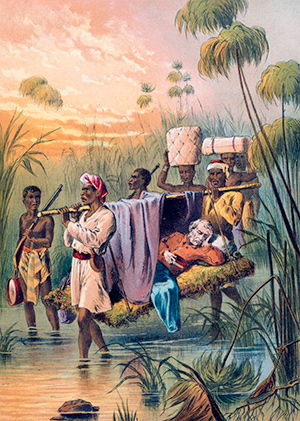
Clearly Livingstone did not achieve anything in Africa without the knowledge, protection and physical labour of Africans. When British explorers travelled in Africa they often required more than 100 porters to carry a huge amount of belongings, which primarily included goods for consumption and goods that acted as currency, such as cloth and beads. The use of beasts of burden was out of the question because of the climate, disease and the threat posed by wild predators such as lions. The absence of roads meant that carts were also useless. This meant that Livingstone relied heavily on porters who knew the routes and the dangers.
Finding non-slave labour was not an easy task. According to Livingstone’s missionary colleagues in Zanzibar, he sometimes recruited slaves, presented falsely to him as being free labourers, paying a small share of their wages to their masters. Like other missionaries and explorers, he may have done this at times unknowingly, as he preferred his porters to be non-slaves. Nevertheless in 1871 John Kirk, a British administrator and anti-slavery advocate, sent Livingstone a group of Banian slaves as porters, who – to put it mildly – he did not get on with. In his recently deciphered 1871 diary, he described them as ‘senseless slaves with no honour’ and reflected: ‘It is their misfortune to be slaves and mine to be dependent on them.’ Tensions mounted over the slaves’ refusal to travel further and he finally allowed them to leave. When they did not seem troubled by the prospect that they would lose all their wages, he seems to have concluded that this was because all of it would have gone to their masters in any case.
Though Livingstone’s struggles to control his caravan are well documented, writers rarely dwell on his paternalistic disciplinary strategies. His attitude to violence is often contrasted with that of the American journalist and explorer, Henry Morton Stanley (1841-1904), who candidly described his violent acts of punishment and believed in ‘the virtues of a good whip’. While Livingstone was relatively non-violent and insisted that ‘the service of Christ employed no means but those of persuasion’, violence or the threat of violence still played an important role. Generally dissatisfied with his porters’ work ethic, he argued at one point that they should ‘work as hard as slaves’, which suggests that harsh and heavy work, such as he had experienced as a boy in the cotton mills of Clydeside, was the natural replacement for slavery.
In one of Livingstone’s early journeys there ensued a debate about the distribution of beads as presents between his porters. The aggrieved workers aired their discontent the next morning by disturbing his sleep with the noise of their work. When Livingstone had complained three times about being disturbed the porter responded with ‘an impudent laugh’, which caused him to act:
I seized a double-barrelled pistol, and darting forth put the whole of them to a precipitate flight. As some of them stood within hearing I told them I would not kill outright, but he who would not obey would certainly have a limb broken on the spot: so long as they travelled with me they would be made to feel I, and not they, was master. They became very obedient immediately, and they now understand pretty well that they have not that claim on my property they imagined.
Livingstone often claimed that violence was an effective strategy but he considered it degrading to carry out corporal punishment himself. For example, in addition to the African porters, he had also employed 12 sepoys led by an Indian corporal, who was expected to discipline them physically. However, Livingstone’s relationship with the sepoys became increasingly strained and, when one of them refused to work and protested about being led deeper into the country, he resorted again to violence:
I applied a stick vigorously to a part of his body where no bones are likely to be broken till he came to his senses. On the first gentle application he said ‘you may take your gun and shoot me I’ll do nothing’. This shewed me that a gentle chastisement would not do and I gave it him in earnest till he was satisfied he had made a mistake in ringleading.
Though having a reputation for kindness towards Africans compared with other explorers, Livingstone was still influenced by pseudo-scientific racism and held very prejudiced attitudes towards his workers. To take one example, he bitterly criticised the African freed slave boys, whom he had collected from a government-run school at Nashik in India, for their laziness and for conspiring to divert his caravan back towards the coast, claiming that they ‘have the slave spirit pretty strongly; it goes deepest in those who have the darkest skins’. This equation of black skins with a slave mentality and laziness is a central part of the Livingstone legacy that needs further examination. This remark and much of the evidence above is not derived from obscure letters buried in an archival labyrinth; they are published and easily accessible, yet rarely surface in historians’ books and articles.
Livingstone cannot be understood as either a humanitarian or a hypocrite: his failings are not peculiar to his character but rather reflect the failings of the British imperial mission. The contradictions between his claim to help Africans and his perception and treatment of them on the ground reflected the feeble and occasionally destructive impact of Britain’s efforts to end slavery in Africa. Livingstone’s experiences in relation to these wider issues should be debated more openly.