Prison Pets in the French Revolution
Beasts behind bars - Katharine MacDonogh tells the tale of the animals forced to share their owners' fall from grace after 1789.
 It is appropriate that the end of the French Enlightenment should coincide with the publication of the last volume of the Comte de Buffon's hugely popular Histoire Naturelle in 1788. Whereas the philosophes of the eighteenth century had sought to upgrade the beast to the level of Man, the Revolution would degrade Man to the level of beast. Dogs, Buffon believed, learned to be civilised through living with humans; the miniature pedigree dog of the social elite was ipso facto superior to the kennelled working dog.
Two years after the book's publication, a large number of these pedigree dogs, known as lexicons, were burned in the Place des Greves, their owners having abandoned them in the first wave of emigration following the outbreak of the French Revolution.
Many noble breeds, like the greyhound, became all but extinct during these years; the royal hounds were dispersed and hidden; on the landed estates, dogs were given cosmetic surgery in order to disguise their pedigree. As with the lexicons these hunting breeds were judged guilty by association: hounds represented feudalism; cats and miniature dogs, whether in rococo art or the crude pornographic pamphlets so widely circulated through the 18th century, were the passive images of sexuality. Pets suggested idleness and, as Robert Darnton has noted, 'keeping pets was as alien to the workers as torturing animals was to the bourgeois'.
Animal hecatombs were not an innovation of the Revolution: the ritual burning of cats Metz on the feast of St John (June 24th) was not outlawed until 1765. Not only did animals sporadically succumb to epizootic disease but there was a general conviction that pedigree dogs were linked with smallpox; Edward Jenner, inventor of the vaccine, took the precaution of innoculating his own dog.
The popularity of pedigree dogs was undermined by a heightened consciousness of hygiene: Mercier, in his Tableau de Paris of 1783, reproached pet owners for being 'more concerned about their dogs than keeping their stairs clean'. Anxieties about hygiene were aggravated by the dramatic increase in the number of dogs throughout France; in 1788 thirteen of the cahiers de doleances from all three Estates called for the institution of a dog tax. By 1790, fear of famine called for desperate measures to ration food supplies and the forsaken Iexicons were an obvious target.
Notwithstanding the fate that befell these small animals, many notorious pet lovers survived the Revolution remarkably unscathed: Madame Helvetius, whose husband – a friend of Buffon – had been a pioneer in the movement to prevent cruelty to animals, spent these years in Auteuil, surrounded by twelve silk-clad cats which she fed on partridge from gold plates; the Princesse de Chimay, whose pet monkey was a celebrity at Versailles, was released after a short internment at the relatively luxurious Oiseaux prison.
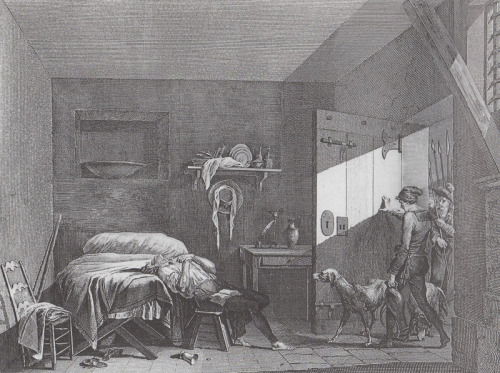
The revolutionary prisons were the last salons of the 18th century; pedigree dogs were as common a feature behind their walls as they had been in the Faubourg St Germain. Despite the decree passed on September 29th, 1791, specifying that the prisons should be 'clean and well-aired', the conditions of detainees rapidly deteriorated. Cats, previously encouraged as a means of controlling vermin, were frightened off by a canine force of considerable numerical superiority, leaving the rats the field, The only references to cats in the narratives of the prisons is as an item on the menu. The Duchesse de Duras recalled how at Plessis:
One had the impression that considerable attention had been paid to every- thing that could cause disgust ... the smell was awful, the dishes were filled with hairs ... Pigs trotted in the dining-hall during meals.
The concierge at L'Abbaye prison, Lavaquerie, referred to Madame Roland's cell as the 'Pavilion de Flore' because she strewed it with flowers to counter the smell emanating from the woodshed outside where the animals relieved them- selves. When Madame Lachabeaussiere was imprisoned at Port-Libre in January 1794, she was kept in solitary confinement, sharing her cell for the first four days with a bitch feeding its litter. A fellow-inmate, Coittant, recalled how, nauseated by the smell, 'she begged to be spared such disagreeable company, a favour only granted after several requests. When the straw was removed, it was noticed how the animals' excrement had destroyed the floor'. To keep her company, Madame Lachabeaussiere elected to keep one of the puppies which turned out to be: [an animal] of surprisingly strong instinct, which became her one consolation. Brilliant was his name ... Whenever she needed anything ... Brilliant would go and get the warder, jump up and not leave him until he came to his mistress. This dog had taken a serious aversion to the keeper; as he could not get his revenge for the mistreatment his mistress had endured, he fell back on his dog and, although far smaller and weaker, never relented until the other was floored.
When the order came to expel the 190 dogs at Port-Libre, an exception was made in the case of Brilliant. Thus did the craving for companionship triumph over fastidiousness.
Living under the spectre of the guillotine, prisoners soon became less preoccupied with health and hygiene and many attest to the curiously remedial effects of prison life: the Duchess de Tourzel, governess of the royal children, imprisoned with the ill-fated Princesse de Lamballe at La Force in 1792, marvelled at the latter's improved constitution in such insalubrious surroundings. Dogs, providing an emotional outlet, helped maintain morale. The former war commissioner Blanchard, imprisoned at the Madelonnettes, had a pet dog so loyal that it allegedly howled every time his master mentioned his wife or children. The Duchesse de Tourzel's daughter Pauline, later Comtesse de Bearn, recalled how Francois, their gaoler at La Force, 'a very good man ... was touched by my position and, thinking to do me a pleasure, he left his little dog with me by way of distraction, saying "Whatever you do, do not betray me, I shall pretend I forgot him"'.
Occasionally the prisoners' pets were of more material use to their owners, acting as messengers and alerting them to danger. Nougaret, in his History of the Paris Prisons of 1795, describes how Madame Lachabeaussiere's husband, at the Luxembourg, received regular visits from his dog Diamant, whose collar.served as a repository for a clandestine correspondence between husband and wife. Similarly, the future Empress Josephine, imprisoned at the Carmmes in 1794, received messages from her children, Eugene and Hortense de Beauharnais, concealed in the collar of her pug, Fortune, the only member of her family to be granted visiting rights.
Sometimes the assistance afforded by pets was unwitting: at La Pelagie the end of the Terror was signalled when one of the prisoners heard a gaoler shout at his dog 'Down Robespierre!' a name no one would have dared bestow on an animal before Thermidor.
Although dogs had long been used in guard duty (Mercier was struck by their size, might and ubiquity when he visited the Parisian prisons in 1783) their numbers multiplied during the Revolution, particularly after the September Massacres of 1792 when the questionable reliability of prison wardens led to many being supplanted by these incorruptible Cerberi. Most of the detainees allude to the 'enormity' of these dogs. Dr Lafisse at La Pelagie complained:
Now, if ever. I nod off for a moment, Twenty great dogs, buttresses of our wardens, With thunderous voice and bowls persistant, In all my senses increase the torment.
These dogs were 'built', according to Riouffe at the Conciergerie, like the gaolers themselves, 'to spread alarm', and Beugnot could not sleep for their barking as every hour struck. At the Luxembourg, when the well-liked keeper Benoit was replaced by Guyard in 1783, night patrols were introduced to prevent any repetition of the spate of suicides that had recently occurred, and the guards performing the interminable roll calls were inevitably accompanied by ferocious dogs (fleeing the prison after Thermidor, Guyard, like Ribbentrop in 1945, abandoned everything but his dogs).
At Port-Libre, Coittant recalled how the prisoners themselves 'were made to buy a dog to guard them, for which they paid 240 livres' – most of which doubtless went to line the pockets of their gaolers. Although only one prisoner, a Bostonian at La Force, is reported as ever having successfully grappled with a guard-dog they were not as incorruptible as was imagined: Ravage, the dog of the keeper Richard at the Conciergerie, acted as night-security in the prison courtyard. Some prisoners had dug a tunnel and only needed the animal's co-operation to effect their escape. The next morning they were found to be missing, despite the presence of the dog which had remained obdurately silent. The conundrum was explained by a note attached to the animal's tail on which was written: 'Ravage can be bribed with a 100 sous assignat and a handful of sheep's trotters'. Ravage was punished for this dereliction of duty by being interned in one of the cells.
The punishment inflicted on Ravage pales into insignificance alongside that suffered by the dog of Monsieur St Prix in 1793. A former actor at the Comedie Francaise, St Prix enrolled in the National Guard and was stationed at the Tuileries (o keep watch over the royal family before they were transferred to the Temple. Not only did he engineer private meetings between Louis XVI and Marie-Antoinette but, as a royalist agent, he corresponded with emigres and kept their relations in Paris abreast of their news. He trained his dog to bark at the approach of anyone wearing the revolutionary carmagnole or the uniform of the National Guard; the animal was reputed to be able to sniff out a Jacobin at more than 100 metres. One day it hit the postman who complained to the comite revolutionnaire of his section. A domiciliary visit resulted in an 'anti-civic' correspondence being, unearthed. St Prix and his dog were summoned before the Revolutionary Tribunal which condemned them to death for lesenation. The dog was taken to the Barriere du Combat and shot. This was the first instance of a dog being put on trial in 200 years.
Ravage would have been a familiar sight to Marie Antoinette when she was interned in the Conciergerie on August 2nd, 1795. Notwithstanding the highly questionable authenticity and reliability of many Revolution, empire and restoration memoirs, across whose pages her dogs come and go with an elusiveness worthy of the Scarlet Pimpernel, the queen's love of animals is indisputable. Shortly after her marriage, the bored Dauphine had applied to the Austrian ambassador, the Comte de Mercy-Argenteau, to send her pug, Mop, from Vienna; at her famous Dairy at Le Petit Trianon, built between 1782- 88, she kept a variety of animals including two cows, Brunette and Blanchette, and a four-horned goat. Her aversion to hunting she confided to her sister, Marie-Christine, in a letter of 1772 The queen had to rein in her urge to have another pet dog, however, after the birth of her youngest son in 1785, for reasons explained to the Duchess de Tourzel in 1789:
... any noise to which he is not accustomed frightens him; for example, he is afraid of dogs, because he has heard them bark near him. I have never forced him to see them, because I believe that as his reason develops, his fears will subside.
Maternal misgiving yielded in 1792 to expedience. Marie Antoinette's former favourite, the Princesse de Lamballe, returning from sanctuary in England at the queen's request, presented her stricken mistress with a puppy. 'Will anyone credit that a queen of France was reduced to having a little dog to sleep in her room, to warn her if the slightest noise was heard in it?' chafed the Duchesse de Tourzel. Marie Antoinette named the animal Thisbee in an oblique reference to the Swedish Count Fersen, her Pyramus, whom she had last seen on the night of February 13th, and her relationship with whom she knew to be as doomed as that of the mythological lovers. It seems likely that this dog accompanied the queen from the Tuileries to the Temple where she was imprisoned after the journee of August 10th; a small dog appears in contemporary engravings of the royal family in the courtyard. The silence of those present at the Temple – Clery, the king's valet, Hue, an usher of the king's chamber and even Madame Royale, the queen's daughter – on the subject of the animal may be conspiratorial: allusion to the putative lover was hardly becoming in a martyr; no act of human kindness, even the toleration of a pet, should tarnish the image of her sacrifice or of the inhumanity of the revolutionary authorities.
If indeed Marie Antoinette did keep a dog at the Temple, what became of it when she was transferred to the Conciergerie? Both Nougaret and Freville (in his History of Famous Dogs written in 1796) assert that the animal followed her but was barred entry. The latter alleged that the animal committed suicide in despair; the former that it disappeared after a long vigil outside the prison gates after the queen's execution. Highly romantic, hagiographic and sentimental as these narratives undoubtedly are, they are endorsed by Monsieur de Salamon who was imprisoned in the Conciergerie in 1796. An acquaintance of the keeper, Richard, since ancien regime days, Salamon recalled how:
A pug dog came into the room as the door opened, and after jumping on my bed and exploring it all over, ran out again. This was the queen's pug, of which Richard had obtained possession and treated with the greatest care. The dog's object in coming in like that was to smell his mistress’ mattresses. I saw him behave in this way every morning at the same hour, for three whole months, and in spite of all my efforts I was never able to catch him.
The humanity with which Richard and his wife had behaved towards the queen during her first month at the Conciergerie, and the suspicion of their having collaborated in the Carnation Affair, had led to their being suspended. By the time they were reinstated in November 1793, Made Antoinette had perished on the guillotine. Given their previous acts of kindness they may well have taken pity on her pug, a breed to which she was famously attached. Whether this dog was the original Thisbee or the pet of another victim which she had adopted is impossible to gage.
The reticence of Madame Royale on the subject of her mother's dog at the Temple also applies to her own spaniel, Mignon, which her brother, the Dauphin, gave her before being finally separated from his sister on October 7th, 1793. In all probability he retained some of his earlier ambivalence towards dogs. The existence of Mignon is well documented: the eye-witness Hue, refers to 'a dog which was long the sole witness of her sorrows', and the dog features in many engravings of Madame Royale after her release on December 19th, 1795. When Mignon died in 1801, having fallen from a balcony of the Poniatowski Palace in Warsaw, Louis XVIII wrote to the poet Jacques Delille, then in England, asking for some lines to inscribe on the dog's tomb. In Malheur et Pitie, Delille incorporated an elegy to Mignon:
Be then the subject and the honour of my poems, Oh you! who consoling your royal mistress, Until your last breath proved to her your kindness, Who beguiled her misfortunes, enlivened her prison; Oh of the last farewell of a brother, unique and tragic gift ...
If the Dauphin was wary of dogs, he was unequivocal in his liking for birds. At the Tuileries in 1792 he took care of the aviary and of the ducks in the pond, he also raised rabbits. At the Temple in 1795, in response to the boy's entreaties, one of the towers was transformed into a pigeonry and his gaoler, Simon, had a birdcage built in one of the window-recesses, even removing a plank from the hoarded-up casement-window 'in order to provide the birds with light'. Bills for supplying 'bird-seed for the little Capet's pigeons' are still in evidence. The Commune baulked, how- ever, when presented with a demand for 300 livres from a clock-maker, Bourdier, whom Simon had commissioned to repair a very beautiful bird- cage which he had found in the furniture-repository of the Prince de Conti, the former proprietor of the Temple. Simon had undertaken to pay this sum out of his own pocket but, by the time the work was completed, he too had been guillotined.
While the royal family languished at the Temple, Hebert, leader of the sans-culottes and editor of the scurrilous Pere Duchesne, printed the following description of them in captivity:
It was my blasted turn to stand guard over the menagerie ... I allowed myself a day off to examine the ferocious beasts: first of all, imagine the rhinoceros, fuming with rage at being chained, and panting with the thirst for blood which consumes him; it is the spitting image of Louis the Traitor, snoring at night like a pig in shit, daylight eliciting a grunt, only happy when he sees his nosh arrive, devouring a fattened pullet in one bite while saying to himself: could I but do the same to a Jacobin, a sanc-culotte! As for the Austrian, she is no longer that tigress swimming in the pools of blood which she let flow on St Lawrence's Day. She has assumed the treacherous mask of a cat; she gives the impression of gently mewling; she draws in her claws all the better to pounce in good time and scratch again ... The trial of Louis the Traitor must begin at once in order to reduce not only the number of people ministering to his needs but also the amount of display required to keep this measly pig.
That the dehumanisation of the royal family was a psychological pre-requisite for their judicial murder is evident from Hebert's momentary fit of compassion after the beheading of Louis XVI on January 21st, 1793: bursting into tears, this 'Homer of smut' as a contemporary called him, blurted: 'The tyrant was very fond of my dog; he often used to stroke it; I couldn't help recollecting'.
The widespread use of animal metaphor during the French Revolution provides insight into the mentality of a predominantly rural population living in a pre-industrial age. Hebert and his sort released metaphorically the wild beasts from the famous Versailles menagerie and caged the monarchs in their place. Marie Antoinette is ever the 'arch-tigress', or the 'Austrian she-wolf, and her children are 'the little wolves'; Louis XVI is most frequently likened to a pig – Clery recorded seeing graffiti on the wall of the Temple promising 'we shall find a way of reducing the great hog's fat'.
These metaphors are steeped in the folklore of 18th-century France; in the fairy-stories of Perrault and Grimm, compendia of tales passed orally across the centuries, it is these same animals that are anathematised. Evil spirits were deemed to manifest themselves in. bestial form and animals were put on trial in France as late as 1845. Pigs, particularly troublesome because of their numbers, had long been the victims of a primitive superstition that the seven piglets of which their farrow was held to consist represented the seven deadly sins. The sans-culottes were the Circes of their day, metamorphosising Louis XVI and his courtiers into swine. Prison slang was riddled with animal metaphor: in- mates alerted each other to a new arrival with calls of 'to the cat! to the cat'; spies were called 'sheep'; at La Force, the room in which the inmates first encountered the warden was called the 'mouse-trap' and the warden at the Madelonnettes, Vaubertrand, referred to his prisoners as his 'pigeons'.
Coittant recalled playing cards with the warden's four-year-old son on which were depicted 'kittens, asses, dogs, birds etc.,' designed in happier days to foster love of animals as a means of preventing cruelty amongst men. It was the experience of the Terror which destroyed the notion of human supremacy; as Freville wrote in 1796: 'Nowadays a good dog is easier to come by than a good man'.