Edward VI and Mary Tudor: Protestant King and Catholic Sister
Judith Richards helps us appreciate a Marian perspective on the reign of the boy-king.
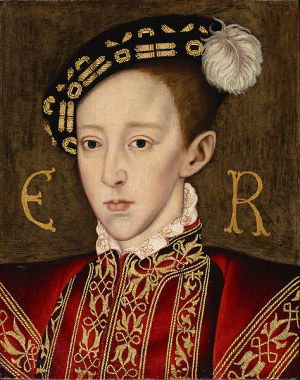 The contest between a young Tudor king and his older sister discussed here was part of wider struggles between Christians across most of Europe. At issue was true Christian belief, at a time when difference of worship was often seen as heresy, deserving death. This particular struggle began after the death in January 1547 of Henry VIII. His heir was his son, Edward aged nine, and therefore too young to rule in person. The next heir was Mary, then 31 and Henry’s daughter by his first wife Katherine of Aragon. Elizabeth, the daughter of Anne Boleyn and now the best known of Henry’s children, was 14 when the struggle began, and not really involved.
Successor Regime
When Henry died, there were already many different opinions about ‘right religion’ in England; his death soon made clear how important he had been to maintaining his preferred religious settlement. The old king’s death was kept secret for several days while a few of his closest associates rearranged his will for their benefit. The Council Henry had nominated to govern for his son was originally made up of men of diverse political and religious interests. Although some had done so with considerable reservations, all of them had accepted Henry’s religious settlement. That had meant keeping most of the Lutheran changes at bay and retaining most Catholic beliefs, above all about the nature of the mass. Henry had, however, completely repudiated the authority of the pope.
The secret negotiations meant power shifted significantly to Edward’s uncle Edward Seymour, who acquired two new titles, Lord Protector (to the king) and Duke of Somerset. Like his most important supporters, he gathered new wealth to match the new titles. Those excluded from the original Council for resisting the changes to its structure and composition included religious conservatives, but some original Council members like John Dudley, and new members, like another of the new king’s uncles, Thomas Seymour, endorsed further moves away from Catholic doctrine.
Among the innovations, they supported the acceptance of married clergy and widespread attacks on religious images and symbols. Most significantly, many were uneasy about the Catholic mass, which taught that the sanctified bread and the wine became the body and blood of Christ, the Real Presence. They supported the more evangelically minded of Henry’s leading clergy, including Thomas Cranmer, Archbishop of Canterbury, and Nicholas Ridley, Bishop of London, although there was as yet no clearly agreed set of doctrines to the changing religion.
Mary’s Situation
Despite her age and status, Princess Mary had been kept ignorant of the changes made to Henry’s arrangements. She was, however, someone whom the new regime had cause to fear, since she had been constantly at Henry’s court in recent years and probably knew how much the details of Henry’s will had been changed. That would explain why her bequests in her father’s will were also changed, so that instead of receiving £3000 in money and goods, she was granted so much property that the income from it was worth roughly that amount every year. She also had the use of rich furnishings and furniture from the royal stores for the several impressive houses she had been given. It was later to be important that much of the land she now owned was in East Anglia, making her the most important magnate in that wealthy area, as well as rivalling the richest peers in the realm in income – and therefore in power.
Nobody anticipated that Mary would ever use such power. Her cousin, the traditionally Catholic Emperor Charles V, believed Mary secretly shared all his views, and briefly hoped she might claim the throne, but she fully accepted her brother’s right to succeed. (The Catholic argument ignored by Mary was that, since Henry had married Jane Seymour without papal approval, their son Edward was illegitimate.) She and Edward had always been fond of each other, and since his mother, Jane Seymour, had married Henry only after the deaths of both Katherine of Aragon and Anne Boleyn, Mary saw no reason to doubt his legitimacy.
After Edward was crowned king, Mary moved away from the royal court to take control of her estates. She was still heir apparent to the throne, and now had the resources to live in appropriate magnificence. She was free to move at will between her many residences and to hunt, to gamble, to develop her considerable musical talents and collect paintings, all matters of great interest to her. She was free to take long walks, to visit and assist the poor. She was also free to have in her household whomsoever she wished. She had a number of attendants who had been with her for many years, and attracted more who proved to be equally loyal to her. Her household naturally attracted both gentlemen and gentlewomen who shared her religious sympathies. All of that, and more, Mary had quite sufficient resources to maintain.
Above all, being a very devout woman, she was free to observe her religious practices which were just as Henry VIII had prescribed. What she did not anticipate was how much official religious practice would change, and how quickly those changes would take place.
Reform or Heresy?
If Mary was an observer at Edward’s coronation – no evidence for this has survived, but precedents suggest she may well have been – she would have heard Archbishop Cranmer, in his coronation sermon, call upon the young king to model himself on the equally young Biblical king Josiah and ensure that all ‘idolatry’ was destroyed, and images removed from all churches, but that was not a new call.
The intensity of the subsequent attack on images was, however, much greater than those of Henry’s day. Much more worrying to the religious conservatives was the publication, in July 1547, of a Book of Homilies, ready-made sermons to be read in church. One of the homilies invited doubts about whether the bread and wine consecrated during mass was indeed the ‘natural body and blood of our Saviour Jesus Christ.’ That doctrine of the Real Presence had been restated in 1539 by the Act of the Six Articles. It also declared that to question the doctrine was heresy and that the usual punishment – burning at the stake – should apply. So the new arguments about the nature of the communion being officially promoted by the middle of 1547 were literally illegal and heretical.
Furthermore they were being put forward in the name of a king, and head of the church in England, who was clearly too young to decide such weighty matters.
Henry had taught that the king alone, God’s ‘vicegerent’ on earth, had the power finally to determine true doctrine. This is graphically illustrated by the Title Page to the 1539 Bible. The objections to both the increased attack on religious images and changes to the doctrine and practice of communion led to violent popular protests in Cornwall and elsewhere.
At the other end of the social hierarchy Mary Tudor was one of those who also protested. She insisted that since the Henrician religion was still established by parliamentary statute, it was illegal to defy it. She wrote to the Lord Protector, Somerset, referring to the ‘usurped power’ by which he and the Council now governed, and deploring the way they overturned the old king’s views now he was dead. She added that she at least would remain ‘an obedient child’ to his laws, until the new king was old enough to make his own decisions about religion.
When Edward’s first parliament finally met in November 1547 several months after the first religious changes had been promulgated, many traditional religious rituals came under attack, and clergy could marry. Henry’s Act of Six Articles was also finally revoked. Several new laws and the First Book of Common Prayer were foreshadowed to come into force at Easter 1549. Among the changes the Book of Common Prayer established was that it introduced a new form for what was now called Holy Communion, no longer the Latin mass. The changes included the practice whereby the lay congregation should share both the bread and wine, previously confined to the clergy.
Resistance
As the traditional mass came under attack, Mary increased the number of times it was celebrated in her own household. She was able to defy the new laws because of her wealth, her standing as popular heir apparent, and because her cousin, the Emperor Charles V, the most powerful ruler in Europe, set himself up as protector of her religious rights. When England was at war with France and Scotland, in 1549, for example, the Council had to pay some attention when the Emperor sent them a message that he would ‘suffer no pressure’ to be put on her religious practices. That protected her and gave him an opportunity to intervene in English politics.
The problem for the Council was that Mary was not unusual in her resistance to the religious changes. The year 1549 saw renewed risings in the south west and protests that Cornishmen could not understand the new English forms of worship (Cranmer marvelled that Cornishmen apparently understood Latin better than English). There were significant protests in Oxfordshire and Buckinghamshire, and an important uprising, led by Kett, in Norfolk, which also included religious grievances. The Edwardian regime had more trouble suppressing the revolts because so many of the gentry sympathised with the commoners. Nor did it help them that although Mary was the greatest landowner in East Anglia, she made no moves to suppress even the uprising closest to her. There were dark suspicions that she had foreknowledge of the planned uprising, but of that no proof was found.
By late 1549, some councillors were increasingly critical of Protector Somerset’s foreign and domestic policies. His continuation of Henry’s wars had proved very expensive and failed in the stated purpose of uniting Scotland and England by marriage. Instead of being confirmed as Edward’s betrothed, in 1549 the infant Mary Stuart was taken to France and betrothed to the Dauphin – and France declared war onEngland. Somerset’s policies were also blamed for the social unrest troubling several parts of England. When John Dudley, Earl of Warwick, led the moves against Somerset, his allies were such a mixture of conservatives and others that there were rumours of a change in religious direction, and even some that Mary might be made regent for Edward.
Mary’s in Difficulties
Far from that being the case, Mary found herself in an increasingly difficult position. Warwick found that England’s disastrous financial position meant he had little choice but to make peace on quite humiliating terms. His pursuit of friendship with France inevitably meant deteriorating English relations with Charles V, France’s most powerful opponent. Mary therefore was likely to have much less protection for her practice of traditional religious forms. One sign of her changing fortunes was that when Somerset was taken prisoner again in 1552 and executed for treason, one charge against him was that he was too protective of Mary.
Despite earlier indications of conservative sympathies, Warwick, who transformed himself into the Duke of Northumberland in 1551, became a supporter of further church reformation. More bishops appointed during Henry’s reign now found themselves in prison and Mary came under yet more pressure to conform to the – still evolving – new religious practices. To remove her from the scene, Edward’s Council produced several foreign marriage proposals for her, but she refused to consider any of them. So Mary stayed in England, where she remained very popular, as the legitimate heir to Edward and as a powerful symbol of resistance to the religious changes of the new regime.
Although she continued to visit Edward’s court to see her beloved brother, and received much popular applause as she rode through London, Mary’s personal situation was becoming more difficult. Her problems intensified as the young king began to voice his own religious opinions more forcefully. By the middle of 1550, the situation was becoming so tense for Mary that she seriously, if briefly, considered flight from England. Charles V’s ambassador, Van der Delft, who saw protecting Mary as an important part of his responsibilities in England, undertook organising her escape. It helped considerably that she had a residence very close to Maldon and therefore to the sea. Two ships, sent by Mary of Hungary, Charles V’s sister and regent of the Netherlands, duly arrived off Maldon in June 1550, and the commander of the enterprise disembarked to seek further advice from Mary’s household. He met with opposition from the household, deep suspicion from the local inhabitants, and Mary’s own refusal to go. The ships perforce withdrew, and historians have puzzled over what was going on ever since.
If Mary had left, she would have been able to return only at the head of an army, an outcome no thoughtful person wanted. It is possible that Van Der Delft, deeply worried about Mary’s personal safety, was the main force behind the plot. King Edward blamed Mary of Hungary, sister to Charles V, for the scheme and saw it as a plan to start a civil and a foreign war in the name of the Catholic religion, and presumably to put Mary on his throne. Rumour added that while she was abroad she was to be married to Philip of Spain, the only son of Charles V. Once the attempted flight had failed, everyone in England insisted they had never approved the scheme. The main significance of the episode now is that it helps explain why the Edwardian regime was so anxious about both Mary’s popularity, and widespread hostility to the new religion.
Mary under Attack
Soon the Council renewed the attacks on Mary’s chaplains for saying mass for her household. InSomerset’s time, an agreement had been struck between Van Der Delft and the Council, allowing Mary to hear mass. The Council now insisted that she alone had permission to do so and only in her private chamber, with no others present. Under no circumstances could mass be said for her household when she was absent. Initially, the old argument went on much as before, but then it took a new form as the 13-year-old Edward himself intervened, writing to advise his sister that he could not tolerate bad religion and would see his laws strictly obeyed.
The letter was in Edward’s own hand, though Northumberland had probably drafted much of it. Whoever the author, Mary could not ignore the evidence that Edward himself was now taking a strong stand against her. She wrote back, entreating ‘in the humblest possible manner’ that she be allowed to continue her religious practice. At their most recent meeting, Mary had wept when pressured about her religious practice, and Edward had wept to see her weeping. But now he had become much more obdurate. When Mary visited the court again in March 1551, she had her usual joyful reception in the streets of London but the court reception was much more chilly. Edward subsequently noted, with what reads like satisfaction, that his councillors had reminded her how long he had endured her hearing mass, but such tolerance could no longer be permitted. The king required her, like any subject, to obey his command.
Mary left the court shaken, but unharmed. In the following months, senior members of her household were summoned to attend the Council in London, questioned about Mary’s religious practices and ordered to advise her that her chaplains were not to say mass. On their return, Mary forbade her officials to give her the message, and they on returning to London were imprisoned for disregarding Council’s instructions. Royal commissioners rode to her residence to order obedience in the king’s name; she responded she was his most humble subject and would obey his religious wishes as soon as he was of an age to declare them. For uncertain reasons, a very dangerous impasse was ended as both sides silently backed down. Her household officers were released, mass was resumed in her house.
Succession Crisis
To all appearances, something resembling courteous relations between brother and sister were resumed. But Edward’s final move against Mary came as he lay dying in mid 1553. Then he declared that both Mary and Elizabeth were excluded from the throne, since they were both illegitimate. Moreover, both being unmarried, either might marry a foreign prince and thereby bring in a foreign (i.e. Catholic) religion. So, ignoring Henry’s Act of Succession, Edward turned to his cousin Lady Jane Grey, safely married to Guilford Dudley, son of the Duke of Northumberland, as his successor. His Council agreed to varying degrees, from Northumberland’s complete support through ambivalence to silence. And on Edward’s death, Jane Grey was proclaimed queen.
Queen Jane reigned for nine days, while Mary, who had retreated to her East Anglian stronghold, began rallying her forces. Impressive numbers from East Anglia and beyond rallied to her support. There was no real battle, because there was so much support for Mary as the legitimate heir, including from those with different religious views. Northumberland, in Cambridge when he realised he had lost, proclaimed Mary as queen and flung his cap in the air for joy at his proclamation. At Mary’s command, some of the same men who had promised at the Council to stay with him all the way to install Queen Jane, took Northumberland prisoner. Subsequently executed for treason, he very publicly reverted to Catholicism before he died.
Mary waited a few days, while London prepared itself for the royal entry of England’s second queen regnant, planning an occasion which would, by its splendour, overcome any suspicions its brief acceptance of Queen Jane had raised. (The first queen regnant was the twelfth century Queen Matilda whose reign was very brief.) Mary entered London with all the magnificence of a Tudor monarch, indisputably Catholic and very warmly welcomed. Appearances suggested a considerable majority of the population, even in London, was eager to return to Catholic forms of worship, and apparently the triumph of Protestantism was indefinitely postponed. Perhaps the final irony is that Mary’s intervention against Jane Grey ultimately cleared the way for Elizabeth to claim the throne after her, and alter the course of English religion once again.
Issues to Debate
- How far did Mary, rather than Edward VI, have the backing of the law of England during this period?
- What personal qualities did Mary display during the reign of her half-brother?
- Why was Mary so popular during this period?