Portrait of Britain: AD 1300
Bruce Campbell argues that a unique conjunction of human and environmental factors went into creating the crisis of the mid-14th century.
In 1258 a parliament held at Oxford – the first to include two representatives per county – imposed the so-called Provisions of Oxford on Henry III (r.1216-72) to curb his royal power. The same year, in Wales, Llywelyn ap Gruffyd (r.1246-82) assumed the title of Prince of Wales and began to consolidate his power base in Gwynedd. Across the Irish Sea Brian Ó Neill of Tyrone was engaged in a similar enterprise: at Cáeluisce near Belleek he was given the ‘kingship of the Gaels of Ireland’ by Fedlimid Ó Conchobair and Tadg Ó Briain. Their confederation was the first co-ordinated Gaelic resistance to Anglo-Norman expansion. In Scotland, however, the young Alexander III (r.1249-86) would have to wait another three years before he assumed personal rule in 1262, whereupon one of his first and greatest achievements would be to negotiate the treaty of Perth with Magnus VI, king of Norway, thereby securing the Western Isles to Scotland.
Meanwhile, early in 1258, somewhere in the tropics, a major volcanic eruption occurred. Particles from the eruption were ejected high into the stratosphere, shrouding earth in a ‘dry fog’. In Britain the ensuing cool, wet summer followed a year of ‘excessive and long rains’ and produced one of the worst harvests of the thirteenth century. Record wheat prices were accompanied by dearth and famine. Atmospheric circulation remained disturbed for several years, resulting in 1262 in a summer that was exceptionally dry and hot. In Ireland drought-induced famine fanned the spread of disease. It could have been even worse. In 1258 and 1259 bubonic plague had spread west from central Asia, where it was endemic, into southern Turkey. On that occasion the deadly pandemic got no further, and in Britain and Ireland the environmental disturbance of 1258-62 caused only a momentary faltering in the established demographic and economic expansion. It was, however, a harbinger of things to come.
From the late thirteenth century the climate became cooler and more prone to extremes, heightened storm surges in the North Sea threatened reclaimed coastal marshlands, and pestilences of animals and humans became rife. In 1300 Britain stood on the threshold of what environmentally was to be its most apocalyptic half-century.
A range of archaeological indicators identify the years between 1315 and 1353 as a time of pronounced environmental hiatus on a global scale. The historical record confirms this period as exceptionally hazardous and unhealthy for both humans and domesticated animals. All of northern Europe suffered famine during the terrible years 1315-17 and in Britain there were further serious harvest failures in 1331, 1346 and 1351. As if this were not enough, in 1319-20 cattle herds were ravaged by disease – probably rinderpest – and over the next thirty years recurrent outbreaks of infectious murrain and scab ensured high levels of mortality in sheep. These biological catastrophes can hardly have been unconnected with the disturbed environmental conditions that prevailed. The same is probably true of plague, a disease of rodents transferred by fleas to humans, which – as in 1258 – began its terrible spread across Europe at precisely the point of greatest environmental stress.
It now seems likely that the extreme weather conditions that caused harvest failure and famine and the various pestilences of animals and humans were all part of a single prolonged episode of environmental disturbance. Viewed in this light, these events assume far greater magnitude than historians have been inclined to ascribe to them. No socio-economic system exposed for so long to such a variety of severe shocks could have withstood them unscathed, let alone one at Europe’s stage of development in the early fourteenth century. Agricultural producers, in particular, had to contend with a series of environmental hazards outside their control and far beyond their comprehension. In England, historians have represented the fourteenth-century crisis as ‘population outstripping resources’, ‘feudal over-exploitation of the production system’, and ‘the price paid for burgeoning warfare’. Yet when nemesis in the form of plague eventually came, it was essentially non-economic in origin.
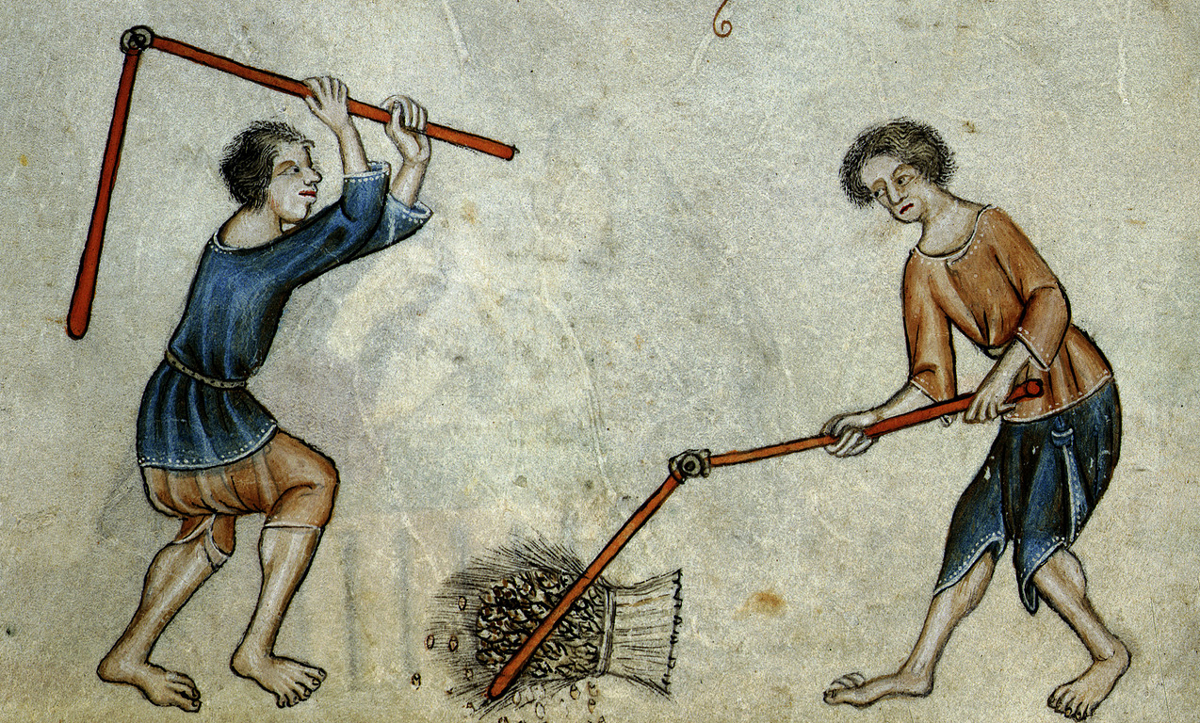
The resources upon which the population depended for food, drink, fuel, raw materials and export earnings were essentially organic: the product of plants and animals. Lead, tin and iron were the only significant exceptions. Likewise, technology was mainly reliant upon human and animal muscle power augmented by the renewable power sources of wind and water applied to mills, boats, and ships. In this sense, Britain was still a green and pleasant land. Yet, as Alfred Crosby has pointed out, the mills present in practically every settlement bestowed upon Britain, in common with much of the rest of northern Europe, ‘a greater proportion of individuals who understood wheels, levers, and gears than any other region on earth’. Machines needed to be maintained, soil fertility renewed, and flocks and herds restocked. Sustaining output was an enduring challenge. In areas of common-field agriculture local communities enacted by-laws and appointed officials – reeves, messors and haywards – to ensure that resources were managed effectively in the collective interest. In coastal areas there was also intra- and inter-community co-operation in the maintenance of sea defences and drainage dykes. Everywhere the effort to prevent the degradation of resources was a struggle, even when the climate was clement.
By 1300 tillage had been extended almost to its physical limits: only common pastures and the private parks and royal forests set aside as hunting grounds for the nobility proved immune to the advance of the plough. Royal forest was subject to forest law and this was deeply resented, hence the popularity of tales that told of outlaws who poached the king’s deer. These forests, too, were at their medieval maximum. In areas of woodland, upland and marsh there had also been much reclamation to accommodate an expanding livestock population. Around 1300, 8 to 10 million sheep supplied wool for the export trade alone. There were also more horses than ever before, both for riding and for draught. Hay was a vital commodity, and carefully managed, artificial hay meadows were the most highly valued of all possible land uses. The key to producing more from the land now lay in fuller participation in international markets, greater specialisation, more intensive use of labour and capital, and the development of more sophisticated agro-systems, in which arable and pastoral husbandry were closely integrated. Already farmers in eastern Norfolk and eastern Kent – agriculturally the two most advanced regions – were employing methods akin to those whose wider adoption was to constitute the agricultural revolution of the eighteenth century. Elsewhere farming methods were far less advanced and husbandmen worked hard often for disappointing returns.
Farmers worked both with and against nature. Organic waste was recycled almost everywhere, either by feeding it to pigs or spreading it on the land – cities like Norwich sold ‘night-soil’ and other biodegradable refuse to farmers within a five-mile radius. Natural predators were dealt with by hawking, hunting and hiring boys to scare off birds. The rabbit, which had been introduced for its meat and fur in the twelfth century, was beginning to become sufficiently acclimatised and numerous to pose a serious nuisance to cereal farmers. Everywhere fields were infested with weeds which threatened to throttle the grain and competed with it for scarce soil nitrogen. At best farmers could contain the weed problem: against recurrent outbreaks of rust and other parasitic infestations of grain crops they were effectively defenceless. Bread incorporating seeds from weeds could have hallucinatory effects. Cases of ergotism – poisoning produced by a fungus affecting rye and other cereals – were frequent.
Surviving examples of medieval smoke-blackened thatch have preserved samples of crops harvested six or seven centuries ago. All the grains were significantly taller than the dwarf varieties grown today. In contrast, preserved animal bones show that livestock were of debased stature relative both to Romano-British livestock and those of the eighteenth century. Probably breeds had become genetically debased. Pastures, too, had become degraded through repeated heavy stocking. Consequently, carcass weights, milk yields and fleece weights were relatively modest and ripe for systematic improvement in later centuries. Keeping flocks and herds up to strength required constant care and attention. Disease and the asset-stripping activities of executors and crown officials could undo years of effort at a stroke. Wales, the north of England, and Scotland served as reservoirs of replacement animals for pastoral producers in the English lowlands, most of whom had long since abandoned any attempt at complete self-sufficiency.
Wood for fuel and timber for construction and a host of other purposes were among the most essential of renewable resources. The more closely settled and intensively exploited parts of the countryside were almost devoid of woodland and such as existed was jealously guarded and closely managed. Communal ovens were one way of conserving fuel; in large conventual and aristocratic households, communal kitchens and hearths were another. Strictly, monasteries should have had only one heated room, apart from the kitchen; but this rule, made in southerly climes, proved hard to enforce in cool and rainy Britain. Scarcity of fuel was a greater constraint upon London’s growth than scarcity of food. Smiths and other industrial workers in the capital were already turning to coal shipped from the north-east, which was also finding a market in port towns on both sides of the North Sea. Irrespective of social status, most houses at this time must have been smoky, draughty and cold; all social classes placed a premium upon heavy fur-lined clothing. Communities mostly in the north and west with free access to an abundance of peat therefore enjoyed a significant advantage.
Britain in 1300 was almost certainly more crowded than ever before. There has been much debate among historians over the size of the population. For England a figure of 4.25 million to 4.5 million is consistent with the agricultural resources of the country, and Wales and Scotland between them are unlikely to have contained more than a further million. However, some have argued for a population of 6 million for England alone. If this is correct, it would not have been exceeded until well into the eighteenth century. Whatever the population size, it was relatively unevenly distributed in England at least. In the most congested districts there may have been in excess of 400 people per square mile, but much lower population densities were generally the rule. Norfolk was the most populous county, closely followed by Cambridgeshire, Huntingdonshire, and Lincolnshire. Significantly lower densities prevailed north and west of a line from the Humber to the Severn and the Exe, and in the highlands of Wales and Scotland densities must have been lower still. Nor, at this point, were the Home Counties around London as relatively populous as they were to become. England’s demographic centre of gravity lay very much around the Wash. This reflected institutional and historical factors which often ante-dated the Norman Conquest. Later centuries would see the population map of England redrawn, with many settlements that had been thriving in 1300 shrinking or abandoned entirely.
In England the population varied as much in status as it did in distribution. This was a male-dominated age and there were many grades and conditions of men: laymen and churchmen, townsmen and countrymen, lords and peasants, great magnates and minor country gentlemen, merchants and hucksters, franklins and petty freeholders, substantial customary tenants and poor cottars, and a growing class of landless who laboured, begged and stole. Serfdom, in which three-quarters of the rural population had been entrapped at the time of Domesday, had long been on the wane. By 1300 serfs were outnumbered by freemen, and about 60 per cent of all tenanted land was held by some form of free tenure. Freemen had reproduced themselves more rapidly than customary tenants and the extensive land reclamation and colonisation of the twelfth and thirteenth centuries had tended to create free, rather than unfree, tenancies. Moreover, customary rents and obligations, once fixed, were hard to raise. Custom now protected serfs from some of the more arbitrary actions of lords – including, in most cases, the raising of rental obligations. Customary tenants holding 15-30 acres for a fixed rent were often comparatively well off at this time of scarce land, high rents, and low real wages.
On most manors substantial customary tenants filled the most important offices and helped operate the manorial courts. Notwithstanding some celebrated struggles of serfs against their lords, the more enlightened landlords, such as Ramsey Abbey, employed co-operation rather than coercion in dealing with their tenants. Social control was difficult to maintain without good landlord-tenant relations. Only a minority of customary tenants were expected to perform regular work on the lord’s demesne; hired labour was better motivated and cheaper to supervise. Within the economy at large, wage labour may have accounted for about a fifth to a quarter of the total labour expended in producing goods and services, with family labour accounting for the lion’s share of the remainder. Lords also increasingly preferred money rents to labour rents, lay lords receiving seven-eighths of their income in that form by the early fourteenth century. This was possible because the economy was more based on money than ever before, with three times more coinage per capita in real terms than in 1086.
The population had grown in response to the absence of serious mortality crises coupled with expanding employment opportunities, as the European economy became more commercialised and integrated. The great cities of Italy and Flanders were the nerve centres of that economy. Their growth owed much to the absence until the end of the thirteenth century of major European wars. In England it was war that in 1275 first led kings to tax and manipulate trade. Until then, except for the tolls charged by towns through which goods passed, conditions of free trade had effectively prevailed. Latin provided merchants with a common language for international trade and silver and gold a common currency. As a result trading volumes had risen everywhere, with the value of English overseas trade trebling over the course of the thirteenth century. An increasing share of that trade was channelled through London, where native merchants vied for its control with foreign merchants. London alone among British cities regularly attracted merchants from all of the countries with which Britain conducted trade. Lombard Street in the City of London takes its name from the great Italian companies who based themselves in the heart of the metropolis.
Since 1100, lowland Britain had become covered by a close network of towns. In Wales and Scotland the bulk of these were deliberate foundations and their streets and property boundaries still display evidence of formal planning. Many English towns were of similar origin, including several that had risen to commercial prominence – Newcastle-upon-Tyne, Kingston-upon-Hull, Boston, King’s Lynn, Liverpool and Salisbury. Together, developing administration and trade had reshaped the league-table of towns. London – second only to Paris among northern European cities – headed that table, the undisputed national focus of commercial, cultural, legal, administrative and political life. The capital’s population of perhaps 75,000 was supported by a sophisticated system of provisioning which guaranteed the city’s food supply in even the worst harvest years.
Monks, nuns, friars, clerics and clerks accounted collectively for about one in ninety of the total population. This was institutionalised celibacy on an impressive scale. Fast advancing fashions and techniques of art, architecture and musical composition helped make religion the great consumer product of the age, offering something to suit almost every purse. Cathedrals, convents, churches, chapels, chantries, altars, retables, statues, monuments, windows, books, vestments and choral masses were all available to be endowed, adorned or purchased by those with the wherewithal to do so. Pilgrimages and crusades provided both the pretext and the means for those inclined to travel.
Monarchs and magnates with their retinues and households, merchants, mongers and hawkers with their wares, armies with their cavalries, infantries and baggage trains, prelates, priests and pilgrims, carters and drovers on land and boatmen and sailors on river and sea were all on the move. Even bonded villeins regularly took to the road to transport demesne produce to market or estate headquarters. The roads, many of them inherited from the Romans, were in better shape than in centuries to come when traffic would be heavier, while unit transport costs compared favourably with those of the eighteenth century. Except in the remoter and less developed parts of the country, the horse had largely replaced the slower ox for haulage. Under private initiative, most major rivers had been bridged while ferries operated at crossings too wide to be bridged. Tolls helped repay the investment. Travellers could purchase lodging, food and drink in most settlements. Writs issued by Exchequer officials at Westminster would be acted upon in the furthest corners of the realm, usually within a matter of weeks. Information and instructions travelled fast.
Bulk goods travelled more slowly and more cheaply by water. England’s major navigable rivers, especially those that flowed east, carried a busy traffic. Boats of varying capacities were readily available for hire, as were warehouses and granaries in the principal towns. From 1296 Edward I (r. 1272-1307) would exploit this infrastructure to assemble the mountain of grain, beans, and bacon required to provision his armies and garrisons in Scotland. This lively riverine activity interconnected with an equally busy seaborne trade. The superior prosperity of Britain’s east-coast ports demonstrates that maritime commerce was far more strongly orientated towards the North Sea than the Atlantic. Flanders, the northern terminus of the great overland trade route to Italy and the Mediterranean, was the focus of most northern European seaborne trade, and its great cloth-working towns the destination for the bulk of the wool that dominated both English and Scottish exports. From the closing years of the thirteenth century, however, trade was increasingly disrupted by warfare. In particular, the trans-Alpine trade route became more risky. Piracy and the conscription of merchant vessels to serve naval needs also became blights upon North Sea shipping.
The thirteenth century had witnessed a process of state building in England and Scotland. In England the common law had developed and royal justice rose to eclipse seigniorial justice. At the same time, the crown’s constant need for revenue from taxation and other sources fed the growth of an increasingly depersonalised administration, reliant upon the written word. Central government was aided by a host of clerks and facilitated by royal officials in the shires – sheriffs, escheators, and, from the early fourteenth century, justices of the peace. Public record-keeping fostered private record-keeping, as manifest in England’s unique wealth in extant manorial records. Without widespread literacy the transition could not have been made from memory to written record.
The recent invention of spectacles lengthened the working life of clerks, scribes and all who made their living from or relied upon the written word. The mechanical clock likewise introduced the possibility of better time-keeping and payment by the hour. Britons, like their fellow Europeans, were becoming more preoccupied with measurement and quantification, heralding the scientific achievements of later centuries. Attitudes towards money and concepts of profit also began to change. By the second quarter of the fourteenth century Italian merchants had invented double-entry bookkeeping but already from the late thirteenth century the monks of Norwich Cathedral Priory were beginning to experiment with profit-and-loss accountancy. Under the pressure of commercial change canon lawyers began to reformulate the position of the Church on the lending of money for interest.
In England it was now firmly believed that English ways were best and there was a growing desire in some quarters to extend those ways to Wales and Scotland. Emigration had already carried English settlers and some others deep into south Wales, Ireland and Scotland. In Scotland these immigrants mostly settled in the newly founded boroughs but in south Wales and Ireland they occupied both town and country. The cultural, demographic, and economic impacts of settlement were tremendous. Politically, alien communities were created which long remained defiantly separate from those around them and which helped further English economic, political, and military domination of the greater part of the British Isles.
Edward I harboured an ambition to create a single empire of Britain and by 1306 it looked as though he was on the brink of fulfilling that aim. By 1272 Llywelyn ap Gruffyd felt sufficiently secure in his base of Gwynedd to refuse homage to Edward. He misjudged Edward, who in 1277 wheeled the English military machine into north Wales and forced Llywelyn to acknowledge his overlordship. Renewed Welsh rebellion in 1282 was crushed more ruthlessly and in 1284 the principality was annexed to the English crown. To consolidate and defend his conquest Edward encircled Llywelyn’s former mountain stronghold of Snowdonia with a ring of stone castles of the most up-to-date military design. He intended Caernarfon Castle as a royal residence and modelled its walls on those of the imperial city of Constantinople.
The opportunity to intervene in Scotland came in 1290 when, disastrously, there was a failure in the Scottish direct line of succession. Edward was invited to arbitrate and chose John Balliol, whom he required to swear fealty to him and accede to his claimed right to hear appeals from Scots courts. When in 1296 John renounced his fealty, Edward forced him to abdicate and invaded Scotland with the intention of annexing it. Notwithstanding England’s superior resources, this eventually proved ruinous to England. At their peak in the Falkirk campaign of 1298, the armies fielded by the English against the Scots numbered over 25,000 men. Keeping such large forces in the field at such a distance was a huge undertaking and a great strain upon the administration and the economy. Nevertheless, all was ultimately in vain.
Scottish independence was forged in its war of independence against England, as were anti-English Scottish sentiments. Following the crushing defeat of Edward II (r.1307-27) by Robert the Bruce (r.1306-29) at Bannockburn in 1314, the Scots took their war to the enemy, raiding deep into northern England, burning, destroying, and driving off cattle to great economic harm. The once peacefully settled border counties would not know security again until the union of the Scottish and English crowns in 1603. In 1315 a Scottish army was also despatched to Ireland – since 1171 a Lordship of the English crown – to cut off this important source of supplies to English armies in Scotland, open up a pan-Celtic front against the English, and create a kingdom for Robert’s brother, Edward Bruce. This dealt a blow to the English colony in Ireland from which it never recovered, converting it from a source of profit to a drain upon the English purse as crown control shrank to the lands of the Pale.
Until the last quarter of the thirteenth century, war in Europe had been relatively localised and short-lived. Kings and magnates had mostly done their fighting against the ‘infidel’ in Spain or the Holy Land. In the closing years of the century, large-scale warfare returned to Europe. England spent much of the new century fighting a war on three fronts: against the French, the Scots and the Irish. War was destructive – of property, goods, and confidence. It was also costly. Kings took out loans to finance their wars and bribe their allies, often bankrupting those from whom they borrowed. Edward I expelled the Jews in 1290 after they were of no further financial use to him. Europe’s bankers, the Italian super-companies, now served him better. His grandson, Edward III, would borrow even more heavily in order to finance the opening stages of the Hundred Years’ War. Edward III (r.1327-77) was one of several militaristic monarchs who by reneging upon huge loans contributed to the collapse of a succession of Italian merchant banks. The shock waves were felt throughout the European monetary system. Meanwhile, English kings had begun to tax trade and use the once-lucrative wool export trade to coerce the Flemings into providing support against the French. As the burden of taxation mounted and law and order broke down, brigands and pirates preyed with increasing effect upon the all important long-distance trade. The long boom was over and as markets contracted so commercial recession deepened and poverty increased.
This, and the adverse environmental changes, was the background to the worst subsistence crisis and greatest crisis of public health in recorded British history. There were at least half a million excess deaths during the Great European Famine of 1315-22. A generation later a further 1.25 to 2 million would perish in the Black Death of 1348-49. Governments had no way of dealing with catastrophes on this scale – indeed, during the Black Death England’s found it difficult to keep functioning at all – nor was it yet accepted that it was the responsibility of government to take action. Instead, family support, private charity, and the Church were relied upon for welfare, relief, and spiritual consolation, irrespective of whether their means were adequate to the need. Hence the devastating toll exacted by these disasters. As populations collapsed in England, Wales, Scotland, and Ireland so the tide of English power receded. An era had culminated.
For Further Reading:
R.H. Britnell, The Commercialisation of English Society 1000-1500 (Manchester University Press, 1996); B.M.S. Campbell (ed), Before the Black Death: Studies in the ‘Crisis’ of the Early Fourteenth Century (Manchester University Press, 1991); R.R. Davies, Domination and Conquest: the Experience of Ireland, Scotland and Wales 1100-1300 (Cambridge University Press, 1990); C. McNamee, The Wars of the Bruces: Scotland, England and Ireland, 1306-1328 (Tuckwell Press, 1997); E. Miller and J.Hatcher, Medieval England: Towns, Commerce and Crafts 1086-1348 (Longmans, 1995); M. Prestwich, Edward I (Guild Publishing, 1988); Alfred Crosby, The Measure of Reality: Quantification and Western Society 1250-1600 (CUP, 1997).
- Bruce M. S. Campbell is Professor of Medieval Economic History at The Queen’s University of Belfast.