How was Italy Unified?
Alan Farmer examines the process which led to the unification of Italy.
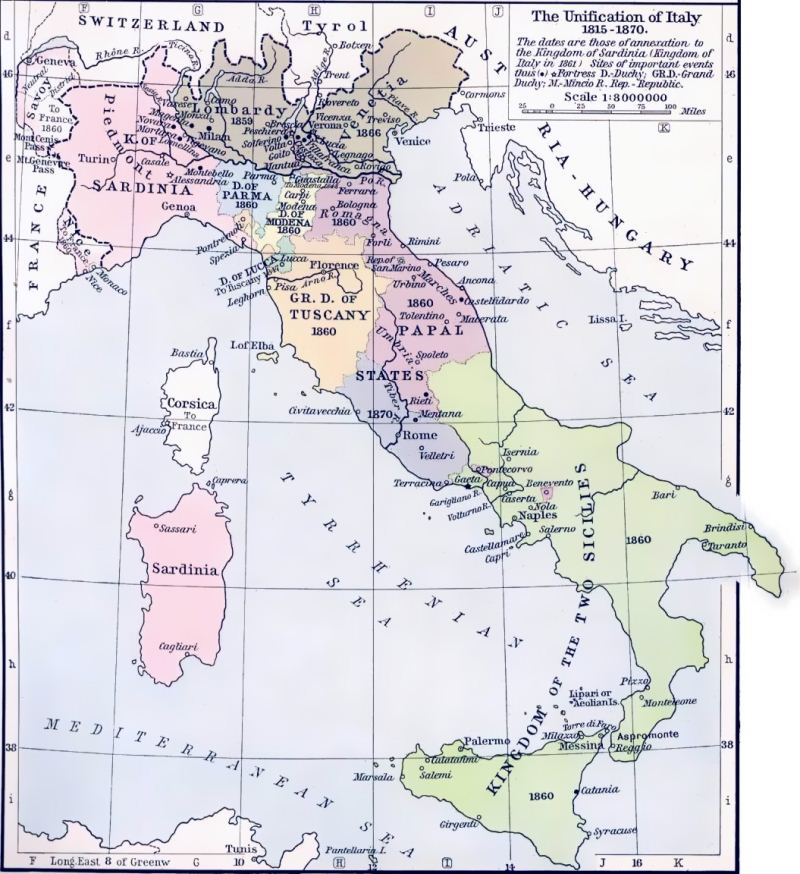
‘Gary Baldy united Italy with the help of his Victory Manual’. Can anything positive be said about this apocryphal A-level answer? Certainly during the mid-19th century Italy was united. The acquisition of Rome in 1870 was the final phase of the unification movement or Risorgimento.
But just how important were the roles of Garibaldi and King Victor Emmanuel II of Piedmont in the unification process?
Italy in the Early 19th Century
By the late 18th century there were eleven states in the Italian peninsula. In the 1790s France conquered most of the peninsula, remaining in control until 1814. Some Italians preferred French occupation to the anciens régimes. However, opposition to aspects of French rule – conscription, heavy taxes, repressive anti-clerical measures – provoked hostility and may have helped promote nationalist sentiment. The Vienna peacemakers, anxious to suppress revolutionary movements and to prevent France regaining control of Italy at a future date, tried to ensure that Austria dominated the peninsula. Lombardy and Venetia were placed under direct Austrian rule, while members of the Habsburg family were installed as the ruling sovereigns of most other Italian states. There was no suggestion of establishing a Confederation under Austrian control as was done with Germany. Italy, in Metternich’s view, was no more than a ‘geographical expression’. Given the strength of local loyalties and bitter regional antagonisms, the notion of a united Italy seemed a political fantasy in 1815.
Secret societies, like the Carbonari, became the focal point for individuals with grievances against the restored monarchies. Most society members did not agree about the means to achieve their ends or even about the ends themselves. A few dreamt of Italy becoming a single nation with a democratically elected parliament. Most simply wished for local constitutional reform. The only thing they had in common was a desire to kick out the absolute monarchs and free Italy from Austria’s grasp. Revolutions in 1820-1 and 1831 were unsuccessful. Austrian troops quickly restored order. The secret societies failed to generate mass support and were not up to the task of directing a great national revival.
Mazzini, Gioberti and Balbo
In 1831 Giuseppe Mazzini launched ‘Young Italy’. Those who joined the society had to swear to dedicate themselves to the endeavour to make Italy ‘one free, independent republican nation’. Believing that Italians must achieve unity by their own efforts, Mazzini envisaged ‘Young Italy’ inciting a war of national liberation against Austria and the petty despots. Pinning his hopes on the educated middle class and urban artisans, he had little faith in the peasantry and thus little interest in land reform which might have brought the rural masses to his side.
Mazzini’s efforts to spark a war of liberation failed miserably and in 1836 he was forced to disband ‘Young Italy’. His movement was too idealistic to be a practical blueprint for revolution. However, his writings helped put the idea of a united Italy firmly on the political agenda and his influence on a section of patriots, not least Garibaldi, was huge. In the 1830s and 1840s the idea of an independent Italy captured the minds of writers, historians and composers and a host of poems, books and operas emphasised Italy’s glorious past.
Mazzini was not the only Italian ideologist. Gioberti in the early 1840s dismissed total Italian unity as ‘madness’, rejected revolutionary methods and saw no future for republicanism. Instead he placed his hopes in the Pope, whom he envisaged as leader of a federation of existing Italian states. Balbo had a different vision. While accepting Gioberti’s idea of an Italian federation, he saw no specific role for the Pope. He claimed that Piedmont was the only Italian state capable of expelling Austria from Italy – the first step to political change. He thus advocated that its king should lead the federation. In 1846, when Pius IX became Pope, it seemed as though Gioberti’s ideas, rather than Balbo’s, might come to fruition. While far from a wholehearted liberal, Pius was not an out-and-out reactionary. A series of reforms in the Papal States was imitated elsewhere. Popular enthusiasm for the papacy rose to great heights.
The 1848-9 Revolutions
The 1848-9 revolutions changed everything. Poor harvests in 1846 and 1847 created a potential revolutionary situation even before news of the February 1848 revolution in Paris and the March revolution in Vienna reached the peninsula. While the 1848 revolutions can be seen as evidence of growing national consciousness, local grievances were more important than Italian nationalism in sparking off risings. The ‘alliance’ of Italians never amounted to much. Pope Pius dissociated himself from war against Austria and called on Italians to remain loyal to their present rulers.
The creation of a Roman Republic, headed by Mazzini, cemented Pius’s conservatism. Fleeing to Naples, he appealed to France, Austria and Spain for help. The decisive campaign was undertaken by 20,000 French troops. Garibaldi led a gallant defence of Rome before the city fell in July 1849. Returning to Rome, Pius set up a reactionary government. Henceforward, the Catholic Church was to be a major stumbling block in the way of unification.
Piedmont, unlike the papacy, gave some hope to Italian nationalists in 1848-9. King Charles Albert (1831-49) began his reign as a reactionary. However, in the 1840s liberalising influences crept into Piedmont. In March 1848 Charles Albert, apparently throwing in his lot with the liberal nationalists, granted a constitution (the Statuto) and went to war with Austria. It should be said that he was more concerned to annex Lombardy and Venetia than to pursue the goal of a united Italy. Defeated at Custoza (July 1848), Charles Albert re-entered the war against Austria in 1849. Crushed at Novara (April 1849), he abdicated in favour of his son Victor Emmanuel II.
By 1849 the hopes of liberals and nationalists had collapsed. Austrian military strength, lack of cooperation between the revolutionary groups, and failure to appeal to the peasant masses ensured the failure of the 1848-9 revolutions. Apart from the Statuto, none of the constitutions obtained from their rulers by the revolutionaries survived. The Statuto was far from democratic: it created an impotent parliament, elected by less than 3 per cent of Piedmont’s population. Nevertheless, it did offer a few, wealthy, citizens opportunities for political participation – opportunities not possible elsewhere in Italy once the old guard returned.
The lesson of 1848-9 appeared to be that romantic idealism could not succeed against the existing order unless supported by force. Lombard revolutionary Pallavinco said: ‘To defeat cannon and soldiers, cannon and soldiers are needed. Arms are needed and not Mazzinian pratings. Piedmont has soldiers and cannons. Therefore I am Piedmontese’. Nationalists of various hues, including Garibaldi, reached a similar conclusion: if Italy was to be liberated and united it would be by the military strength of Piedmont. The National Society, which emerged in 1857, promoted this view. It had only a few thousand members but substantial influence.
Victor Emmanuel and Cavour
King Victor Emmanuel was 29 years old in 1849. Likeable and courageous, he was also shrewd and politically skilful. Seen by some as a cautious conservative and by others as a cautious liberal, in reality he was just cautious. His main aim was to speed up Piedmont’s recovery so that it was able to fight Austria again. He hoped to marry a policy of extending Piedmontese influence in Italy with the idea of nationalism.
In 1852 Count Camillo di Cavour became Piedmont’s prime minister. In his journal Il Risorgimento Cavour had claimed that Italian rulers should cooperate to throw out Austrian influence. But he was no revolutionary and his hopes for unification were tempered by his loyalty to the Piedmontese monarchy. While he believed in parliamentary institutions, he had no faith in full democracy and was vehemently opposed to Mazzini’s republicanism. A cunning opportunist, Cavour was to play a major role in Italian unification. However, unification did not come about according to any carefully conceived plan on his part. Indeed, pre-1860 he did not conceive of the possibility of Italy as a unitary state. In most respects Cavour supported traditional Piedmontese aims – to free Italy from Austrian influence and to strengthen Piedmont by annexing territory in north and central Italy.
Cavour realised the importance of foreign assistance if Piedmont was to defeat Austria. In 1855 Piedmont joined Britain and France in the Crimean War. Cavour returned home empty-handed from the 1856 Paris Peace Conference but at least he had made important contacts, especially with Napoleon III. The Crimean War helped Cavour’s cause in another way. It left Austria isolated. Britain, France and Russia were angry she had not helped them in the war. In 1856 Cavour committed himself to the goal of securing an alliance with France. Napoleon III, who had maintained a long interest in Italian affairs, told Cavour he wanted ‘to do something for Italy’. Keen to champion liberal causes and to support the principle of nationality, his wish to help the Italians was sincere. However, his policy was shaped by other motives, not least his desire to secure a revision of the 1815 settlement. While not anxious to create a strong unified Italy which might represent a threat to France, a federation of Italian states with an enlarged Piedmont acting as a French satellite was an attractive proposition.
In July 1858 Napoleon and Cavour met at Plombières to discuss the Italian question. After lengthy negotiations a deal was struck. Essentially Cavour would provoke Austria into war. France would then send troops to help Piedmont evict the Austrians from Lombardy and Venetia. These provinces would be added to Piedmont. In return France would take Savoy and Nice from Piedmont. A formal – and secret – treaty, largely incorporating this deal, was signed in January 1859. Napoleon and Cavour did not agree about everything. Whereas Cavour hoped to annex the central Italian states, Napoleon aimed to form a separate central Italian kingdom, to be ruled by his cousin who was to marry Victor Emmanuel’s daughter.
The First War of Italian Liberation
Things did not go quite to plan. Cavour’s efforts to provoke Austria into war failed. Diplomatic intervention from Russia and Britain resulted in Napoleon losing his nerve, and in April 1859 he joined the other powers in asking Piedmont to demobilise its army. Ironically, Austria now came to Piedmont’s rescue. Determined to humiliate Piedmont further, Emperor Franz Joseph demanded that Piedmont’s army be returned to a peacetime footing. The ultimatum was rejected. Thus, on 29 April Austria declared war. Victor Emmanuel immediately issued a proclamation: ‘People of Italy! Austria assails Piedmont … I fight for the right of the whole nation … I have no other ambition than to be the first soldier of Italian independence’. The proclamation had only a limited effect. Few Italians outside Piedmont rallied to his cause. However, Napoleon kept his word and declared war. Over 100,000 French troops crossed the Alps, defeating Austrian forces in two brutal battles at Magenta and Solferino. These French victories decided the first war of Italian unification.
The war provoked popular disturbances across central Italy. The rulers of Tuscany, Parma and Modena were forced to quit their states and Papal authority was challenged in the Romagna. Rebels in these regions established provisional governments and sought fusion with Piedmont. Events were moving too fast for Napoleon. Concerned about the international situation and developments in Italy, he concluded an armistice with Austria at Villefranca. Lombardy was to be transferred to Piedmont, Venetia would remain Austrian and the rulers of Tuscany and Modena were to be restored. Cavour, furious at the arrangements, tried to persuade Victor Emmanuel to fight on alone. When the King sensibly refused, Cavour resigned.
That Villefranca did not end the process of unification was largely due to the work of nationalists in central Italy. The provisional governments in Tuscany, Parma, Modena and the Romagna, all strongly influenced by the National Society, arranged for the election of assemblies. These proceeded to vote for union with Piedmont. Victor Emmanuel, aware of Napoleon’s opposition, did not annex central Italy immediately. The Treaty of Zurich, signed by France, Piedmont and Austria in November 1859, upheld the rights of the old rulers in principle but contained no practical provisions for their reinstatement.
This was the situation when Cavour returned to power in January 1860. Fortunately for him, Napoleon was now ready to accept Piedmontese expansion in central Italy, provided Savoy and Nice were ceded to France. Plebiscites across central Italy, in March 1860, resulted in huge majorities in favour of annexation to Piedmont. Savoy and Nice were handed over to France. Northern and central Italy, Venetia apart, was now united under Victor Emmanuel. Cavour wanted to stop there. Garibaldi had other ideas.
Garibaldi
Impetuous and charismatic, Garibaldi was very different from the wily Cavour. Initially a supporter of Mazzini, he had now abandoned his republican ideals but remained devoted to the cause of Italian unity. Scandal and gossip followed him everywhere but could not obscure his ability as a guerrilla leader. He inspired devotion among his men and a near-religious adoration among the masses. Unlike Mazzini, he was essentially practical: his achievements rested upon his actions rather than his thoughts.
In April 1860 a revolt broke out in Sicily. It arose in part from the excitement generated by the events in Italy in 1859-60. A more important cause, however, was the disappointment felt at the conservatism of the new King Francis II. Garibaldi, who had been planning action against France in Nice, now set about raising a force to invade Sicily. Hoping to spark a nationalist uprising that would unite the whole of Italy, he asked Cavour for support. That support was not forthcoming. Cavour was not convinced that the conquest of backward Sicily and Naples was desirable, even if it could be done. Moreover, foreign governments might be tempted to interfere if too much was done too quickly. He thus made it clear that Garibaldi did not have Piedmont’s official backing. However, aware that Victor Emmanuel supported Garibaldi, he did not prevent his departure. Cavour reckoned there might be benefits whatever happened: if Garibaldi failed Piedmont would be well rid of him; if he succeeded, Piedmont might derive some advantage.
In May 1860, with 1,089 red-shirted volunteers, Garibaldi set sail for Sicily in two old paddle steamers. His chances of success were remote. Francis II now had 25,000 troops in Sicily and the revolt had been crushed. However, Garibaldi set about winning the Sicilian peasants by promising land reform and tax reduction. Gathering recruits, he won a surprise victory at Calatafimi. In July Neapolitan troops withdrew to Naples. Sicily was Garibaldi’s. Appointing himself ‘dictator’, he set about preparing to attack the mainland. Fearing – correctly – that Cavour might prevent him using the island as a base for an attack on Naples, he did not hand over Sicily to Piedmont.
In Naples King Francis accepted a constitution and brought in liberal ministers. Meanwhile, Cavour was concerned that Garibaldi might get too much credit for uniting Italy if he continued unchecked – credit which should go to Piedmont. An attempt by Cavour to arrange a revolution in Naples in favour of Victor Emmanuel failed. On the night of 18-19 August, Garibaldi, dodging Piedmontese ships sent to prevent him crossing the Straits of Messina, ferried 3,360 men to the mainland. Winning the support of poor peasants, he headed north. King Francis fled from his capital and on 7 September Garibaldi entered Naples to a hero’s welcome.
Garibaldi now aimed to advance on Rome. However, Neapolitan military resistance north of Naples hindered his plans and gave Cavour time to regain the upper hand. He knew that Garibaldi’s march on Rome could provoke war with Napoleon, who considered himself the Pope’s protector. Aware that the ‘thousand’ had swelled to over 50,000, Cavour also feared that Garibaldi might take over the whole of Italy, including Piedmont. Determined to intercept Garibaldi before he reached Rome, Victor Emmanuel led the Piedmont army southwards. After defeating a Papal army, Piedmontese forces reached Neapolitan territory. Garibaldi now had the choice of acknowledging Victor Emmanuel or fighting him. On 26 October Garibaldi saluted Victor Emmanuel as ‘the first king of Italy’ and handed over his conquests. Refusing titles and wealth, he retired to Caprera with a year’s supply of macaroni and little else.
Plebiscites were organised in Naples, Umbria and the Papal Marches. The voters had little alternative: unite with Piedmont or continue the present state of near anarchy. A huge majority in favour of union was returned. What those who voted ‘yes’ thought they were voting for is not clear. A united Italy could take several forms: it could be a federal state in which the regions retained considerable autonomy or it could become a centralised state, dominated by Piedmont. After 1860 Piedmontese systems were imposed upon the rest of the country. The first Italian parliament, elected in 1861, met in Turin, capital of Piedmont.
Italy adopted the far from democratic Piedmontese constitution. Piedmontese civil servants, politicians and soldiers dominated the new kingdom – which was proclaimed in March 1861. Unification was almost but not quite complete: the area round Rome remained under papal control and Venetia was still Austrian.
The Risorgimento Completed
In 1861 Italian politician d’Azeglio remarked to Victor Emmanuel: ‘Sir, we have made Italy. Now we must make Italians’. The governments of the 1860s, led by a succession of undistinguished conservatives (Cavour died in June 1861), struggled to make a united Italy a reality. They faced huge difficulties. Strong local loyalties remained. As Cavour had recognised, the rivalry between north and south was a major problem. For many southerners it was hard to distinguish between unification and colonisation by Piedmont. Not surprisingly southern opinion soon turned against Victor Emmanuel and law and order broke down. By 1863 90,000 Italian troops were committed to peacekeeping operations in the south. The government emerged victorious but more lives were lost in the ‘brigands’ war’ than were lost in all the battles for unification. The Pope’s hostility to the new state was an added problem. So was Garibaldi, who was determined to bring Rome and Venice into the new state. In 1862 and 1867 he raised volunteer forces to conquer Rome, only to be stopped by government troops. The Italian government had no wish to damage relations with France, whose forces still guarded Rome.
The international situation led to the addition of Venetia and Rome to the new kingdom. In a secret treaty with Prussia in 1866, Italy agreed that if Prussia went to war with Austria within two months, she would follow her in declaring war on Austria, receiving Venetia for her pains. While the war was a disaster for Italian forces, Prussian victory led to Italy’s take-over of Venetia. Then the Franco-Prussian war in 1870 led to French forces being withdrawn from Rome. Italian troops were thus able to occupy the city. Pope Pius IX shut himself in the Vatican and refused to negotiate. In a plebiscite in October 1870 Rome voted overwhelmingly for union with Italy and became the capital.
Conclusion
Mazzini had wanted Italy to ‘make itself’. This is not quite what happened. Without the favourable international situation, unification would not have come about when it did. Piedmontese expansionism, rather than Italian nationalism, was the real driving force behind unification. Moreover the Italy that was created by 1861 was not the Italy that nationalists like Mazzini had envisaged. Nevertheless, nationalism was a vital element in the Risorgimento, not least in 1859-60 when the National Society persuaded Italians they should support Piedmont. Italian individuals also played key roles.
The three musketeers of unification were Mazzini, Cavour and Garibaldi. It was hardly a case of all for one and one for all. The three hated each other’s guts and opinions. Yet their interaction was crucial. Mazzini provided the intellectual basis for the nationalist movement and inspired some influential leaders, including Garibaldi. Cavour was more important. He was once seen as an Italian nationalist whose every diplomatic manoeuvre was designed to promote unification. In reality, his chief concern was to extend Piedmontese power and to use the appeal of a united Italy as a means to this end. Garibaldi’s contribution to the cause of Italian unity was vital. His exploits made him a focal point for patriotic emotion. His conquest of the south in 1860, against all the odds, was a major element in the unification process. He could have established himself as dictator of southern Italy but believed national unity to be more important than personal ambition.
Victor Emmanuel is often seen as lucky – a ruler who was simply in the right place at the right time. However, perhaps he made his own luck. He appointed the right people (not least Cavour) who carried out his policies. His role in the unification process has often been under-estimated. Accordingly, while it is possible to argue that Garibaldi did unite Italy with Victor Emmanuel’s help, a stronger case – the case that really takes the Garibaldi biscuit (!) – is to claim that Victor Emmanuel united Italy with the help of Garibaldi (and Cavour).