Dr Who? The First Cartoon Character
Mark Bryant discovers the world’s first cartoon character, who sold large numbers of books, and all manner of merchandising.
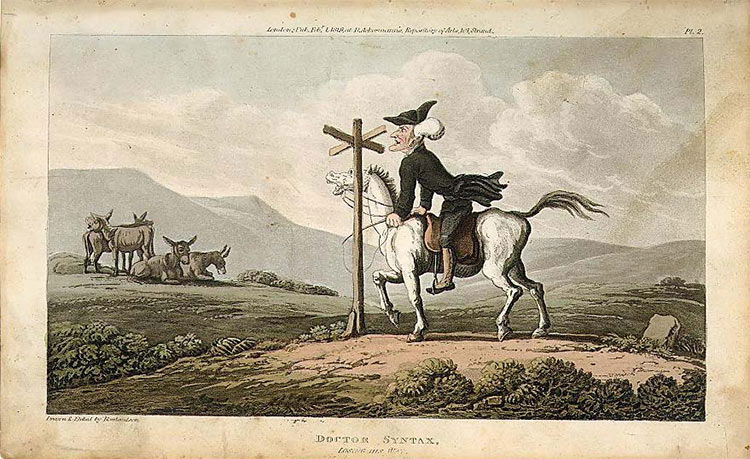 Many people, faced with the question ‘Who was the first popular fictional cartoon character?’ might assume this to be Walt Disney’s Mickey Mouse, created in 1927. However, before Mickey came Bonzo the Dog and Felix the Cat, and earlier still were Ally Sloper and Max and Moritz (both from the 1860s), Brown, Jones and Robinson of Punch (1850s) and Honoré Daumier’s Ratapoil (1830s). However, it is now generally acknowledged that the first ever popular fictional cartoon character was created in 1809 – more than a century before Mickey Mouse. A scrawny and eccentric elderly clergyman/schoolmaster, he was hugely successful, spawning many imitators and even creating the first ever market for tie-in merchandise. His name was Dr Syntax and he was the creation of a distinguished British artist who celebrates the 250th anniversary of his birth this year and who is perhaps better known for his topographical watercolours, portraits and political cartoons: Thomas Rowlandson (1757-1827).
Rowlandson was born on July 13th, 1757, in Old Jewry, near the Bank of England in the City of London, the oldest child of a wool and silk merchant who was declared bankrupt when Thomas was aged two. He and his younger sister Elizabeth were brought up by their childless uncle James, a prosperous silk weaver, and his French Huguenot wife Jane. After his uncle’s death Thomas’s aunt sold the business and moved to Soho. Here Thomas attended the famous Soho Academy school in Soho Square, where fellow pupils included Edmund Burke’s son Richard, Henry Angelo (son of the royal family’s fencing master) and the future actor-manager John Bannister.
At the age of fifteen Rowlandson was admitted to the Royal Academy Schools (then in Somerset House) and was awarded the RA’s silver medal in 1777. A close friend of James Gillray, he was influenced at first by the work of the painter, etcher and caricaturist John Hamilton Mortimer (1740-79) and began producing political and social prints in 1780. He had his first big success at the age of twenty-eight with ‘Vauxhall Gardens’ (exhibited at the Royal Academy in 1784) and his caricatures of the protagonists in the Westminster election held in the same year.
In the late 1790s Rowlandson began working with the German-born printseller, publisher and art-dealer Rudolph Ackermann, who was based at 101 Strand – one of the first buildings in London to be lit by gas. He quickly became the publisher’s star artist and thus when Ackermann decided to launch a new monthly journal, the Poetical Magazine, in 1809 he turned to Rowlandson for ideas for a serialized story in verse with colour illustrations.
Rowlandson had already been toying with the idea of lampooning the latest craze for books of ‘picturesque’ travels. The best known of these were by the schoolmaster and clergyman Rev. William Gilpin (1724-1804), whose accounts of his sketching trips in Britain published from 1782 onwards were very popular and in 1808 had just been reissued. Influenced by Gilpin and his followers, a new class of ‘aesthetic’ traveller had emerged who sought out pastoral and gothic landscapes, ruined castles and dramatic scenery in the more rugged parts of Britain. For Rowlandson they were a perfect target for satire.
Dr Syntax, like Gilpin a clergyman/school-master, had originally been conceived as a fat man, based on one of Rowlandson’s wealthy patrons, a 24-stone ‘walking turtle’. However, John Bannister advised against this, suggesting instead ‘a skin and bone hero, a pedantic old prig in a shovel hat with a pony’. Ackermann was delighted with the initial drawings and engaged the poet and journalist William Combe to produce verses to accompany them. The result was ‘The Schoolmaster’s Tour’, written in rhyming couplets, which began in the launch issue of the Poetical Magazine on May 1st, 1809, and continued monthly until May 1st, 1811.
Rowlandson conceived and produced the illustrations and Combe ‘wrote up’ to them. As Combe later said:
When the first print was sent to me, I did not know what would be the subject of the second; and in this manner, in a great measure, the Artist continued designing, and I continued writing, every month for two years, till a Work containing near ten thousand Lines was produced: the Artist and the Writer having no personal communication with, or knowledge of, each other.
The story follows Dr Syntax as he sets off for the Lake District, gets lost and is robbed by highwaymen who tie him to a tree and crop the ears and tail of his horse, Grizzle. He is then rescued, pursued by a bull, falls into a river while trying to sketch a ruined castle, goes to Liverpool and then London (where the book of his travels is finished and published) and eventually ends up with a new job as Vicar in a Lake District town and as private tutor to the son of the local squire.
The series was an immediate success and was so popular that in 1812 it was republished as a book, The Tour of Dr Syntax, in Search of the Picturesque, priced at one guinea and royal octavo (10 x 6¼ inches) in format. The thirty-one drawings by Rowlandson included a new title page and frontispiece and an additional picture, ‘The Doctors’ Dream of the Battle of the Books’, to accompany an extra episode written especially for this version by Combe. The book was also a great success. It had reached its fifth edition by 1813 and Danish, French and German editions were published in 1820, 1821 and 1822 respectively.
Numerous imitations also began to appear, such as The Adventures of Dr Comicus (1815), The Tour of Doctor Syntax Through London (1820), Doctor Syntax in Paris (1820) and The Tour of Doctor Prosody (1820). So Ackermann commissioned two further series from Rowlandson and Combe.
The Second Tour of Dr Syntax, In Search of Consolation (published in eight instalments in the Poetical Magazine from January to August 1820 and as a book the same year) begins with the death of Syntax’s wife and follows his travels, with his Irish companion Pat, through Cheshire, Ludlow, Bath, Oxford and London. As well as having rats eat his wig, and being attacked by bees, Syntax has the sketches in his book compared to ‘the gay skill of ROWLANDSON’.
The Third Tour of Dr Syntax, In Search of a Wife was published in the Poetical Magazine from November 1820 to May 1821 and as a book the same year. In it Syntax buys a blind horse, upsets the flowerpots in a famous Tulip Conservancy, accidentally takes lodgings in a brothel, discovers a foundling, gets married and dies two years later. Combe’s final lines read:
My verse has now no more to tell.
The story’s done. SYNTAX, FAREWELL!
However, this was far from being the end of the good doctor. Soon after The Third Tour was published Dr Syntax starred in a pantomime and a musical, and even had a racehorse named after him (whose portrait was painted by James Ward RA, grandfather of the future Vanity Fair caricaturist Leslie Ward – ‘Spy’). Syntax merchandising also flourished, from textiles, wigs, coats and hats, to walking-sticks and snuff-boxes. In addition porcelain figurines were produced, as well as Staffordshire dinnerware and a set of three Dr Syntax jugs by Chamberlain of Worcester.
Realizing the potential for still more sales, Ackermann commissioned Combe and Rowlandson to continue the storyline after Syntax’s death with the adventures of the foundling brought up by his second wife. Thus came The History of Johnny Quae Genus, the Little Foundling of the Late Doctor Syntax. This was published in eight parts (1821-22) and as a book, the last to be written by William Combe, who died in 1823. It featured twenty-four engravings by Rowlandson who himself died at his home on April 21st, 1827.