Images of a Dead Queen
‘There was such a generall sighing and groning, and weeping, and the like hath not beene seene or knowne in the memorie of man’: visual images of the death of Elizabeth I played a key role in her funeral and in creating the ensuing cult of Gloriana.
Elizabeth I died at about three o’clock in the morning of March 24th, 1603. While the natural body of the queen perished, the body of symbolism that had been built up around her did not. The cult of Elizabeth persisted, enjoying a revival under the Stuart kings. It engendered posthumous images of Elizabeth’s form in written texts, in visual art and – as is appropriate for a period when the word ‘image’ referred primarily to a sculpted three-dimensional figure or model – in life-size effigies. It is these effigies of the dead queen and their cultural and political context that are the concern of this article.
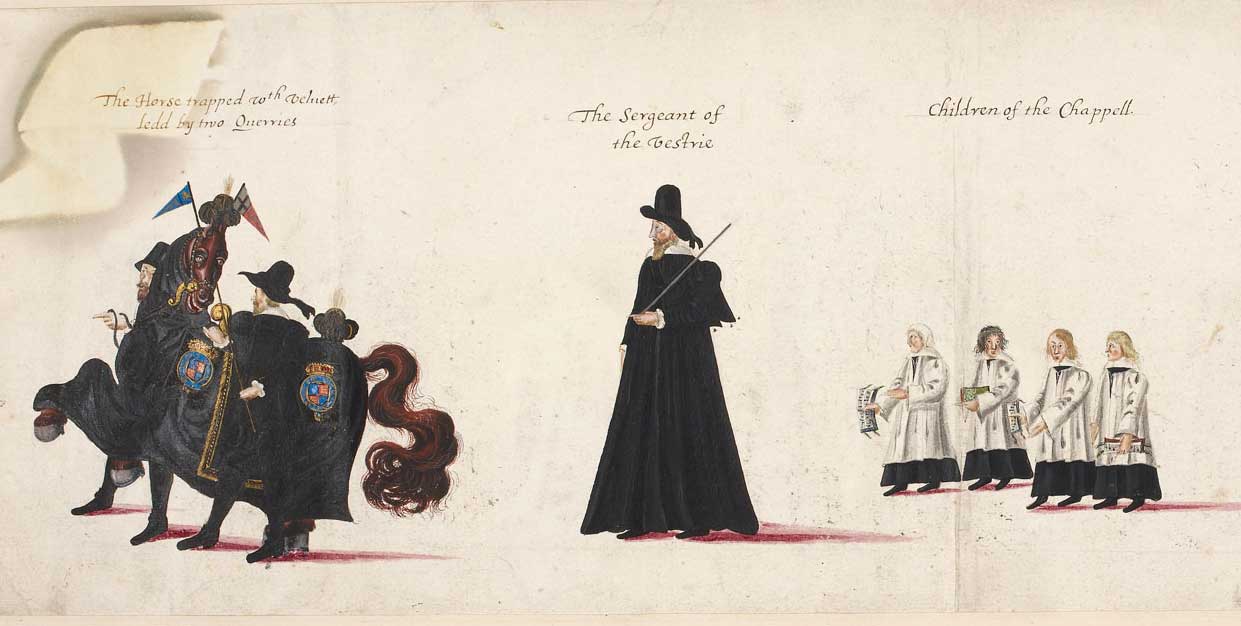
Elizabeth’s funeral procession, held on April 28th, was recorded in a series of drawings showing the mourners walking towards Westminster Abbey. The focal point of the procession was not the physical remains which were sealed inside the coffin, but a life-like effigy of the dead queen. Henry Chettle described it as:
The lively Picture of her Highnesse’s whole body, crowned in her Parliament Robes, lying on the corse balmed and leaded, covered with velvet, [and] borne on a chariot.
What was the function of the funeral effigy of the dead queen? The historian John Stow, writing not long after the event, described the effect upon onlookers as follows:
[when] they beheld her statue and picture lying upon the coffin set forth in Royall robes, […] there was such a generall sighing and groning, and weeping, and the like hath not beene seene or knowne in the memorie of man.
One must be wary, however, of taking such expressions of national grief at face value. John Clapham, writing within four months of the funeral, notes that those watching the procession were busy analysing Elizabeth’s reign. Some drew a positive picture but others had negative comments to make. There was no national consensus of support. The political success and popularity which Elizabeth enjoyed in the 1580s had severely waned in her last decade. Poor harvests brought economic hardship, inflation raged and government finances floundered in debt. The Essex rebellion and increased factionalism damaged the image of the court, and the country suffered from continuing wars in Ireland and the Netherlands.
While such political difficulties threatened to mar Elizabeth’s official public image as Gloriana, the ‘most royall Queene or Empresse’ as propounded by Spenser in his epic poem The Faerie Queene , the funeral effigy restored and perpetuated it. Unfortunately the original effigy of Elizabeth has not survived, but written accounts confirm that the dead queen’s image was ‘all very exquisitely framed to resemble life’. The effigy was dressed in Parliamentary robes, the trappings of rule and majesty. Upon its head was the imperial crown and in its hands the orb and sceptre, symbols of sovereignty.
The effect of this life-like, magisterial effigy on observers was to provoke the spontaneous expressions of grief recorded by Stow. Clapham emphasises the causal relationship between effigy and emotion: ‘At the sight thereof, divers of the beholders fell a weeping’. The image of the dead queen was being deliberately used to create an impression of community feeling. Of course the record of ‘grief’ in Clapham and Stow may simply be a convention, in which case the textual record becomes part of the process of creating an impression of political consensus. This is not to say that there were none who genuinely mourned the queen, but simply that the homogeneity of the emotional response was a product of the performance of the funeral procession and its record.
The effigy directed the collective emotional response back towards the dead Elizabeth. What purpose could this serve for the new monarch? Certainly James and his English advisors attached value to the occasion. A total of £11,305 was spent on the proceedings at a time when the cost of the most extravagant noble funerals did not exceed £3,000.
There is another context in which contemporaries may have viewed the public image of the dead queen as represented by the effigy. The sixteenth-century politico-legal theory, often referred to as ‘the king’s two bodies’, stated that the monarch had two bodies: the body natural and the body politic. The natural body was subject to error, decay and ultimately death but the body politic was unerring and immortal. The theory attempted to address the paradox that, while individual monarchs died, the crown survived.
This theory has previously been used by Ernst Kantorowicz to illuminate the symbolism of the French royal funeral which similarly employed an effigy of the deceased monarch. Kantorowicz argues that the effigy was the external manifestation of the public image of the king, his royal Majesty, while the coffin contained the king’s private body, the human remains. It was in England, not France, however, that the theory was developed and expounded by jurists, notably Edmund Plowden, and where it played an important role in Elizabethan succession politics.
For our purposes Plowden’s most important application of the theory is his explanation of what happens when a monarch dies. Normally the body politic is contained within the body natural, but at death a disjunction occurs as the body politic is instantaneously vested in the natural body of the successor. The idea of instantaneous succession suited James’ theories of kingship as described in his Trew Law of Free Monarchies . The throne, James argued, was never vacant, ‘for at the very moment of the expiring of the king reigning, the nearest lawful heir entereth in his place’. There seems, however, to be an incompatibility between the theory of the instant investiture of Majesty in James and the continued display of Elizabeth’s Majesty, embodied in the effigy of the funeral procession.
Although James was legally king from the moment of Elizabeth’s death and was proclaimed such on the very morning of her demise, he was at the time far away in Edinburgh. There would be no public ceremonial affirmation of his position in London until his coronation on July 26th, 1603. The intervening period, during which there would be no living monarch in the capital, might be characterised as a ‘ceremonial interregnum’. The effigy of Elizabeth then, by perpetuating the ‘public ruler’ image of the dead queen, filled the ceremonial gap, demonstrating a continuity of government until the arrival of the new king.
Continuity and consensus were underlined by the form of the performance: the procession. The effigy of Elizabeth appeared within a hierarchically ordered convoy, with representatives from a range of social groups including the whole of the late queen’s household, organised according to their relative status, mirroring society. A crescendo of dignity reached its climax around the effigy before tailing off again towards the end of the procession. The central symbolic resonance of the effigy was marked by, among other things, a concentration of heraldic signifiers and a canopy. The procession constituted a visual paradigm of social order, centring around the effigy as society centred around the monarch. Thus the procession ritually displayed and affirmed that nothing had changed or would change even though the sovereign had died.
Despite the smooth manner in which James’ succession was effected, there had been many fears of civil disturbance. Although James’ claim was well-known and widely accepted, Elizabeth had never explicitly named him as her successor. Robert Cecil had masterminded the transfer of power, but his correspondence with James had been secret. Although there were no other realistic contenders, the general populace, unaware of these quiet political machinations, was still subject to fears of civil unrest and even foreign intervention. The ritual demonstration of order was welcome.
Ritual duties allowed the form of Elizabeth to fill the ceremonial vacuum caused by the absence of a monarch, while James was still journeying towards London. The symbolic import of the effigy went further, however; display of the image of the dead queen took precedence over display of the new king. James had to wait outside the capital until the funeral proceedings were over before making his entry. There was a shared assumption, reflecting royal funeral tradition, that the new king could not make his appearance in London until the old queen was buried.
Similarly, during his journey south, James acknowledged that the display of his own royal person was of secondary importance. He wrote to Henry Howard on April 12th, with reference to his planned royal entry into York, saying:
We mean to enter in a manner more public; and therefore like it well that some of our servants and officers have authority to meet us, not being any of those principals, which may diminish part of the honour and dignity which belongs to our dearest sister as long as her body is above ground.
Elaborating on the reason for honouring Elizabeth’s funeral, James declares that he is not only her successor
… but so near of blood as we will not stand so much upon the ceremony of our own joy, but would have all things observed which may testify it well that they [Elizabeth’s household] remain still entire as they were at her death.
Fulfilment of his duties to the dead Elizabeth demonstrates his family or lineal association with her and thus the rightfulness of his succession.
Further, as we have seen, the funeral, with its Gloriana effigy, promoted the image of Elizabeth the imperial ruler. In staging the funeral, James associated himself with the continuation of that public image and in so doing began to appropriate it for himself. Thus the obsequies formed part of a broader official policy identifying James’ public image with that of Elizabeth; a policy apparent, for example, in the imagery and iconography employed in the 1604 Royal Entry. The identification of the new monarch with the virtues of his predecessor stressed the continuity of rule and was particularly valuable in paving the way for acceptance of a foreign king.
So James and his inherited government deliberately used the funeral ritual to smooth the succession process. There is some evidence of opposition to their plans. The Privy Councillors met privately at the Lord Admiral’s house to arrange conveyance of the body from Richmond to Westminster. Clapham reports that some lords took exception to the meeting, ‘alleging that they [the Privy Councillors] ought not to propound and conclude anything in Council without their [the lords] privity and consent’. This attempt to take political advantage of the ceremonial interregnum seems, however, to have had no wider repercussions.
There is also a hint that the political propaganda of the procession was under threat. Lady Arabella Stuart had been intended as chief mourner, a key symbolic role which heraldic regulations determined should be taken by the woman nearest in blood to the deceased. Clapham reports, however, that, ‘the Lady Arabella refused, saying that since her access to the queen in her lifetime might not be permitted, she would not after her death, be brought upon the stage for a public spectacle’. In the event, the Marchioness of Northampton took the role and the dispute was kept firmly in the background.
A further discordant note was sounded by the Venetian ambassador, Scaramelli, who put a rather different complexion on James’ absence from his predecessor’s funeral than that of respect due to both Elizabeth herself and to royal funeral tradition. Scaramelli reported that James ‘wishes to see her [Elizabeth] neither alive nor dead, for he can never expel from his memory the fact that his mother was put to death at the hands of the public executioner’. Such testimony is undermined, however, not only by the care which James, as we have seen, took with the funeral arrangements but also by his subsequent deliberate perpetuation of her memory.
As part of this policy, James ordered a tomb for Elizabeth to be constructed in Westminster Abbey. Cecil, who was probably the project originator, felt that it was a good investment as he indicated in a letter to Sir Thomas Lake, saying, ‘For […] it does his Majesty honour that the people see some little thing in doing for [Elizabeth]’. Cecil wanted James to profit from public loyalty to Elizabeth by creating a ‘material focus for it’ in the form of a monument. The tomb was completed in 1606 and it became part of the Abbey’s collection of royal and non-royal monuments on display to the public. The recumbent figure, in full-length marble, has been judged fine and accurate. The features are reproduced with great realism suggesting that a death-mask was used. The effect of the image was augmented by colouring executed by Nicholas Hilliard and gilding by John de Critz.
The tomb at the Abbey once again placed a life-size image of the dead queen on public view. Thomas Platter, a continental traveller who visited the Henry VII Chapel in 1599, testifies to the way in which the monuments had become tourist attractions, as does Thomas Middleton’s A Chaste Maid in Cheapside (1613, Lady Elizabeth’s Swan). When Tim lacks a weapon (to ‘watch’ his sister), he says:
Take you no care for that, if need be I can send for conquering metal […]
’tis but at Westminster: I am acquainted with him that keeps the monuments,
I can borrow Harry the fifth’s sword … (IV.iii.57-62)
Tim’s reference implies audience familiarity with the monuments and with the system of visiting them. The keeper acted as a guide for the cost of one penny, the same price as entrance to the public playhouse.
Following the obsequies the funeral effigy of Elizabeth remained lying in its hearse in Westminster Abbey for one month. Subsequently it is reasonable to assume that the effigy joined others surviving from earlier royal funerals on display in Westminster Abbey. Elizabeth’s effigy was certainly exhibited there on August 4th, 1606. On this date Prince Henry took Christian IV of Denmark, who was making a state visit to England, to the Abbey, as is recorded in Treasurer’s Accounts for 1606. These accounts also state that an advance of £50 was sent to the Dean for dressing the effigies, including that of Elizabeth I. Stowe confirms that the image of Queen Elizabeth was ‘newly beautified, amended and adorned with royal vestures’ for the occasion. Thus a double set of images of Elizabeth as Gloriana went on show in London in 1606, the tomb and the revamped effigy.
Such deliberate cultivation of images of the dead queen was, however, not entirely a state monopoly. At the time of Christian IV’s visit James’ tactic of associating himself with the Gloriana image of his predecessor had worn rather thin. By 1606 many had become disillusioned with this foreign king who, it was said, put hunting before government duties, squandered hardly-won revenue on masques and revels at court and sold off titles to all and sundry. The visit itself provided ammunition for an attack on James. The disgruntled courtier, John Harington, paints a particularly lurid picture of the court festivities held in honour of the occasion, contrasting the disordered Jacobean court with the order and serenity of Elizabeth’s household. His account is notorious but is perhaps only an exaggerated version of a more widely-held opinion of court corruption under James.
The world conceived in The Revenger’s Tragedy , performed at the Globe Theatre by the King’s Men in the season of 1606-7, has close affinities with the world portrayed by John Harington. In the play, court revels offer an opportunity for licentious behaviour, even for rape. Other allusions firmly establish the play’s topical resonance. Patrimonies are ‘washed a-pieces’; ‘fruitfields turned into bastards’; estates sold to meet the fantastic price of ‘court dress’.
My concern, however, is with another topical reference: the name of Vindice’s long-dead ‘betrothed lady’. Audience acquaintance with this lady begins in the opening scene, where Vindice meditates, Hamlet-fashion, upon his ‘studies’ ornament’ her skull. She was murdered nine years before by the old duke because she would not consent to become his mistress. While the revenge motive is given, the lady’s name is quite deliberately withheld.
The dramatist chooses the climactic moment of this, the primary revenge plot, as the old duke is fatally poisoned by kissing the lips of the skull, for Vindice to disclose the name of the long-dead mistress of his affections.
Duke, dost know
Yon dreadful vizard? View it well; ’tis the skull
of Gloriana , whom thou poisoned’st last.
(III.v.146-8)
The name is only mentioned once contributing to its easy dismissal as a casual, glancing reference to Elizabeth I. Nomenclature is, however, loaded with significance in this play. ‘Vindice’, for example, comes from the Latin vindicare meaning ‘to take revenge’. If pointed naming is not enough, the moment of disclosure is given tremendous visual impact. The sheer length of the scene alerts us to its significance. The audience watches Vindice stage-manage the build-up to the ‘crowded minute’ of revenge. First we see him re-fashion the skull into a ‘country lady’, dressing it in a mask and tires. In the accompanying soliloquy Vindice draws attention to the skull’s dual function. On one level it is the emblematic reminder, so frequently employed in English Renaissance iconography, of the vanity of the flesh. ‘Does’, Vindice asks of the skull, ‘the silkworm expend her yellow labours/For thee? For thee does she undo herself?’ Yet, Vindice has fashioned more than a memento mori. This is no ‘useless property’, but the very instrument of his revenge.
By giving advance knowledge of the practical and symbolic functions of the skull, the dramatist frees his audience from over-concentration on plot, making it more receptive to additional layers of meaning. Vindice prolongs the moment of revenge, unmasking the skull and displaying it to the duke. Stage directions given by Vindice indicate his determination to maximise his victim’s horror. ‘Brother’ he says, addressing Hippolito, ‘Place the torch here, that his affrighted eyeballs/May start into those hollows’. The careful staging underlines the significance of the moment for the audience, too. Disclosure of the skull’s identity is necessary to facilitate the completeness of revenge. The duke must know why he is dying. Vindice, who delights in the ironies of plot, insists that his victim appreciates the aptness of the revenge. All of this would be so irrespective of the particular appellation given to Vindice’s love. Withheld until the final line of the speech, the naming of Gloriana explodes, charging the scene with sudden and pointed contemporary allusion.
That the courtiers and other educated members of the Globe audience associated the name Gloriana with their dead queen is hard to doubt. Gloriana was the name Spenser gave to Elizabeth in The Faerie Queene which was published in its complete form in 1596 and was enjoying considerable popularity and influence. The identification of Elizabeth with Gloriana had also received at least one explicit airing on the stage prior to 1607. Dekker’s play Old Fortunatus , performed by the Admiral’s Men at the Rose in 1599, was introduced by the following exchange between two old men:
First man: Are you then travelling to the temple of Eliza?
Second man: Even to her temple are my feeble limmes travelling.
Some cal her Pandora, some Gloriana, some Cynthia: some Belphoebe,
some Astraea: all by severall names to express severall loves:
Yet all those names make but one celestiall body, as all those loves meete to create but one soule.
This prologue was admittedly only used for the court performance of the play but indicates that there, at least, the Gloriana/Elizabeth association was well-known. Those in the Globe audience unaware of the literary association may have been receptive to the form of the name itself: ‘Glory-ana’, or ‘glorious-one’ and may still have sensed the allusion to the glorious Elizabeth, particularly if, as is quite feasible, visual clues were given in the costume and staging.
With the naming as a trigger, Vindice’s act of dressing up this skeletal Gloriana may well have suggested direct parallels with the re-adornment of the Elizabeth-Gloriana funeral effigy for the visit of Christian IV of Denmark just a few months before the performance of The Revenger’s Tragedy . Earlier in the same year the painted and gilded image of Elizabeth atop her funeral monument had been unveiled in Westminster Abbey. Certainly Elizabeth as triumphant queen was once more in the minds of Londoners at the time of the first performances of The Revenger’s Tragedy .
Vindice’s Gloriana may well have been a deliberate visual pun on the Christian IV visit, subverting the official propaganda of the refurbished images of the dead queen and turning them into a weapon with which to attack James. It is not clear from the play text whether Vindice’s Gloriana is supported upright or is lying down at the time of the duke’s fatal kiss. Vindice hands the skull over to his sibling assistant, Hippolito, but then gives him further instructions: ‘Back with the torch, brother; raise the perfumes’. Hippolito may now be otherwise occupied to a point which precludes supporting the skull. If the dressed-up skull is indeed independently supported, perhaps on a raised couch to facilitate the duke’s imminent conquest, the resultant tableau may well have carried strong visual echoes of Elizabeth’s recumbent funeral and tomb effigies on display at Westminster.
At the moment of revenge, then, for some in the original audience at least, the skull in its flowing tires momentarily became Elizabeth-Gloriana, and the duke, profligate ruler of a corrupt court, became James, her successor, poisoned in the act of her violation.
The public playhouse tableau offers a visual analogue of the way in which James’ cultivation of the Gloriana image could backfire. The posthumous functions of both Glorianas mirror one another: Vindice’s mistress is used to attack the duke of the play as the revived image of Elizabeth is used by John Harington and others to attack the James of the Jacobean court.
This analysis of the Gloriana scene in The Revenger’s Tragedy is offered as an interpretation of a momentary tableau: striking and fraught with political allusion it may be, but a key to the whole text it is not. There is no suggestion that Gloriana ‘is’ Elizabeth in the text as a whole, or that the duke must always and only be identified as James. This would be to greatly exaggerate the significance of this scene in relation to the rest of the play. Nevertheless, this remains an important moment when the distanced political comment of the play becomes vivid, immediate and explicit. The world of the play and the world of the Jacobean court briefly collide: stage fictions manipulate state fictions creating daring and potent playhouse drama by re-deploying the image of the funeral effigy originally cast in the official theatre of death.
Further Reading:
- Roy Strong, The Cult of Elizabeth (Thames & Hudson, 1977)
- Clare Gittings, Death, Burial and the Individual in Early Modern England (Routledge, 1984)
- Nigel Llewellyn, The Art of Death: Visual Culture in the English Death Ritual c.1500-c.1800 (Reaktion Books, 1991)
- Anthony Harvey and Richard Mortimer, The Funeral Effigies of Westminster Abbey (Boydell & Brewer, 1995)
- Peter Burke, The Fabrication of Louis XIV (Yale University Press, 1992).
About the Author:
Jennifer Woodward is a former research student at the University of Warwick. Her book The Theatre of Death: the Ritual Management of Royal Funerals in Renaissance England 1570-1625 is published this month by Boydell & Brewer priced £39.50.