Chersonesos: The Ukrainian Pompeii
Danny Wood visits a remarkable excavation in Ukraine.
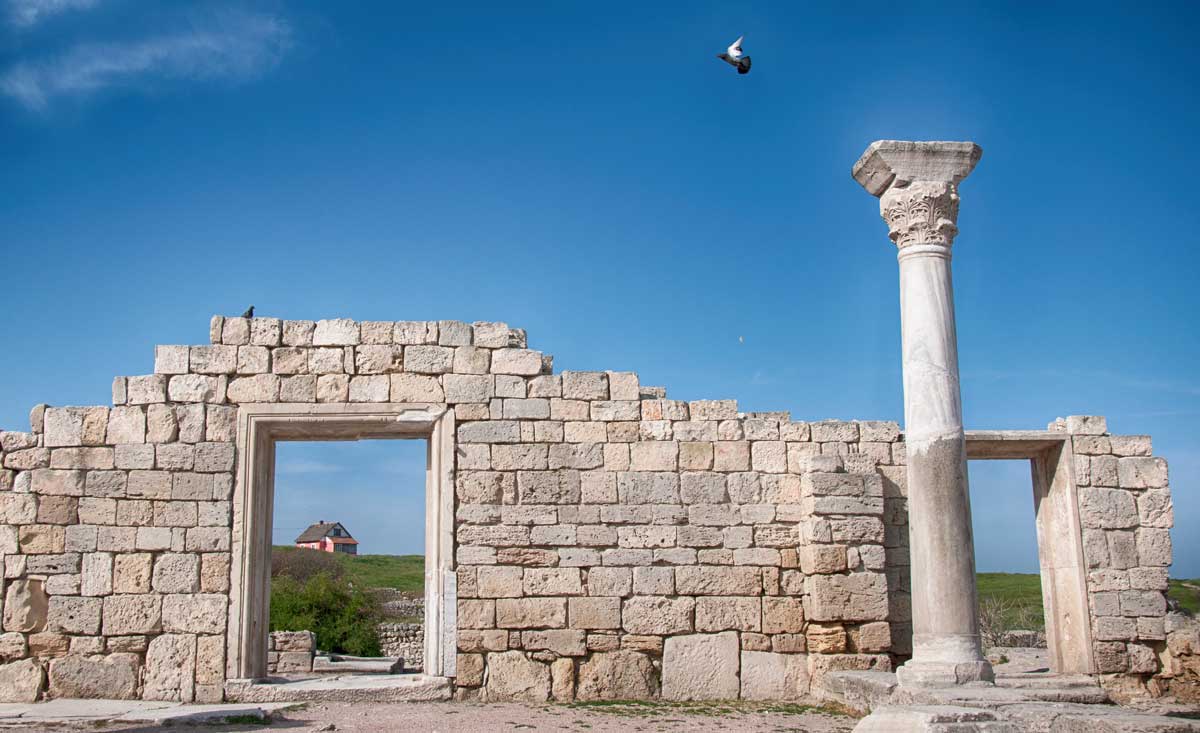
Chersonesos is an enormous, ancient ruin alongside the Ukrainian city of Sevastopol, on the shores of the Black Sea. The expansive site is a mix of Greek, Roman and Byzantine remains; and, hundreds of hectares of ancient, agricultural farmland that make it unique in the world.
To archaeologists like Adam Rabinowitz, from Texas University’s Institute of Classical Archaeology, the soubriquet for Chersonesos, ‘the Russian (or Ukrainian) Pompeii’, is well deserved.
The Roman amphitheatre, hundreds of metres of defensive walls and a Greek temple perched on the sea’s edge look impressive, but the most significant remains within the ancient city limits are from the Byzantine era. We know much less about how ordinary people lived in this period than we do for a great many other periods. So this site in particular provides us with a window. The comparison to Pompeii is an apt one. ‘As you look at the remains you can basically reconstruct the entire life of this town, in the same way that you can reconstruct the life of the citizens of Pompeii in AD 79.’
Texas University and the local Archaeological Park have uncovered the foundations of a small, two-storey blacksmith’s workshop, a tavern with large scale food preparation areas, a chapel and dozens of broken storage vessels. Graves that have been excavated near the site paint a sorry picture: over half the skeletons belong to infants or children. Burnt, wooden remains and a woman’s headless corpse under a collapsed wall suggest that this once-bustling, medieval quarter came to a sudden end. During the thirteenth century the area was suddenly abandoned, probably because of an invasion by the Mongols.
But the most important feature of Chersonesos is that it’s probably the best place to study ancient farming. Hundreds of hectares of agricultural land called Chora, farmed by Greek colonists, is still as it was more than two thousand years ago. This area was the equivalent of the ‘wild west’ for ancient Greek civilization. What the Chora tells us about the interaction between ancient Greek colonies during the third and fourth centuries bc and local tribes, makes Chersonesos unique in the world. Dozens of ancient farmsteads with their wine presses and crumbling defensive towers survive in now-barren fields once covered with vineyards.
‘What happens at the margins of a colonial situation has become increasingly interesting for ethnographers and sociologists in the modern period but it’s taken a long time for anybody to start thinking about it in the Classical period,’ says Adam Rabinowitz.
Work on the Chora – brought to the attention of Western archaeologists by Dr Joseph Carter – is still at an early stage. Evidence suggests that local people were paid, rather than enslaved, to work on farms and there’s Greek pottery made according to local, ‘barbarian’ pottery styles. There was a surprising amount of interaction between Greek and local cultures here. Rabonowitz says there are tantalizing hints that the interaction between the Greeks and the ‘barbarians’ (the local tribes) was quite different to how historians have normally interpreted it.
‘What people usually say is that there were these barbarian populations who were sort of crude and uneducated and when they saw Greek culture they realised that it was better and so they became like Greeks in so far as they could, being stupid barbarians. In fact, the situation in my opinion was much more dynamic and there was much more influence both back and forth and much more transformation of culture on both sides.’
The way the Greeks adopted local cultural traditions is very obvious in the remains of ancient tombstones. Dr Richard Posamentir from the German Archaeological Institute in Istanbul has been using a special infra-red technique – pioneered by his teacher in the 1960s on the Alexander Sarcophagus – to reveal the original paintwork on Chersonesos’ ancient gravestones. Even when there are no original fragments visible to the human eye, this method can allow you to see all the colours.
The gravestones at Chersonesos have an added advantage. During an emergency, many were torn up from the graveyard and used to bolster the fortifications and this has protected them from the elements’ preserving much of their original paintwork.
These tombstones contribute more evidence that local culture strongly influenced the Greek colony. Unlike on the Greek mainland, each stone marked an individual’s grave rather than a family. Even more curious, the decorations on the tombstones only depict objects: for example females’ tombstones are decorated with sashes, while those of soldiers depict small helmets and weapons. The naturalistic human form never appears, instead the stones are painted with highly stylized head and shoulders portraits.
Classical Greek civilization, famous for its portrayals of the human body, didn’t use its favourite artform to commemorate the dead in Chersonesos.
‘Obviously this kind of complete rejection of human depictions has something to do with the people they met here,’ argues Richard Posamentir. ‘To my mind this is some sort of proof for the interaction between local tribes and Greeks. The tribes wouldn’t let the Greeks just use the types of gravestones they wanted; their local idols or icons had to be placed on the same gravestones.’
It is ironic that this evidence of a vibrant local culture in Ukraine, which interacted with the ancient Greek colonies has failed to impress some Ukrainian archaeologists. At talks held by Texas University at Chersonesos, one local archaeologist was eagerly quizzing anthropological expert Rennata Henneberg about evidence of ‘racial’ differences between the bones of Greek colonists and those belonging to local tribes.
In Greek colonies, the divisions between civilization and barbarian were rarely clear. Scholars argue that the actual physical separation of different peoples is a much more recent phenomenon – for example under the apartheid regime in South Africa. Which is why the word ‘barbarian’ is out of vogue with many historians and archaeologists.
There is more to this site on the Black Sea. As well as being the ‘Ukrainian Pompeii’, it has also been known, since the nineteenth century, as the ‘Russian Troy’ – a place as psychologically important in Russian and Slavic history as Troy is in Western history. Chersonesos is where Christianity entered the old Slavic kingdoms. In the twelfth century, King Vladimir was baptised here, signalling the start of Russia becoming Greek Orthodox. There’s an Orthodox Church in the middle of the ruin; its priest has been at loggerheads with the archaeologists for several years. Meanwhile Texas University, with the support of the Ukrainian government, is attempting to have Chersonesos designated a UNESCO World Heritage site. If this bid is successful it will bring access to millions of euros of funding and professional expertise to help preserve the ruin, promote its potential as a tourist attraction and underline its symbolic importance to Ukrainian national identity as – under the ancient Greeks – the first place in the Slav world to operate as a democracy. But perhaps the most important contribution of Chersonesos is how it demonstrates that the people the ancient Greeks called barbarians weren’t that bad after all.