People are bound to ask what is happening to our country. Having been one of the most law-abiding countries in the world a byword for stability, order and decency - are we changing into something else? Daily Express, July 6th, 1981.
We need to consider why the peaceful people of England are changing … Over the 200 years up to 1945, Britain became so settled in internal peace. Daily Telegraph, March 11th, 1982.
The fear of the mob that has now returned after a century or more to haunt the cities of this land. Daily Mail, July 7th, 1981.
Register to read more articles for free.
When you register, you will receive the History Today newsletter. Click here to read our Terms of Use.
People are bound to ask what is happening to our country. Having been one of the most law-abiding countries in the world a byword for stability, order and decency - are we changing into something else? Daily Express, July 6th, 1981.
We need to consider why the peaceful people of England are changing … Over the 200 years up to 1945, Britain became so settled in internal peace. Daily Telegraph, March 11th, 1982.
The fear of the mob that has now returned after a century or more to haunt the cities of this land. Daily Mail, July 7th, 1981.
History might seem a queer way to problems of crime approach the urgent and violence in contemporary Britain. But perhaps not. Because so often the way in which we think and feel about crime implies an historical judgement, that we have fallen away from the standards of the past - often lovingly portrayed as the golden age of the ‘British way of life’.
We have heard a great deal in recent years, for example, about ‘Victorian values’. It is undoubtedly more common, however, to invoke a much shorter timescale than this when discussing crime, and particularly juvenile Crime. One, that is, which describes the problem as something that has come about ‘in the past twenty years so’ or ‘since the war’.
Under the catch-all phrase of ‘permissiveness’ we immediately think of the together with alleged decline in family life, the irresponsibility of a new generation of parents and their ‘latch-key’ offspring. Then, there are the demoralising influences of popular amusements – television violence and so on – which invite ‘copy-cat’ crime, the breakdown of discipline in schools, the weakening of all forms of traditional authority, and what is seen as the increasing leniency of the law.
So:
That’s the way we’re going nowadays. Everything slick and streamlined, everything made out of something else. Celluloid, rubber, chromium-steel everywhere … radios all playing the same tune, no vegetation left, everything cemented over … There's something that’s gone out of us in these twenty years since the war.
Or, again:
The passing of parental authority, defiance of pre-war conventions, the absence of restraint, the wildness of extremes, the confusion of unrelated liberties, the wholesale drift away from churches, are but a few characteristics of after-war conditions.
We know the arguments well enough, but there is an immediate point of difficulty here. Because these complaints against postwar irresponsibility both come from before the Second World War. The first is from George Orwell's pre-war novel Coming Up for Air, the second from a Christian boys' club worker James Butterworth writing in 1932 about the sweeping changes of the ‘postwar’ years.
Nor was it only youth workers and fictional characters in novels who succumbed to this unhappy vision in the inter-war years. One active focus of discontent was the Scrutiny group gathered around F.R. Leavis at Cambridge which repeatedly thundered against ‘this vast and terrifying disintegration of social life. ‘Change has been so catastrophic’, Leavis wrote in 1930, that it had ‘radically affected religion, broken up the family … the generations find it hard to adjust themselves to each other, and parents are helpless to deal with their children.’
There has been a tendency of late to paint a rather alarming picture of the depravity of the youth of the nation. Headlines scream the menace of ‘boy gangsters’. Elderly magistrates deplore the abandonment of their panacea, the birch ... by gloomy forebodings in the Press of the inevitably disastrous results of the leniency and weakness of the present day. The Times, January 4th, 1937.
Then, as now, these preoccupations settled around a cluster of uncannily familiar themes. Newspapers sensationalised motor-bandits, razor gangs and bag snatchers in the city streets. There were regular disorders at football matches - pitch invasions and attacks on referees and players - and the Hollywood cinema was blamed for lowering public morals and inciting ‘copy-cat’ crime among the young. Violent clashes between the police and the unemployed, especially after the dole cuts in 1931 when there was looting in Glasgow, and street battles between fascists and anti-fascists which prompted the Public Order Act of 1936 were other dimensions of these ‘peaceful’ pre-war years. The greater freedom from restraint which is characteristic of our age' and ‘this rejection of conventional standards’ meant for Roy and Theodora Calvert, writing on The Law-Breaker in 1933, that ‘we are passing through a crisis in morals.’ Plus ça change.
These inter-war complaints seem like a carbon-copy of our own post-war ennui. And those who voiced them often looked back to happier times ‘before the war’, of perfect innocence and well-founded tradition. Indeed, the late Victorian and Edwardian years - from the ‘Gay Nineties’ until the outbreak of the Great War - are often remembered as a time of unrivalled domestic harmony.
But this was not how it felt at the time. ‘The tendencies of modern life’, wailed the Stipendiary Magistrate for Brighton in 1898, ‘ignore or disparage social distinctions, which formerly did much to encourage respect for others and habits of obedience and discipline children are deteriorating. . . the child of today is coarser, more vulgar, less refined than his parents were.’ In the following year ‘the break-up or weakening of family life’ was on the editorial agenda of The Times, no less than ‘the break-up or impairment of the old ideas of discipline or order’ in the cities. Because the old traditions were already seen to be in eclipse, and on a number of fronts.
’A somewhat unlovely characteristic of the present day’, according to Mrs Helen Bosanquet in 1906, was ‘among the children a prevailing and increasing want of respect towards their elders, more especially, perhaps, towards their parents.’ Not everyone was sure, however, that their parents deserved respect. The Physical Deterioration Committee of 1904 found ‘no lack of evidence of increasing carelessness and deficient sense of responsibility among the younger women of the present day. . .This is testified to by a crowd of witnesses’: as indeed it was.
The elementary Board Schools (also known as the ‘Bored’ Schools) were in like manner criticised for their frail disciplines. Many a boy, said E.J. Urwick in 1904, was ‘a Jekyll in the classroom, a Hyde in the street’. The music halls received their portion of blame as a breeding ground for imitative crime, and soon the earliest silent movies would be condemned in equal terms as 'a direct incentive to crime' and 'a grave danger to the community responsible for the downfall of many young people. Football crowds, too, were such a carnival of disorder as to make one observer 'thankful that murder is illegal'. Even the popular bicycling boom of the 1890s provoked flurries of respectable discontent, as headlines such as ‘The Cyclist Terror’, ‘Moloch of the Wheel’ and ‘Cyclomania’ depicted the problem of boys whizzing about madly among the traffic, the unruly working class ‘scorcher’ and the notoriously liberated female cyclist.
These deeply felt anxieties in late Victorian and Edwardian England were registered most forcibly in the sudden arrival of the words ‘Hooligan’ and ‘Hooliganism’ into common English usage. And among the many forces conspiring to produce what was seen as a new streak of violence among the young, such as the penny dreadful' comics and music hall entertainments, the freedom from home restraint was understood as a major influence. That young people ‘have tasted too much freedom’ or ‘had no idea of discipline or subordination’ was a tireless accusation. They lived ‘a bandit life away from their homes’, said a government report of 1910, ‘free of all control’. Even more remarkable - given the pioneering researches of Charles Booth and Seebohm Rowntree which revealed such awful poverty among the common people at this time in history - the 'irresponsible freedom' of the average youth was compounded by ‘the large amount of money he has to spend on himself. At the root of the newly-named 'Hooliganism’, said Sidney Webb, was ‘too much pocket-money’: and this in evidence before the 1909 Poor Law Commission of all places!
There were controversies, to be sure, about whether the problem had become enlarged in the public mind. Whether the family was in quite such a state of disrepair. Whether the rising generation was in such bad shape: Baden-Powell, the founder of the Boy Scouts, even went so far as to celebrate the Hooligan as ‘the best class of boy’ because he had fighting spirit and pluck. And in some quarters it was even whispered that street violence might have been magnified by newspaper sensationalism – it was ‘press-manufactured Hooliganism’ said Thomas Holmes, the distinguished London Police Court Missioner. But the more common response was to understand the problem as symptomatic of a recent deterioration in public conduct, one that had taken place ‘in the last quarter of nineteenth century’. Or, to put that another way, ‘twenty years ago’.
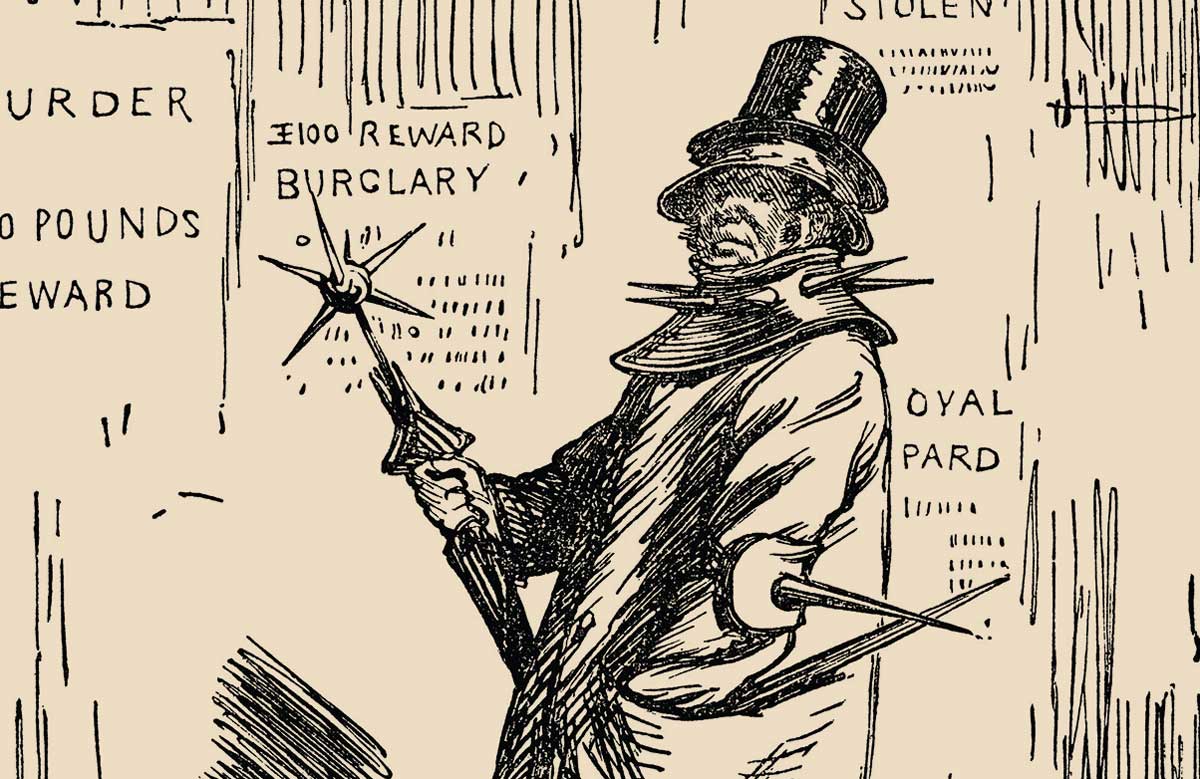
What if we were to retreat further back into history, would we find the stable ‘golden age’ of crime-free tradition? The simple answer is ‘No’. Twenty years before the original Hooligans, London was already besieged by the late 1870s burglary scare when, amidst formidable criticisms of the Metropolitan Police, Punch jokingly nicknamed fashionable Belgravia as ‘Burglaria’. Twenty years before that there were the ‘garotting’ panics of the late 1850s and early 1860s, which The Times heralded in 1863 as ‘this modern peril of the streets’ and ‘a new variety of crime’. And twenty years before that, we would find Lord Ashley rising before the House of Commons in 1843 to describe the problem of London’s ‘street arabs’ and how ‘crime advances at a rapid pace’.
The truly extraordinary thing is the way in which the form of complaint fails to register any significant change across more than a century of our history. So, in the 1840Ds working mothers were said to be failing in their domestic duties, and the ‘freedom’ afforded to the children who worked in the factories and mines sent our ripples of anxiety. ‘The factory system’, Samuel Smiles explained in 1843, ‘has invaded the sanctuary of the home and broken up the family and social ties.’ The ‘penny gaff’ theatres and 'two-penny hop' dancing saloons were also condemned for causing imitative crime: the daring enactments of Jack Sheppard, Dick Turpin and Claude Duval, it was said, ‘exhibit to admiration noted examples of successful crime’ thus tempting the young boy ‘to emulate the conduct of his favourite hero’. The Reverend Henry Worsley’s prize-winning essay on Juvenile Depravity (1849) was one of the many books and pamphlets from this period which summed up the fears of his generation. ‘In the convulsions of change’, he thought, 'the working classes have generally deteriorated in moral condition.' And with utter predictability Worsley looked back to his own ‘golden age’ of civility and social harmony: ‘Rather more than fifty years ago’ there was ‘one united family. . . any candid judge will acknowledge the manifest superiority of the past century’.
Taken in its own terms, this history of fearful complaint would describe to us a moral downfall of landslide proportions among the British people across more than two centuries of relentless decline. But can we take it on its own terms? And if not, does this then mean that the world never changes? Perhaps all that can be said in summary is that while the world obviously does change, this immovable vocabulary of complaint has somehow failed to keep pace with a moving world.
Even so, perhaps we can take some reassurance from this history that the world is not falling apart quite so rapidly as some of our modern-day jeremiahs would have us believe. It reminds us also that the official crime statistics are an unreliable measure of the actual level of crime, just as the Home Office’s own British Crime Survey has recently tried to reach behind the official figures to the ‘dark figure’ of unrecorded crime, while showing that fluctuations in official statistics are contaminated by many factors such as the size of our police force, the scope of what the law defines as crime, and the increasing requirement by insurance companies that crimes are reported to the people.
Most importantly, this history obliges us to re-examine those commonplace assertions that youthful crime is a result of the disorienting effects of television violence, ‘new-fangled’ educational philosophies, the arrival of black people in Britain, or any other symptom of ‘permissive’ modernity - which are usually followed by the requirement to administer a few ‘short, sharp shocks’ to the rising generation in order to bring them back into line with the old traditions. This kind of response actually trivialises the problem, because what this history shows is that street violence and disorder are a deeply ingrained feature of the social landscape, and long-standing disputes and difficulties are not solved by short, sharp remedies. Nostalgic remembrances of things past – or harking back to the steadying disciplines of hanging, flogging, or the old-fashioned British bobby who was often ill-used in the streets which he policed - are not easily reconciled with the actual history. The answer to the problem of crime does not lie in the past. Rather, it is a prospect for the future.
The word ‘Hooligan’ made an abrupt entrance into common English usage during the hot summer of 1898, in the wake of an excessively rowdy August Bank Holiday celebration in London which resulted in large numbers of people being brought before the courts on charges of disorderliness, drunkenness, assaults on police officers, street robberies and fighting.
In the following years a regular pattern of disorder came to be associated with the ‘Hooligan’ gangs. They engaged in pitched battles among themselves in the streets Fulham Boys against Chelsea Boys, Chapel Street against Margaret Street - and were said to take great pride in their famous victories over neighbourhood rivals. News reports also featured them smashing up coffee stalls and public houses, assaulting bar staff, robbing old ladies, and knocking down innocent bystanders who happened to get in their way. There were, in addition, some delirious rumours that ‘Hooligans’ were regularly armed with pistols and revolvers which they used in their street battles, along with an assorted weaponry of knives, leather belts, iron bars and powerful catapults.
The ‘Hooligans’ were, in fact, what we would now call a ‘youth culture’ who had adopted a uniform dress-style. Bell-bottom trousers with a buttoned vent in the leg, colourful neck scarves, a distinctive style of cap, boots said to be ‘toe-plated with iron and calculated to kill easily’, ornamental leather belts with designs worked in metal studs, and a characteristic ‘donkey fringe’ haircut: these were the elements of the London ‘Hooligan’ style.
In other cities, youths with the same clothes and the same street-fighting habits were known by different names: ‘Scuttlers’ in Manchester, and ‘Peaky Blinders’ in Birmingham. Some of the local gangs had improvised stylistic details - the ‘Velvet Cap’ gang from Battersea, or the ‘Plaid Cap Brigade’ from Poplar - and there were also trendsetters among Hooligans. One young man, for example, was said to have caused some amusement when he appeared before a London police court in 1898 with what sounds remarkably like a ‘Mohican’ cut: ‘Clipped as closely as possible to the scalp, with the exception of a small patch on the crown of the head, which was pulled down over the forehead to form a fringe’.
One of the more worrying aspects of the Bank Holiday outrages of 1898 was that they highlighted fierce traditions of resistance to the police in working-class neighbourhoods. So that a police officer attempting to make an arrest would not uncommonly be set upon by a large crowd – sometimes as many as two or three hundred people – shouting ‘Rescue! Rescue!’ and ‘Boot ‘im!’ So well loved were the 'British bobbies' in late Victorian London that, as shown by the annual reports of the Metropolitan Police Commissioner, each year one-in-four of London’s police were assaulted in the course of their duty, and one-in-ten of these would be on the sicklist for a fortnight or more. A policeman’s lot in those days was a most unhappy one.
Geoffrey Pearson is a Senior Lecturer in Applied Social Studies at the University of Bradford, and the author of Hooligan: A History of Respectable Fears.
Today’s History
On Sunday 14 November 1982 at 4.30pm, the monthly television programme Today’s History began on Channel 4.
Today’s History reflected on television History Today’s approach to the past, showing the historical background to current affairs and examining historians’ perceptions on the past today. Each month a pull-out supplement provided readers with four pages of background to link with the subject of the television programme, in the form of chronologies, maps, charts, factual information, suggestions for reading, up-to-date surveys and historical insights.