

Subversion in Khruschev’s USSR
The death of Stalin in 1953 marked a shift in the Soviet Union. Robert Hornsby discusses the underground groups that mushroomed in the aftermath and how the state responded to them.
Russia has had a long and colourful history of underground political activity. In 1825, almost a hundred years before the revolutions of 1917, the Decembrists, a group that emerged from the flourishing secret societies of the early 19th century, made their doomed attempt to prevent Tsar Nicholas I from coming to the throne. Two decades later the Petrashevsky Circle (whose members included a young Fyodor Dostoevsky) met in secret to propound their views of a future democratic and socialist society to replace tsarist autocracy. The group was uncovered and its members imprisoned in 1849. Failure was not always the outcome of such activity, however. The Bolsheviks, who ultimately gained power in October 1917, had up to that point also spent much of their existence as an underground group.
The Soviet regime showed itself more adept at keeping tabs on those it ruled over but it too proved unable to stamp out these secretive organisations entirely. Evidence from the Stalin era must be approached with care since the falsification of plots and opposition activity was commonplace at the time but reliable accounts tell us that even in the stultifying and dangerous environment of the 1940s and early 1950s a few anti-Stalinist groups still formed, such as the ‘Union of Revolutionary Struggle’ in Taishet, Siberia (1941), the ‘Communist Party of Youth’ in Voronezh in south-west Russia (1947) and the ‘Democratic Union’ in Moscow (1951). The sudden death of Stalin in March 1953 marked a clear, almost instant point of change for leaders and citizens alike enabling long-suppressed questions and frustrations to surface.
A melting moment
Hundreds of these secret groups appeared during what has become known as ‘the Thaw era’. The dissident Vladimir Bukovsky, who was exiled in 1976 during Brezhnev’s leadership and now lives in Britain, recalled: ‘The 1950s and 1960s in Russia saw a mushrooming of clandestine organisations, unions, groups and even parties.’ Some were little more than discussion circles where people talked about literature and debated ideological matters; others secretly distributed leaflets and manifestos that attacked government policies and members of the leadership; others threatened unmistakably subversive actions, such as inciting mass insurrection and even revolution. Although these groups led a precarious existence, too small, too isolated and too few ever to constitute any kind of threat to the stability of the Soviet state, they represent a fascinating social phenomenon that touches upon key themes of the post-Stalin USSR.
The boundaries between them could be amorphous but there were essentially three types of underground group: nationalist, religious and political. All three strands had elements in common – most notably in sharing some objection to the existing social and political order in the USSR – but they also tended to differ in terms of the characteristics, behaviour and aims of participants. For example groups might be formed of Baptists, Jews, Jehovah’s Witnesses, Ukrainians, Estonians or Armenians, all of whom championed their own distinctive religious and national concerns.
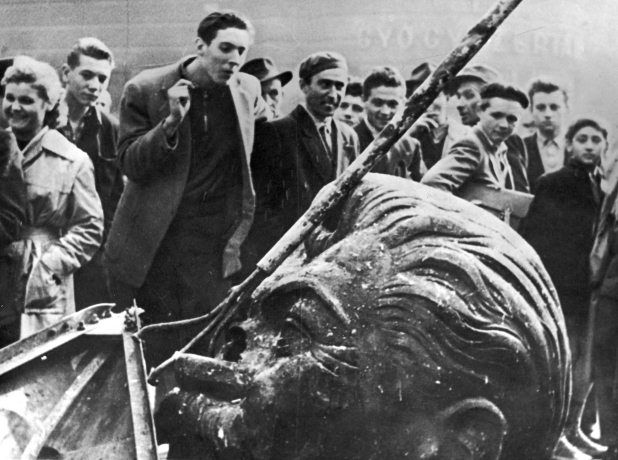
By the mid-1950s western regions of the USSR including Latvia, Lithuania, Estonia (and parts of Ukraine) were alive with nationalist sentiment as former guerrilla fighters, who had resisted being incorporated into the Soviet Union at the end of the Second World War, returned home from the Gulag. Year after year nationalist groups appeared in these areas. They were joined by Armenians, Georgians and, from the early 1960s, by Russian nationalists. For many the revolutionary events in nearby Hungary during autumn 1956 further stoked anti-Russian sentiment and raised hopes for independence. Others were less ideologically hostile to the state but wanted to protect their native language and culture from creeping Russification.
Most religious groups wanted little more than the right to practice their traditional rites and customs away from the interference of a state that prohibited and often punished acts of religious expression such as baptism or proselytising. Even so, dozens of Baptists, Jehovah’s Witnesses, Jews, Orthodox Christians and others – though seemingly none of the USSR’s large Muslim population – were arrested and jailed for participating in these clandestine ‘sects’.
A healing process
The more overtly ideological groups were a particular striking feature of the Khrushchev era. Over the course of the decade that followed Stalin’s death they were also markedly more heterogeneous in their composition and more dynamic in the way their activities evolved. As such, they provide a useful insight into an era that is increasingly the focus of historians both in the West and in the former Soviet Union.
A range of underground groups had appeared by the end of 1956. The two most significant of these from a political perspective were university based and led by Revolt Pimenov (1931-90) at Leningrad State University and by Lev Krasnopevtsev (b.1930) at Moscow State University. Typically for the early Khrushchev years both were made up mostly of young men and included several card-carrying Communist Party and Komsomol (the Party youth wing) members. They were also typical in that both leaders were uncovered by the KGB and jailed within just a few months of forming.
In the winter of 1956/57 Revolt Pimenov held a series of clandestine meetings on subjects such as ‘legal methods of struggle for democracy’ and ‘the truth about the Hungarian Revolution’. His group produced an information bulletin, theses critiquing the state of Soviet Communism and leaflets bearing statements such as ‘land to the peasants, factories to the workers and culture to the intelligentsia’. The Moscow cell appeared a few months later in May 1957 when a circle of like-minded friends decided to consider themselves an underground group. They produced leaflets calling for Stalin’s henchmen to be tried in court, for the state to abandon article 58 of the criminal code (which had long been the regime’s main legal tool of political repression) and urging Soviet workers to go out on strike. However within two months members were tracked down and arrested. By the end of 1957 11 of the Leningrad group and nine of the Moscow organisation had been convicted of ‘counter-revolutionary activity’, with sentences ranging from three to ten years ‘corrective labour’ in what remained of Stalin’s Gulag.
Some observers have interpreted signs of covert political unrest in the USSR as an indication of suppressed disdain for Communism and a growing desire to be free of the Soviet regime but in the 1950s this was usually wide of the mark. The Communist Party leadership, too, was usually wildly inaccurate in its assessments of such groups, often describing them as ‘anti-Soviet elements’ and insisting they were a product of western attempts to undermine the system. However as a number of those who were arrested and tried subsequently testified (including Lev Krasnopevtsev himself), they did not consider themselves anti-Soviet.
Of course for some this kind of response may have been a tactic to temper the ensuing punishment. But plenty of those who took the risk of forming illegal political groups positioned themselves as critics of the regime rather than as hostile opponents. They were neither anti-Communist nor pro the liberal West. Few in this period spoke of aiming to bring down the Soviet regime and even fewer indicated a desire for a capitalist system in its stead. They did, however, demand genuine democratisation and greater freedom of expression. Most of these groups, such as Petro Grigorenko’s ‘Union of Struggle for the Revival of Leninism’ started in 1963, sought the correction of flaws in the existing system and a return of the USSR to the path of ‘true Leninism’. Up to a point it was precisely a faith in the Communist project and sense of investment in its future that provided the impetus for them to criticise its failings. The poet and literary historian Igor Volgin has recently recalled: ‘All of my generation (of students) were anti-Stalinists but they were not anti-Soviet. They saw their role as speeding up the healing process.’
The ‘healing process’ referred to overcoming a quarter-century of damage inflicted by Stalinism on the Soviet system. This was a process that Khrushchev himself had promised to begin when he exposed the mass abuses of the preceding era in his denunciation of Stalin in the ‘Secret Speech’ of February 1956. However, a lack of anti-Communist sentiment within underground groups and the Soviet authorities’ apparent shared stance on the Stalin period did not mean that the latter were any less suspicious or hostile to political groups. Alternative interpretations of Marxist-Leninist ideology were considered just as much a heresy as outright opposition to Communism. Dominance of public discourse was jealously guarded by the regime so that groups did not have to speak of inciting revolution or violence to be seen as a threat. In fact when the regime began a major clampdown on dissent in December 1956 officials were specifically warned of the danger posed by these ‘neo-Bolsheviks’ and told they were not to be tolerated or mistaken for allies.
The most dangerous moment
But what prompted the surge in underground political groups during the early Khrushchev era? It is certainly significant that the cohort they comprised had not lived through mass state terror as its parents’ generation had. Alexis de Tocqueville’s assertion that the most dangerous moment for a bad government is when it begins to reform comes to mind. Since the end of the Second World War there had been rumblings of discontent within Soviet society but two major events of 1956 were most often at the root of underground activity around this time. First, Khrushchev’s denunciation of Stalin made it clear that the ‘bad old days’ of intense state repression were over and the tariff for acts of protest had become less deadly. The executions and 25-year Gulag sentences for political offences were gone. For young educated people in particular the swiftly leaked Secret Speech painted Stalinism as a temporary aberration that would be overcome and enthusiasm for the Communist project revived. Yet it brought to the fore a series of questions about the past, present and future of the Soviet regime that went well beyond anything the authorities were willing to tolerate being voiced in public.
Then in the autumn of 1956 Soviet tanks rolled into Budapest and crushed the nascent Hungarian Revolution, making it seem to some that nothing had really changed at all since Stalin’s death. This action provoked consternation among the very elements of the population that had been so recently enthused by Khrushchev’s attack on Stalinism and his promise of a ‘return to Leninism’.
Undoubtedly there were more nebulous reasons why individuals created or joined secret organisations at this time: some did so out of youthful exuberance and a simple desire for excitement; some because friends and acquaintainces were already involved; others were roused by state propaganda about the daring acts of pre-revolutionary Bolsheviks and the heroic sacrifices of their parents’ generation during the war, seeing this as their own chance to make a contribution to their country’s history.

The fact that, as in tsarist times, there was practically no legitimate outlet through which to debate concerns and objections of a political nature meant that the underground beckoned for those who wished to engage in these issues with others. Add to this an increasingly educated population, less isolated from the outside world and often deeply committed to political matters and yet more reasons emerge as to why such groups formed.
An evidence issue
There are plenty of interesting KGB files and reports on individual groups in the archives yet data on the overall number of underground organisations that appeared during the era is both problematic and scant. The biggest problem is that this information mostly provides the perspective of the security organs and thus constitutes a highly distorted lens through which to observe the phenomenon. At best we can only hope to see what the authorities saw and this cannot have been everything. Some groups would have formed and disbanded without ever coming to the attention of the authorities.
In a rare scrap of evidence shedding light on the scale of underground group activity, in 1962, a year of heightened unrest due to unpopular price rises, the KGB reported to the Central Committee that 60 ‘anti-Soviet groups’ totalling over 200 members had been uncovered in the first six months. In spite of the particular circumstances this figure can stand as a tentative average for the era, at least until more accurate statistics emerge. It leads to two rudimentary conclusions: that there were many more secret groups during the period than has generally been supposed but that in the grand scheme of things the number of Soviet citizens who participated in these remained absolutely minimal: a few thousand people in a population of over 200 million.
As the 1960s progressed the scale of the activities of underground groups grew. Where previously leaflets had been produced in quantities of a few dozen copies, they were now appearing in the hundreds and, on occasion, thousands. In February 1963 the security services found 350 leaflets printed by ‘The Union of Free Thought’ scattered around Moscow. A further 550 copies awaiting distribution were discovered once they had tracked down the members. Two months later the ‘Revolutionary Social Democratic Front’ produced 800 leaflets demanding Khrushchev’s removal from power, an improvement in living standards and amnesty for political prisoners. An investigation found the group had managed to distribute its leaflets in several major Ukrainian cities, including Donetsk, Zhitomir, Rovensk and Lugansk. In April 1964 the KGB reported that a group calling itself the ‘Democratic Union of Socialists’ had posted over 850 ‘slanderous leaflets’ that turned up as far apart as Leningrad, Novosibirsk, Kazan and Kharkov.
As the era wore on the key demographic of political groups seems to have shifted from idealistic students to disgruntled workers. Signs of greater ideological diversity and deepening cynicism began to appear more frequently. Many still called themselves loyal-sounding names like the ‘Union of Struggle for the Rebirth of Leninism’ and the ‘Krasnoyarsk Workers’ (an all-female group from Siberia) but they were moving further away from the regime politically. Though they were still in the same ideological sphere as the Communist Party they now espoused opposition rather than healing. For example a May 1963 leaflet by the Revolutionary Social Democratic Party not only set forth demands for higher wages, a shorter working week and amnesty for political prisoners but also ended with the lines: ‘All to the ranks of the revolution! We will win! Down with Khrushchev’s reactionary clique! Long live socialist democracy! Long live the fourth Russian Revolution!’
Nonetheless these kinds of statements can hardly be said to have reflected the wider public mood and even if they had led to genuine attempts to overturn the existing regime they were never likely to threaten the might of the Soviet state. There is little indication of any popular sympathy or even knowledge that such groups existed. Still a number of cases point to a growing degree of extremism in the 1960s. Leaflets appeared in Tashkent during March 1963 in the name of ‘The Secret Terrorist Union’; two months later a plot to blow up one of the authorities’ radio jamming stations in Minsk was foiled by the KGB almost at the last minute. A subsequent search revealed that the trio responsible had acquired artillery shells, detonators and a plan of the site in question. Only a month later the KGB in Voronezh wrote to Moscow with news that a group of four youths calling themselves the ‘National Socialist Party’ and ‘performing fascist rituals’ had been uncovered in the city. Most remarkably the teenagers had also acquired an automatic pistol, a rifle and two grenades along with explosives and detonators.
Cases like these were so far beyond the norm for Soviet society that one might well question whether such apparently dangerous groups were anything more than a KGB fabrication, yet this does not appear to have been the case. For example, in a 2005 interview with the Belarusian newspaper Belgazeta Sergei Khanzhenkov, who had masterminded the abortive attack on the Minsk radio station, gave an account of the events in question which corroborated the key points set out in the KGB report of 1963. That is not to suggest that all such cases or all KGB evidence from the era are unquestionable.
Conversely, evidence exists of ‘phantom groups’ invented by dissenters. For example D. Kruritskii, a Communist Party member of 15 years standing and a decorated war veteran, was arrested in 1960 after pasting up leaflets around Moscow (which according to the KGB included ‘slander against the Party and state’ as well as threats against Khrushchev) and sending over 230 anonymous letters to political leaders of the highest rank. All of this was done in the name of the ‘Committee of Liberation’: of which Kruritskii proved to be the only member. This practice was not entirely uncommon. Threatening letters might be written in the name of whole towns or factories and leaflets distributed in the name of supposed underground groups and political parties that simply did not exist. The reasoning behind such a step was often that the authorities were more likely to take seriously the grievances of a large number of people than those of a solitary citizen. However it also upped the stakes by ensuring that the KGB would give the matter its utmost attention as it investigated the imaginary group in question.
A shift from above
By the 1960s the Soviet regime had begun to change its stance and was taking slightly less draconian measures against those that participated in underground groups. Increasingly it was only those deemed to be ‘ringleaders’ who were jailed, while their accomplices tended instead to face non-custodial punishments like expulsion from the Communist Party and the loss of a job or university place, accompanied by a black mark on one’s personal record and a warning of dire consequences if such behaviour happened again. This was not a sign that such behaviour had become more acceptable in the eyes of the authorities. Rather it represented a wider shift in punitive policy. Harsh measures were still employed against critics but far more selectively. If people could be made to fall back into line by the threat of jail, then actual jail terms were only needed to remove the most troublesome individuals from society and to serve as an example to others.
So what became of this trend for underground activity? As yet unopened archives may well reveal a more vibrant and diverse underground in the post-Khrushchev USSR than historians are currently aware of, but the extant literature suggests this was a type of dissent that was already dying out by the mid-1960s. Bi-annual KGB reports from 1963 and 1964 indicate that the number of anti-Soviet leaflets appearing around the country was in marked decline: from 11,000 in the first six months of 1963 to just over 3,000 during the same period of 1964. By 1965 the number of leaflets found had dropped again by more than half.
There were several reasons for this but, perhaps most importantly, bitter experience had shown that underground activity was both dangerous and almost entirely ineffective since most ordinary citizens did not even know that such groups existed. Under Brezhnev the perpetual upheaval of the Khrushchev years was replaced by stability and consistency at the top. Living standards that had begun to rise in the 1950s continued to do so for a good many years. Furthermore a wealth of primary and secondary literature tells us that the kind of Communist idealism that contributed so much to the creation of underground groups during the early part of the Khrushchev era was in serious decline by the middle of the 1960s. The KGB was becoming ever more adept at monitoring society and nipping in the bud any deviance that did occur. Lastly, and perhaps most importantly, the regime was becoming better at managing society. Through a combination of incentives to conform and punishments for non-conformity the authorities were able to rein in most overt manifestations of discontent.
Those few who did continue to protest and criticise on political, nationalist or religious platforms increasingly chose to do so openly and through a framework of legal struggle rather than underground activity. This, of course, had its own risks but it was to be much more effective than ‘going underground’ had been. The dissidents of later years – some of them veterans of the underground era – were able to bring Soviet political repression to the attention of the outside world and had at least some restraining influence on the behaviour of the authorities towards their domestic critics. Historians such as Ludmilla Alexeyeva have pointed to a re-emergence of underground activity in the 1980s, when the open and legalistic dissident movement that had blossomed in the late 1960s and 1970s was all but moribund. As if to show the transformation that glasnost quickly wrought on the Soviet system by 1990 the Leningrad group leader Revolt Pimenov was taking up his seat in the Congress of People’s Deputies – Russia’s first elected parliament since the First World War.

