Republic or Empire. Crisis or revolution. Statesman or dictator. Our political imagination is generously populated with examples and ideas drawn from Roman history. Inevitably, when we look back on the Roman experience, we do so with eyes sensitised by the concerns of our own world. This is hardly new. Edward Gibbon wrote his Decline and Fall (1776-89) at a delicate moment for British imperialism. Theodor Mommsen’s Römische Geschichte (1854-56) was composed in an atmosphere of turbulent reform and ‘nation-building’. Ronald Syme’s Roman Revolution appeared in 1939, with fascism on the march. The challenge for any ancient historian is how to use parallels without being overpowered by them. Perhaps no phase of the past offers more temptation than the century that elapsed from the consulship of Cicero in 63 BC to the death of Tiberius in AD 37. The drama is obvious, the personalities vivid, the theatre immense. And the sources are rich.
Three recent books remind us why this period has such endless appeal. Each manages to say something fresh without falling into hidden traps of cheap analogy. David Potter’s Master of Rome: A Life of Julius Caesar is set the earliest in time. It is the most conventional of the three, a biography with rather a lot to work with. As Potter notes, we probably know more about Caesar than any individual who lived before Augustine. The challenge is often that we are told too much and have to sort through the myth, polemic, and ideology, not least from the pen of Caesar himself.
Master of Rome also bills itself as a study of Caesar’s leadership. Some of the traits Potter identifies are familiar: a brilliant strategist who used speed and decisiveness to advantage, a natural demagogue with a preternatural talent for controlling the narrative. Potter also highlights Caesar’s adaptability, his capacity for updating tactics and strategies in real time. The Caesar who emerges is neither a rank opportunist nor an idealistic visionary but something in between. The choice of the Julians to link themselves by marriage with Gaius Marius (who wed Caesar’s paternal aunt about a decade before Caesar was born) proved savvy. It meant that Caesar grew up in a dangerous world of factional politics with family ties to the populist side. There is no full-blown character sketch in the manner of Plutarch, but we are given the outlines of a man with unique energy and ambition, who could be abstemious with food and drink but still prone to reckless affairs. Potter is among those who think the attachment to Cleopatra must have been a matter of the heart, since it was so politically stupid.
In Potter’s telling, Caesar was a sincere populist without being a democrat. As he forged his own political identity in the heated atmosphere of the 60s BC, Caesar was animated by a consistent sympathy for elements of society that felt disenfranchised. A master communicator who understood the power of symbolism, his family kept its home base in the gritty Suburra, not on the posh Palatine, to maintain the image of being a friend of the people. Mediated through centurions, Caesar had deft touch with the rank and file. He became a living legend by controlling the story of his campaigns in Gaul, as every introductory Latin student knows. For Potter, the Gallic campaigns also taught Caesar that strong executive action was more effective than collaboration or institutionalism. Consensus was a ‘waste of time’. Caesar the politician would apply these lessons with increasing impatience. The years of conquest also taught him the importance of logistics. These lessons would ultimately lead to lasting victories over Pompey and the traditional senatorial faction. Caesar had a knack for making his enemies seem responsible for conflict, and for making his opponents feel that their safest option would be to surrender to the ‘merciful’ Caesar.
In all, Potter has given us an excellent portrait of an evergreen figure. As he acknowledges, the book was deeply influenced by Syme’s work on factional politics and Fergus Millar on the crowd in the political life of the late republic. The problems that Caesar confronted (and sometimes solved) were all too real and seemed insurmountable, hence the temptation to hand power to an effective, sympathetic strongman. The last line of the book is ominous: ‘Democracy cannot coexist with Caesar.’
Of course in any treatment, there will be subjects one wishes were given more ink. Almost in passing, Potter mentions Caesar’s tax reforms in the Eastern provinces, changing the system so that taxes would be paid directly to governors. While ancient fiscal policy is never the sexiest topic, these reforms upended the entire political economy of the Roman Empire. They are also in the background of Giusto Traina’s The Roman World War.
Traina’s book takes us forward in time, covering the years after Caesar’s assassination in 44 BC through the so-called Second Triumvirate to the final dissolution of the alliance between Octavian (later Augustus) and Mark Antony. The Roman World War is the most original and ambitious of the books under consideration here, in line with the author’s record for creative approaches such as his microhistory of the ‘ordinary’ year AD 428. Even if The Roman World War does not quite pay out on its promise, the reader leaves enriched by this valiant effort.
The thrust is this: ‘the events of the late Republic cannot properly be characterized as a concatenation of civil wars, because their implications were worldwide’. That is, our traditional Rome-centred view, focused on political factions and struggles among the great figures, is far too narrow, giving a misleading view of what was a tricontinental conflict, with far more varied actors, with far more diverse motives, than we are apt to recognise.
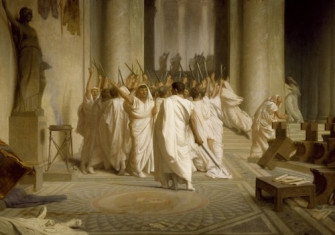
Traina starts in medias res, with Caesar’s planned Eastern campaign. The expedition was to venture along the Danube and pacify the region, then continue east to Parthia in what was intended to be a decisive confrontation. The assassins disrupted these plans. For Traina, it is fundamental that Caesar’s Eastern invasion was not some egomaniacal effort to imitate the exploits of Alexander the Great. Nor was it merely revenge for the Parthian victory at the Battle of Carrhae. Instead, it was grand strategy of the highest order.
One of the strengths of Traina’s vision is to treat the Balkan theatre as central rather than an afterthought. The region abounded in natural resources. It had dangerously easy access to Italy. It was the home of an increasingly unified, hostile, and technologically sophisticated polity that posed a geopolitical threat. Here, Traina has the benefit of much historical hindsight – already in the first century BC, the Balkans were a ‘powder keg’. It is no accident that the contest between the triumvirs and the ‘liberators’ (or assassins, if you prefer) was settled on a battlefield in northern Greece. For Traina the geography is a reminder that these were not just factional civil wars. The eastern Mediterranean had much at stake. The eventual victory of Caesar’s side allowed his grand geopolitical strategy to resume. Octavian would eventually focus on Illyricum, Antony on Egypt and the East. Traina sees Antony’s work in the East as traditional Roman policy. If Potter would have us see Caesar and Cleopatra as a story of inconvenient but very real attraction, Traina sees Antony’s approach first and foremost as a matter of sound politics.
Traina tells us that ‘it must always be kept in mind that friendly kingdoms had lives of their own and were not mere pawns in the game of Roman politics’. Alas, this point is so compelling that The Roman World War is a victim of its own success. It hardly takes its focus off the celebrities of Greco-Roman historiography, which leaves us wanting much more from the perspective of those on the edges of Roman power. The family of Antipater and Herod are a fascinating case in point – they flit in and out of the book, but we never quite see the world through their eyes. What was life like for Herod’s sons, educated in elite fashion in Rome? How did someone like Juba II, king of Mauretania, married to the daughter of Antony and Cleopatra, see the events unfolding around him?
I have posed these questions from the perspective of men, but Caitlin Gillespie’s Livia: Mother of Rome is a reminder of what a limited perspective that is, for this period especially. Her biography takes us forward into the early Principate, though it overlaps with events covered by Potter and Traina.
Livia – wife of the first emperor, mother of the second – is a symbol for her unsettled times. Her father sided with the ‘liberators’. So did her luckless first husband, Tiberius Claudius Nero, who then changed his allegiance to Antony. He survived and ended up back in Rome, only for Octavian to fall in love with his wife. Octavian was married to Scribonia at the time; Livia was already pregnant with Nero’s second son. No matter. They each divorced in order to marry. Livia would then spend six decades at the centre of power politics, but there was no name for her position. That did little to slow down one of the most remarkable figures in Roman history. Gillespie (taking advantage of previous scholarship such as Anthony Barrett’s biography of Livia) nimbly sorts through the extreme contradictions we face in the surviving source material. Either Livia was an overbearing schemer with a penchant for orchestrating murder, or a ‘quasi-divine, perfect specimen of Roman womanhood’. Gillespie gives an empathetic view of Livia’s inner life, including her personal interests (gardening, for example).
The image of Livia as a paragon of female virtue was carefully crafted. The political stakes were high. The marriage of Octavian and Livia was supposed to be a reflection of their commitment to traditional Roman ways, a pointed contrast to the besotted Antony and his Egyptian queen. This was good training for Livia, since private life and public life would remain hard to separate.
Livia was born in 59 BC in the chaos of the late Republic, but she helped build the stable world of the early Empire. Hers is a story of court politics, always shrouded in rumour and innuendo. We graduate from Cicero and Caesar to Tacitus and Suetonius. Gillespie gives us rich accounts of Livia’s relationships with Octavia, Julia the Elder, and Julia the Younger, as well as a memorable picture of her marriage to Octavian/Augustus. Born in passion, it was also enduring, and seems to have been genuinely affectionate (so far as we can understand anything about their true feelings). So much of Livia’s life was unexpected. The great irony is that her lack of children with Augustus was the central problem of dynasty-building, and yet it was Livia who secured the dynasty. She had a surviving son, Tiberius, and although her relationship with him was as troubled as the man himself, she smoothed the succession and enabled the Principate to survive.
We live in a world where authoritarian populism hangs like a spectre over our politics, where the old geopolitical order is breaking up, and where family dynasties are as powerful as ever. It would be nice if the end of the Roman Republic did not feel so relevant. Meanwhile we can appreciate fresh explorations that approach antiquity on its own terms, letting the ancients speak all the more profoundly to us.
-
Master of Rome: A Life of Julius Caesar
David Potter
Oxford University Press, 400pp, £22.99
Buy from bookshop.org (affiliate link)
-
The Roman World War: From the Ides of March to Cleopatra’s Suicide
Giusto Traina, translated by Malcolm DeBevoise
Princeton University Press, 248pp, £30
Buy from bookshop.org (affiliate link)
-
Livia: Mother of Rome
Caitlin C. Gillespie
Yale University Press, 240pp, £20
Buy from bookshop.org (affiliate link)
Kyle Harper is the G.T. and Libby Blankenship Chair in the History of Liberty at the University of Oklahoma.