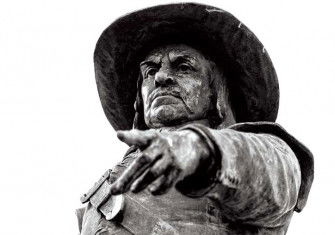
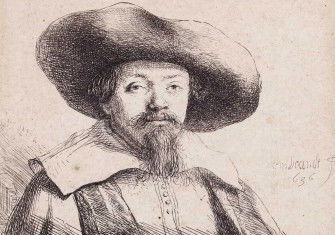
In a humorous nod to 1066 and All That, Miranda Malins tells us that Thomas Cromwell’s reputation had been good and then bad while Oliver Cromwell’s reputation had been bad and then good. Here she makes a case for the Cromwells as the architects of English statehood and British imperialism, great men who forged the Protestant Church, the constitutional monarchy, and ideas of liberty which ‘reached into every corner of the world’. They were two of England’s most influential commoners, who rose from ordinary backgrounds to remarkable positions of power changing Britain forever in the process.
These bold claims are fully justified in this wide ranging and deeply researched book on the Cromwell family. Thomas and Oliver are compared and contrasted throughout in chapters charting their early lives, paths to power, family and home lives, use of art, heraldry, and ceremony to reinforce their status respectively as earl or lord protector, and their posthumous reputations. Malins not only explores the historical contexts in which the two men operated, but also fleshes out the history of the generations in between. Anyone who has ever wondered about the precise relationship between the two protagonists will discover that Oliver was the great-great-great nephew of Thomas.
Before the publication of Hilary Mantel’s Wolf Hall trilogy and Mark Rylance’s sympathetic television portrayal of him, Thomas Cromwell had little public recognition. To generations of history students he was simply the bureaucratic agent of Geoffrey Elton’s Tudor Revolution: Henry VIII’s obedient right-hand man, who used Parliament, the Reformation, and departmental reforms to strengthen royal authority. His role in the execution of Anne Boleyn and his elevation as earl of Essex created powerful enemies, who were not slow to pounce when he was blamed for Henry’s disastrous marriage to Anne of Cleves. His execution as a traitor and heretic in 1540 left his closest male relatives, his son Gregory and nephew Richard, vulnerable and exposed. However, both men survived the wreckage and founded the two distinct branches of the Cromwell dynasty whose fortunes are followed in this book.
In contrast, Oliver Cromwell’s achievement of being a king ‘in all but name’ has meant that he has never fallen far from public consciousness. In 2000 he ranked at number ten in a public vote of greatest Britons but, as Malins tells us, in 2025 he placed almost last in a YouGov vote on the popularity of British monarchs. Oliver’s demotion could be attributed to growing awareness of his brutal campaigns in Ireland, which are briefly discussed here. Before the outbreak of civil war in 1642, his fortunes were fairly bleak. His father was a younger son without much inheritance, who died at an early age, leaving Oliver to care for his mother and no fewer than seven sisters. As a minor gentleman and backbench MP, Oliver did not make much impact on the political scene until he emerged as an effective military leader and strategist in Parliament’s fight against Charles I in the 1640s.
Oliver’s position as a leading general and later as commander-in-chief of the New Model Army from 1650 gave him a remarkable power base which, as Malins demonstrates, allowed him to dominate key political decisions including the execution of the king, the adoption of two written constitutions, and the assumption of power as lord protector. As the author ably argues, this was not achieved through military might alone, but also through an extraordinary network of kin created by the marriages of his sisters, his cousins, and his aunts, not to mention his four daughters. At least 53 MPs sitting in Parliaments held between 1640 and 1660 were related to Oliver, including his cousins John Hampden and Oliver St John. His eldest daughter, Bridget, married two senior army officers, Henry Ireton (in 1646) and Charles Fleetwood (in 1652), both of whom were instrumental in advising their father-in-law, while her younger sister Elizabeth married another officer, John Claypole. Oliver’s widowed sister, Katherine, married a regicide, John Jones, and, as the eldest of 12 siblings, Oliver’s wife Elizabeth Bourchier added her own impressive tally of relatives to the mix.
The women who married into or who were born into the Cromwell family feature prominently throughout The House of Cromwell. Thomas Cromwell’s daughter-in-law, Elizabeth Seymour, sister of the ill-fated queen Jane, petitioned Henry for pity for her family after Thomas’ execution. Her appeal worked and her husband Gregory was soon made Baron Cromwell. Gregory’s granddaughter, Catherine Cromwell, who married into the prominent Tollemache family of Helmingham in Suffolk in 1580, is introduced as a polymath and early empirical scientist. Oliver’s widow, Elizabeth, tried to rally the family after their son, Richard, had been ousted as Oliver’s successor as lord protector in 1659. In the political vacuum that followed, she wrote to Fleetwood chiding him for inaction and urged him to restore Richard to power. In response to the messenger, her son-in-law lay mute in bed. Bishop Gilbert Burnet later observed of Oliver’s children that ‘those who wore breeches deserved petticoats better; but if those in petticoats had been in breeches they would have held faster’.
Throughout the book, Malins’ handling of the contemporary sources, including state papers and personal letters, is exemplary. She is particularly adept at tracing the complexities of the years between the execution of Charles I in 1649 and the restoration of Charles II in 1660, when Cromwellian supporters fractured into military and civilian factions. Oliver always stood with the parliamentarian army, a tactic which Richard abandoned to his cost. After resigning as lord protector, Richard spent decades in exile only returning to England in his old age. By the early 19th century the name Cromwell had died out in both lines of the family, but as Miranda Malins demonstrates, the House of Cromwell continues to attract debate, admiration, and public attention.
-
The House of Cromwell: Power, Family and the Making of Modern Britain
Miranda Malins
William Collins, 480pp, £25
Buy from bookshop.org (affiliate link)
Jackie Eales is president of the British Association for Local History.