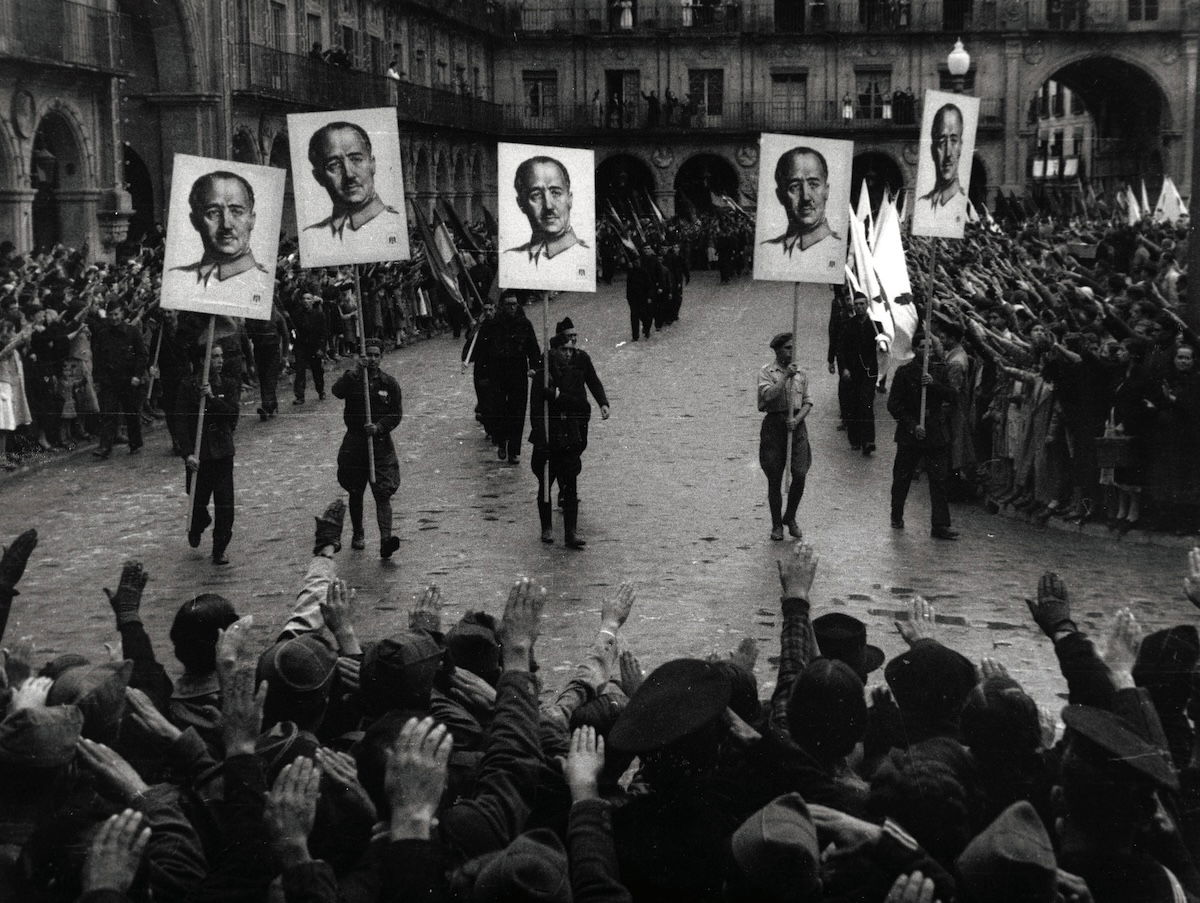
The bloody victor of the Spanish Civil War continues to evoke controversy. When, in 2011, Spain’s Royal Academy of History, under the supervision of a former Franco loyalist, published a dictionary describing Franco as ‘authoritarian, but not a dictator’, the backlash raged for years. The past quarter-century of Spanish public life has been shaped by so-called ‘memory wars’ in which both the intransigent left and right have politicised attempts to identify the mass graves of republican dead and unveil the convenient silence (‘pact of oblivion’) which overlay the latter two-thirds of Spain’s 20th century. Franco’s regime has been presented as authoritarian (Juan Linz), genocidal (Helen Graham), and fascistic in inception (Paul Preston). The regime’s apologists presented the personal rule of Western Europe’s last dictator as developmentalist, providential, even as an ‘organic democracy’. In this biography, Giles Tremlett describes Franco as ‘a giant dam, determined to control the flow of Spanish history’. However, 50 years after his death in November 1975, ‘what surprises is not the size of the dam that was opened after he died, but the ideological emptiness that lay behind it’.
Mediocre, incurious, and obsequious towards his Axis patrons, Franco had none of the charisma of Mussolini or Mao, nor any of the avuncular qualities of the sister regime of Salazar in Portugal. It is faint praise to rate him less fanatically murderous than Adolf Hitler, or less tyrannically ruthless than Joseph Stalin (even though Franco possessed as much internal power as Europe’s bloodiest totalitarians). Tremlett’s Franco is a cautious, ambitious, and unthinkingly authoritarian man, youthfully brave in Spanish Morocco, callously attritional in middle age leading the rebels to victory in the Spanish Civil War (1936-39), and vindictive and shifty in the grey areas of politics thereafter. Unrivalled at dividing and ruling allies and enemies alike, he was also prone to delusions which only his peculiar luck prevented from unravelling his regime at home and abroad.
Tremlett explains Franco’s formative years without imposing 21st-century psychology on the patriarchal norms and family hypocrisies of 1890s Spain. He was born to a doting mother and a wayward (later estranged) father in Ferrol, a Galician port city where the navy was everything in a Spain where it was nothing. Franco’s childhood was forged by the upheavals of the turn of the century. The loss of Spain’s major colonies in the war of 1898 fired up a generation of army officers determined to restore national honour in new campaigns to extend Spanish control over the northern part of Morocco. Like so many of his generation, Franco believed in ill-focused national ‘regeneration’ – and in the responsibility of the army to achieve it. As a young officer Franco excelled. Despite his social awkwardness, he married into a higher social rank in 1917. His subordinates and officer comrades respected his battlefield bravery and at 31 Franco became Europe’s youngest general since Napoleon. The Second Republic (1931-36) alienated his naturally conservative and Catholic instincts. But unlike other leading army plotters (Sanjurjo, Mola, Queipo de Llano, et al.) Franco was politically malleable. He was neither too monarchical, nor too Carlist, nor too fascist, nor too republican: these factors as much as his command of elite troops in Spanish Morocco made him Generalísimo ten weeks into the Civil War. In addition to his clever operations marching on Madrid in October 1936 and his direct diplomacy with Hitler, Franco was a soldier’s soldier who divided right-wingers the least. But neither his allies nor his enemies imagined that the five-feet-four-inch Galician would remain in power for half a century.
After the victory of 1939 Tremlett takes us into the well-trodden ground of postwar Spain. Believing until incredibly late in the Second World War that an Axis victory was likely, Franco was too slow in reverting from non-belligerent to neutral status. He aggravated his regime’s postwar isolation by imposing self-defeating economic autarky and indulging the corruption of his subordinates. Another 50-or-so pages on the post-1939 era would have improved Tremlett’s analysis. More could have been made of the ravages of the developmentalist frenzy of the 1940s and 1950s, including hydrology, irrigation, and resettlement schemes. The diplomatic context is largely Eurocentric: not much is made of Franco’s unusually good relations with the Arab world, or the integrist links with Latin America.
The economic impact of world trade and tourism is better handled. Once liberalisation finally improved the economy after 1959 Franco’s regime took the credit, in a similar way to the post-Cold War Chinese Communist Party after the horrors of Maoism. Youth revolt, European cultural norms, and the defection of the Catholic Church all frayed the dictatorship in its final years. But the failure of internal and external opposition to unite, combined with the dreary apoliticism which the regime had drummed into the masses, meant that Franco died a natural death in November 1975 – a remarkable achievement for one of Europe’s nastiest dictators.
Given Franco’s remarkable agency throughout his reign, one is given to ponder the ‘what ifs’ implicit in Tremlett’s account. What if Franco’s stomach wound in 1916 had proved fatal? What if his feet had stayed cold in the army plot of 1936? What if he had joined the Axis in 1940 and suffered Allied invasion as a consequence? Or, even more radically, what if he had dared to break with the Axis in the final weeks of the 1945 campaign in Western Europe and declared war on the Nazis, thereby accruing to his regime something of the cheap economic and geostrategic benefits that the left-authoritarian Cárdenas regime of Mexico enjoyed in its symbolic war with Japan? In a biography as agentic as Tremlett’s, one is given to wonder about Spanish history’s many glaring counterfactuals.
- El Generalísimo: Franco: Power, Violence and the Quest for Greatness
Giles Tremlett
Bloomsbury, 528pp, £30
Buy from bookshop.org (affiliate link)
Mark Lawrence is Senior Lecturer in Military History at the University of Kent.