On 8 January 1981 Isabel Allende was living in Venezuela when she learned that her grandfather was dying. A cousin of Chile’s deposed president Salvador Allende, she had been forced to flee her native country almost six years earlier, after criticising the military junta headed by General Augusto Pinochet, and had been in exile ever since. She had already sacrificed a great deal. The thought that she might now be robbed of her dear ‘Tata’ was almost too much to bear. Since she could not go to visit him in Santiago, she settled down at the table her grandmother had used for seances, took out her typewriter, and began writing him a letter. She felt as if she had suddenly unwound a ball of yarn. Words poured onto the page, conjuring up memories of the loved ones she had lost and the country she had left behind. She could not stop. Within a year the sprawling, unstructured letter had grown to become a spectacular 500-page novel. Published in Barcelona as The House of the Spirits, it was immediately recognised as a masterpiece of Latin American literature and catapulted her to international stardom.
Register to read more articles for free.
When you register, you will receive the History Today newsletter. Click here to read our Terms of Use.
On 8 January 1981 Isabel Allende was living in Venezuela when she learned that her grandfather was dying. A cousin of Chile’s deposed president Salvador Allende, she had been forced to flee her native country almost six years earlier, after criticising the military junta headed by General Augusto Pinochet, and had been in exile ever since. She had already sacrificed a great deal. The thought that she might now be robbed of her dear ‘Tata’ was almost too much to bear. Since she could not go to visit him in Santiago, she settled down at the table her grandmother had used for seances, took out her typewriter, and began writing him a letter. She felt as if she had suddenly unwound a ball of yarn. Words poured onto the page, conjuring up memories of the loved ones she had lost and the country she had left behind. She could not stop. Within a year the sprawling, unstructured letter had grown to become a spectacular 500-page novel. Published in Barcelona as The House of the Spirits, it was immediately recognised as a masterpiece of Latin American literature and catapulted her to international stardom.
Chilean spirits
It is, above all, a family story. Blending the supernatural with the real, it follows the fortunes of the Trueba family across four generations as its various members attempt to navigate political and socio-economic upheaval. Understandably, many of its characters are based on Allende’s own relations and its dramas fictionalise struggles she had experienced. Clara del Valle is modelled on her grandmother, Isabel Barros Morira; while her depiction of Clara’s husband, Esteban Trueba – the family patriarch – most likely owes something to her father’s abandonment of her mother while she was still a child. It is even possible that the molestation of Esteban’s granddaughter, Alba, by her illegitimate half-uncle may reflect the abuse the eight-year-old Allende suffered at the hands of a fisherman.
The novel’s setting is deliberately left open. ‘I prefer the ambiguity of an unnamed place and an undetermined time’, she later explained. ‘It gives me a sort of mythical or legendary tone.’ But there is no doubt that, beneath the layers of magical realism, it is a portrait of Chile’s recent history. Of course, this is not to say that Allende meant it to be a perfect representation of the past. It makes no pretence at verisimilitude and simplifies the country’s winding trajectory. Nor does it present the past in the same way as most contemporary historians. Like almost all of Allende’s books, it is narrated from a woman’s perspective (the novel is notionally written by Alba from Clara’s notebooks); and it accords far more attention to the fate of mestizo peasants than was then customary even in literary works.
It is, nevertheless, populated with figures whom any Chilean would recognise. The socialist balladeer Víctor Jara, tortured and killed by Pinochet’s soldiers, appears as the musical Pedro Tercero García; Pablo Neruda, who died just days after the coup, is the Poet; and Salvador Allende, of course, is the Candidate/President. To emphasise the latter’s identity, Allende even gave her character the same farewell speech she had heard her cousin deliver over a crackling radio while he was under siege in the presidential palace years before.
Most of all, however, The House of the Spirits is an attempt to answer a fundamental question. A little over a decade earlier, the Peruvian author Mario Vargas Llosa began his novel Conversations in The Cathedral (1969) by asking: ‘At what point did Peru get fucked up?’ Allende set out to answer the same for Chile. How, in short, did Pinochet’s dictatorship happen?
Marx and magical realism
The novel’s answer at first seems straightforward. As Christopher Hitchens rightly noted, Allende’s magical realism is fused with the Marxism of her famous relative – and much of the narrative seems to explain the country’s descent into tyranny in terms of class struggle. Esteban Trueba represents the dominance of Chile’s landowning class. After the death of the green-haired Rosa, whom he had been hoping to marry, he devotes himself to developing his family estate at Las Tres Marías. He is enterprising, energetic, and resourceful – and soon turns it into a tremendously profitable concern. He builds homes for his mestizo tenants, establishes a school for their children, and provides for their welfare. But he is also a brutal and violent man, who never hesitates to exact what he perceives to be his seigneurial rights. He rapes several young women and fathers a legion of children – including Esteban García – in whom he shows little, if any, interest. Even his marriage to Rosa’s sister, Clara, does not seem to deter him.
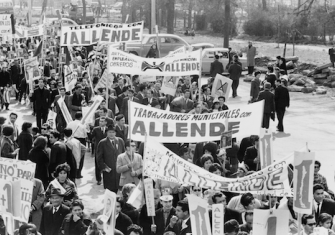
A march in support of the election of Salvador Allende for president in Santiago, James N. Wallace, 5 September 1964. Library of Congress. Public Domain.
Trueba’s brutality leads to the eruption of social conflict. When his foreman’s son, Pedro Tercero García, begins distributing socialist literature on the estate, Trueba banishes him, only to discover that his own daughter, Blanca, has fallen in love with the ragged songster. Furious, Trueba resolves to kill Tercero, but only succeeds in chopping off three of his fingers – and, to mitigate his daughter’s shame, he marries her off to a perverted French count. Rather than resolving tensions, however, this only increases the resentment against Trueba – soon to become a senator – and stores up further trouble for the future. The conflict even spreads to his own family. While he rages against socialism, his son Jaime becomes a doctor and devotes himself to ministering to the poor, while Blanca’s daughter, Alba, becomes a socialist sympathiser.
The House of Spirits does not pretend that class struggle was the only reason for Chile’s ills, of course. Nor, indeed, does it pretend that Allende’s cousin, the deposed president, was entirely innocent. It strongly suggests that political collapse was hastened by the agrarian reforms enacted by Salvador Allende’s Popular Unity government. As Allende later recognised in her memoir My Invented Country (2003), this attempt to confiscate private estates and redistribute the land to peasants was a disaster. In the novel, this single event radicalises Trueba even further, and – as shortages sweep the country – persuades him that only a military coup can restore order.
At root, however, Allende’s novel suggests that Chile’s suffering was the result of blindness. Trueba’s wife, Clara, is part Cassandra, part Delphic Oracle. Able to communicate with the ghosts and spirits that inhabit her home, she conveys prophecies to her husband which he either ignores or fails to understand. When she tells him that ‘those who have always won will win again’ in the lead-up to an election, he fails to realise that victory will only come at a price, and that a more conciliatory approach to political questions might be needed.
It is this same naivety that ultimately ensures the transition to dictatorship. Whereas Trueba sees the military as a temporary means of overcoming the socialist ‘threat’, it quickly becomes clear that its leaders see the junta as an end in itself. And when Trueba and his family suffer along with everyone else, he has only himself to blame. He created the horrors which follow. After humiliating and scorning his bastard son, Esteban García, throughout his childhood, Trueba eventually agrees to help find him a position in the police. And in the end, it is Esteban García who captures, rapes, and tortures the senator’s granddaughter, Alba – symbolically closing the cycle of violence which began with Trueba’s rape of his mother, Pancha García, all those years ago.
Inherent violence
Allende has continued to explore these themes across her long and prolific career. After the tremendous success of The House of the Spirits she embarked on Of Love and Shadows (1984), which further explores the brutality of the regime, the blind complicity of the social elites, and the persecution of indigenous peoples. Especially after her emigration to the United States, however, her work has begun to reveal a growing sense that there is nothing particularly unique about Chile’s recent travails. Although Pinochet’s dictatorship was, of course, specific, he was representative of a tendency that was somehow inscribed in Chile’s history from the very beginning. In Inés of My Soul (2006), for example, Allende uses a fictional recreation of the life of the Spanish conquistadora Inés Suárez (c.1507-80) to contrast her heroine’s search for freedom with the oppression inherent in Spanish colonialism.
Nor, indeed, is there anything unusual about Chile’s past. In Eva Luna (1987) – which, despite some similarities with Chile, appears to be more closely modelled on Venezuelan society – Allende indicates that women have always faced oppression and mistreatment in South America’s machismo-ridden societies, even during the sexual revolution of the 1960s and 1970s.
Haunted Chile
So what hope is there for the future? Allende’s novels offer no clear answer. In The House of the Spirits there is a strong sense of doubt. When Alba discovers she is pregnant after being freed from prison, she is uncertain whether her child is the product of her affair with Miguel, a socialist agitator, or Esteban García, the incarnation of the military dictatorship, leaving open the possibility that the next generation, that is to say, today’s generation, could go either way. In Of Love and Shadows Allende is marginally more optimistic. In the final passages, her two central characters, forced – like her – into exile abroad, swear that they will one day return. And in Daughter of Fortune (1998) there is even a hint that true freedom lies abroad, in the US. The only certainty is that the past is always with us. It haunts us like ghosts. It torments us like demons. And the only way to exorcise them is through stories. Or rather, histories.
Born2 August 1942, Lima, Peru
Notable worksThe House of Spirits (1982) | Of Love and Shadows (1984) | My Invented Country (2003)
Alexander Lee is a fellow in the Centre for the Study of the Renaissance at the University of Warwick.