

The Men Who Foiled Fawkes
Much has been written about Guy Fawkes, but less well-known are the two figures who apprehended him in Parliament's cellars.
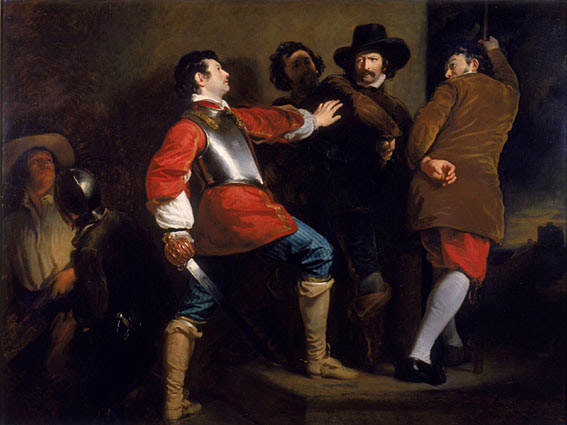
Sir Thomas Knyvett (c.1545-1622), the keeper of the Palace of Westminster, encountered Fawkes as the latter was about to leave the cellars, and thinking his presence suspicious sent him upstairs (presumably under armed guard) while he and his sidekick Edmund Doubleday (c.1564-1620) continued the search. Before long, however, they heard a noise from above, and Doubleday was sent to investigate. Finding the source of the commotion to be Fawkes, Doubleday demanded 'to search or see what books or instruments Fawkes had about him'. Fawkes was naturally unwilling to be frisked, and 'very violently gripped Master Doubleday by his fingers of his left hand', whereupon Doubleday instinctively reached for his dagger. In the event, though, Fawkes was overpowered rather than stabbed, and tied up with a pair of his own garters.
By the time of the Gunpowder Plot, the sixty-year-old Knyvett and his junior colleague Doubleday were all but inseparable, but they were men of markedly different backgrounds. Knyvett was the son of a well-to-do Wiltshire gentleman, and devoted his career to royal service. Starting out as a groom of the chamber to Queen Elizabeth, he rose to become keeper of both Whitehall and Westminster palaces during the 1580s and warden of the Mint in 1599. He also sat in seven parliaments, six of them for the borough of Westminster. Following the accession of James I, he continued to be held in high esteem, for in June 1605 he and his wife were entrusted with the care of the King's short-lived daughter, Princess Mary. He subsequently entered the service of James's queen, Anne of Denmark, perhaps on the recommendation of a leading member of her household, the Countess of Suffolk, who happened to be Knyvett's niece.
Doubleday, by contrast, was the son of an obscure London haberdasher, and initially earned a living as a scrivener. A 'tall, proper man', he married four times and fathered no fewer than eighteen children. By marriage he acquired several properties in Westminster, including the inn known as the Saracen's Head in King Street, and by the 1590s was a key figure in the administration of St. Margaret's parish. Determined to better himself still further, in 1598 he entered the Middle Temple, qualifying ten years later as a barrister.
Knyvett and Doubleday probably first encountered each other during the early 1590s; both men owned houses in King Street, Westminster, and in 1591 Doubleday bought some land in the parish of St. Martinin-the-Relds from Knyvett. However, their professional careers did not overlap until 1601, when Doubleday was appointed joint teller of the Mint. As Knyvett was by then already warden of the mint, it seems likely that Doubleday owed his preferment to his King Street neighbour. Over the next few years Knyvett conducted an acrimonious feud with the elderly master of the mint, Sir Richard Martyn, whom he accused of incompetence. In this dispute Martyn regarded Doubleday as Knyvett's ally, and when, in 1606, he retaliated by challenging Knyvett's accounts he pointed a finger of blame at Doubleday. It must also have been to Knyvett that Doubleday owed his appointment as co-librarian at Whitehall in 1604.
Following the Gunpowder Plot Knyvett and Doubleday continued to work in harness. Indeed, in 1609 Knyvett, then in his early sixties, decided to share the wardenship of the mint with his protégé. However, only Knyvett received formal recognition for helping to thwart the plotters, being elevated to the peerage in July 1607 as Baron Knyvett of Escrick. Doubleday went on to represent the borough ofWestminster in the Parliament of 1614, thus following in the footsteps of his mentor. Re-elected in December 1620, he died before he could take his seat, and was followed to the grave nineteenth months later by Knyvett, who was buried in the parish church of Stanwell, Middlesex, where a life-size effigy adorns his marble tomb. No monument exists to Edmund Doubleday, but he was singled out for praise by the seventeenth-century clergyman Thomas Fuller, who included a brief entry on him in his great work, The Worthies of England, published in 1662.
This is an abridged and adapted version of draft articles written for the 1604-29 House of Commons section of the History of Parliament by Andrew Thrush.

