Pete Hegseth, self-styled US secretary of war, has repeatedly depicted the current conflict in the Middle East as a religious one. Back in 2020, in his book American Crusade: Our Fight to Stay Free, he called for a ‘360-degree holy war for the righteous cause of human freedom’. This war, he asserted, needed to be fought against the woke left internally, but against Islam externally. The two complementary threats were conflated, because Islamic infiltration of Christendom was taking place under a woke aegis. In 1095 Pope Urban II had acted against the existential menace of Islam by proclaiming the First Crusade: ‘Enjoy Western civilization? Justice? Freedom under the law? Thank a crusader.’ They are all consequences of the Christian triumphs over Islam in the 11th and 12th centuries. The medieval crusading spirit whence they flow needs now to be rekindled against the renewed Islamic threat.
On 25 March this year, in a religious service held in the Pentagon, Hegseth prayed that ‘every round’ fired by US forces should ‘find its mark’ against ‘the enemies of righteousness and our great nation’, and for ‘justice’ to be ‘executed swiftly and without remorse’. His many tattoos, often proudly on show, include an enormous crusader cross on his right breast, and the supposed crusader battle cry ‘Deus vult’ (attributed by him to Urban II) on his right bicep. He imputed to God the ‘glory’ of the ‘victory’ he declared in the first week of the Iranian campaign, though he acknowledged that contemporary American crusaders deserved ‘the credit’. In his view, then, a Christian holy war is one divinely sanctioned in defence of conflated religious and secular values. He is not concerned with spiritual rewards: he ignores the fact that crusading was by definition spiritually meritorious, so meritorious that becoming a crusader might secure the remission of all one’s sins.
Vice President Vance is sometimes judged to agree with Hegseth, but his position is different. Not unlike his colleague, he has talked in general terms of ‘MAGA revenge’ as a ‘crusade’; but he refers to the conflict in the Middle East as a just war, not a holy one. All Christian holy wars have to be just, but not all just wars are holy. Just war may be a necessity in a fallen world. Though necessary, the warfare cannot be other than sinful. By contrast, holy war can be so meritorious that waging it will, in itself, save the warrior’s soul.
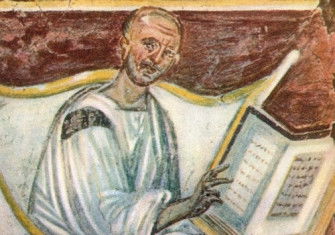
The greatest Christian theorist of just violence remains St Augustine of Hippo. He identified three essential criteria, which may be summarised thus: 1. a just cause, which meant a proportionate response to unprovoked attack; 2. legitimate authorisation of that defensive response; and 3. pure intentions on the part of those perpetrating the violence – they must not be motivated by greed or hatred, but ultimately by obedience to authority and by love even of their enemies, as well as of their friends.
Vance is a great admirer of Augustine. In a long account of his conversion to Catholicism, published in 2020, he revealed that he had become ‘a fan’ when he was made to read The City of God while studying political science at Ohio State University. He went so far as to say that the book includes ‘the best criticism of our modern age I’d ever read’. He chose Augustine as his patron saint, that is to say, his special intercessor and spiritual guide. And when he was granted an audience by the new pope, he presented Leo with copies of two works by Augustine: City of God and On Christian Doctrine – a curious choice of gifts for any pope, especially the first pope to be a member of the Order of St Augustine. At Palm Sunday mass this year, the pope preached ‘Jesus does not listen to the prayers of those who wage war, but rejects them’, and later declared ‘truly unacceptable’ President Trump’s threat, issued on 7 April, that ‘a whole civilization will die tonight [in Iran]’. Vance responded to Leo: ‘There is more than a thousand-year tradition of [Christian] just war theory.’ He conceded that views might differ ‘about whether this or that conflict is just’, but added: ‘I think it is very, very important for the pope to be careful when he talks about matters of theology.’ As he should have known from his own reading of City of God and other works by Augustine – the Treatise on the Sermon on the Mount is particularly important – the pope was being very precise in his application of Augustinian doctrine to the current international situation. There might be disagreement about whether the war was just, but there could be none about the flagrant breach of several of the Augustinian criteria. Vance advised elsewhere that the pope ‘should stick to matters of morality’. Leo might have answered that that was exactly what he was doing, and that morality must have theological underpinning.
It is striking that 1,600 years after Augustine wrote, the US vice president and the pope are publicly disagreeing about the application of his doctrine of just war to current events. It is even more remarkable that the secretary of war should term the conflict with Iran a crusade. He appears not to have learnt from the unhappy consequences of President George W. Bush characterising the invasion of Iraq thus in 2003, a comment which proved a gift to Islamist propagandists. But six years after Hegseth published his book, he has been able to take the lead in responding to the call to arms he issued in it: its concluding chapter is titled ‘Make the Crusade Great Again’.
George Garnett is Professor of Medieval History and Fellow of St Hugh’s College at the University of Oxford.