

The King on the Scaffold
Kay Staniland discusses the authenticity of the 'ghastly' relics claiming to have originated from Charles I's execution.
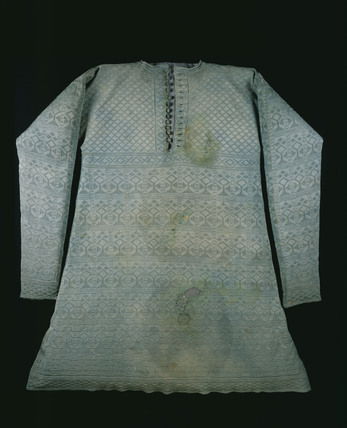
Of the wide range of royal personalia scattered throughout public and private collections, the most poignant items must be those pieces of clothing gathered in the wake of Charles I's execution in Whitehall in 1649. These were treasured possessions in royalist families, passed from generation to generation. Some seem to have disappeared even in the last hundred years, while others have remained hidden from public view, displayed only infrequently, if ever. Many are little known to historians, even to biographers of Charles I. If genuine, however, these royal relics are the sole survivors of that cold January day in 1649 when English history took such a dramatic turn.
The execution following the King's trial took place on a temporary scaffold erected outside the Banqueting House in Whitehall, at first floor level. A huge crowd gathered to witness the event, but they would have seen little or nothing in detail, so high was the scaffold, and so solid the phalanx of troops stationed around it. At the time it was reported that spectators dipped their hand- kerchiefs in the blood spilled on the scaffold and a number of stained examples exist claiming to be these. Analysis shows that the stains are in fact iron mould from deposits of iron in the washing water rather than from blood. Nevertheless, owners of these relics are often loath to bow to scientific or historical certainty.
A more intimate relic of the martyr-king is the knitted silk 'vest' in the Museum of London, acquired from a collector in 1925 together with its documentation. The stains on the front are believed to be blood, but forensic tests in the 1950s and 1980s failed to prove this conclusively. Exposure to light, and possibly washing, have weakened and faded the structure of the fibres beneath the stains. Further tests would require such unacceptably large portions to be removed from the garment that it is unlikely that further research will be pursued until more refined methods can be developed.
There is no question that the 'vest' is a genuine mid-seventeenth- century garment, rare and originally probably rather expensive. It could certainly have belonged to Charles I. The correct contemporary term for it was probably 'wastcoat' and several similar finely handknitted examples are known. The royal clothing accounts of the 1630s show that 'fine silke wastcoats’ were supplied for the King by the merchant Thomas Robinson, alongside royal ‘silke hose’ and ‘tennis sockes’ and it is possible that these ‘wastcoats’ were also knitted. They were presumably worn next to the skin, under a linen shirt, and consequently do not appear in any portraits. The ‘vest’ was handed down in the family of the King’s physician Dr Hobbes, one of the small group of loyal retainers who were with Charles at his death; it is likely he acquired it whilst preparing the body for burial, and that the rest of the clothes removed from the royal body likewise became cherished relics. But what were these?
Thomas Herbert, the King’s attendant during his last two years, describes in his memoir of 1678 how, on rising on the morning of January 30th, 1649, his master,
...appointed what Cloaths he would wear; ‘Let me have a Shirt on more than ordinary,’ said the King, ‘by reason the season is so sharp as probably may make me shake, which some Observers will imagine proceeds from fear. I would have no such Imputation. I fear not Death!’
At least two linen shirts have been associated with the execution; so too has a satin doublet. Did the King wear all these on the scaffold? The doublet is at Longleat and is close-fitting with buttons down the front and long sleeves buttoned at the cuff. Believed to have been handed down from William Seymour, another of the King’s loyal courtiers, it has what are claimed to be bloodstains around the neck and seems rather neatly to match the description in William Sanderson’s Compleat History of the Life and Raigne of King Charles of 1658, of the King just prior to his beheading ‘unclothed... to his Sky-colour Satten Wastecoat’. Did Sanderson actually witness the execution, or draw his information from an eye-witness?
One of the linen shirts (now in the Royal Library) can be discounted immediately, as recent examination has revealed that it is a woman’s chemise of the second half of the century. It is not in the least like a man’s shirt of 1649, and indeed is probably not English. Like the handkerchiefs, it too has a spattering of ‘bloodstains’ which are more likely to be iron mould deposited by washing water. Believing this to be an authentic relic, Edward VII purchased the shirt from its owners in 1907. By family tradition it had been associated with Charles’s Lord Chancellor, Lord Keeper, Thomas Coventry, but it is another victim of the misunderstandings and misattributions attached to objects from the past. The other shirt is the property of Lord Ashburnham, but its authenticity remains to be explored. It was preserved with a pair of silk drawers, a pair of garters, a sheet (said to have been thrown over the royal corpse after the execution), a watch and a lock of the King’s hair.
Thomas Herbert accompanied the King to the Banqueting House but he could not bring himself to be present on the scaffold. The King’s long hair needed to be contained under a cap so that it did not get in the way of the executioner’s axe. Therefore ‘the King had ordered [Herbert] to have a White Satin Night-Cap ready’. Herbert gave the night-cap to Bishop Juxon who handed it to the King when he needed it. There are several embroidered night-caps which have been claimed to have been worn on the scaffold. Since none of them accurately match Herbert’s description they must be discounted as genuine relics, though this does not necessarily disprove all association with the King himself.
Many relics remain that are associated with the King’s death. He is recorded as having given a number of small mementos to the companions of his last days, in addition to those he entrusted to Thomas Herbert to give to his children. It is highly likely that some of these relics are not genuine. They include several pairs of gloves (at least two pairs said to have been given by the King on the scaffold to Bishop Juxon), a silver tissue scarf and remnants of a cloak. The King's outerwear on the scaffold is never described. Portraits, records and descriptions confirm that he wore rich and fashionable dress in the earlier days of his reign, in keeping with his status. His personal taste is said to have been modest and by his last years it is likely that his wardrobe became more sombre. For his trial he apparently opted to wear black, relieved only by fine white lace, the blue of his Garter ribbon and the sparkle of the George suspended from it. A different personality might have chosen to cut a glittering regal figure in his last moments, to remind those present of his annointed God-given position. But it seems likely that Charles selected the black of mourning to underline his plight. It is tempting to see the white night-cap as a further intentional symbol of his innocence.
By the late nineteenth century a considerable interest in royal relics such as these had developed, fuelled by exhibitions, articles in contemporary magazines and newspapers (many relics associated with Charles I are mentioned which cannot be located today) and by items which passed through the salerooms. The knitted silk 'vest' sold in 1898 for 200 guineas (£210), 'not an exhorbitant price', one writer thought at the time, for 'a relic at once authentic and ghastly'. This 'combination of Royal associations with gruesome memories' would prove 'quite irresistable', he continued, should the garment again appear on the market. It did, in 1910, changing hands for the same price.
None of the paintings or engravings of the execution are thought to be by eye-witnesses, and they are full of inaccuracies. Their purpose was more iconographic than documentational. More macabre are a number of portraits of the King as he is said to have appeared just before, or just after, his death one example even shows his head stitched back to his trunk. All present him wearing a light coloured night-cap and an ill- defined light blue upper garment, and all are by anonymous and not overly competent artists. These images nevertheless constitute intriguing icons which deserve serious attention by scholars.
A clear picture of the King on the scaffold remains elusive and, certainly, the known collection of assorted garments does not add up to a particularly convincing ensemble. Some will not welcome the close scrutiny necessary to establish the authenticity of these 'ghastly' relics. But such intriguing minor memorials deserve proper attention to ensure their correct place in the historical record. 'Certainly', wrote William Sanderson in 1658, 'there were vary many such that coveted any thing as a Relique which evidenced his Martyrdom as they esteemed it'. Let us be certain that, 350 years later, we are esteeming genuine relics.
Kay Staniland was until recently Curator of Costumes and Textiles at the Museum of London.

