John Bull Spirit
The rise of UKIP has spread panic among Britain’s political establishment. But there is nothing new about populist movements, as David Nash reveals in this profile of the newspaper proprietor Horatio Bottomley.
The recent rise of UKIP, with its claim to break the mould of British politics, is a reminder of those occasions when a self-proclaimed challenge to the traditional political system has taken centre stage, usually in the wake of the conventional arrangement suffering strain and distortion. These challenges have only been able to make an impact because they tap into populist feelings and sentiments. Such interventions depend on ‘instinctive’ values and enter political rhetoric because they appeal to not entirely rational sentiments, which are ‘felt’ more readily than they are understood. The skill to evoke these feelings relies upon the power of charismatic personalities, who serve to embody such feelings and provoke intense public sympathy through their compelling media presence. In our own time Nigel Farage, the UKIP leader, has captured the public mood by appealing to the range of feelings we call ‘popular’. As Farage is quoted as saying: ‘If an idea is indeed sensible, it will eventually become just part of the accepted wisdom.’
Common sense
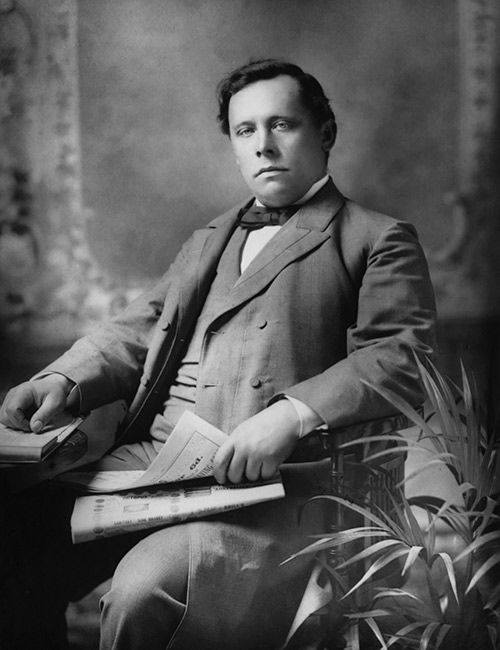
UKIP and Nigel Farage are hardly the first modern manifestations of unashamed populism, with its appeal above traditional politics to ideas of common sense. A century ago the public was enthralled by the remarkably similar ideas and personality of Horatio Bottomley, celebrity, newspaper proprietor, demagogue and politician. Bottomley realised the power of the popular and set about shaping all elements of his personality and media profile to publicise this end.
Bottomley was born in 1860 into a radical family and had the secularist leader G.J. Holyoake as an uncle. He would regularly claim that he was the illegitimate son of Charles Bradlaugh, the secular movement’s greatest leader and the first openly atheist MP. This parentage was plausible since Bottomley bore an uncanny physical resemblance to Bradlaugh, but this was equally indicative of how Bottomley used every opportunity he could to inherit authority and gain people’s support and sympathy. In his written self-portraits (of which there were many) Bottomley claimed to have read in detail the writings of every major thinker of the late 19th century. But, with an eye to his audience, he declared them dry and of little virtue compared to the wider public, with its more straightforward ‘common sense’, a message which went down well. With a further astute eye on public distrust for authority, he likewise declared himself to believe in some of the basics of Christianity, while having no time for organised religion and the established Church.
Bottomley managed to construct for himself a cross-class appeal, which portrayed him as an ambitious individual who had made good in the expansive atmosphere of the ‘naughty nineties’, where fortunes were to be made. He further appealed to populist adulation through his patronage of the turf and legendary taste for champagne. This made him an aspirational fantasy figure for many of his (particularly working-class) readers and he perhaps carried echoes of the larger than life music hall turns Champagne Charlie and Burgundy Benjamin. However, his business dealings were frequently on the wrong side of the law and public knowledge of this dogged him throughout his business career.
Local Parliaments
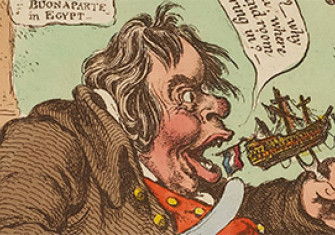
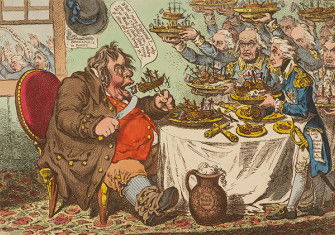
Bottomley’s interest in politics had been nurtured in a number of London debating societies, known as Local Parliaments. Not only did he take part in these, but he also organised their own version of Hansard. At some point in the early years of the 20th century Bottomley hit upon the idea of launching a newspaper, which he entitled John Bull. This tapped into a vast reservoir of popular ideas about the personification of national character, which readers flocked to identify with. The pugnacious, well-fed and ample figure of John Bull graced the cover of every edition. He was frequently to be seen in cartoons pointing out the right course of action to hapless politicians, civil servants and military men, or pricking the consciences of those who had damaged the country in some way. However, in Bottomley’s hands the John Bull character moved on from being a trustworthy caricature to become a full-scale brand, exuding the kind of hearty characteristics the person in the street could trust. Thus the newspaper began by staging ‘catchphrase’ guessing, lotteries and football pool competitions and it even became possible to purchase John Bull writing instruments, take advantage of other special offers and buy sets of John Bull encyclopedias.

A particular feature of John Bull was that its journalism regularly identified those who it claimed were enemies of England, which the character of John Bull disapproved of. Benevolent and beneficial national characteristics were lauded and celebrated often in self-conscious language that would borrow quotes and ideas from the canon of great English poets, from Shakespeare and from the Book of Common Prayer, all calculated to have multiple resonances with the paper’s readership. This Englishness, by default, set these cultural ideas above those of the other nations of Europe and interestingly managed to blot out or overwrite Scottish, Welsh and Irish identities – in John Bull’s hands English quickly became British and stayed that way – much in the manner of the Sun’s recent delivery of a free version of its paper to 22 million homes declaring on its cover ‘This is our England’.
Bottomley, however, had loftier ambitions beyond offering his opinions in his newspaper and set his sights upon a political career. Although he stood as a candidate in the 1902 ‘khaki election’, he eventually served as a Liberal MP after being elected in 1906. Again, like his mentor Charles Bradlaugh, once in Parliament Bottomley adopted a range of causes, which addressed his twin concerns of promoting ‘common sense’ and helping the man in the street oppose vested interests. Bottomley’s bankruptcy drove him out of Parliament and eventually led to the formation of the John Bull League, which was launched at a meeting from which thousands were turned away. This organisation declared itself opposed to cant and self-righteousness and set itself to enable ‘the introduction of common sense business methods into the government of the country’. This organisation even had its own song, which encapsulated its populist message:
If you would to Parliament
businessmen of grit to be sent
join the John Bull League.
Men and women who despise
Party tactics, party lies,
foolish fake election cries
Join the League
The outbreak of the First World War gave Bottomley his chance to become an important figure, one that he grasped. Gushing excitedly to his private secretary he declared: ‘Houston, this war is my opportunity. Whatever I have been in the past, and whatever my faults, I am going to draw a line at August 4th, 1914 and start afresh.’ John Bull and its cartoon persona rapidly responded to the call to arms with a particularly abrasive approach towards the enemy that resulted in them being referred to as ‘Germhuns’ at every conceivable opportunity. This was also evident in a wider scepticism of all things European, extending to outright disgust at the neutrality of a number of Continental countries, which the paper argued could not be trusted. Some Scandinavian countries were targeted in articles but it was the Netherlands that was singled out for particular vitriol. The apparent cowardice of the Dutch in failing to confront Germany inspired angry articles and scathing cartoons. John Bull further protected its readers from Europe when Bottomley offered them free insurance against bomb damage, provided they completed a coupon each week available within the paper.
But John Bull (and Bottomley) did not simply target enemies abroad. The former conceived of its mission as a quest to unravel all the poor institutions, inept structures and red tape that stood in the way of ‘England’ fighting an effective modern war. It railed angrily against party government and its failures to organise munitions and food supplies adequately. By the issue of January 1st, 1916 the paper had clearly had enough when it described the previous year’s war effort as ‘a ghastly record of Bungle and Blunder’. This same issue carried a cartoon that portrayed party government as a tired and worn out old age pensioner above the caption ‘Nearing the End’.
By this stage of the war Bottomley hit upon the bright idea of carrying a column of soldiers’ anonymous complaints under the heading ‘Tommie and Jack’. This simultaneously carried the fight against red tape, corruption and profiteering still further, while dramatically extending Bottomley’s populist appeal. The latter phenomenon was so successful that he was widely regarded as the greatest advocate of serving troops and their grievances, so much so that John Bull was nicknamed ‘Trench Weekly’. The grievances tackled by John Bull ranged from the seemingly arbitrary way some regiments were awarded leave while others were not; popinjay officers demanding salutes from wounded men who were unable to comply; and the maintenance of clear distinctions in employment between those unfit for war service and despised conscientious objectors.
Throughout, John Bull created an imagined community of a nation at war trying to use common sense to muddle through and battle with both the enemy, ‘slackers’, conscientious objectors and shortsighted, dangerous self-interest at home. However John Bull was also proactive, setting agendas, again with an eye to the populist impulse. In May 1915 the paper proclaimed an ‘anti-German’ pledge that tried to clamp down on any outlets that provided a favourable opportunity for the trading of German goods and patents. Instead it promoted companies that were willing to produce substitutes for German goods and offered to actively assist any parliamentary candidates who pledged their support for this stance. As with so many John Bull schemes the paper craved committed membership and active subscription from its readership.
Hard-won freedoms
Similarly, in the manner of Nigel Farage’s attack upon the ‘nanny state’s’ smoking ban in pubs, Bottomley was aware of similar assaults upon the hard-won freedoms of people in 1914. He used John Bull to oppose loudly what he saw as attempts to over-regulate licensing laws and licenced premises in the name of industrial production for the war effort. This was portrayed as an assault upon the freedoms of Englishmen and the tyranny associated with a government obviously out of touch with the will of the people. Government became fully aware of Bottomley’s populist power and he was frequently called upon to conduct recruitment meetings and, on one occasion, talk Glasgow workers out of taking strike action damaging to the war effort. This appreciation of his talents led Bottomley to believe he was perpetually on the verge of being drafted into the wartime Cabinet. Nonetheless, the possibility of promotion did not stop Bottomley from being critical of coalition government, every bit as much as he had criticised the earlier failure of party government to deliver a significant and credible war effort.
Dissatisfaction with the coalition allowed Bottomley to gain a seat at the 1918 election, when he became an important member of the Independent Parliamentary group, which again displayed policies distrustful of Europe and European politics. It took a strong line on the payment of war indemnities and reparations, treatment of undesirable aliens and the perils of an unregulated open market in goods, demanding that Britain’s place in the world be ‘unfettered by Leagues of Nations’.
This last organisation was a particular bugbear of Bottomley’s. Nonetheless the Independent Parliamentary group never became remotely large enough to cause the existing government significant discomfort. Although Bottomley got to the stage of running his own parliamentary candidates, he soon disappeared from the political scene as he was pulled under by financial impropriety and eventually a successful prosecution for fraud leading to a prison sentence.
The example of Horatio Bottomley and the remarkable appeal of his message indicates the power of populism when conventional forms of politics are challenged by crises. The comparison between Bottomley and Nigel Farage’s UKIP shows how an appeal to national, local and perhaps even imagined values can seem a comfortable alternative to the uncertainties and contingencies of mainstream politics. Whether it offers serious solutions now, or offered them then, is another question.
David Nash is Professor of History at Oxford Brookes University and the author of Christian Ideals in British Culture: Stories of Belief in the Twentieth Century (Palgrave Macmillan, 2013).