

I.K. Brunel, Engineer, 1859
Uniquely of engineers, the reputation of Brunel lives on, commemorated by a university, dockyards, steamships, and countless other works of his discipline. But what, asks Walter Minchinton, were his achievements?
 Strikingly named after his father, Sir Marc Isambard Brunel, and his mother, Sophie (nee Kingdom), Isambard Kingdom Brunel, one of five children but the only son, was born at Portsmouth on April 9th, 1806. There his father, a Frenchman who had fled from his homeland in 1793 because of his royalist sympathies, was engaged in installing blockmill machinery, one of the first examples of mechanized production.
Brunel was educated first at a boarding school at Hove, then at the college in Caen and at the Lycee Henri Quatre in Paris, renowned for its mathematics teaching. He also received practical training from Louis Breguet, a well-known watchmaker. The importance of these early years in France has perhaps so far been underestimated in studies of his life.
When he returned to England at the age of seventeen he entered his father’s office in London but spent much of his spare time in the works of Maudslay, Sons & Field, former associates of Marc Isambard, where, as he later wrote, ‘I probably acquired all my early knowledge of mechanics’. Thus Brunel’s education was soundly based in both theory and practice.
In 1818 Sir Marc Isambard had patented a design for a tunnelling shield which made possible work through water-bearing strata and this design won for him the contract for building the Rotherhithe tunnel under the Thames. Work began in 1825 and Isambard Kingdom became resident engineer under his father’s direction at the age of nineteen. In this post he worked tirelessly, as he continued to do for the rest of his life.
At a period of great difficulty in September 1826 he was actively engaged on the work for ninety-six hours continuously with only a few snatches of sleep in the tunnel. Two years later he was badly injured when there was a serious inundation in the tunnel. To recuperate he went first to Brighton and then to Bristol, a move which proved to be a turning point in his career.
While recovering from his accident he produced-with, it is now clear, the help of his father, who recorded in his diary that he had spent several months of almost uninterrupted labour on ‘Isambard’s bridge’ - a design for a suspension bridge across the Avon gorge at Clifton. After some manoeuvring, Brunel’s design was accepted in 1831. Although the first sod was cut in that year and the foundation stone was laid in 1836, the bridge was not completed until after Brunel’s death in 1864, using the chains from the Hungerford bridge which he had designed and which was taken down in 1861.
His contact with leading business interests in Bristol brought Brunel two further commissions. First, in 1831 he was appointed engineer to the Bristol docks. There he was responsible for a number of improvements, including in the 1830s the underfall, a system of culverts and sluices designed to flush mud away from the harbour, and alterations to the Cumberland Basin southern entrance lock, to which he gave a U-shaped profile, a project that was completed in 1849.
He also designed the Monkwearmouth Docks in 1831 and in later years similar works at Plymouth, Briton Ferry, Brentford and Milford Haven. Second, and more important, in 1833 when he was twenty-seven he was appointed engineer to what was soon to become the Great Western Railway. Commissions at this time came thick and fast. He summed up his position with an entry in his diary on December 26th, 1835:
The Railway is now in progress. I am the engineer to the finest work in England. A handsome salary of £2,000 a year, on excellent terms with my directors, and all going smoothly... And it has not been this alone, but everything I have been engaged in has been successful. Clifton Bridge - my first child, my darling - is actually going on-glorious! Sunderland Docks, too, going on well. Bristol Docks - all Bristol is alive and speculative with the railway. We are to widen the entrance, and the Lord knows what.
Merthyr and Cardiff Railway this too; I care not, however, about it-Bristol and Exeter Railway, Newbury Branch - a little go, almost beneath my notice now. Suspension Bridge over the Thames; I have condescended to be engineer to this, but shan’t give myself much trouble about it. If done, it all adds to my stock of irons- it totals £5,320,000, a pretty considerable capital likely to pass through my hands, and this at the age of 29.
I am just leaving Parliament Street where I may say I have made my fortune, or rather the foundation of it, and have taken Lord Devon’s house, No. 18 Duke Street - a fine house - I have a fine travelling carriage - I go sometimes with my four horses - I have a horse and cab, I-have a secretary - in fact I am now somebody. Everything has prospered, everything at this moment is sunshine. I don’t like it - it can’t last - bad weather must surely come. Let me see the storm in time to gather my sails.
This is a passage which tells us much not only about his work and the standing an engineer could at that time achieve in society but also about the man himself.
Of his many activities, it is for his work as a railway engineer, which was both monumental and daring, that I. K. Brunel is best remembered. For the GWR everything was to be on a grand scale. On the line between London and Bristol, notable were the viaducts at Han well and Chippenham, the various bridges including the surprisingly flat-arched bridge at Maidenhead and the stations of which Paddington, Bath Spa and Bristol old Temple Meads are striking examples.
But while the northern railway lines were built on what Brunel acidly called ‘the coal-wagon gauge’ of 4 ft 8½ in, the Great Western was constructed on a broad gauge of 7 ft with the rails longitudinally instead of transversely supported. And the route Brunel chose showed a lack of concern about generating traffic along the way, for west of Reading it avoided towns...
While it also gave easy gradients for eighty miles west of London, it involved him in the construction of the Box tunnel, nearly two miles long with a gradient of 1 in 100. A superb piece of engineering with impressive porticoes, it had cost about 100 lives when it was opened in 1841. The legend that the sun shines directly through the tunnel on Brunel’s birthday has been shown to be false but it does do so a few days later, between April 15th and 17th depending on the year.
The construction of the GWR was followed by extensions of the system into the West Country and South Wales. For the South Devon Railway west of Exeter he proposed to use the atmospheric method of traction which he had seen in operation on a trial line near London. While the absence of noise, the lack of a locomotive that had to pull its own weight and the possibility of higher speeds and operation up severer gradients was seductive, the ‘atmospheric caper’ was a spectacular and expensive failure. The South Devon Railway operated on the atmospheric system for barely twelve months from September 1848 to September 1849 and then this system of working was abandoned.
The lines in the West Country and South Wales were particularly noteworthy for two features. First there were the timber viaducts which Brunel employed to bridge the river valleys in the two areas. Brunel had gained experience in the use of timber with station roofs at Bristol and Bath, with the engine house at Swindon and the goods shed at Bristol and with bridges at Sonning and Bath. He then went on to build five timber viaducts on the line between Totnes and Plymouth, three of which were over 100 ft high and over 750 ft in length, and a number for the South Wales Railway, the most important of which were the viaducts at Landore and Newport.
Then followed a further six on the Plymouth to Tavistock line and the enormous total eventually of fifty-one in Cornwall. A small bridge across the Cumberland Basin in Bristol allowed Brunel to experiment with bridge construction in iron. Then came the tubular suspension bridge across the Wye at Chepstow, which was only replaced in 1962. But his greatest achievement was the Royal Albert Bridge across the Tamar at Saltash. Brunel originally planned to span the river with a timber viaduct but when the Admiralty demanded greater clearance, as they had done at Chepstow, he designed a bridge in wrought iron with two spans of 455 ft supported on a central pier.
The successful employment of a compressed air caisson to sink the foundations of this pier was a considerable achievement in itself and helped gain acceptance for such techniques for underwater construction. The precision of planning and construction too was impressive and the Tamar bridge remains today the only self-anchored suspension bridge used by main line traffic.
In 1854 Brunel had been responsible for the construction of more than one thousand miles of railway line in England and Wales. But his contribution reached beyond his activities as architect and engineer so far discussed. He was not only responsible for design but for construction as well. He showed, it was said, ‘an extreme and unprecedented insistence on excellence of work’.
In a letter of 1854 that has recently come to light, he complained that ‘the manufacture of rails is become as discreditable a scramble to turn out quantity instead of quality... The trade meaning of words is quite perverted - best only means not bad... The specification of GWR is looked upon by makers as peculiar - and would, as they pretend, be above the best - altho’ not nearly equal to the rails of 10 years back.’
And not the least of his services to the railway companies by whom he was employed was the skill with which he presented their case before Parliamentary committees and the diplomacy he showed in negotiating rights of way with reluctant landowners. As well as operating in England, Brunel constructed two railway lines in Italy and advised on railways in eastern Bengal and in the Australian state of Victoria.
Brunel made a second reputation as a ship designer. Although he designed a number of small vessels including dredgers for the Bristol and Bridgwater docks, it is as the architect of three large steamships that he made his reputation. With a vision of the Great Western Railway being extended by steamship from Bristol to New York, he designed the Great Western, a wooden paddlesteamer that was launched in Bristol in 1837. Then, as the result of experimental work that he carried out for the Admiralty, Brunel became convinced of the possibility of using screw propulsion for large steamships.
Accordingly his second vessel, the Great Britain, floated out of Bristol in 1843, became the first iron-hulled screw-propelled ship in the world, ‘the fore-runner’, it is said, ‘of all ships of significance afloat today’. By her economy in coal consumption she demonstrated the practicability of steam for ocean-going vessels even if her own career was less than glorious.
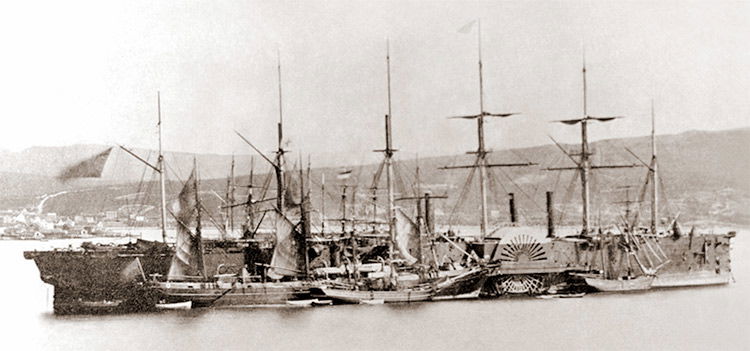
After an eventful though not very profitable series of voyages, she was abandoned in the Falkland Islands in 1886 and brought back to the dock in which she was built in 1970. The third vessel, the Great Eastern, was a leap forward not in propulsion, for she employed sails, paddles and screw, but in construction - like the Great Britain, she had a double iron hull - and in tonnage.
While the Great Western displaced 2,300 tons and the Great Britain 3,675 tons, the Great Eastern displaced 27,380 tons. Variously assessed by nineteenth-century critics as ‘a melancholy illustration of great ambition but great ignorance’ or ‘the most wonderful piece of naval architecture ever projected’, a current view is that ‘in point of size’ Brunel made his ‘most important contribution’. Since others had already employed iron, screw propulsion and subdivision of the hull, Brunel’s contribution was the application of the broad principles of the economies of scale to ship construction.
While bridges, docks, railways and ships were undoubtedly Brunel’s main achievements, his versatility as a civil and mechanical engineer did not end there. Early in his career, from 1825 to 1833, he carried out abortive experiments on a gas engine that was intended to produce gas from carbonate of ammonia and sulphuric acid. He was concerned with drainage works at Tollesbury on the Essex coast in 1830 and in the following year he designed an observatory for Sir James South in Kensington that was dismantled when Sir James refused to pay for it since he alleged its cost had exceeded the original estimate.
In Bristol, conscious of the problems of the city docks, he put forward a scheme for docks near the mouth of the Avon that led to the formation of the Portbury Pier and Railway Company. He also produced a somewhat fantastical design for a water-pumping station for the Bristol Society of Merchant Venturers. When he was invited by the Dean to examine Bristol cathedral for structural defects, he wrote in June 1850 offering ‘to give a couple of hours for a cursory inspection to form some opinion of the subject’. Characteristically he went on: ‘I can be at the Cathedral at 5 o’clock on Tuesday morning next, having to leave Bristol by train to Exeter at 7.50’. About this time, too, he was a member of the Building Committee for the 1851 Exhibition.
Further, during the Crimean War he designed a floating gun carriage for the Prussian attack on Cronstadt in 1854. And, as the result of the high death rate at the hospital at Scutari, he was asked by his brother-in-law, Sir Benjamin Hawes, then Under-Secretary at the War Office, to consider the possibility of producing a pre-fabricated building. Accepting the challenge, he did so. The hospital, which was erected at Renkioi in the Dardanelles, was ready for shipment in eight weeks.
Though he never read a paper to one of their meetings, he was prominent in the affairs of the Institution of Civil Engineers and helped to found the Institution of Mechanical Engineers. He became a fellow of the Royal Society in 1830.
When he died on September 9th, 1859 at the age of fifty-three, worn out through years of anxiety, the ‘little giant’ had seen the Great Eastern safely launched, despite considerable difficulties and some loss of life, and the Saltash Bridge completed. Like Robert Stephenson who died shortly afterwards, he was a second generation who made good, the illustrious son of an illustrious father. The immediate reaction was expressed by Daniel Gooch, the locomotive designer, who was Brunel’s best friend.
‘By his death’, Gooch wrote, ‘the greatest of England’s engineers was lost, the man with the greatest originality of thought and power of execution, bold in his plans but right. The commercial world thought him extravagant; but although he was so, great things are not done by those who sit down and count the cost of every thought and act.’ A decade later, F. R. Condor was cooler in his assessment of Brunel. Contrasting him with his great friend, Robert Stephenson, he wrote in 1868:
The imperfections of the character of Mr Brunel were of the heroic order. He saw always clearly before him the thing to be done and the way to do it, although he might be deficient in the choice and the management of the human agency which was necessary to effect his designs... It may be that the perfection and success of each individual work was more the study and aim of Mr Brunel, the return of benefit to the shareholders the more present idea of Mr Stephenson. The former preferred the luxurious cabins of Atlantic steamers and the commodious sofas of the Broad Gauge carriages: the latter opened the way for parliamentary and workmen’s trains.
Of the originality and intuitive nature of Brunel’s engineering there continues to be agreement, though it is now clear that he was also indebted to his collaborators. His father obviously gave him considerable help with the design for Clifton suspension bridge.
Much, too, of the soundness of the basic design of the Great Western is attributable to William Patterson, the Bristol shipbuilder in whose yard the vessel was built, while Patterson now appears to have been largely responsible for the hull form of the Great Britain, and that of the Great Eastern resulted from Scott Russell’s notions of ship resistance as embodied in the ‘wave line’ principle on which he had been working since 1834. Further, the device of annular space in the Saltash bridge caisson was suggested by R. P. Brereton.
Clearly the acts of creation and innovation were more important to Brunel than their commercial consequences. While the broad gauge provided a short-run stimulus to operation at higher speeds, in the longer run it was both unnecessary and extravagant. Today standard gauge trains operate safely and comfortably at higher speeds than Brunel was used to, and advanced high-speed trains require not a wider gauge but a cambered track so that curves can be negotiated at high speed.
Moreover, the broad gauge led Brunel to lay down specifications for the first Great Western locomotives, regarded by one critic as his greatest mistake, that produced engines of unwieldy and gargantuan proportions. The atmospheric railway, which Robert Stephenson regarded as a great humbug, had in theory some advantages but practical disadvantages which even technical advances since would not overcome. The cost of the severe gradients between Newton Abbot and Plymouth are a continuing burden on railway operation there.
Innovative as his bridges and viaducts were, they did not provide effective precedents for subsequent engineering. The flatness of the Maidenhead bridge did not evoke emulation, the Saltash bridge had no successors while the Clifton suspension bridge required the development of a means of spinning cables on site before the suspension principle could be used on the world’s longest bridges.
And the character defects to which Condor referred are confirmed by his grand-daughter who described Isambard Kingdom Brunel as ‘proud, complicated, exacting, subject to moments of elation and depression... a hard man to work with’.
The verdict on which there has been no dissent is that he paid little regard to economics, though as an engineer Brunel was not alone in this. There were occasions, as with the construction of the Tamar bridge, where he showed some concern about cost, but this was not a common occurrence. The line between London and Bristol, for example, cost £6.5 million, more than double the original estimate.
While not the equal of his father in originality, he was a more charismatic figure. With more mathematics than many engineers, he put this ability to good effect on many occasions, though his calculations sometimes let him down spectacularly, as with the atmospheric railway or the launch of the Great Eastern. In 1910 The Engineer wrote: ‘In all that constitutes an engineer in the highest, fullest and best sense, Brunel had no contemporary, no predecessor’.
It continued: ‘If he has no successor, let it be remembered that... the conditions which call such men into being no longer have any existence’. Though Brunel was undoubtedly an extremely talented engineer, the first phrase verges on the side of extravagance but there must be agreement with the second. Unquestionably Isambard Kingdom Brunel was the man for the moment. In the second quarter of the nineteenth century it was possible for an engineer to be fleetingly concerned with a large number of works. But by his last years a change had taken place.
Concerns could no longer be served by an occasional consultation with a freelance professional who was heavily preoccupied with other commitments. With Brunel’s death the age of the great independent engineer had ended and that of the salaried professional engineer had dawned. To this most distinguished and imaginative engineer, Paddington station - which has just celebrated its 125th anniversary - and the track between London and Bristol - so effectively engineered that it provided the route for Britain’s first high-speed train -are a continuing memorial.
Further Reading
For a study of I. K. Brunel, the starting point must be The Life of Isambard Kingdom Brunel, Civil Engineer, Longmans and David & Charles, (London and Newton Abbot, 1870 and 1971) by his son Isambard Brunel, to which Celia Brunel Noble, The Two Brunel's, Father and Son, Cobden-Sanderson (1938), provides a more personal supplement. The standard recent life is Lionel T. C. Rolt, Isambard Kingdom Brunel: a Biography, Longman and Penguin (London, 1957 and 1970), while a popular illustrated account is provided by John Pudney, Brunel and his World, Thames & Hudson (London, 1974); Sir Alfred Pugsley has edited a collection of essays on The Works of Isambard Kingdom Brunel: an Engineering Appreciation, Institution of Civil Engineers (1976); while particular aspects of his work are discussed in Ewan Corlett, The Iron Ship: the History and Significance of Brunel’s Great Britain, Moonraker Press (Bradford-on-Avon, 1975); Charles Hadfield, Atmospheric Railways: a Victorian Venture in Silent Speed, David & Charles (Newton Abbot, 1967); and Geoffrey Body, Clifton Suspension Bridge, Moonraker Press (Bradford-on-Avon, 1976).

