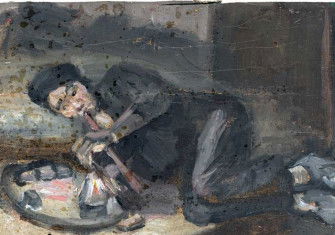
In 1920 the Soviet Union became the first country to embark on a national campaign against smoking. Advanced by the first commissar of health, Nikolai Semashko, leader of the world’s first national health service and an avid anti-smoker, the campaign aligned with Marxist ideology: tobacco was yet another ‘opiate of the masses’ akin to alcohol or religion.
Register to read more articles for free.
When you register, you will receive the History Today newsletter. Click here to read our Terms of Use.
In 1920 the Soviet Union became the first country to embark on a national campaign against smoking. Advanced by the first commissar of health, Nikolai Semashko, leader of the world’s first national health service and an avid anti-smoker, the campaign aligned with Marxist ideology: tobacco was yet another ‘opiate of the masses’ akin to alcohol or religion.
Vladimir Lenin, architect of the 1917 revolution, decried advertising as the trickery of capitalist manufacturers. In Russia advertising was limited in the 1920s and eliminated in the 1930s. For Soviet manufacturers to advertise and create demand would also have been foolish when they were bedevilled by shortages. In 1920 Soviet cigarettes came from tobacco grown largely in Ukraine and produced in Moscow and Leningrad.The quality of Soviet tobacco products for the Soviet standard Belomorkanal (White Sea Canal) or Stalin’s preferred brand Gertzegovina Flor (Herzegovina flor) did not compare to Western foil inserts and slick cellophane. Quality was irregular and there were complaints of everything from tobacco being packed too firmly to allow inhalation, rocks and sticks in the mix, or packs so moist they had to be dried out on radiators.
Still, surveys of worker youth from the Moscow Department of Health in the late 1920s found 50-75 per cent of young men and 11-23 per cent of young women smoked. The Soviet leadership fought tobacco use. In 1918 they founded the world’s first national health care system – Narkomzdrav – with a commitment to universal, prophylactic care for every citizen. Prevention was the cheapest health intervention, and so smoking cessation became a top cause alongside Soviet sanitary campaigns and vaccination drives.
Lenin was an anti-smoker and in 1920 pushed Semashko: ‘Why not start a fight with that weed tobacco? I will support you.’ Head of Narkomzdrav, Semashko proposed legislation to ration, restrict, and stamp out tobacco. When, however, Semashko faced opposition from leaders of the state-controlled tobacco industry as well as agriculture and export advocates, Lenin’s support evaporated. Instead, the industry recovered and was pushed to produce more to help fund heavy industry. Stalin encouraged alcohol production in 1928 for the same reason.
Semashko did not get his ban or production cuts, but he did inaugurate the world’s first national tobacco cessation campaign. Posters appeared across cities with couplets from avant-garde poets such as Vladimir Maiakovskii: ‘Quit your smoking: It’s paper-wrapped poison!’ Articles in the press and in health manuals, such as V. I. Sazhin’s 1926 The Truth about Smoking, all warned of smoking causing nervous weakening, stomach problems, and death.
To stop smoking was not just protection against ill health, but the choice of proper Marxists. Communist youth groups pledged not to take up the poisonous habit while plays in workers’ clubs, such as the 1927 Trial of a Smoking Pioneer, presented lightly theatricalised stories of poor choices for audiences to judge while worker-actors lectured on the societal costs of a habit that endangered the health of female tobacco workers and diverted labour for a useless commodity. As the Soviet anti-smoking author S. Nezlin put it, under capitalism:
The poor man drinks and smokes from sadness and despair. The rich man from greed and alarm for his wealth and thirst for pleasures. The construction of a new, better life … is the most trustworthy way to fight with all drugs and included with that, is tobacco.
A Soviet anti-smoking and anti-alcohol poster, 1950s. Wellcome Collection (CC BY 4.0).
But the problem of smoking was met with more than propaganda. In 1924 specialised state-run clinics called narkodispensaries began taking in thousands of people who wanted to stop smoking. At first there were only a few dozen per month but by 1927 there were 3,000 a year and by 1928 there were 8,000, overwhelming the system.
After Semashko was removed from his post in the late 1920sand pipe-smoking Stalin came to power, anti-tobacco messaging largely disappeared. In 1931 the commissar of the food industry, Anastas Mikoyan, called cigarettes ‘a new type of weapon in the state’s economic policy’ for the incentive it gave to workers and the money it brought the state. He also noted that tobacco would be essential to any future war: ‘The front is difficult. Spirit is not enough for troops. After a good fight, it is necessary to have a good smoke.’ Mass-smoking did become integral to the war effort. After the German invasion of 22 June 1941 the Soviets scrambled to pull strategic resources out of enemy control, including tobacco factories and workers. In besieged Leningrad they scraped the residue from tobacco factory smokestacks and mixed it with leaves just to smoke. As Soviet troops pushed the German forces out, they stopped to harvest shag tobacco fields.
In the 1960s, in the face of declining health indicators for Soviet citizens, the Ministry of Health again campaigned against the leading culprits: drinking, smoking, and general accidents. In the 1970s the campaign against tobacco intensified. Maiakovskii’s stale slogan from the 1920s was dusted off but gained little traction in a population fatigued by propaganda. When Russia’s leading cigarette brand Iava tested pack warnings – ‘The Ministry of Health warns that smoking is hazardous to your health’ – in 1978 they reported that a long line formed and customers, shown the label, responded ‘this is nonsense’. There was no effect on sales; all bought their full, one-carton limit.
Usage remained steady into the 1980s, at about 60 per cent of men and 10-20 per cent of women, despite problems of quality and supply. Western manufacturers watched this captive market closely as the number of American and British smokers decreased in the wake of new cancer research and government warnings. When in 1990 a group of smokers rioting over cigarette shortages diverted Gorbachev’s motorcade, a helpful R.J. Reynolds (makers of Camel and Winston) and Philip Morris (makers of Marlboro) sent in 34 billion sticks to quell the crowd. After the fall of the Soviet Union, these cheap and sophisticatedcigarettes flooded the now open market. Tobacco supplied in abundance meant usage rose for men and doubled for women – but the capitalist inducements met an already primed market.
Today, one in three Russians smoke. Estimates are that in 2024 tobacco use caused 224,000 deaths in the form of cancer, cardiovascular disease, or stroke. Despite the fearful consequences of illness and death, Russia remains the top country in the WHO European region for tobacco use.
Trish Starks is Distinguished Professor of History at the University of Arkansas.