The acute housing crisis of mid-Victorian Britain generated stormy opinions about the nature of state intervention and the need for ‘wholesome despotism’.
In 1866 James Hole, a writer from Leeds, called for ‘a little wholesome despotism’ in tackling the problems of housing the urban working classes. He was not alone in favouring a no-nonsense, top-down approach. ‘You must have little short of a despotism with respect to the metropolis’, opined William Haywood, chief engineer of the Corporation of London in 1863, ‘if you want everything done in the way it should be done.’
Such sentiments reflected the mood of the 1860s, as anxieties about sanitation and public health evolved into deep unease about housing conditions for Britain’s workforce. Railway companies were pushing their tracks through overcrowded urban neighbourhoods, demolishing dwellings and displacing the helpless as they went. Overcrowded homes brought moral evils alongside rising death-rates. One MP thought the situation required not a wholesome but a ‘severe despotism’.
Register to read more articles for free.
When you register, you will receive the History Today newsletter. Click here to read our Terms of Use.
The acute housing crisis of mid-Victorian Britain generated stormy opinions about the nature of state intervention and the need for ‘wholesome despotism’.
In 1866 James Hole, a writer from Leeds, called for ‘a little wholesome despotism’ in tackling the problems of housing the urban working classes. He was not alone in favouring a no-nonsense, top-down approach. ‘You must have little short of a despotism with respect to the metropolis’, opined William Haywood, chief engineer of the Corporation of London in 1863, ‘if you want everything done in the way it should be done.’
Such sentiments reflected the mood of the 1860s, as anxieties about sanitation and public health evolved into deep unease about housing conditions for Britain’s workforce. Railway companies were pushing their tracks through overcrowded urban neighbourhoods, demolishing dwellings and displacing the helpless as they went. Overcrowded homes brought moral evils alongside rising death-rates. One MP thought the situation required not a wholesome but a ‘severe despotism’.
The need for mandatory intervention was obvious to many. Sanitary reform had already demonstrated that state-enforced regulations could improve common lodging houses, but what about non-institutional living? ‘Vagrants and tramps are better cared for than the labouring man living in ordinary lodgings under no regulations’, wrote Hole. There was no shortage of evidence that ‘ordinary lodgings’ often meant property unfit for human habitation.
But who was to exert any new despotic control and how far should interventions go? The Torrens Act of 1868, characterised at the time as the ‘pulling down act’, enabled local bodies to condemn, purchase and demolish houses deemed insanitary. Much altered in its passage through Parliament, amendments led eventually to the 1875 Artisans’ and Labourers’ Dwellings Improvement Act (the ‘Cross Act’). This was intended to enforce the building-up of decent dwellings that was supposed to follow the pulling-down, which the 1868 Act, despite amendments, had failed to achieve. The Torrens Act, it was said, ‘allowed local authorities to use the pick-axe but withheld the trowel’.
Together, these two acts are often cited as the start of municipal housing in Britain. But this was a beginning characterised by words rather than action as arguments about the principles, practicalities and wisdom of state intervention, whether at local or national level, rose and fell. Many opinions piled in, not least over what the primary aim of such intervention in housing might be. Was this about sanitary matters – clearing slum areas in the interests of public health; or was it about housing supply – increasing the availability of decent, well-regulated homes for workers? In both cases, should municipal bodies be agents of delivery as well as the regulating authority?
Reconciling intervention with ‘fairness’ was a constant refrain: fairness to property owners, whose buildings, however decayed, might be seized; fairness to ratepayers, who might have to bear the costs of compensating irresponsible property owners whose buildings had gone to rack and ruin; fairness to lodgers who faced displacement, however wretched their living conditions.
In its efforts to steer a course of fairness between all stakeholders, the Cross Act proposed a kind of public-private partnership whereby public authorities cleared unsanitary sites but then sold the land to private housing companies, who took on the risk of building and managing new model dwellings. In practice, this led to expensively cleared land standing empty as public and private bodies squabbled over land values and national government tried to micromanage the process through bureaucratic procedures – under the new legislation every step had to be approved by the secretary of state.
‘A grand Metropolitan improvement’, Holborn Viaduct, from a children’s card game, 19th century. Look and Learn/Bridgeman Images.
Debates over the housing acts also enflamed old arguments about localism and centralisation. The new legislation seemed to sidestep recent examples of municipal authorities acting for themselves, building and managing blocks of workers’ dwellings through powers embedded in local improvement acts. The City of London had built Corporation Buildings, a block of tenements in Finsbury, in 1865 using money juggled from various budgets including the sale of land near the Metropolitan Railway. The City had followed the business model established by philanthropic housing companies: the block housed 846 people and was said to achieve a four per cent return on investment.
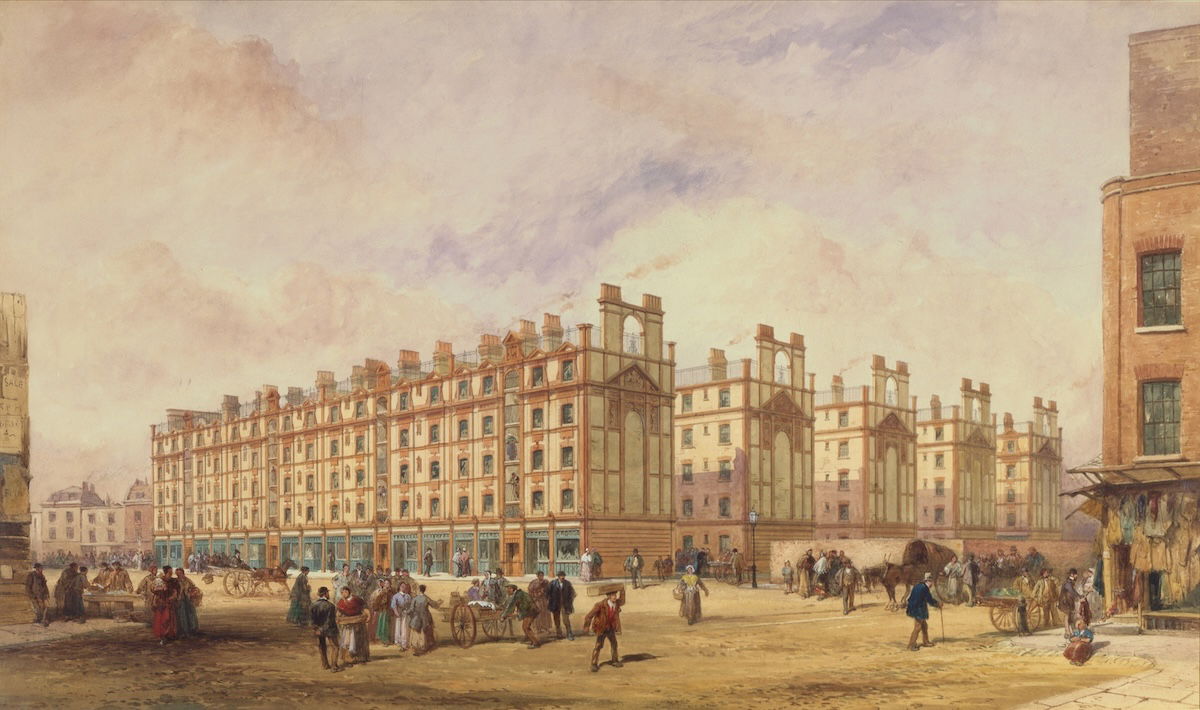
Glasgow Corporation had also been entrepreneurial. The Glasgow Improvement Act of 1866 had enabled the Corporation to clear a large area, using only part of the site for municipal dwellings, the remainder being leased or sold ‘to the best advantage’. Liverpool Corporation had built St Martin’s Cottages in 1869 with a loan from the Public Works Loans Commissioners. The City of London’s second tenement block was realised through an improvement act associated with Holborn Viaduct. Viaduct Buildings opened in 1875, housing 565 brewery draymen, print workers and City policemen. It still stands today: England’s earliest surviving example of municipal housing.
In 1882 a Commons Select Committee investigated the 1875 legislation and found it wanting. Municipal authorities, it was said by one witness, needed ‘unfettered freedom’ rather than centralised control. Glasgow Corporation had adopted the Cross Act despite misgivings:
They were empowered to do things which they did not think it wise to do; for instance, to devote the land … exclusively to dwellings for the poorest classes; they have not followed that policy.
Whether new dwellings should house workers or the jobless poor was a matter where local and central views often differed.
The Select Committee’s report ushered in pragmatism on both sides. Central government relaxed the Cross Act’s red lines, such as forbidding new dwellings to be built with ground-floor shop units; municipal authorities became more active in the task of constructing new dwellings on land the Act had enabled them to clear. In 1885 two local projects that had got stuck were finally completed. Liverpool Corporation erected its flagship Victoria Buildings and the City of London erected five tenement blocks in Petticoat Square, Aldgate.
Arguments over the Petticoat Square site had been particularly fractious, trying the patience of all involved. Financial problems were only resolved when the City raised extra money through the issue of housing bonds, but the resulting tenements offered a lower standard of accommodation than the Corporation’s earlier blocks. William Haywood sounded a graceless note as he emphasised that, although the tenements had been built under national legislation, this was primarily a local improvement, devised for local conditions and realised by local effort through local funding:
The largest portion of the tenements and a few of the shops have been let, and to a large extent, to those whose occupations are in the City; the remainder to those poor persons whom it is hoped will appreciate the great advantage which has been bestowed upon them by the erection of these structures at the expense of the ratepayers of the City of London.
The housing acts of the 1860s and 1870s can be seen as wholesome despotism turning into a rather British make-do-and-muddle. But if they provided examples of what not to do, they also demonstrated the need for pragmatism when approaching this most complex of social problems.
Cathy Ross is a former Director of Collections at the Museum of London and the author of Dwell I Never: The City of London’s Lost Residents (Quickfry Books, 2024).