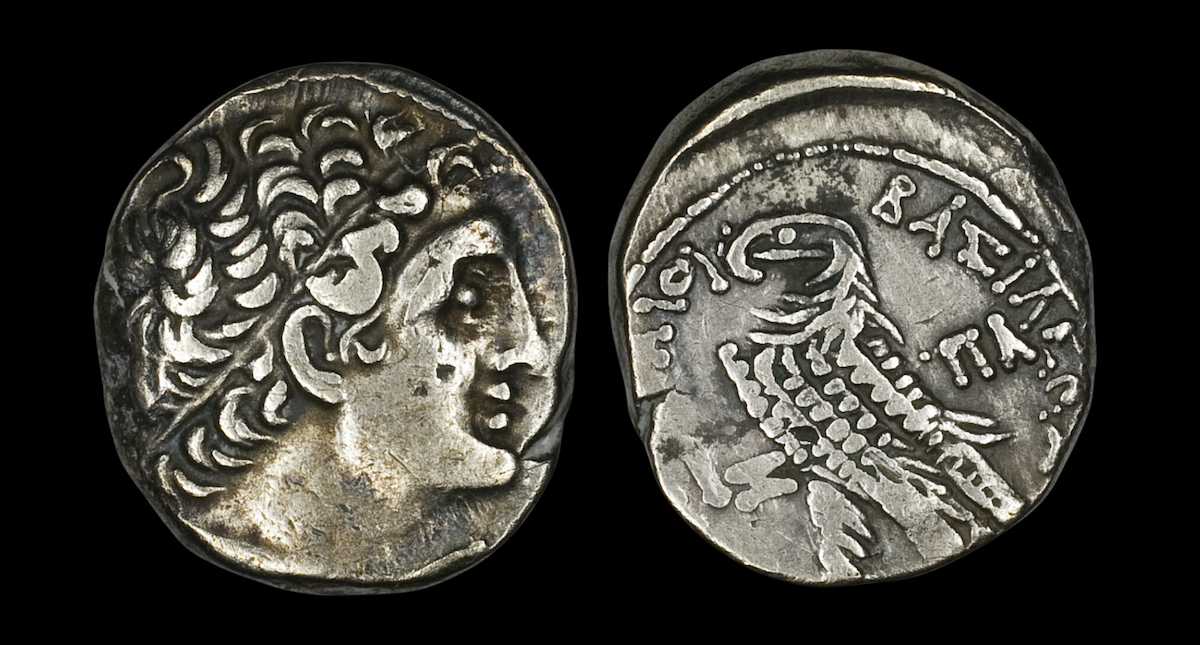
After Alexander the Great’s death in 323 BC his generals vied for control of the vast territories of his empire. Among them were Ptolemy I Soter, founder of the Ptolemaic dynasty in Egypt, and Antigonus I, king of Macedonia, who contested for possession of Cyprus. Nestled in the Eastern Mediterranean, Cyprus was renowned throughout antiquity for its rich natural resources, notably copper and timber. The island changed hands during their struggle, until Ptolemy secured lasting control in 295 BC. Governed from Alexandria, Cyprus became the first and most enduring possession of the Ptolemaic dynasty, economically self-sustaining and a key military stronghold.
During the first century BC the dynasty’s grip on Egypt and the Eastern Mediterranean weakened as they grew increasingly reliant on Rome, by then firmly established as a Mediterranean superpower after the fall of Carthage in 146 BC. Cyprus was governed by Ptolemy of Cyprus (r.80-58 BC). Very little is known about him: his parentage is uncertain, though he was the brother of Ptolemy XII Auletes, who ruled the Ptolemaic kingdom between 80-58 BC and 55-51 BC, and thus the uncle of Cleopatra VII. Cicero, the Roman statesman and orator, described him as a ‘friend and ally’ of Rome, yet surviving accounts about Ptolemy of Cyprus are fragmentary, drawn from later writers such as Strabo, Plutarch, and Ammianus Marcellinus, who often use him as a narrative device to reflect personal agendas or the broader currents of Roman politics. His suicide, after the island’s annexation by Rome in 58 BC, marked an end to Ptolemaic authority in Cyprus. The annexation was a headline moment in late Republican politics. It helped finalise Rome’s dominance over the Mediterranean, following Pompey the Great’s conquests in Asia Minor and the re-organisation of the east following the collapse of the Seleucid Empire.
The annexation has many possible beginnings. Rome was tightening its grip on the Eastern Mediterranean; Ptolemy XII Auletes had secured his own position by bribing Rome (weakening Egypt’s financial position and exposing the region’s power disparities). Unlike his brother, Ptolemy of Cyprus made no payment to secure recognition as a friend of Rome – an omission construed not only as a failure of deference, but also as evidence of parsimony. A pivotal moment came in 67 BC when Ptolemy of Cyprus allegedly sent the insulting sum of ten drachma to ransom the Roman politician Publius Clodius Pulcher from Cilician pirates when he was appealed to for help. Strabo, in his Geography, written around the turn of the first century BC, explained: ‘The king [Ptolemy] indeed sent a ransom, but so utterly small that the pirates disdained to take it and sent it back again, but released [Clodius] without ransom.’
The slight was not forgotten. According to Strabo it was ‘the chief cause of the ruin of the king’. Clodius, elected Tribune of the Plebs in 58 BC, used his new power to pass the leges Clodiae, a suite of populist laws that included a pointed decree: Cyprus would be annexed and Ptolemy stripped of his throne. Cicero was another victim of the leges Clodiae, which targeted him for ordering executions without trial during his consulship of 63 BC. He declaimed of Clodius:
You, by an iniquitous law, holding no inquiry, and involving the Roman people in your criminal act, outlawed Ptolemy, the king of Cyprus, who was brother to the king of Alexandria, and who held his kingdom upon a title equally good; you inflicted the patronage of this empire upon the realm, the property, and the fortunes of one with whose father, grandfather, and ancestors we had been on terms of alliance and friendship.
Cicero’s protestations highlight the extraordinary dominance of the Roman state during the late Republic, as well as the personal ambitions of its politicians. Clodius’ alleged mistreatment of Ptolemy served as a convenient pretext for Cicero to spotlight his own grievances against Clodius, the man who had ensured his exile from Rome in 58 BC.
The episode captures a distinctly Roman blend of private vendetta and public action. In 58 BC, after the leges Clodiae were passed, Cyprus’ annexation was assigned to Cato the Younger. According to Plutarch, Clodius regarded Cato ‘the purest man of all the Romans’, but he goes on to say that this was a ploy to get Cato out of the way so that Clodius could overthrow Cicero. Cato left Rome in 58 BC for Cyprus. En route, he paused in Rhodes and dispatched a subordinate ahead to initiate negotiations. Ptolemy was offered the esteemed position of high priest of Aphrodite in exchange for relinquishing his power and property. He refused, casting his treasure into the sea, and choosing suicide over subjugation to Roman rule.
Cato’s conduct bolstered his reputation as a principled Roman, overseeing the sale of property and maintaining meticulous financial records. He returned to Rome in 56 BC with 7,000 talents and Plutarch’s account describes a spectacular arrival:
The Romans did not fail to hear of his arrival with his ships ... and a large part of the people went to the river to meet him, so that both banks of the stream were hidden from view, and his voyage up to the city had all the show and splendour of a triumph.
In contrast, Roman sources portray Ptolemy of Cyprus as a decadent, miserly king. His failure to negotiate with Rome, compounded by Ptolemy XII Auletes’ desperate efforts to secure Roman favour, present the brothers as symbols of a dying dynasty. Ultimately, he was vulnerable in an era in which Roman policy often veiled personal ambition, and clemency came only on Rome’s calculated terms. Ammianus Marcellinus, a fourth-century historian, recounts the island’s history, following Strabo’s earlier narrative but with a more condemnatory view of Rome’s behaviour:
The Roman people in invading that island showed more greed than justice; for King Ptolemy, our ally joined to us by a treaty, without any fault of his, merely because of the low state of our treasury was ordered to be proscribed, and in consequence committed suicide by drinking poison; whereupon the island was made tributary and its spoils, as though those of an enemy, were taken aboard our fleet and brought to Rome by Cato.
The annexation of Cyprus was more than another milestone in Roman expansion – it was a showcase of political theatre. In the episode’s aftermath stood Cleopatra VII, the last of the Ptolemies, whose story would echo her uncle’s.
Ersin Hussein is Senior Lecturer in Classics at Swansea University.