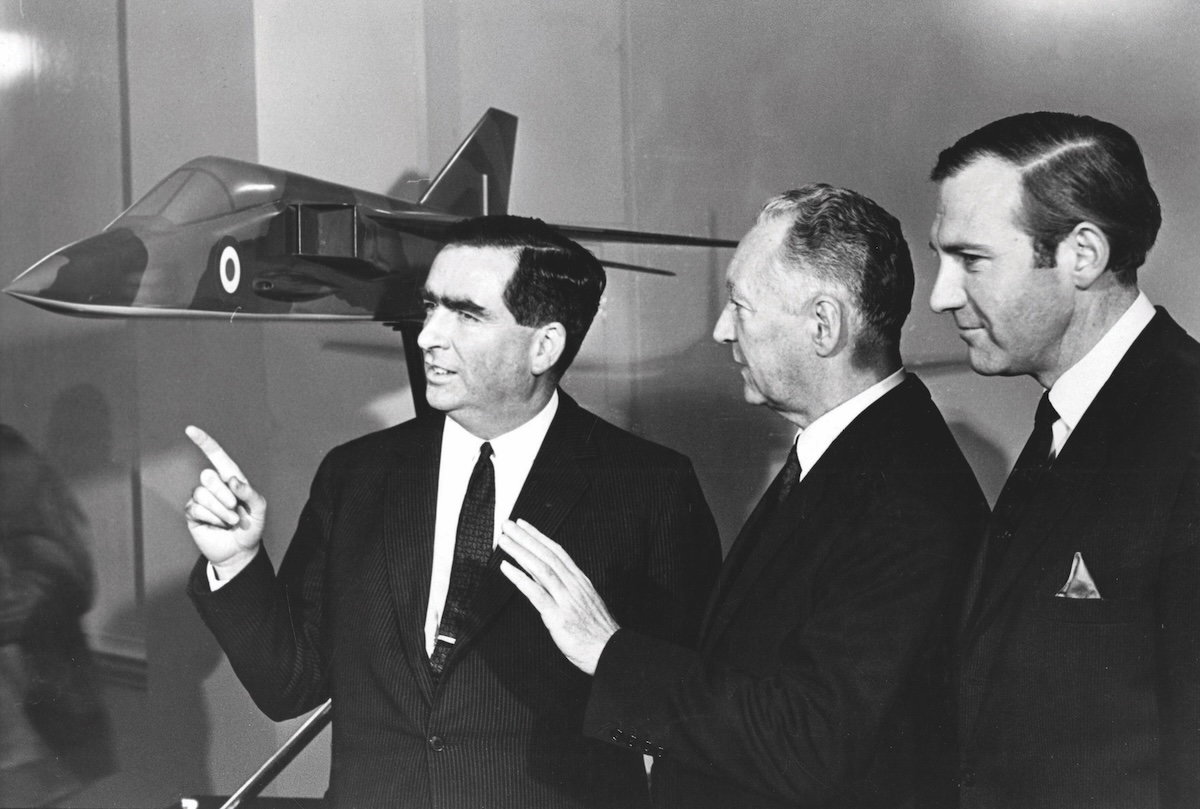
On 19 June 1967 Paris informed London that it was withdrawing from the Anglo-French Variable Geometry (AFVG) supersonic combat aircraft project. For the incumbent Labour government, the consequences were enormous. Both the Royal Air Force (RAF) and British industry had lost a vital combat aircraft. Three months later, British magazine Flight International declared that the Labour government’s plan for a long-form defence-industrial relationship with France had ‘suffered a wound that has failed to heal’.
Register to read more articles for free.
When you register, you will receive the History Today newsletter. Click here to read our Terms of Use.
On 19 June 1967 Paris informed London that it was withdrawing from the Anglo-French Variable Geometry (AFVG) supersonic combat aircraft project. For the incumbent Labour government, the consequences were enormous. Both the Royal Air Force (RAF) and British industry had lost a vital combat aircraft. Three months later, British magazine Flight International declared that the Labour government’s plan for a long-form defence-industrial relationship with France had ‘suffered a wound that has failed to heal’.
During the 1960s Anglo-French aerospace collaboration was expansive, encompassing the Concorde supersonic airliner, military helicopters, guided missiles, the Jaguar strike/trainer aircraft, and the AFVG. Surface-to-air missile systems and interceptors proliferated during the Cold War, making operational environments increasingly hazardous and justifying larger, faster, more sophisticated penetrating aircraft. As research and development (R&D) costs surged, international collaboration became increasingly attractive. Economic pressures in Britain and France reinforced this logic. When prime minister Harold Wilson came to power in October 1964 he sought to balance military commitments overseas with a balance-of-payments deficit. Britain’s postwar economic growth trailed behind the US, Japan, and West Germany. French president Charles de Gaulle faced similar challenges, including a major stock market crisis (1961-67), significant unemployment, and high inflation.
Wilson worked to shift public funds away from military R&D towards civil industries to stimulate growth. Aerospace enjoyed significant state sponsorship and was dominated by defence-related projects. By spring 1965 Labour had cancelled Hawker Siddeley’s P.1154 and HS.681, and the British Aircraft Corporation’s (BAC) long-range strike/reconnaissance TSR-2, opting for cheaper American aircraft and sparing only the P.1127. Washington offered 110 TFX/F-111 aircraft at £2.1 million each, compared with at least £4.8 million for the TSR-2. As the Ministry of Defence concluded: ‘The last administration may have been prepared to spend some £300M more than they needed to meet the needs of the R.A.F. This government is not.’
However, relying fully on American aircraft risked destroying domestic capabilities, straining the balance of payments, and gifting Washington leverage. Instead, only 50 F-111s were ordered, and Labour opted to pursue a broad policy of defence-industrial collaboration with France. Together, they possessed Western Europe’s largest and most capable aerospace industries, while their air forces were roughly comparable.
The Jaguar and AFVG projects emerged following a bilateral memorandum of understanding signed in May 1965. The simpler Jaguar progressed faster, with France’s Breguet Aviation leading airframe design, seconded by BAC, and Rolls-Royce leading aeroengine development, supported by Turbomeca. London assumed that leadership roles would be flipped for the AFVG. It would incorporate advanced variable-geometry swing wings, able to sweep back to reduce drag at high speeds and forward to increase lift at low speeds. This promised flexibility, reducing the need for specialised aircraft. It met Britain’s requirement for long-range strike/reconnaissance and France’s for a carrier-based strike aircraft. Assuming BAC’s leadership, Labour’s 1966 Defence White Paper described it as ‘operationally and industrially … the core of our long-term aircraft programme’.
Dassault Aircraft Factory, c.1948-67. US National Archives and Records Administration. Public Domain.
In Paris, however, the matter remained unresolved. Early in 1967 Wilson’s chief scientific adviser, Solly Zuckerman, corresponded with industrialists. Rolls-Royce’s Paul Willert explained that, as his firm had presumptively given ‘[aeroengine] leadership to SNECMA [Société Nationale d’Étude et de Construction de Moteurs d’Aviation] it is feared that B.A.C. will demand the air-frame leadership’. René Lucien, president of the French equipment firm Messier, warned that this arrangement would be ‘doomed to failure’. Convincing Marcel Dassault, founder and president of airframe manufacturer Avions Marcel Dassault, to collaborate had proved difficult; accepting British leadership was another matter entirely. ‘[Dassault] is not by temperament, nor is his Company, inclined to favour cooperation on anything like level terms’, Willert explained.
Lucien credited de Gaulle with sustaining the project through its first two years despite industrial frictions and French economic instability. In May 1967 Paris even requested performance target increases, raising projected unit and R&D costs by 20 per cent. Whitehall assumed that France’s concurrent procurement of Dassault Mirage F1s had motivated these revisions to differentiate the AFVG. They cautiously accepted the revisions, provided that BAC’s leadership was affirmed.
By 16 June, however, mounting economic pressures forced Paris to seek savings of £150 million in military expenditure for 1968-70. Secretary of state for defence Denis Healey was informed by defence minister Pierre Messmer that this would likely prove fatal to the AFVG. Although Wilson intended to urge de Gaulle to delay any decision pending further talks, France withdrew three days later. While London understood the impact of budgetary pressures on government-sponsored aerospace, suspicions swirled around Whitehall, centred chiefly on Dassault. This was worsened by Messmer’s ‘cool statement’ in September that Dassault was developing its own supersonic, variable-geometry aircraft: Mirage G. Privately, he assured Healey that Paris would fund only prototypes; they could not risk falling behind in variable-geometry technology. Regardless, with French firms leading on the airframes for the Concorde, Jaguar, and the Airbus project, the damage to bilateral relations was done. As Flight International chided: ‘What a triumph for France! What a humiliation for the British aircraft industry.’
Following the cancellation, a Conservative MP, Robert Carr, questioned whether ‘a core is no longer needed for this apple?’ The Guardian observed that: ‘Whatever his decision, Mr Healey must expect serious political uproar from one quarter or another.’ A national project would have been prohibitively expensive, contradicting years of Labour messaging. If abandoned entirely, the RAF and industry would have suffered enormously. An Anglo-French project might still be plausible, but only if BAC accepted a junior role in a Mirage G offshoot. This, the Ministry of Defence advised, would be ‘a shocking climb-down’.
Britain and France parted ways following the AFVG’s demise, never again collaborating on a new combat aircraft. Labour seized an opportunity to cooperate with West Germany and Italy before 1970, ultimately producing the Panavia Tornado. This model was later replicated for the Eurofighter Typhoon during the 1980s. France, meanwhile, pursued fighter production alone through Dassault. Although French participation in Eurofighter was considered, Dassault’s familiar leadership demands soured negotiations. Today, Dassault Aviation is pushing for design leadership in the faltering sixth-generation Franco-German-Spanish Future Combat Air System. By contrast, Britain, Italy, and Japan are making tangible progress with their Global Combat Aircraft Programme.
Samuel Hollins has a PhD from Lancaster University and was former Interim Historian and Academic Access Manager at the RAF Museum.