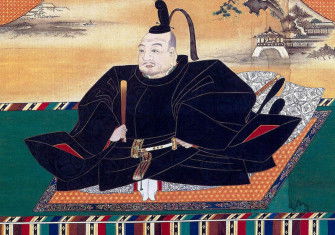
‘Though separated by ten thousand leagues of clouds and waves, our territories are as it were close to each other.’ These were the words with which the retired but de facto ruler of Japan, Tokugawa Ieyasu, responded to a letter from the ‘defendor of the Christian faithe’, England’s James I, in 1613, in which he reached out to the ‘Emperour of Japan’ to establish trade relations between the two nations.
The Tokugawa Shogunate granted the English permission to trade freely within the country and the English East India Company (EIC) established a trading factory in Hirado, a port city in modern-day Nagasaki prefecture, where the Dutch had had a trading factorysince 1609. The EIC also established outposts in other parts of the country such as Edo (Tokyo) and Sakai (in Osaka prefecture), though these were to be shortlived. The English brought goods including broadcloth, lead, and gunpowder to Japan, and trade continued for ten years until the English left in 1623, after finding ‘some discouragements in their trade’.
Register to read more articles for free.
When you register, you will receive the History Today newsletter. Click here to read our Terms of Use.
‘Though separated by ten thousand leagues of clouds and waves, our territories are as it were close to each other.’ These were the words with which the retired but de facto ruler of Japan, Tokugawa Ieyasu, responded to a letter from the ‘defendor of the Christian faithe’, England’s James I, in 1613, in which he reached out to the ‘Emperour of Japan’ to establish trade relations between the two nations.
The Tokugawa Shogunate granted the English permission to trade freely within the country and the English East India Company (EIC) established a trading factory in Hirado, a port city in modern-day Nagasaki prefecture, where the Dutch had had a trading factorysince 1609. The EIC also established outposts in other parts of the country such as Edo (Tokyo) and Sakai (in Osaka prefecture), though these were to be shortlived. The English brought goods including broadcloth, lead, and gunpowder to Japan, and trade continued for ten years until the English left in 1623, after finding ‘some discouragements in their trade’.
The English returned to Nagasaki harbour roughly 50 years later, in 1673, seeking to re-establish trade relations and bearing a letter from Charles II. There were no words of welcome from the Shogunate this time. Instead, without ever being able to set foot on Japanese soil, the English ship Return was sent away.
Why the different reception? According to the captain of the Return, Simon Delboe, the official reason the Shogunate gave for rejecting the English in 1673 was that Charles’ wife, Catherine of Braganza, was ‘the daughter of Portugal their enemy’. More importantly, in between the two letters, the political climate had changed considerably and Japan had become a ‘closed country’.
In a series of edicts and orders issued piecemeal between the 1610s and 1640s, the Tokugawa Shogunate had banned Christianity and restricted foreign trade and travel in an effort to consolidate its power. The Portuguese were expelled in 1639, nearly a century after their arrival on the island of Tanegashima. Only the Dutch remained, largely confined to a small artificial island, Deshima, in Nagasaki.
As scholars Tanaka Takeo and Arano Yasunorihave pointed out, Japan was never fully ‘closed’. Trade and exchanges existed with its East Asian neighbours, China and Korea, the Ainu people to its north, and the Ryūkyū Kingdom to its south. And, while limited to the Dutch, trade with Europe did continue. Rather than calling Japan a ‘closed country’, or sakoku, such scholars advocate using the term kaikin, or ‘maritime prohibitions’. To some, the term sakoku is Eurocentric and misleading. Yet the term is informative precisely because it shows how Europeans came to view Japan. In fact, the word sakoku is a Japanese rendering of a perspective expressed by a German scholar, Engelbert Kaempfer, that Japan ‘hath been shut up’.
Accounts of the East India Company factory in Japan, 30 December 1621. Folger Shakespeare Library. Public Domain.
In the early 1690s Kaempfer visited Japan as part of a Dutch mission. He wrote an essay in Latin defending Japan’s policy, which was published in 1712. An English translation appeared in 1727 with the title:
An Enquiry, whether it be conducive for the good of the Japanese Empire, to keep it shut up, as it now is, and not to suffer its inhabitants to have any Commerce with foreign nations, either at home or abroad.
A Dutch edition followed in 1729. In 1801 Shizuki Tadao, a rangakusha (Dutch scholar), coined the term sakoku while translating Kaempfer’s essay into Japanese; 18th-century English readers of Kaempfer’s essay encountered Japan as a country that was ‘shut up’, but this was not how it had appeared to the previous generation of English travellers. In the period between the two letters, they did see obstacles to trade, but not insurmountable ones.
Soon after their arrival in 1613 the EIC traders began having their liberties stripped away. When a 1614 edict decreed that all Christian missionaries be banished, Richard Cocks, the head of the Hirado factory, initially found the news ‘too good to be true’, seeing it as a problem for the Jesuits; he quickly felt the repercussions when the English were disallowed from hoisting the St George’s flag ‘because it had a crose in it’.
The restriction of European trade to the two ports of Hirado and Nagasaki in 1616 came as a great blow to the EIC factory. One EIC trader complained of the ‘heathen dogges’ working against them, while Cocks protested against being ‘shut … up’ in ‘a corner’ of Japan. Yet the EIC traders were still ‘in good hope’ to have their privileges granted by the ‘ould Emperor’ Ieyasu ‘redressed’. Should this not happen, however, they were concerned that it would ‘overthrowe’ their trade and it would be ‘folly’ to hold the factory. The EIC president George Ball at Bantam in Java considered nothing unique about the situation, ‘having found itt ellswher per experyence’; Cocks retorted that the president clearly had ‘not experemented any busynes in Japon’. Feeling the squeeze, the factory was closed in 1623.
Oblivious to these events, the EIC’s Batavia (Jakarta) presidency contemplated re-establishing trade relations with Japan as early as 1626, though it was not until 1673 that such an attempt was actually made. While making preparations for that mission in the late 1660s, the EIC Court of Directors in London was mindful of Japan’s proscription of Christianity, but again understood this to concern Catholics only. Being Protestant, like the Dutch, they optimistically believed that they would be able to conclude an agreement. Charles II’s letter, again erroneously addressed to the ‘Emperour of Japan’, echoed this sentiment: ‘The great God that gave being to the world and appointed nature what it should bring forth in each country’, he wrote, ‘hath accomodated your Majesty’s empires and our kingdoms so as more than ordinarily to suit in commerce with each other.’ Charles noted that it was God’s will that there be trade among nations and hoped that his Japanese counterpartwould respond to this call.
After waiting on board the Return for two months, the English were turned away. Delboe recorded: ‘We have had a troublesome life here under the severe commands of this people.’ Learning about Japan’s trading practice of price-setting, the embittered skipper further commented that ‘few will seek after their commodities upon such unequal terms’.
Even after all this, the EIC continued to contemplate resuming trade with Japan; they did not see Japan as impenetrable. Interest only faded away in the 18th century as attention gradually shifted towards China. When a trade treaty was concluded with Japan in 1858, it was Japan, not Britain, bemoaning the ‘unequal’ terms.
J.K. Numao is Associate Professor of Foreign Languages and Liberal Arts at Keio University.