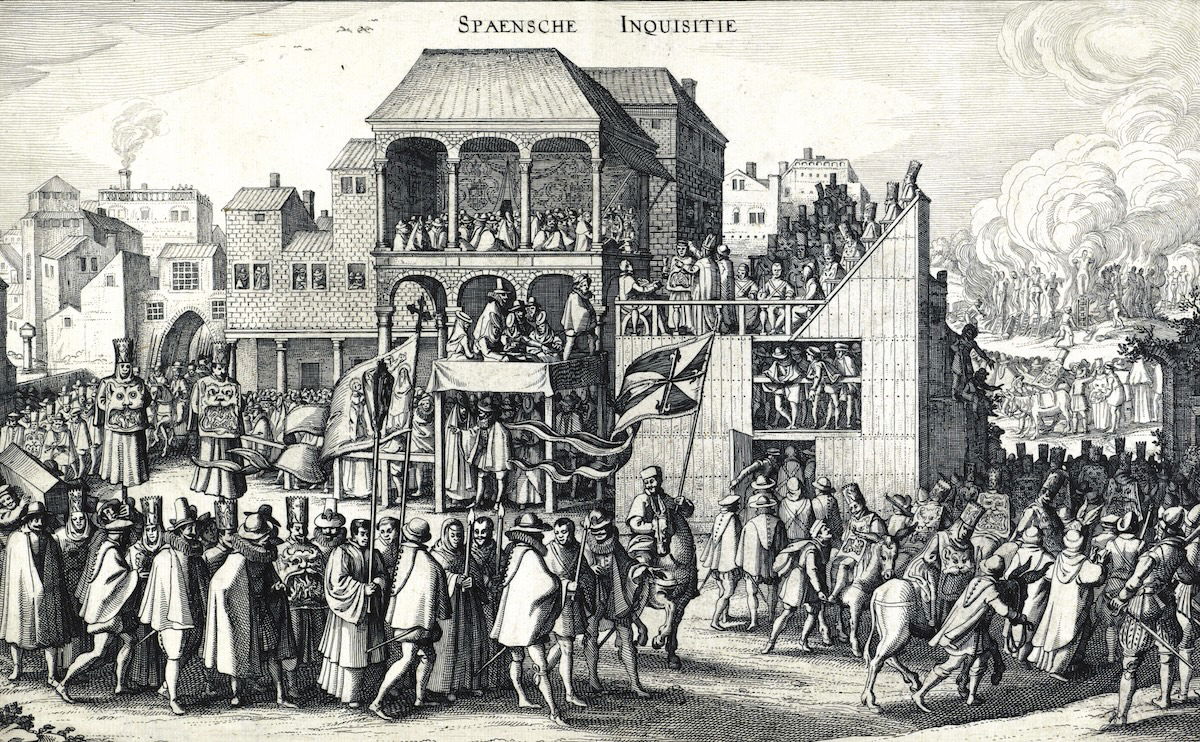
Like all legal institutions, the Spanish Inquisition recognised that justice needed not only to be done but also to be seen to be done. Its public judgments were solemn occasions, as befitted a religious body concerned with the salvation of souls. An auto de fe, or ‘act of faith’, was, in part, a religious procession, possibly designed to mimic the Last Judgement. Autos emphasised penance and reconciliation; many first offenders escaped death by publicly confessing their crimes. This show of mercy was intentionally humiliating. Penitents were forced to wear sambenitos, special garments, which, upon completion of their sentences, would be hung in the parish church to remind them, their offspring and their communities of their crimes.
Register to read more articles for free.
When you register, you will receive the History Today newsletter. Click here to read our Terms of Use.
Like all legal institutions, the Spanish Inquisition recognised that justice needed not only to be done but also to be seen to be done. Its public judgments were solemn occasions, as befitted a religious body concerned with the salvation of souls. An auto de fe, or ‘act of faith’, was, in part, a religious procession, possibly designed to mimic the Last Judgement. Autos emphasised penance and reconciliation; many first offenders escaped death by publicly confessing their crimes. This show of mercy was intentionally humiliating. Penitents were forced to wear sambenitos, special garments, which, upon completion of their sentences, would be hung in the parish church to remind them, their offspring and their communities of their crimes.
The recent discovery of a lost ballad describing an auto de fe – a form of entertainment that appears to be at odds with its solemnity – would be enough to make any auto de fe exceptional. But the two-day autoheld in the small northern town of Logroño in November 1610 has always been considered remarkable. The 53 accused included the Inquisition’s usual targets: blasphemers, fornicators and a contingent of ‘Judaising Jews’, New Christians accused of returning to their ancestral faith. But the vast crowds, possibly as many as 30,000 people, were not interested in them and the ballad pays them no attention. Everyone was there for the 29 Basque witches who, it was said, had committed unspeakable acts with the devil at their sabbats. Historians have long known that the event resulted in two pamphlets; the existence of a ballad had been reported, but it had never been found.
The first day of the auto – Sunday 7 November – was devoted to the so-called negativos, those who had refused to confess their crimes, all six of them witches. Their sambenitos foreshadowed their grim fate: special caps covered with figures of devils and flames. They were released to the secular authorities and executed. Five others who had died in prison were represented by wax statues, accompanied by coffins of their bones – these would join the living on the pyre. Reading the sentences that detailed their horrifying crimes took until nightfall.
The second day – Monday the eighth – intentionally ended on a more uplifting note. With the negativos literally out of the way, the scene was set for a display of mercy for those who had confessed. The sentences of the ‘confessing’ witches were once more so long–filled, as one pamphlet put it, with ‘things so horrendous and dreadful that had never been seen before’ – that daylight was again running out and the inquisitors ordered that the last ones be shortened. With ears still ringing from two days’ worth of wicked deeds and religious exhortation, the audience returned home, ‘crossing ourselves all the while’.
The first page of the Logroño auto de fe ballad, 1611. Cambridge University Library.
For Logroño’s printer, Juan de Mongastón Fox, the auto de fe presented an invaluable commercial opportunity. In early January 1611 he published a pamphlet which described ‘the great evils’ the witches had committed, warning ‘every Christian of the care with which they should watch over their home and family’. When this pamphlet fell into the hands of one of Spain’s leading humanist scholars, Pedro de Valencia, he was so outraged that he wrote to the country’s inquisitor general in protest. He predicted that the pamphlet would only encourage ‘wicked little women’ to fornicate and commit adultery because every other sin would seem mere child’s play compared to the crime of witchcraft.
Mongastón Fox, however, also spotted another opportunity, publishing a second accountin ballad format. By March 1611 the Inquisition’s supreme council had got word of these ‘printed verses’ and ordered the Logroño tribunal to suppress them – not even the Inquisition expected a ballad. This official hostility may explain why only a single copy survives, held today in Cambridge University Library, and perhaps also why there were apparently never any other auto de fe ballads written. The object’s fragility offers a further reason. The pamphlet is only four folios long – like ballads across Europe, it was printed on a single sheet of cheap paper and then folded.
In some ways, this ballad is typical of the European song of death. An opening note, for instance, indicated the popular tune to be followed, but how this went, we sadly do not know. Its 430 lines are octosyllabic, which was Spain’s national meter. In other respects, it is unusual, particularly for its level of detail. The author was clearly paying attention when the (now mostly lost) sentences were read out. Some details underscore the exceptional nature of the Basque witch-hunt itself. The ballad versified about the devil having sex with female witches from the front and male ones from behind:
After the offerings, the devil knows them well, each witch from the front, as truth will tell and every warlock by his back.
It also described the digging up of the bodies of dead adult witches, which the living then cannibalised at the sabbat:
As for the witches who die their flesh is devoured by their peers their bones ground into ointments powders, and sinister brews.
Whereas the lengthy news pamphlets were aimed at a narrower, educated audience, the ballad shows that even the most solemn of public events could not avoid being entertaining. Indeed, by the 18th century autos were likened to bullfighting.
Still, the fact that people were executed for these crimes also made them seem more real. These verdicts and the ballad’s sensational descriptions combined to generate fear and horror. Historians Gustav Henningsen and Lu Ann Homza have both shown how rapidly the witchcraft panic spread in Logroño’s wake; the ballad’s suppression was the Inquisition’s attempt to reassert control in response to this.
The ballad, then, underscores the sensational, multimedia nature of the Logroño auto de fe, which laid bare a nightmarish netherworld of witchcraft to a wide audience. As a musical performance and as an easily memorised text, it may have contributed to spreading the word, and the panic, more than any other report of the event.
Jan Machielsen is the author, most recently, of The Basque Witch-Hunt: A Secret History (Bloomsbury Academic, 2024).