‘It profoundly reshaped our world’
Roger D. Launius is former NASA Chief Historian and author of Reaching for the Moon: A Short History of the Space Race (Yale, 2019)
On 6 May 1970 Dr Ernst Stuhlinger – who had come to the US from Germany with Wernher von Braun’s rocket team after the Second World War and worked at NASA’s Marshall Space Flight Center during the Apollo programme – responded to a poignant letter from Sister Mary Jucunda, a nun serving starving children in Zambia. She asked how he could justify spending on space exploration when there were so many needs on Earth.
Stuhlinger offered a compelling defence, arguing that space exploration ‘will contribute more to the solution of these grave problems’ than many other efforts, emphasising the long-term societal benefits of space research, a concept now widely known as NASA ‘spin-offs’.
These spin-offs have profoundly reshaped our world. One of the most transformative has been global, instantaneous telecommunications – enabled by constellations of communications satellites. NASA launched the first, AT&T’s Telstar 1, in 1962. Today there are 4,823 satellites in orbit. Without them, the internet would be limited, and real-time global news, sports, and countless other services would be far less accessible.
Other satellite technologies have also revolutionised daily life. Weather satellites have made forecasts more accurate, while GPS has rendered traditional navigation methods obsolete. These innovations have fundamentally changed history.
Beyond these technologies, the knowledge gained from space exploration has changed our understanding of the universe and our place in it. We now know the universe is expanding at an accelerating rate, that countless galaxies exist, and that life may not be unique to Earth. I believe we will one day answer the profound question: ‘Are we alone?’ – perhaps even within our lifetimes. And while I may not live to see humanity become a multi-planetary species, that possibility exists in future centuries.
Critics often argue that space exploration is too expensive, especially given Earth’s many challenges. But NASA’s budget has consistently remained under 0.5 per cent of the total US federal budget for over 50 years. Even during the peak of the Apollo programme (1961-1972), it never reached 6 per cent. That small investment is a commitment to the future. It is worth every penny.
‘Space invites competition’
Jahnavi Phalkey is Founding Director of Science Gallery Bengaluru
On the 23 August 2023 India became the first country to land a spacecraft on the lunar south pole, and the fourth to soft land on the moon after the Soviet Union, the US, and China. This is considered a significant accomplishment in space engineering, and represents India’s insistence not to be a negligible force in global politics. Space invites competition. In response to considerations about increasingly ambitious missions, Krishnaswamy Kasturirangan, former chairperson of the Indian Space Research Organisation, said: ‘It’s not whether we can afford it. It’s whether we can afford to ignore it.’
Led by Vikram Sarabhai, the Indian space programme was set up in 1962, within four years of Sputnik and NASA. The Soviet Union and the US put satellites into Earth’s orbit and launched the space age; India joined the frontier explicitly to leverage space technology for national development. Recent missions such as Mangalyaan (Mars Orbiter, 2013), Chandrayaan (Lunar Exploration, 2023), Aditya-L1 (Sun, 2023), and Gaganyaan (Human Spaceflight Mission, 2005-27) have all come on the back of satellite and launch vehicle development started in the 1960s.
India is a vast country with inadequate resources unevenly distributed. The space programme has helped address these problems, and is recognised globally for cost efficiency, and internally for recruiting in ‘Tier 2’ cities and from national engineering schools instead of elite institutions. With the world’s seventh largest fleet of communication satellites, the programme has reached remote parts of the country with weather forecasts, telemedicine, remote sensing, and distance learning. This has increased access to health services, information for agricultural output, and education, with the most iconic example being the Satellite Instructional Television Experiment, which brought informational programmes to rural India between 1975-76.
Today’s focus on space exploration in India is seen by some as a response to China’s space power. Yet the space programme has navigated the tricky terrain between utility – both civilian and commercial – and geopolitics with more success than the Indian nuclear programme. In doing so, the space programme has changed everyday life for millions in the country.
‘Science fiction made spaceflight, and spaceflight made science fiction’
Matthew H. Hersch is Golieb Fellow in Legal History at NYU School of Law
An irony of spaceflight is that the inventors who made it possible were avid consumers of the unreal. Life imitated art as they tried to realise the fin-de-siècle fantasies of Jules Verne and H.G. Wells. Then, in the 1930s, liquid propellant rockets inspired serials such as Buck Rogers and Flash Gordon. Science fiction made spaceflight, and spaceflight made science fiction.
When Soviet and American spacecraft launched after 1957, humanity transformed from a terrestrial species into an extraterrestrial one, whose reach in an expanding universe seemed limited only by imagination and will. Space fiction went mass-market, and the cosmos became a mirror in which societies could gaze at their own idealised reflections. In Star Trek’s 1966 vision of the future, Americans were noble and self-sacrificing: organising the defenceless and protecting the weak. Yet in periods of political turmoil, works like Trek also became ways to tell stories about modernity and alienation too dangerous to share in other genres: the perils of racism, of nuclear warfare, and of AI (see 1968’s 2001: A Space Odyssey).
Once a niche genre, popular culture about space became blockbuster entertainment in the 1970s, a reflection of both what humanity already was and what it might become. To scientists, building colonies in space could offer a shortcut to a more sustainable Earth; to Afrofuturist musician Sun Ra, space was a realm in which the social ills of the past would find no purchase. With the release of Star Wars in 1977, the 1930s space serials finally became cool, not because Star Wars offered unalloyed optimism, but because it dared to offer hints of unease. In the tradition of German Romanticism, Star Wars was a conflict of opposites and opportunity for synthesis: of the ancient and modern, religious and secular, human and non-human. Audiences distrustful of government and captivated by the Human Potential Movement flocked to theatres and learnt that people who ventured into space might become more than what they were – aware, evolved, peaceful Jedi – or less – xenophobic, totalitarian Storm Troopers.
By the 1980s spaceflight was routine, and the idea that life in space might be as awful as life on Earth had taken root. The voyage was not enough; building a better future would require both exploration and personal growth. ‘No matter where you go’, noted fictional test pilot Buckaroo Banzai in 1984, ‘there you are.’
‘Access to space has become a marker of wealth’
Alice Gorman is Associate Professor at Flinders University and Vice-Chair of the Global Expert Group on Sustainable Lunar Activities
Since the establishment of the International Space Station in 1998 there has been a tiny outpost of Earth’s eight billion people living in space. This habitat, and the material culture that astronauts use to adapt to microgravity, can be contextualised in a deep time trajectory. It starts with the first stone tools three million years ago and may end with humans living on the Moon or Mars in the next century.
Space archaeology studies the places and objects that humans have created in the pursuit of outer space. They include launch sites on Earth, space junk in Earth orbit, landing sites on the Moon, and a smear of artefacts abandoned across the solar system.
When we remove Earth gravity as a constant, we find that some objects are invariant no matter where you are in the gravity well. Toothbrushes are one of them. Toilets are not. The aspects of culture that survive in space may reveal more about what it means to be human than studying early human behaviour on Earth.
Objects are also mobilised to represent ideologies. In the early 20th century, the Russian cosmist Konstantin Tsiolkovsky theorised that space habitats would bring about equality, because material markers of status such as feather beds and fancy houses would be unnecessary. Instead, the high cost of gaining access to space has made it a marker of wealth, exemplified by the red sports car Elon Musk launched into solar orbit in 2018.
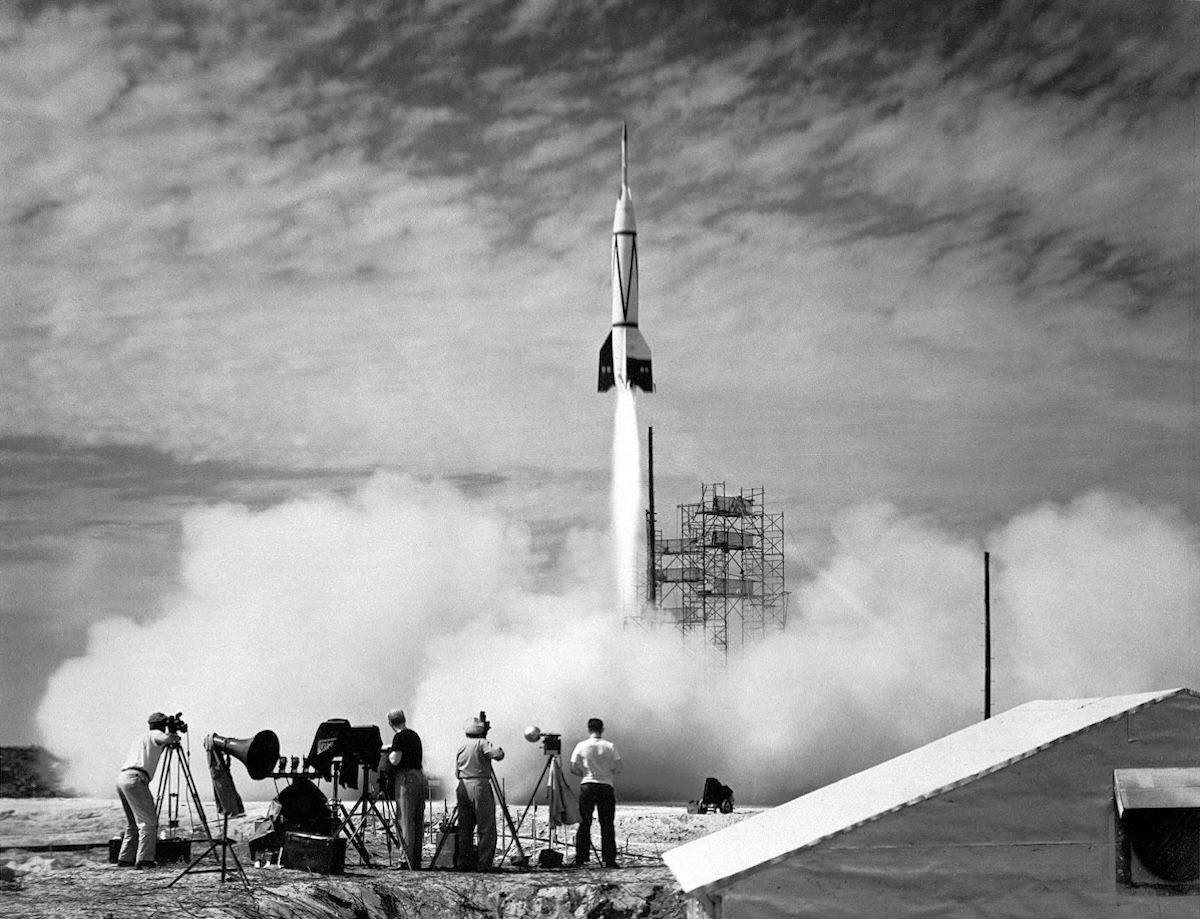
Material culture exposes the difference between the language of peace in the 1967 Outer Space Treaty, meant to prevent territorial claims in space, and the military origins of space technology, which is about defending national interests. The Cold War missiles launched from early rocket ranges were identical to those intended to put satellites into Earth orbit. A high proportion of satellites are ‘dual use’ – delivering both civil and defence services. The archaeological record shows space technology developing from a military ideology, rather than the more egalitarian prewar visions. The material evidence doesn’t support the narrative of human curiosity that we like to tell ourselves.
Today, collisions with space junk are threatening to make Earth orbit too dangerous for spacecraft, and the Moon is about to be carved up for profit. The artefacts left in space reflect the dominant values of the first Space Age.