‘It exposed the extent of the decline of Britain’s influence’
Louise Kettle is Assistant Professor in Politics and International Relations at the University of Nottingham
The Suez Crisis is widely regarded as a pivotal turning point in Britain’s postwar history. Writing in 1963, the historian Elizabeth Monroe famously described it as the end of Britain’s ‘moment in the Middle East’, arguing that four decades of imperial predominance effectively concluded with Anthony Eden’s failed attempt to regain control of the Suez Canal.
Although Britain’s influence had been declining before 1956, the events in Egypt exposed the extent of that decline to British MPs who had been reluctant to acknowledge changing geopolitical realities. Most significantly, Suez demonstrated that Britain could no longer undertake major military interventions unilaterally. President Dwight D. Eisenhower, frustrated by the lack of prior consultation and angered by the operation’s timing during his re-election campaign, exerted considerable pressure on the British government to halt the intervention. An internal Foreign Office assessment subsequently concluded that Britain could ‘never again resort to military action, outside British territories, without at least American acquiescence’.
Suez also revealed the fragility of Britain’s postwar economic position. Military action triggered pressure on the pound and compelled the government to seek support from the International Monetary Fund. Eisenhower encouraged the IMF to withhold support until Britain agreed to a ceasefire. Eden later reflected that ‘we must review our world position and our domestic capacity more searchingly in the light of the Suez experience, which has not so much changed our fortunes but revealed our realities’.
During the following decade these strategic and economic constraints, combined with the rise of Arab nationalism, prompted a reassessment of Britain’s role east of Suez. By 1967 the government had announced plans to withdraw from the region, a process that culminated in the independence of Bahrain and Qatar and the formation of the United Arab Emirates, accompanied by an expanding American presence in the region. From a British perspective, therefore, the Suez Crisis changed the world by accelerating its transition from imperial power to junior partner of the United States in the Middle East. The consequences of this shift continue to be felt today.
‘There was no grand American plan to take control of the Middle East’
Nigel Ashton is Professor of International History at LSE
When Israel, in collusion with Britain and France, moved to attack Nasser’s Egypt in October 1956 the response of the United States was decisive. The Eisenhower administration led the diplomatic charge at the United Nations to force a ceasefire on its closest allies. At the same time, the US refusal to bail out Britain when the pound came under speculative attack on the foreign exchanges generated financial pressure which ultimately proved vital in persuading Eden’s government to halt military action. Britain’s moment in the Middle East appeared to be over, with time called by its closest ally in Washington.
The promulgation of the Eisenhower Doctrine in January 1957 – which proclaimed the United States’ readiness to come to the aid of any nation in the Middle East threatened by another controlled by the forces of international communism – seemed to put the seal on a new era of American hegemony in the region. But appearances can be deceptive. There was no grand American plan to take control of the Middle East. Circumstances, in the shape of Eisenhower’s re-election campaign, the Soviet invasion of Hungary, and the underhand Anglo-French-Israeli collusion plan – which involved Britain and France pretending to have no foreknowledge of the Israeli attack and intervening as ‘peacekeepers’ – dictated the US response to the Suez Crisis. The Eisenhower Doctrine proved to be a damp squib. When the administration decided to respond to an appeal for help from the Lebanese president Camille Chamoun in July 1958 – who feared for his overthrow following the 14 July Revolution in Iraq, which was itself precipitated by Suez – it concluded that the Doctrine was inapplicable. It intervened instead under the terms of the United Nations Charter. Moreover, the manner of intervention, with armed marines storming in over the main pleasure beaches of Beirut to be met not by armed insurgents, but watching bathers, showed that the US still had a lot to learn about the dynamics of the region.
The US did eventually emerge as the new hegemonic power in the Middle East. However, that shift was not an immediate result of Suez, but of a longer process of change culminating in the 1990-91 Gulf crisis which ushered in America’s own moment in the Middle East.
‘Arab nationalism appeared to be the force of the future’
Fawaz A. Gerges is Author of Making the Arab World: Nasser, Qutb, and the Clash That Shaped the Middle East (Princeton University Press, 2018)
It was transformative in many ways. It exposed the collapse of the old European imperial order, accelerated the rise of the United States and the Soviet Union as the dominant external superpowers in the Middle East, and, while it did not create Arab nationalism, it propelled it to the height
of its influence.
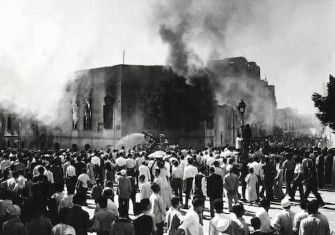
Having been formally elected as Egyptian president on 23 June 1956, Gamal Abdel Nasser announced the nationalisation of the Suez Canal – a potent symbol of Western domination since its construction in the mid 19th century – just over a month later on 26 July ‘on behalf of the Egyptian people’. ‘Operation Musketeer’ – the attempt to regain control of the waterway and overthrow Nasser – failed spectacularly. The Eisenhower administration, furious that its allies had acted behind its back and fearful that the invasion would give the Soviet Union a foothold in the Arab world, forced their withdrawal. The intervention thus accelerated the very geopolitical decline it had sought to arrest.
In the Arab world, however, Suez had an altogether different meaning. Nasser snatched a stunning political victory from the jaws of defeat. His defiance transformed him almost overnight into the symbolic leader of the Arab world. Suez showed that an Arab state could challenge the colonial powers and win.
Nasser skilfully harnessed this moment to the ideology of pan-Arab nationalism, presenting Arab unity, sovereignty, and independence as parts of the same historic struggle: ‘The whole Arab nation will stand by us in our common fight against aggression and domination.’ His prestige surged from newly independent Morocco to Iraq, unsettling conservative monarchies and inspiring nationalist movements. The United Arab Republic – a political union between Egypt and Syria – was declared in February 1958. The overthrow of Faisal II in Iraq that July was carried out by officers emboldened by Nasser’s success.
Until Egypt’s devastating defeat by Israel in the Six-Day War in June 1967, Nasser remained the most powerful symbol of revolutionary Arab politics. Suez was therefore a classic example of the law of unintended consequences: an attempt to destroy Nasser elevated him and, for a generation, made Arab nationalism appear to be the force of the future.
‘Europe was plunged into an energy panic’
Guy Laron is Author of Oil Wars: The Struggle for Control That Has Shaped the Modern World (Yale University Press, 2026)
The Suez Crisis was the world’s first oil supply shock: never before had a chokepoint critical to the oil trade been shut overnight. As soon as British and French planes began dropping bombs on 31 October Egyptian crews scuttled ships in the canal. Europe was plunged into an energy panic.
Europe’s dependence on the canal had been established decades earlier. Oil climbed from 2 per cent of total Suez traffic in 1913 to nearly 25 per cent by 1938. During the First World War militaries became convinced of oil’s superiority over coal. In the 1920s this spread to the wider economy. By the late 1920s Europe had moved from being a net exporter of energy, mostly coal, to a net importer, due to its growing reliance on oil.
This process accelerated after the Second World War. Coal, which had supplied more than 90 per cent of Europe’s energy in 1939, was in critically short supply. Wartime destruction, overworked coalfields, and labour unrest meant coal could not sustain recovery. Oil was the solution and it became abundant just as coal was becoming scarce. Between 1944 and 1950 Saudi Arabia’s daily output exploded from 21,000 to more than 540,000 barrels. Oil was the single largest item on the Marshall Plan’s budget, accounting for between 10 and 12 per cent of its funds. By the mid-1950s Europe relied on the Middle East for 90 per cent of its oil. Half of that passed through the Suez Canal.
By November 1956 Europe was living with the dire consequences of the canal’s closure. Britain, France, and Denmark all imposed oil rationing; Belgium, the Netherlands, and Switzerland banned driving on Sundays. The US had the power to alleviate Europe’s predicament but was in no hurry to do so. Eisenhower was furious with London and Paris; only after they accepted his demand to withdraw from Egypt did the US begin an ‘oil lift’ from the Americas and the Caribbean. For Europe, the lesson was brutal: its energy future lay in American hands. The following attempt to diversify suppliers meant turning increasingly to the Soviet Union, a trend which led to the dangerous dependence on Russia that we see today.
As to the canal itself, almost five million barrels move through it daily. It remains incredibly profitable. This August alone, Egypt’s earnings reached $567 million. This explains why it was worth fighting for in 1956.