

Guy Fawkes and the Gunpowder Plot
S.M. Toyne draws upon Guy Fawkes’ background in an effort to better understand his single-minded motivation.
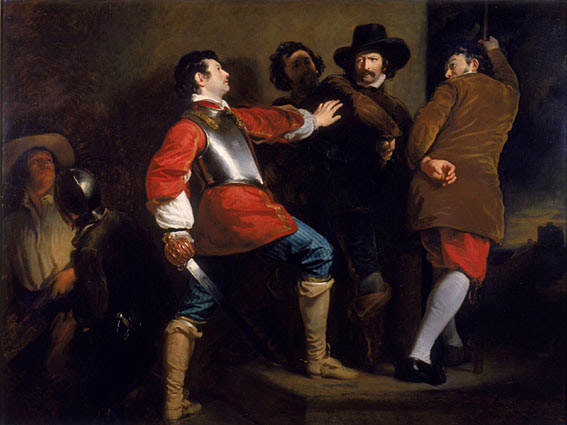 Despite its failure, the Gunpowder Plot has caught the popular imagination more firmly than any other plot in history; while Guy Fawkes, though not its prime instigator, has gained a notoriety out of all proportion to his achievements.
For many years the State kept alive the memory of “The Powder Plot” by a special “State Service” of Thanksgiving, attached to the book of Common Prayer. The “Gunpowder Treason Service” was ordered to be read by an Act of Parliament and additions were made to it in 1690, to include the landing of William III on November 5th 1689 in England as the second gracious deliverance by the Almighty from the Papists.
Described as verbose, below the liturgical standard of the Prayer Book, full of political opinions, and extravagant in the expressions of loyalty, this service was removed from the State Services in 1859 by Royal Proclamation in answer to a petition from Convocation and Parliament. Curiously enough, however, the number of bonfires, especially in the north of England, tended to increase and became the expression of a vague thankfulness for deliverance from some unspecified disaster.
At the very outset, indeed, only the barest details of the plot were known either to the Government or to the general public. Official knowledge went little beyond the fact that Guy Fawkes had undertaken to blow up the King and his Lords when Parliament assembled on November 5th 1605, and next year the Government published “a true and perfect relation” of the conspiracy, which was translated into Latin for Continental consumption. A clever piece of propaganda, it set out to demonstrate that the nation owed much to the care and vigilance of Sir Robert Cecil (created Earl of Salisbury in 1605), asserted that Spain, with whom England had made a political and commercial treaty in 1604, had nothing to do with the plot, and cleared Rome of complicity; but the main instigators were erroneously declared to be the Jesuits and a party of desperate traitors, thwarted by the divine inspiration of King James I.
Until Lingard gave a lucid account in his History published in 1841, historians made few attempts to increase our understanding. But, although he used two hitherto untapped sources, even Lingard did not satisfactorily explain how the conspirators hoped to achieve lasting success, and why they continued with their design after they had learned that they had been discovered. Lingard tells us that Catesby was burning for “revenge”, and that Fawkes was an honourable man who, once he had made a promise, however remote the chances of success, would do his best to carry it out. This may be true enough, but it does not suffice. Gardiner answered Gerard’s deeper study “What was the Gunpowder Plot?” in a brilliant monograph entitled “What the Gunpowder Plot was”.
Having unravelled many difficulties, he proved conclusively three things: Salisbury had no knowledge of the plot until he was shown a letter read aloud at Monteagle’s dinner party: the majority of English Catholics were unaware of any conspiratorial movement; Rome, Roman priests in England and the Jesuits can in no way be called instigators – in fact, probably no one except Fathers Garnet and Greenway had any knowledge of it, and they had only a vague notion obtained through the confessional. Gardiner’s account is the undisputed authority on the facts as ascertained; but it would have been doubly interesting if he had produced a further monograph on the more speculative theme “What the Gunpowder Plot was meant to be?”
Can we solve this problem by an examination of the backgrounds and lives of the conspirators? The story of the events preceding the failure of the plot may be briefly summarized, for they have never been challenged except in some minor details. The chief conspirator was Catesby, who seems to have broached the idea of blowing up the whole executive Government of the country to Thomas Percy and Thomas Winter as early as March 1604. Percy and Winter were somewhat horrified, and argued that it would be of greater benefit to the English Catholics if relief could be procured by the peaceable intervention of Philip III of Spain, who was then making a political and commercial treaty with England. With this end in view, Winter visited Flanders, hoping to induce the Constable of Castile to persuade Philip III to bring pressure on James I.
During his visit Winter renewed his acquaintance with Guy Fawkes, whom he had previously met in Madrid when he had accompanied their friend, Christopher Wright, to Spain. Winter, who had been given a good account of Fawkes’ ability and integrity, persuaded him to return with him to England in May 1604, where, in the presence of Thomas Winter, Thomas Percy and John Wright, Catesby outlined his plan to Fawkes, who shortly afterwards returned to the Netherlands to discover the progress of the Spanish negotiations. The report he received gave no encouragement. On the strength of the Anglo-Spanish treaty, Philip III had informed James that relief to the Catholics* in England would give him great pleasure, but the English King had replied that it was quite impossible for him to put any proposals for the relaxation of the Recusancy Acts and other anti-Papist laws before his Parliament. Thus died the hope of gaining relief by peaceful means.
It was on May 24th that Fawkes’ associates leased part of Whynniard’s block of houses adjacent to the Parliament house. The number of conspirators was kept as small as possible; but Oswald Tesimond (alias Greenway), Christopher Wright, Oldcome, Keyes, Robert Winter and John Grant were gradually added to the list. At a much later date in 1605 Ambrose Rokewood, Sir Everard Digby and Francis Tresham were induced to join them and take the oath of secrecy, chiefly because the conspirators were short of funds and the postponement of the opening of Parliament to November 5th 1605 had made their need of money still more urgent. Of these men Catesby was the most violent and ready to entertain any wild scheme of revenge on the Protestant Government.
The common bond that united the plotters was a desire to secure tolerance for the English Catholics and the abolition of the. cruel recusancy fines, which in many cases amounted to £20 a month. Their attitude was well-known as early as 1596, when, among others, Catesby, the two Wrights and Tresham were arrested as a precautionary measure during an illness of Queen Elizabeth; and, as Gerard points out, since that time they had not improved their record, for all of them, besides Thomas Winter, Christopher Wright, Percy and John Grant, had been engaged in the ill-starred rebellion of the Earl of Essex.
Except Tresham, all were smarting under fines, or the memory of imprisonment, but had hoped for toleration on the death of the Queen. If James had kept his word there might have been no plot. Thomas Percy, a dependant and probably a kinsman of the Duke of Northumberland had visited James in Edinburgh and toleration had been promised. Since his accession James had also twice – in June and July 1603 – promised remittance of the recusancy fines; but the promises were not fulfilled, and furthermore, on February 22nd 1604, a proclamation was issued banishing all priests.
In July, under the influence of Cecil, who had made much capital out of his anti-Papist zeal, a new and harsher Recusancy Act was passed. During the following August, an epidemic of arrests and many executions set the conspirators working feverishly on the tunnel from Whynniard’s house in the direction of the House of Lords. None of the conspirators, it is important to understand, was a person of great standing. Rokewood and Tresham were men of substance, but of little influence. Sir Everard Digby, however, exercised some local authority in his county, having been a member of Queen Elizabeth’s household, and possessed wider social connexions; and it is true that both Percy and Tresham, whose sister had married Lord Monteagle, had the entrée to Court society. Their plan, as handed down, was, after the death of James I and the talented and popular Henry, Prince of Wales, to secure Charles, Duke of York, and his sister Elizabeth.
In the tumult that followed the explosion, these comparatively obscure and uninfluential men were to proclaim Charles King and thus make it clear that they were not warring against England but merely against the faithless James I and his intolerant minister. We are asked to believe that this was the extent of the plan, and that a handful of desperate men intended to seize the Tower and dominate London. That this was part of the plot rests on very slender evidence, given in a confession, that they were “to make friends with the prisoners in the Tower”. It would have been an obvious move, while a nucleus of gentry in the West Midlands held the country, until the new King had set up a government which graritedtoleration to the English Catholics.
It will be noticed that the man now popularly identified with, the Gunpowder Plot – Guy Fawkes – has hardly been mentioned, but I should like to suggest that in him and his career lies our hope of establishing the true intention behind the plot. His mysterious visit to the Low Countries in April 1605 has not yet been properly considered. In Fawkes’ second confession on November 8th, his last confession before torture, in which he did all he could to shield others, he explains his visit as due to the fact that “being a dangerous man he should be known and suspected This is manifestly untrue, for later he was specially chosen to supervise the storage and ignition of the gunpowder because, having spent his life out of England since 1691, he was unknown in the country. His examiners, including Coke, the Attorney General, did not discover that he was not “Jon Johnson, servant of Mr. Percy”, till three days after his arrest.
As we shall see, his visit had quite another purpose. Believing that Parliament was to meet in February, the conspirators began to dig their tunnel or “mine” on December nth, but they soon found out that their task presented unexpected difficulties. They could only work at night, and all rubbish had to be secretly disposed of before daylight. Then, just before Christmas, they encountered the nine-foot-thick stone foundations of the House of Lords. It must be remembered, of course, that the workers were gentry with no experience of digging, and that the only exception was Guy Fawkes, who had witnessed, and probably taken part in, siege mining operations during his military career abroad.
To their relief, they heard that Parliament would not meet until October and, subsequently, of a further postponement until November 5th. Worn out by their exertions, the unpractised diggers rested for three weeks, but resumed their hard and hopeless task about January 18th. Meanwhile, Catesby had managed to procure a commission to raise “a troop” to fight on the continent for the Archduke; and under this pretext he began to purchase horses and “armour” which were gathered in small groups in various parts of the West Midlands. The number of horses and arms is not known; nor is there any reliable evidence how many men were enlisted.
On February 10th the information that it was hopeless to expect any relief from the Recusancy Act – for James on that date enjoined that it should be enforced in all its rigour – apparently spurred them to further action. They had begun to despair of the tunnel; by early February they were only halfway through the wall, and every yard their progress was slower and more dangerous. But by a stroke of good fortune they learned that a cellar, situated just under the House of Lords, was to let. This they hired, ostensibly as a store-house for firewood and coal; and bag by bag the gunpowder was carried there and hidden under faggots. When, about April, their task was completed, the conspirators dispersed to avoid suspicion and agreed to meet again some time in September or October to arrange the final details. Fawkes alone left England. Catesby bought more horses. It is not clear, in the early stages, who paid for Catesby’s purchases; but we do know that the mounting costs proved very embarrassing, until the wealth of Tresham and Rokewood could be drawn upon. We also know that private questions were asked why Catesby and his troop delayed their departure.
About June, some of the plotters began to feel qualms as to the consequences of their act, which was bound to destroy many innocent people as well as the intended victims; and, to allay their scruples, Catesby put a hypothetical case to Father Garnet, the Jesuit Provincial, who replied that in certain cases, so that justifiable ends may be attained, the innocent may have to suffer with the guilty. This seems to have been sufficient to hold the conspirators together for a while, though the preparations for the period immediately after the extirpation of the King and his ministers were still vague and ill defined. Meetings of horsemen were to be arranged at Huddington and Holbeche House to raise the country against the tyranny of James I.
But was England conscious of oppression? Would the people regard these insurgents as deliverers? Could the comparatively few horses gathered together mount a sufficient number of men to be effective? Who were to be the leaders? The authors of the great design were practically unknown. So the plot simmered on until October, when Tresham was told of its full implications and was shocked to, learn that his brother-in-law Lord Monteagle was to be blown up among the rest.
Disclosing his sense of guilt, he suggested that their object might be attained without the deaths of so many innocent men, including English Catholics. But Catesby and “the inner circle” declined to give way; and Tresham devised a clever method of escape from his dilemma. He might, he considered, avert the assassinations without implicating his associates, and to attain this end he was ready to ignore the original idea of bettering the lot of the English Catholics. His sub-plot would have worked out perfectly had not the other conspirators refused to take the opportunity, which Tresham without their knowledge had cleverly engineered for them.
Apparently he confided in Lord Monteagle who, having opened his house at Hoxton on October 26th, gave an unexpected dinner party there. This party was interrupted by a messenger, declaring that he bore an important despatch for the host. Instead of reading the letter himself, Lord Monteagle broke the seal and handed it to one Ward to read aloud – an extraordinary action if he was not already aware of its contents. The letter almost certainly written by Tresham with the connivance of Monteagle himself, gave this warning: “I would advyse youe As youe tender your life to devyse some excuse to shift of youer attendance at this parlement... this cowncel is not to be contemned because it may do youe good and can do no harme for the danger is passed as soon as youe have burnt the letter.”
Gardiner holds that by the reading aloud of this letter Tresham and Monteagle hoped to produce a double effect; the catastrophe might be avoided on the one hand; and, on the other, if Ward at once informed the conspirators that a warning, however vague, had been received, they might flee the country. This Ward did; and, as no names were contained in the letter, the plotters could have escaped or abandoned their plot without discovery. Except for one, every detail worked out as arranged. Monteagle showed the letter to Salisbury, who was puzzled and held his hand.
But the one detail in which it did not work out was the most important. The conspirators did not abandon their project and, though Tresham left London and did not return until October 30th, the others remained for a week. On November 2nd Catesby considered it was time to set out for Warwickshire. Percy left London early on Monday, November 4th; and by noon of that day only Fawkes and Tresham remained, unless we believe Winter’s own account that he delayed his departure till 5 a.m., November 5th, when he heard “some one say, there is a treason discovered.” Then he, too, dashed off to Dunchurch “on his gelding”. Here, then, is the problem before us. Why did Fawkes remain?
The reasons, I suggest, are these. Firstly, he considered, correctly enough, that no names or particulars of the plot had yet come to light, arguing that, if they had been, some action would have been taken between October 26th and November 4th. His assumption was not altogether sound – the government might be giving the conspirators more rope on which to hang themselves; but his opinion had some justification, since the Lord Chamberlain visited Whynniard’s house, in which was the gunpowder covered by coal and faggots, during the morning of November 4th. Fawkes played the role of “Johnson” the servant of Mr. Percy and said the coal belonged to his master; and any suspicion that may have been aroused was apparently laid to rest.
Secondly, Fawkes’ part in the plot was clear and he seemed to have a good chance of causing the confusion which was one of the main objects. Thirdly, the full plan as I see it – that is to say, a combination of the Catesby plan with one evolved during Fawkes’ visit to the Netherlands in April 1605 – was as likely to succeed on November 5th as it had been earlier in the year. The destruction of Parliament was only part of the scheme; but it was an important part and Fawkes’ responsibility; therefore he must carry it through. He was not the man to desert his post. Then, at the supreme moment of his life, a second visitation to the cellar at 11.55 p.m., November 4th – caught him unawares.
Casks of gunpowder were found beneath the faggots, and “Johnson”, the servant of Mr. Percy, was arrested. The other conspirators reached the rendezvous at Dunchurch, where a hunting party had been arranged by Sir Everard Digby; but, when they raised the standard of revolt, the response was not what they had expected. To talk against the King and his ministers was a very different matter from joining a band of gentry, however well mounted and armed; and those who had assembled began to drift away. The leaders went West with such arms and men as they could muster, till, on November 8th, they were rounded up at Holbeche in Staffordshire, where Catesby, Percy and the two Wrights were killed. It was a queer reunion for the Yorkshire schoolfellows. Finally all those suspected of complicity in the plot, except Greenway and Gerard, were arrested and put on trial.
Their failure was due to the miscalculation of English Catholic opinion as a whole and to their belief that Philip III would fall in with the second part of their plan, based on the expectation of Spanish help which Guy Fawkes had believed that he had secured through the offices of Sir William Stanley on his visit in April. The grounds for the belief will be examined later; but two points require explanation or this theory cannot hold good. Firstly, as already stated, James categorically denied that Spanish aid was expected. This is presumptive evidence that the government had information such a possibility did exist. If that is so, the reason for the denial must be established. James was a peace lover, and his own theory was that an alliance between the most powerful Catholic and Protestant nations would enforce peace on Europe.
It sounds rather fanciful to us now, bred as we are on the story of Spanish and English struggles before and after the Armada; but it must not be forgotten that Anglo-Spanish trade agreements had come into existence not merely to promote trade, but to keep the peace in the New World. James’ notion was to revive and extend to Europe the range of this type of agreement. It probably could not have been put into execution before Salisbury’s death in 1612; since Salisbury was strongly anti-Spanish and much of his power was built on anti-Papist hatred and fear. Nevertheless, it was not the time for a break with Spain, and both king and minister had good reason to suppress the complicity of Spain in the rising. A massive dose of anti-Jesuit propaganda, based on the priests’ part in the attempt, would serve Salisbury just as well and would not antagonize Spain.
Secondly, the fact that Fawkes did not mention the possibility of Spanish aid in his evidence is in strict accordance with his behaviour throughout the examination. It would have involved others, Sir William Stanley, Tresham, Winter, Garnet, who, so far as he knew, were not suspected. On November 29th Tresham did mention the Spanish negotiations in which he and Garnet had been involved, but shortly before his death he denied the truth of his own statement. The reason for this denial is obscure. Was it to defend Garnet, or was it at the suggestion of the government, which did not want Spain to be involved? Strangely enough, though a bill of attainder was brought against him posthumously, Tresham was not convicted of any crime and died a natural death on December 22nd.
To find clues to Fawkes’ action, and the foundation for his belief that Spain was sending assistance, we must examine the fascinating and yet almost disregarded life of Guy Fawkes, and his connexion with Sir William Stanley, Guy Fawkes was the son of Edward Fawkes. Proctor and then Advocate of the Consistory Court at York – an undoubted Protestant – and in 1570 was baptized at St. Michael-le-Belfry. He entered St. Peter’s School, York, in 1578; and it is most significant that four other conspirators were at this school at the same time – Oswald Tesimond (alias Greenway), John Wright, Christopher Wright, and Oldcome, while Thomas Percy married Martha the sister of the Wrights. In the official account which Salisbury sent on November 9th 1605 to Cornwallis, our Ambassador in Madrid, he named Johnson (Fawkes’ assumed name) and Thomas Percy as the “principal undertakers”.
The headmaster of this Protestant School was a noted man named John Pullen; but in 1591 he was succeeded by Bayles. Two years later John Pullen, “the old master” and Mr. Oldcome were named as suspected Jesuits, and it seems reasonable to assume not only that his young pupils had been greatly influenced by his teaching, but that Guy Fawkes and the others were firmly convinced that the majority of Englishmen were at heart Catholics longing for emancipation. When Fawkes’ mother married for the second time, the family went to a staunch Catholic “cell” at Scotton, where Guy remained until he reached the age of twenty-one. He then sold his property – on part of which St. Peter’s school now stands to Anne Skipseye and with the proceeds set out to fight for the Spaniards in the Netherlands. Another significant fact is that this year, 1591, was the date of Pullen’s disappearance from York.
Had Pullen inspired young Fawkes? We cannot tell; but it is easy to picture the eager zeal of this honest and single-visioned young man, who had sold his patrimony to fight in the cause of his religion. Whether he became an avowed Papist before 1591 is unknown; but his stepfather and his friends at Scotton were undoubtedly known as such and he was at once received into the force of Irish and English Catholics fighting in the Netherlands. Their leader, Sir William Stanley, was a remarkably fine soldier and an unusually interesting character who, although brought up as a Catholic, had served Elizabeth in Ireland with distinction, and subsequently raised a force of Irish to fight under Leicester in the Netherlands. After Zutphen, he was given a definite command at Deventer but, in 1587, without any warning, went over to the Spaniards.
During the same year Sir William visited the court of Madrid and urged Philip II to adopt his plan for the invasion and emancipation of England. Provided England desired to be emancipated, it was undoubtedly a far sounder plan than that adopted by the Spaniards in the following year. Briefly it was this: While the Spaniards held Milford Haven, just as the English had held Calais for centuries, the Spanish fleet would command the Irish Channel; and Ireland, ever ready to start a rebellion or an offensive movement against England, would act as a useful base a glance at the main roads on a modern map shows how simple the entry to England would have been from Milford. Along the forked roads leading from Llandovery to Builth and Brecon, troops could move easily into Herefordshire, Warwickshire, Staffordshire and Worcestershire, counties reputed to be full of Catholic gentry waiting for outside help. When Philip II rejected the plan, Sir William Stanley returned to the Duke of Parma’s troops in the Netherlands; but the scheme lived on in his brain. The failure both of the Armada and the Spanish plan which superseded his may possibly have strengthened his faith in the scheme that he had put forward.
Here lies the key to the subsequent actions of the single-purposed Guy Fawkes. In 1596 he distinguished himself at the Siege of Calais and became the friend of Sir William Stanley. The next linkin the chain is not hard to establish. Ideas were exchanged, and Guy Fawkes, judging from his narrow Yorkshire circle, misinformed Stanley of the Roman Catholic tendencies of England, while his own imagination was fired by Stanley’s discarded plan. No sooner had Philip III come to the throne in 1598 than Guy Fawkes, Winter and Stanley tried once more to enlist Spanish sympathy in the old scheme. The failure of the Irish rebellion (in 1598) had made Philip wary; but in 1603 Fawkes and his old schoolfellow “Kit” Wright visited Madrid to impress upon the King the advisability of striking before James I was firmly seated on the throne. Again the King hesitated, but in 1604 further links to the chain were added.
Tesimond, now called Father Greenway, could report definite progress among the Catholic adherents in Warwickshire and intense irritation among all English Catholics, since James had already broken his promise of toleration. In May 1604, Winter met Fawkes in the Netherlands; and, on a secret visit to England, Fawkes was informed that Catesby, who had suffered for his participation in the Essex rebellion, had formulated a plot to destroy the King. Guy Fawkes was drawn into it at once and saw the opportunity of uniting the Catesby and the Stanley plans. With this end in view he travelled back to the Netherlands to inform Stanley – surely the real object of the visit in 1605. Though, unfortunately for him, his old chief was still in Madrid, a man named Hugh Owen – not a priest as sometimes stated – promised to acquaint Stanley of the design on his return, and to get him to enlist Spanish aid and sympathy.
Fawkes relied on Stanley’s being able to move the Spanish King, now that an upheaval in England seemed imminent; and Spanish aid, even if delayed, would enable the conspirators to consolidate the new regime. The Spaniards would have four months to make their preparations. That the scope of the plot was bigger than merely blowing-up the House of Lords is certain, and evidence is almost complete to show that the chief conspirators’ scheme was based on two misconceptions – that England was Catholic at heart, and that Spain would lend assistance if an English rising first occurred.
This theory fits in well with all we know of Guy Fawkes. He was a brave and resolute man, who had made the emancipation of the English Catholics his main purpose in life, sold up his patrimony and fought against the Protestants. He possessed, however, a single-track mind, and was a victim of wishful thinking. In the Netherlands, by Stanley and others, he was held in high esteem, but in England itself he was obscure and without influence. Catesby – impetuous, rash, unscrupulous – saw in Fawkes the ideal agent: and between them they convinced one another of the feasibility of holding out, after the annihilation of the King and his Lords, until the Spanish aid had arrived and the English Catholics could be restored to their rightful place in the country.
King James has been credited with suggesting that gunpowder might be used, and though his forecast, in accordance with the tradition of the time, was ascribed to Divine inspiration, a more prosaic age might suggest that his Royal Majesty had not forgotten that this father Lord Damley had met his death through an explosion. Be that as it may, “John Johnson, servant of Mr. Percy” was discovered and is annually remembered for his failure, whereas, had he succeeded, the name of Guy Fawkes would soon have been forgotten, since leadership of the subsequent revolts would probably have been assumed by others. What else might have happened it is hard to say – as hard as to resolve such time-honoured problems as Hannibal’s fate if he had marched on Rome or Napoleon’s destiny had he won the battle of Waterloo. Even had the plot succeeded, there was little likelihood of Spain taking action. But a short period of civil war might well have led to a broader based government under Charles I.

