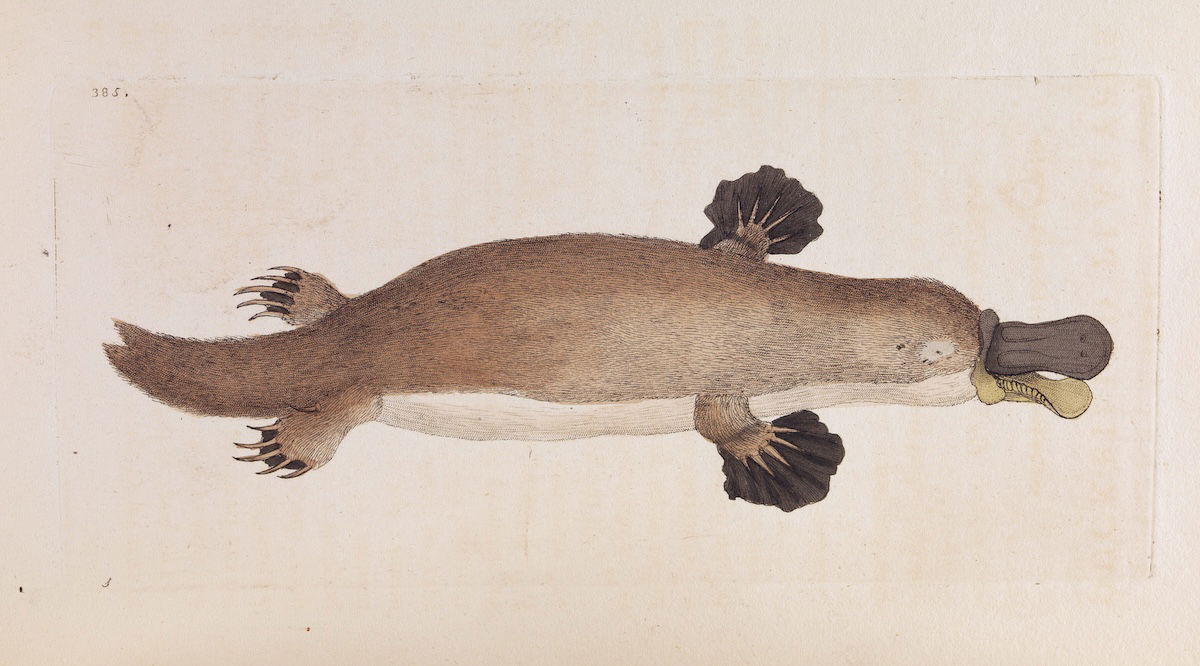
Platypus – Greek for ‘flat-footed’ – may sound a derogatory name, but that was the least of the problems encountered by these small mole-like creatures from Australia. When the British Museum received its first specimen in 1799 the curator, George Shaw, was convinced that it must be a fake and attacked it with a pair of scissors in a failed attempt to detach the beak. Even when persuaded the animal was genuine he remained baffled, expostulating that of ‘all the Mammalia yet known it seems the most extra-ordinary in its conformation’ – and despite that reference to a mammal, the scientific label he devised suggests he thought it was a bird: Platypus anatus (anatus is Latin for ‘duck’).
Three years later in Germany, renowned anatomist Johann Blumenbach reached a different conclusion. When a skin arrived from John Hunter, governor of New South Wales, Blumenbach denigrated it as Ornithorhynchus paradoxus, or ‘paradoxical bird-snout’. Debates about its identity proliferated as zoologists tried to accommodate this Antipodean discovery within an outdated European classification system. Eventually they settled on a permanent, if somewhat unsatisfactory, name. Two conventions came into play: platypus had to be jettisoned because it had already been adopted for some recently discovered beetles; and paradoxus also had to go, because taxonomic courtesy entailed standing by the initial nomenclature. The cumbersome compromise was Ornithorhynchus anatinus, which at least side-stepped the problem of remembering the appropriate plural of platypus (platypuses, not platypi).
For decades, question marks hovered over the nature of the beast. Newcastle engraver Thomas Bewick is best known as an ornithologist, but he neatly summed up the quandary, remarking in 1800 that it was ‘an animal sui generis; it appears to possess a three-fold nature, that of a fish, a bird, and a quadruped, and is related to nothing that we have hitherto seen’. Fascinated yet puzzled, 19th-century scientists competed to unravel the mystery. Charles Darwin was thrilled to be included in a successful hunting expedition, although he did boast rather chillingly that ‘I consider it a great feat to be in at the death of so wonderful an animal’.
Appalling numbers
Traditional classification systems had been bursting at the seams ever since new species began arriving in Europe from the Americas. Under the old Aristotelian scheme, terrestrial life had been arranged in a single hierarchical chain that lay stretched out between inanimate minerals at the bottom and supra-human angels at the top. At the lower end of this ladder lay plants, followed in ascending order by insects, fish, and birds before reaching the quadrupeds; above them, the upper rungs were occupied by primates and, finally, human beings.
That neat simplicity was being challenged long before the egg-laying, duck-billed, warm-blooded enigma appeared on the scene. Mammals, generally the most emotionally and economically significant animals for people, were often differentiated as ‘viviparous quadrupeds’, characterised not only by moving around on four feet, but also by giving birth to live offspring and dwelling on land. That solution provided a sensible way of distinguishing them from four-legged lizards and salamanders that lay eggs – but what about whales and walruses with no feet, or bats that have two wings and only two feet? For hundreds of years, several anomalies were included as if they were honorary quadrupeds.
Whenever explorers triumphantly brought home exotic treasures from distant lands, they somehow had to be absorbed within this imperfect system. In the first half of the 18th century the number of species doubled from 150 to 300 – and by the end of the 19th century more than 1,000 new genera (each potentially including multiple species) were turning up each year. As a writer in Nature put it, this was ‘a simply appalling number’. Marsupials – opossums from South America and kangaroos from Australia – presented particular problems. If possessing a pouch was the main defining criterion, perhaps they could be squeezed in between bears and weasels? On the other hand, if feeding habits were more important, then opossums should be grouped with carnivores and kangaroos with ruminants.
The term quadruped gradually faded away as mammal was perceived to be a more useful concept. But that made it even more difficult to determine the status of the platypus, which was reputed to lay eggs but also to suckle its young. One defiant protagonist declared himself undefeated:
from the want of mammae, and from the structure of the sexual organs, the naturalist surely cannot, with any degree of propriety, arrange this animal with the Mammalia; and very few will be hardy enough … to think of arranging it with Birds or Fishes. The only possible class that remains, is the Amphibia.
But amphibians are cold-blooded, so that solution hardly seemed viable.
Other zoologists pondered the question more creatively, even inventing new groups. French evolutionist Jean-Baptiste Lamarck proposed that platypuses should join echidnas (spiny anteaters) in a non-mammalian class, ‘Prototheria’, while Shaw of the British Museum suggested lumping them together with anteaters and sloths as toothless animals. The debates straggled on for decades. Although plenty of self-styled experts relished the opportunity to make grand pronouncements, they were hampered by a shortage of reliable information. Restricted to examining dead samples in museums and laboratories, European zoologists were in the wrong place for settling the vital question: was it really true that this furry paradox laid eggs?
European curiosity
The true experts remained mostly invisible, unheeded and unnamed: the Aboriginal Australians had been interacting with indigenous fauna long before the first Europeans arrived to declare that they owned the land and that they knew best. Some curious visitors took advantage of local skills and traditions, although results were not guaranteed: ‘I was doomed not to see a living platypus or even a Kangaroo’, lamented Henry Nottidge Moseley, a naturalist on HMS Challenger: ‘I saw only the footprint of the Platypus (like those of a duck).’
Success demanded perseverance. To obtain his specimen for Blumenbach, Hunter had waited for an hour while an experienced fisherman sat patiently by a river, watching his prey surface periodically to take a breath; when he judged the moment was right, he suddenly lunged forward and pierced it with his short wooden spear. Like many other long-term Australians, this anonymous angler was well versed in platypus habits, but many Europeans refused to accept their accounts of eggs as proof, instead insisting on the necessity of scientific training.
There were three major schools of thought, driven by personal and national rivalries as much as by scientific logic. Some French and German biologists chose the easy option of maintaining that platypuses bear live young just like more familiar mammals, while others decreed that they should be placed in a separate category because they laid eggs. Britain’s most vocal representative was the vituperative Richard Owen, who insisted that the eggs were very large but stayed inside the mother’s body. Operating at long-distance from London, he sent out ruthless instructions for resolving the dispute: every week during the breeding season, a specially convened shooting party should kill a female platypus and investigate the state of any eggs. Luckily, the curator of the Australian Museum called a halt to this massacre before the animals fell extinct.
Eager to gratify European curiosity, collectors despatched eggs from other creatures – tortoises, snakes, lizards – and some gullible scientists duly published accounts in scholarly journals. It took 80 years for the colonial invaders to confirm that platypuses do indeed lay eggs, even though that had long been common knowledge among local people. As a Sydney newspaper explained, for evidence to be accepted it must be ‘examined and reported on by scientists in whom all the world has faith’.
Eventually, the matter was settled in under six months of field work by William Caldwell, a recent Cambridge graduate who solicited funds for a research project with the aim of finding platypus eggs. Where others had failed, he succeeded by recruiting over 100 Aboriginal assistants to join him in his search. Spending hours every day in the water, he was soon able to report that: ‘I shot an Ornithorynchus whose first egg had been laid; her second egg was in a partially dilated os uteri [cervical canal]. This egg … was at a stage equal to a 36-hour chick.’
Resolution
In his quest for scientific truth, Caldwell slaughtered 70 females from a single pond in just three months. Numbers plummeted towards the end of the 19th century. In 1912 this unique species – the sole living representative of its family – became legally protected. Once the scientific controversies had been resolved, tempers cooled, and the poet Ogden Nash could indulge in a more whimsical view:
I like the duck-billed platypus
Because it is anomalous.
I like the way it raises its family,
Partly birdly, partly mammaly.
I like its independent attitude.
Let no one call it a duck-billed platitude.
Patricia Fara is an Emeritus Fellow of Clare College, Cambridge.