Surgeons trying to eliminate pain eventually arrived at anaesthesia – but not before a contest with older, more unusual therapies. Why was mesmerism so magnetic?
Next time you reach for a bottle of painkillers, reflect on the agonies endured by surgical patients before anaesthetics were introduced in the 1840s. Waxing eloquent, Charles Dickens’ close friend Chauncy Townshend proclaimed:
They who have heard, as I have heard, the dreadful shrieks, the sounds, more resembling the bellowing of a wild animal than the intonation of a human voice … They, and they alone, can appreciate the almost overpowering thankfulness which swells the heart in return for a gift that, in a few moments, causes the shrill cry to sink into a tremulous murmur.
Powerful rhetoric – but, far from extolling the virtues of ether and other chemical knockouts, Townshend was campaigning against them in favour of an older technique: mesmerism, or animal magnetism. He eventually lost the argument – but this was not a straightforward case of a quack gimmick being supplanted by a powerful drug. It was no foregone conclusion that ether would emerge the victor: medical politics and personal rivalries counted as much as scientific facts.
Register to read more articles for free.
When you register, you will receive the History Today newsletter. Click here to read our Terms of Use.
Surgeons trying to eliminate pain eventually arrived at anaesthesia – but not before a contest with older, more unusual therapies. Why was mesmerism so magnetic?
Next time you reach for a bottle of painkillers, reflect on the agonies endured by surgical patients before anaesthetics were introduced in the 1840s. Waxing eloquent, Charles Dickens’ close friend Chauncy Townshend proclaimed:
They who have heard, as I have heard, the dreadful shrieks, the sounds, more resembling the bellowing of a wild animal than the intonation of a human voice … They, and they alone, can appreciate the almost overpowering thankfulness which swells the heart in return for a gift that, in a few moments, causes the shrill cry to sink into a tremulous murmur.
Powerful rhetoric – but, far from extolling the virtues of ether and other chemical knockouts, Townshend was campaigning against them in favour of an older technique: mesmerism, or animal magnetism. He eventually lost the argument – but this was not a straightforward case of a quack gimmick being supplanted by a powerful drug. It was no foregone conclusion that ether would emerge the victor: medical politics and personal rivalries counted as much as scientific facts.
Magnet market
Magnetic therapy had an auspicious beginning. In 1782, as part of its bid to eliminate charlatans, the Parisian Royal Society of Medicine launched an enquiry into the longstanding use of magnets for healing toothache, easing the pangs of childbirth, and other afflictions. The official report was 150 pages long – and it unequivocally endorsed the use of magnets for curing chronic pain. The inspectors recommended wearing small magnets, wrapped in black velvet or worn next to the skin, fashioned in different shapes for particular ailments – curved ones to loop round deaf ears, heart-shaped plaques strapped to the chest, bars for troublesome teeth. Pointing optimistically towards the future, they suggested that further research would open up new techniques for relief.
Before long, the German physician Franz Mesmer dominated the magnetic market, offering a gentle therapeutic approach that promised to restore a patient’s natural harmony without the discomfort inflicted by invasive medicines or electric shocks. His first step was to launch a luxurious and very expensive clinic in a prestigious quarter of Paris. Its central feature was a baquet, a large oval oak tub filled with magnets, iron filings, and aromatic herbs.
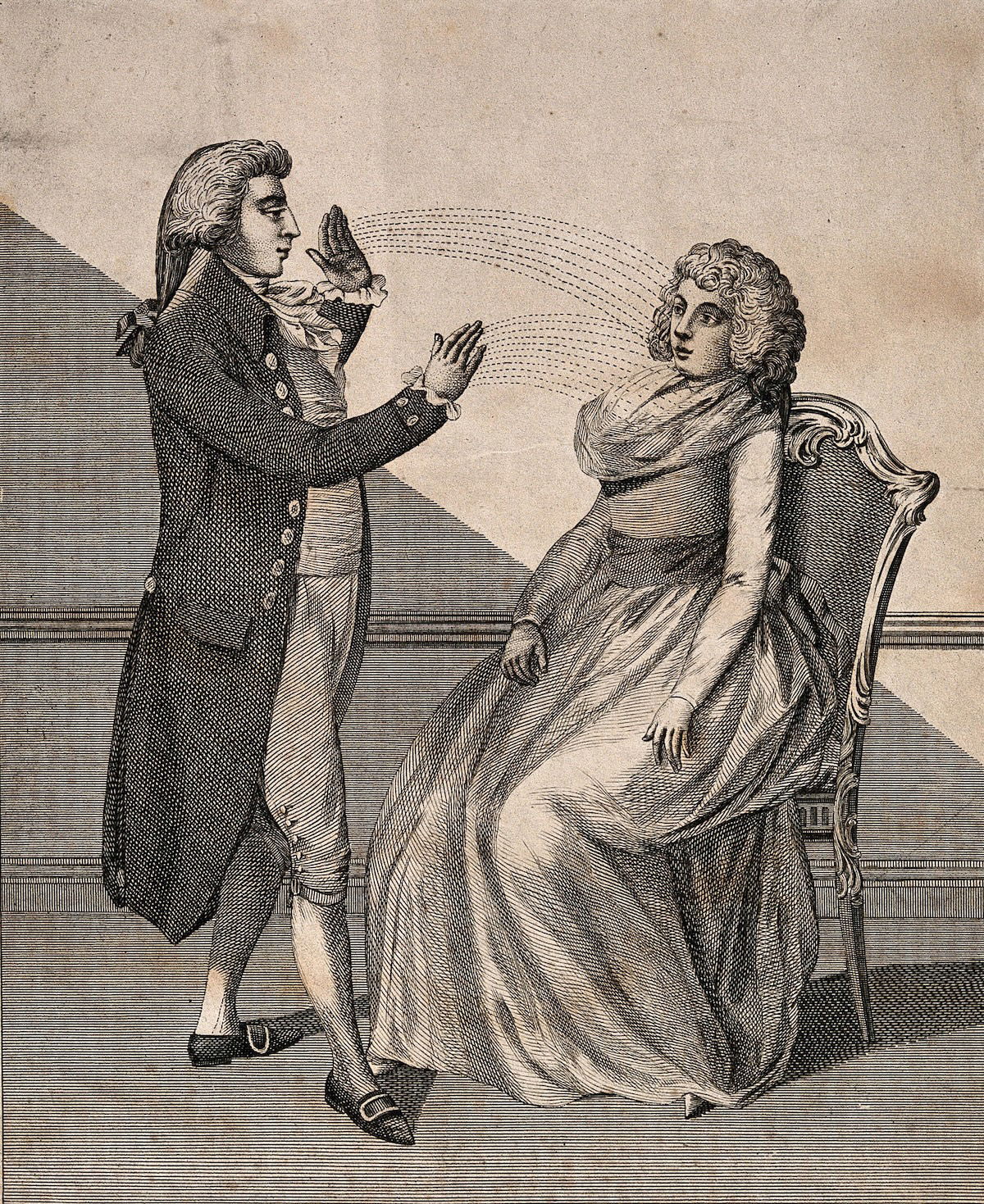
Mesmerism blossomed because – for whatever reason – it worked. Affidavits flooded in testifying to the relief it offered for a range of disorders, including epilepsy, paralysis, haemorrhoids, and menstrual complaints. According to Mesmer’s elaborate if vague theories, a universal magnetic fluid circulated around his tub and was reflected from wall mirrors to intensify the effect. Relaxed by gentle background music, patients – largely women – lapsed into a trance-like state and even convulsed, especially when Mesmer waved his hands around their bodies. Judging from their reports, women found this extremely pleasurable – and were willing to pay for repeat performances.
As testimonials and money poured in, Mesmer moved to larger premises, charging different rates according to social status. Gradually abandoning his communal baquets, he favoured more lucrative individual sessions with no physical magnets. Facing his client, both of them aligned north-south, Mesmer stared into her eyes, moving his hands in the air to realign the flow of magnetic fluid. Before long, medical competitors had set up their own practices in London as well as Paris.
However zany this might sound, at the time magnetic attraction and repulsion were inexplicable phenomena. In the absence of more viable explanations, invisible streams of minute particles seemed plausible. Mesmer had written a doctoral dissertation about the influence of the moon and the planets on human beings; purloining concepts from Isaac Newton’s theory of the tides, he concocted a scholarly system that sounded convincing, even if it was a little short on details. For people in pain, it made sense to opt for animal magnetism, the treatment that was reassuringly expensive and apparently worked.
Political science
In 1784 a French government committee headed by Benjamin Franklin was appointed to investigate mesmerism. Its distinguished members soon encountered a problem: whose testimony could they trust? In their top-down view, women and labourers were naturally more susceptible to influence – and, as anticipated, the inspectors’ own robust, elite bodies proved impervious to the fluid’s power. Their next step towards truth lay in deliberate deception. Blindfolded women collapsed in convulsions when given untreated water, or felt heat in the part of the body that the magnetisers falsely claimed to be treating. Their verdict was unequivocal: magnetic fluid did not exist, and many symptoms could be attributed to overdosing on laxatives.
Magnetic Dispensary, Samuel Collings, 1790. Library Company of Philadelphia. Public Domain.
They did accept that mesmerism worked, but only because of an unacceptably ‘active and terrible power’ – the imagination. Although one farsighted dissenter pointed out its potential value as a therapeutic tool, his advice went unheeded: in this Age of Reason, philosophical men needed to be constantly on guard against such an intruder. An unpublished second report revealed the committee’s alarm about morality and the power of the magnetiser over his subject. The female crisis sounded suspiciously like sexual desire – and suppose a servant learnt the mesmeric art: might he invert the conventions and learn how to control his master?
Franklin’s commissioners had been right to worry: although Mesmer fled the country in disgrace, mesmeric therapy was picked up by movements of radical protest because it could be learnt without formal academic training. Politicised versions flourished in provincial societies across France, although practitioners developed their own variations. One of Mesmer’s former disciples lulled subjects into somnambulistic trances, where they seemed awake but in some altered state of consciousness. A Parisian surgeon even operated on a breast tumour – and when the patient came round two days later, she had no memory of it.
Problematic pedigree
Magnetic techniques were championed in England by a flamboyant physician, John Elliotson, who staged dramatic hospital demonstrations attended by Dickens, Michael Faraday, and other eminent Victorians. Initially, he showed how he could persuade mesmerised subjects to obey his instructions, but he progressed to painless surgery. When ether was introduced in 1846, Elliotson rose to the challenge by itemising over 300 successful operations in London and India.
In contrast to mesmerism, ether arrived with a problematic pedigree, bracketed with intoxicating chemicals marketed as recreational drugs for decadent young men. James Gillray’s famous caricature of a Royal Society lecture degenerating into farce features a real-life event when a member of the audience found inhaling nitrous oxide (laughing gas) so enjoyable that he refused to hand back the breathing bag. Humphry Davy had first synthesised laughing gas in 1772, but he was so diverted by exploring its hallucinatory benefits with Samuel Taylor Coleridge and other enthusiasts that he failed to recognise its anaesthetic value: nitrous oxide was not used in dental surgery until 1844.
Ironically, ether succeeded on the back of nitrous oxide’s initial failure. After some botched dental experiments, in 1846 an American surgeon resorted to ether and news of his success immediately spread to Britain. One of Elliotson’s fiercest critics, the surgeon Robert Liston, staged a spectacular performance in his London operating theatre. After completing a pain-free leg amputation, he announced to his medical audience: ‘This Yankee dodge, gentlemen, beats mesmerism hollow.’ Armed with this sound bite, Liston intensified his battle to eliminate mesmerism, defeat Elliotson, and win control over British surgery.
However, ether was blighted by similar shortcomings to mesmerism. Nobody could explain why either practice worked, and both demanded considerable skill to execute effectively – ether even caused several deaths. They also both relied on the testimony of non-expert witnesses – patients – to confirm that operations really were painless. Like the members of the Franklin commission, sceptics doubted whether their testimony could be accepted as scientific fact. The mesmerists were vulnerable to accusations of being linked with radical politics, but they could point to a serious disadvantage of Liston’s technique – the resemblance of etheric euphoria to alcoholic inebriation. During operations, anaesthetised patients often moved, joked, and cried out incoherently: even if they forgot it all afterwards, could such behaviour be tolerated?
Ethereal advocates
Ether proved victorious not because it was objectively better, but because it had more powerful advocates. Liston was backed by the surgical community, who resented the intrusion of physicians into their domain. With the Lancet and other publications firmly on his side, he ousted Elliotson and the mesmerists.
Yet only a few years later, ether was itself marginalised. Surgeons decided that chloroform was preferable because it rendered the patient unconscious and silent, with no disturbing displays. This controversy had another sad conclusion: anaesthetics eliminated the agony of going under the knife, but did nothing to reduce the mortality statistics.
Patricia Fara is an Emeritus Fellow of Clare College, Cambridge.