President Roosevelt’s introduction of United Nations Day and his Four Freedoms boosted morale in the fight against fascism and set the stage for a post-war UN.
14 June 1942 was the first United Nations Day. An event launched by US President Franklin Roosevelt six months after the United Nations was established on New Year’s Day that year, it was celebrated around the world. Nowadays, UN Day is October 24th (marking the formal ratification of the UN in October 1945). The connection between the United Nations and the Second World War has almost entirely been forgotten, and the date is more likely to be remembered as the day that Anne Frank began her diary. If it is marked at all, it is as a non-governmental occasion at the fringes of national life. But between the first United Nations Day in June 1942 and spring 1945 (the time of the creation of the UN Charter at San Francisco), the United Nations became a political-military alliance without which the outcome of the Second World War would have been different and the UN we know today non-existent. During this period, United Nations Day played an important part in the international political mobilisation for the war and the peace that followed.
Register to read more articles for free.
When you register, you will receive the History Today newsletter. Click here to read our Terms of Use.
President Roosevelt’s introduction of United Nations Day and his Four Freedoms boosted morale in the fight against fascism and set the stage for a post-war UN.
14 June 1942 was the first United Nations Day. An event launched by US President Franklin Roosevelt six months after the United Nations was established on New Year’s Day that year, it was celebrated around the world. Nowadays, UN Day is October 24th (marking the formal ratification of the UN in October 1945). The connection between the United Nations and the Second World War has almost entirely been forgotten, and the date is more likely to be remembered as the day that Anne Frank began her diary. If it is marked at all, it is as a non-governmental occasion at the fringes of national life. But between the first United Nations Day in June 1942 and spring 1945 (the time of the creation of the UN Charter at San Francisco), the United Nations became a political-military alliance without which the outcome of the Second World War would have been different and the UN we know today non-existent. During this period, United Nations Day played an important part in the international political mobilisation for the war and the peace that followed.
In the spring of 1942, with the Japanese threatening to repeat Pearl Harbor and bomb targets on America’s West Coast, and with U-boats sinking ships in sight of Long Island, Roosevelt needed to boost morale. In the 1930s, he had used parades as a means of getting across the idea that his New Deal was getting people back to work. He used a similar approach on a global scale in the Second World War. The rousing of martial spirit was underpinned by the ideals Roosevelt had espoused first in his Four Freedoms speech of January 1941 and then in the eight-point Atlantic Charter of war aims issued with Churchill that August. These points included social security and labour rights alongside free speech and self-government.
The nationwide programme centred on a declaration of principles governing national policies drawn up between Churchill and Roosevelt and set out in the United Nations Declaration of January 1942. It was planned to lead up to a national observance on 14 June 1942, which a presidential proclamation set aside as United Nations Day. Clubs, churches, unions and other organisations were urged to devote one of their monthly meetings in either May or June to the United Nations’ role in winning the war and the Atlantic Charter’s in the ensuing peace. Radio broadcasts on the subject were transmitted, and simultaneous mass meetings were to take place nationwide on June 13th. The president outlined his vision in a letter to Clark M. Eichelberger, Chairman of the United Nations Committee:
Nothing could be more important than that people in the United States and of the world should fully realize the magnitude of the united effort required for this fight ... I have read with interest of your plan to inform our people of the United Nations’aspect of the struggle ... With the vital contribution toward winning the war that has been made, is being made, and will be made, by each of our allies, we shall be successful in our struggle against Axis domination of the world by force of arms.
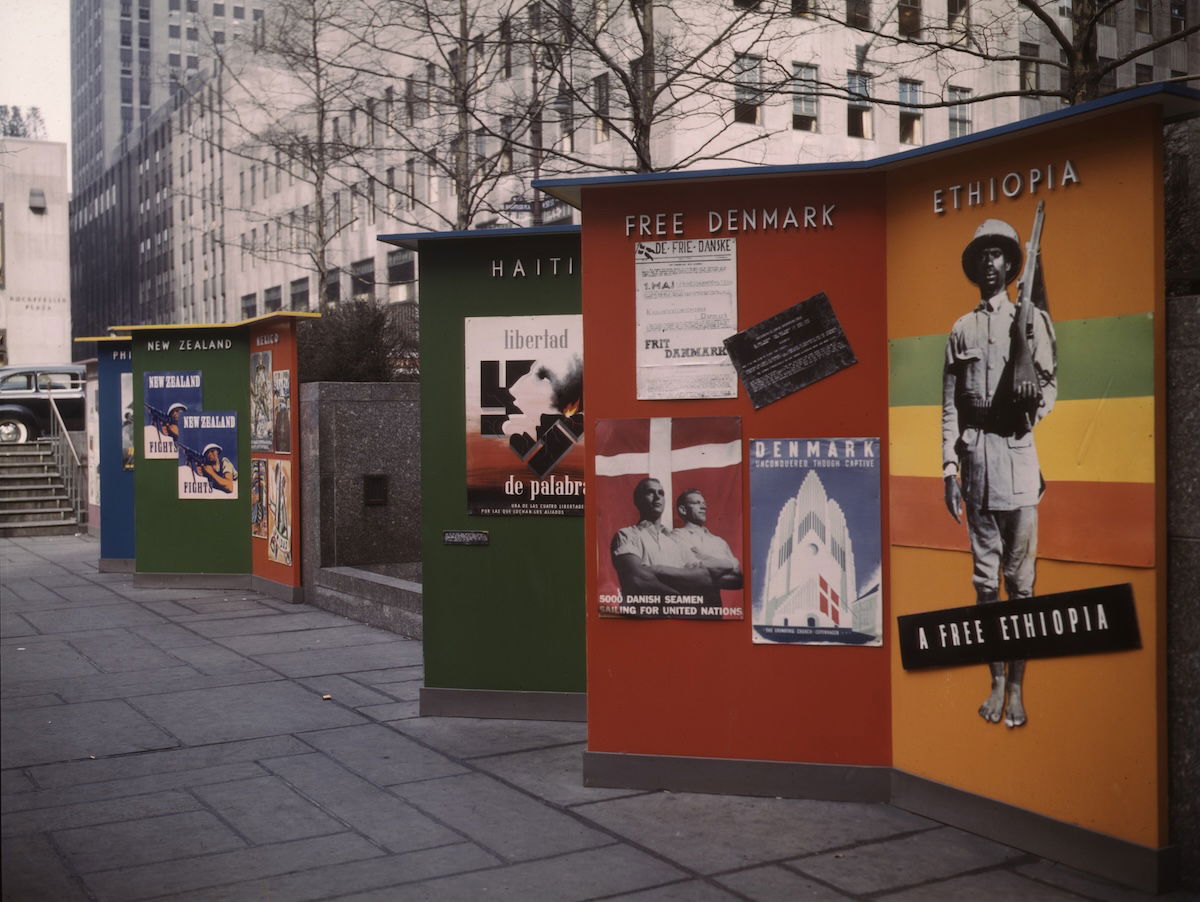
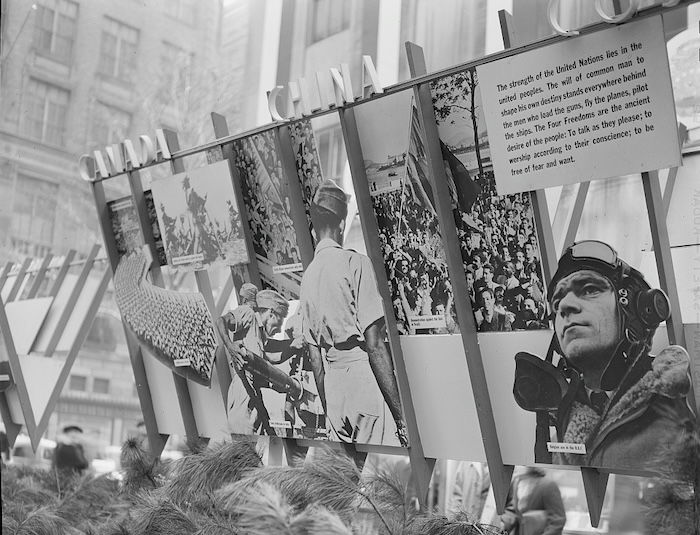
A wartime United Nations exhibit of photographs of Rockefeller Plaza, New York, March 1942. Library of Congress. Public Domain.
Many supported the president’s rallying cry. Archibald MacLeish, Director of the War Department’s Office of Facts and Figures, stated:
It is naturally of the utmost importance that all the people of these nations engaged in the struggle against slavery shall understand each other to the greatest possible extent. To that end, it is desirable that as many civic organizations and other bodies as possible, will, during May and June of this year and also during months that follow, stage celebrations which will heighten the understanding among the United Nations.
The response to Roosevelt’s initiative was huge, both nationally and internationally. From Culman, Alabama, to Stoke-on-Trent in England and the Kremlin in Moscow, UN Day provided a focus of solidarity. Sigrid Arne, the pioneering female diplomatic correspondent of Associated Press, reported how ‘Six months after the United Nations were formally allied through the Declaration, there was a world celebration to dramatise the union. The notion of the United Nations was taking hold’.
In April 1942, Lord Halifax, the British Ambassador to Washington, had telegraphed London to outline the President’s strategy:
The Administration is seeking ways and means of bringing home to American people the existence of the United Nations of which this nation is but a part, and it is in our interest that such a campaign should succeed, for with the exclusion of China, Australia and perhaps Russia we and other nations are apt to be left in the background and even our successes are often attributed in the press to the assistance which we obtain from American participation. It is reliably stated that the President is considering announcing the fact that June 14th normally celebration as Flag Day and is seeking the involvement of the British other allies.
Enthusiasm for the ideas of the United Nations infused American society. In Washington, DC celebrations on 14 June centred on Union Station with parades and concerts at the Water Gate on the Potomac River. In Chicago, the main parade went down Michigan Avenue. One report from New York described how:
The greatest parade in New York’s history moved up Fifth Avenue hour after hour Saturday night with more than 500,000 men and women joining in a tremendous demonstration of the nation’s will to win.The parade was more than twice as big as any ever held here. The fighting men and the men and women from the factories and behind-the-front organizations stepped briskly before miles of close-packed spectators estimated at more than 2,000,000. There were jeeps and tanks and field guns on the ground and flying fortresses, pursuit ships, overhead. From stands along the line, broadcasters sent the stirring story in seven languages around the world. Floats told the tale of what New York and the entire nation had pledged as a fight to the finish.
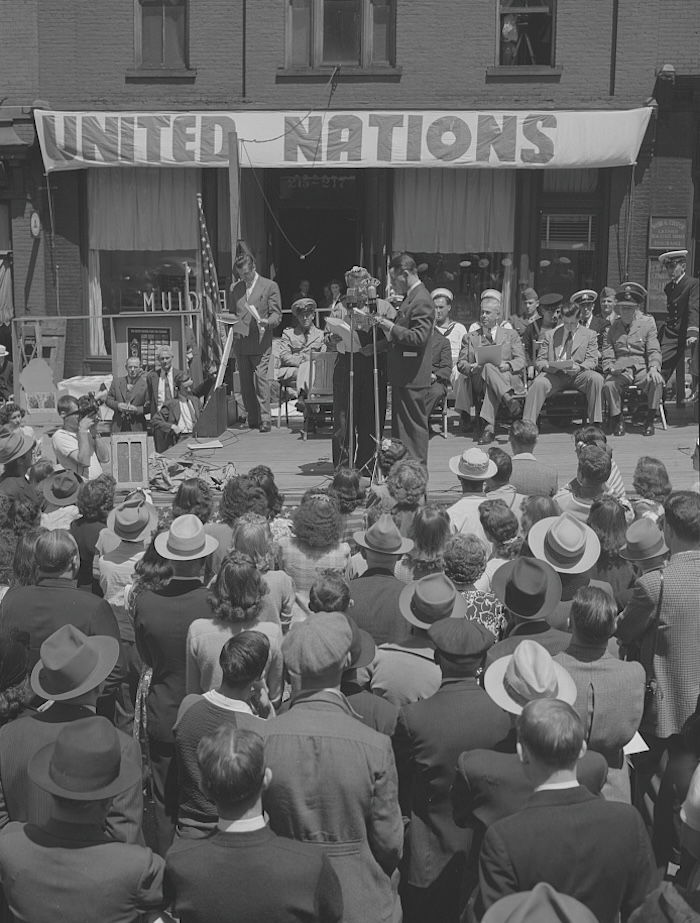
By the following year, not content with a United Nations Day, the town of Oswego in upstate New York organised a whole week of events celebrating heroes from the fighting forces.
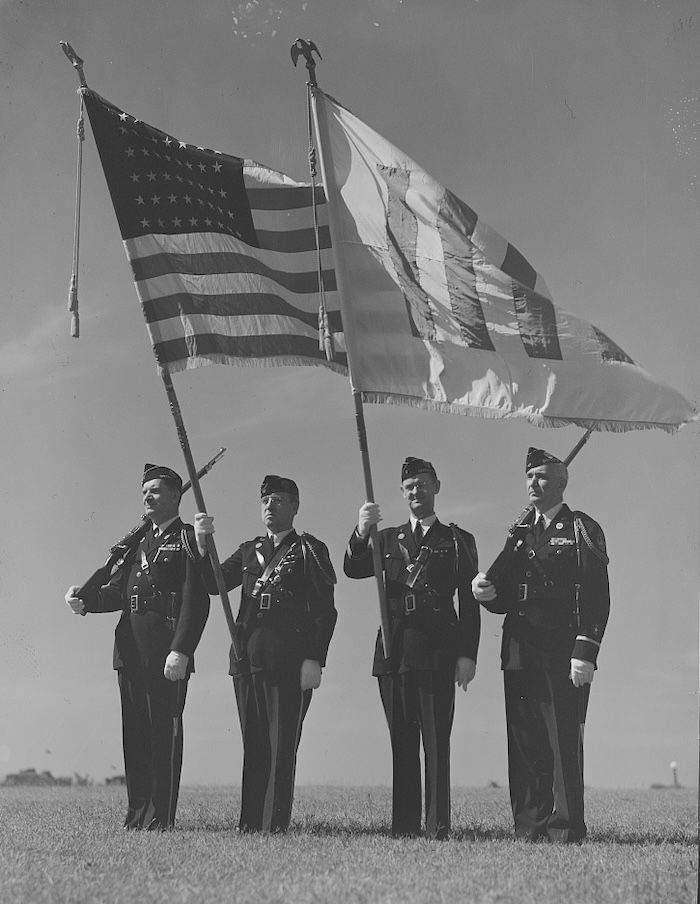
The United Nations celebrations in Oswego, New York, June 1943. Library of Congress. Public Domain.
The significance within US domestic politics of the international celebrations is hard to conceive now. But up until Pearl Harbor in December 1941, the Republican party in Congress had sought to oppose US resistance to Germany and Japan and had strong public support for this stance. However, Roosevelt’s oft-repeated warnings of the dangers abroad proved stronger, and his development of the United Nations programme for war and peace accelerated their momentum. The Roosevelt package offered international support for free trade and free trade unions, for an end to the British Empire and some kind of new global security body. A Gallup poll taken after the June 1942 celebrations indicated that 73 per cent of the American public now supported a postwar League of Nations (up from 51 per cent in May 1941) despite that discredited organisation being mentioned by name in the question.
By the time the parades took place, there was finally some good news about the war. In early June 1942, US naval aircraft had sunk irreplaceable Japanese aircraft carriers off Midway Island in the Pacific. In Washington, following a meeting with the Soviet Foreign Minister V.M. Molotov, there was anticipation that D-Day was just over the horizon. In a communiqué of June 11th, Roosevelt and Molotov announced that ‘full understanding was reached with regard to the urgent tasks of creating a Second Front in Europe in 1942’. Although neither the British nor senior US officials, including General Marshal, believed their forces were strong enough to do more than make a suicidal attack on the French coast, the impression was created that the liberation of Western Europe was at hand.
With something to cheer about, the press made the most of events. The United Press report of 14 June 1942, listed the impact of United Nations Day around the world:
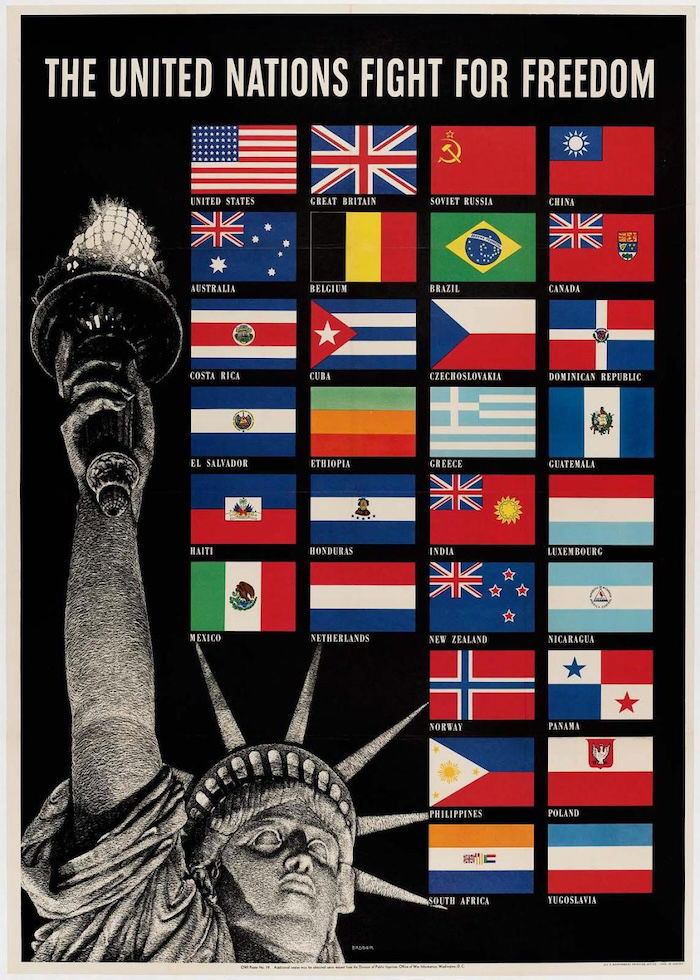
Twenty-eight nations were pledged today to successful prosecution of the war after colorful United Nations day celebrations in every capital. The Stars and Stripes held honored positions throughout the world yesterday on the anniversary of its creation and military parades, public demonstrations and prayers marked the observance. In Washington, President Roosevelt welcomed two new signatories to the United Nations declaration [Mexico and the Philippines]. In London, crowds broke through police lines to cheer the King and Queen and Prime Minister Churchill. They shouted at Churchill, ‘Give ‘em hell, Winnie’. In Moscow, American and British flags flew with the Red Banner on the Kremlin spires. Throughout the Empire, prayers for the United Nations were offered and pastors read a message from Churchill: ‘In this ceremony we pledge to each other not only support and succour until victory comes, but that wider understanding, that quickened sense of human sympathy, that recognition of the common purpose of humanity without which the suffering and striving of the United Nations would not achieve its full reward.
In Chungking (Chongqing) in China, the American minister to Australia, Nelson T. Johnson, addressed a mass meeting expressing gratification that the United States and China were allied ‘in this great fight against primitive despotism’. China replied with a resolution: ‘Today the people of China’s wartime capital are flying the flags of all nations as an expression of a sense of comradeship with the Allied nations. We are confident of our ability to persevere in our duty to the fullest, and we trust you also will do all in your power to bring about a common victory over the Axis.’ Australian cities were flag-bedecked, but there were no formal observances except in churches.
The United Nations Fight for Freedom, Office of War Information poster, 1942. Museum of Fine Arts, Boston. Public Domain.
A ceremony was held in New Delhi in India, attended by Lord Linlithgow, the viceroy, General Sir Archibald Wavell, the commander-in-chief, and the Duke of Gloucester. American, British, Russian, Chinese and Dutch flags were displayed outside the viceroy’s palace, and the national anthems of these countries were played.
In Moscow, public lectures, concerts and exhibitions were held emphasising the strengthening of bonds among the leaders of the three leading United Nations. Two book fairs were devoted to British and American literature and shops displayed commentaries by Western authors on the power of the Red Army.
The Soviet newspaper Izvestia explained that the United Nations chose June 14th for their international demonstration because it was the day annually commemorated in the United States ‘as the day the American flag was consecrated by the traditions and struggle of the American people for independence and liberty’. The report continued that Flag Day coincided with the ‘truly historic events opening a new chapter in the annals of the war of liberation against the Fascist hordes – the signing of the agreement between the United States, Russia and Britain’.
In the British colony of Jamaica, where church services were held and a military parade was led by the Governor, the Kingston Gleaner carried three stories on Flag Day. An official British film from June 1942, The First United Nations Day, describes how:
In London, the Royal Family is joined by the exiled heads-of-state of Norway, Yugoslavia, Poland and Czechoslovakia on the stand [at Buckingham Palace] to review a parade of Civilian Defence Service contingents, workmen and women, merchant seamen, Royal Navy, RAF, Commonwealth troops, Home Guard and British Army; in Aylesbury, the Lady Mayoress (Mrs Olive Paterson) reads the Prime Minister’s proclamation adopting President Roosevelt’s idea that June 14th (previously marked in the USA for honouring the national flag) should be a day of honouring all of the flags.
As the war progressed, momentum for the United Nations gathered with varying degrees of encouragement from the Allied governments. The first multinational United Nations organisation with an international staff and budget was formed in late 1942. This was the UN Information Board based on Fifth Avenue in New York. Its function essentially was information and propaganda.
In Washington, a private group, The Four Freedoms Committee, debated the need for a UN flag with representatives of national governments. Committee members included officials from the American Legion, Veterans of Foreign Wars and Elizabeth Mallett Barnes, chairman of the ‘Correct Use of the Flag Committee’ of the Daughters of the American Revolution. After lengthy consultation in early 1943 the Committee produced a flag representative of all the United Nations. Designed by Brooks B. Harding, a New York industrialist, the flag was white with four vertical red bars emblazoned on it, representing the Four Freedoms. According to the eight-page colour United Nations Flag Manual, distributed internationally by the Committee, it was intended ‘to stand for freedom in any place in the world ... the new flag is never to be flown alone but alongside or beneath the flag of the country in which it is flown,’ stated the manual.
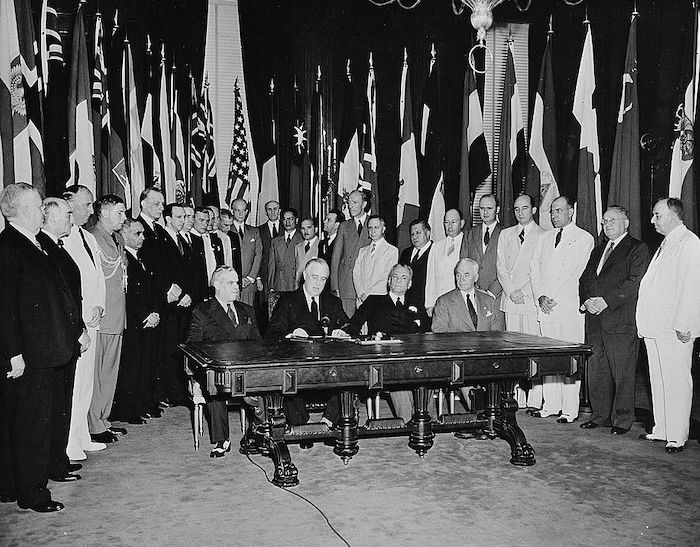
Represenatives of the the wartime United Nations – including President Roosevelt – reaffirm their pact in Washington, DC, July 1942. Library of Congress. Public Domain.
There was some consternation among the Allies about this new flag and the American way of doing things. Lord Halifax sought advice from London, reporting that several US government agencies were producing United Nations symbols, some of which were already being attached to supplies headed for Africa, and that at a meeting of the United Nations Information Board of 30 nations, there was general support for the idea of a United Nations flag. The Four Freedoms flag failed to get formal approval from the Allies, but it still appeared even after the familiar pale blue flag we know today was created in 1945.
The Washington Post waxed lyrical about the Four Freedoms flag when it flew alongside the 30 national flags of the United Nations in June 1943 in celebrations around the world. In the second year of global political mobilisation, a great parade was held in Cairo celebrating the defeat in May of the Axis in Africa. The Post was keen that United Nations Day become a permanent feature of international society. However, the British Cabinet was sceptical about making it an annual event, claiming that there were not enough troops left in the country in June 1943 to mount parades nationwide, so ceremonies were limited to London, Edinburgh and Cardiff.
By 1944, Britain had bowed to the mood of internationalism and formed the United Nations Day Committee, of which Brendan Bracken, a British minister of information in Churchill’s government (and the founder of History Today), was honorary president.
In the Soviet Union, distrust over the repeated postponements of D-Day was finally overcome with the success of the Normandy landings. The Soviet press was euphoric about the United Nations’ unity, and the USSR went on to join the World Bank established at the UN monetary and financial conference at Bretton Woods in July 1944.
For Americans, the development of the wartime United Nations into a postwar system seemed a natural progression. Development assistance for people liberated from the Nazis was available as early as UN Day 1943. There were US-led United Nations conferences and proposals on food and agriculture, global economic regulation and relief. NGOs and nations as diverse as New Zealand and China were clamouring for the United Nations alliance to become a formal Executive Council long before the meetings to discuss global security at Dumbarton Oaks in August and September 1944 and in San Francisco the following year, key dates at which histories of the UN are usually started.
Lessons to be drawn
Internationalist policies were necessary to win the Second World War. The ideas of the Four Freedoms and the United Nations provided key reasons for Americans to spend money on a war between foreigners. Time and again, the Roosevelt administration used these ideas to win the argument for sending huge quantities of weapons to the Allies. In Russia, the Atlantic, India and the Middle East, UN-inspired Lend-Lease weapons helped tip the balance against the Axis in 1942. They held the Alliance together in 1943 and provided the muscle for victory in 1945.
The wartime history of the UN provides a powerful reinforcement of its mission. The UN system we know today was created in wartime as a necessity for winning the war and preserving peace, not as a liberal accessory to the military victory.
The UN created by the Charter at San Francisco is clearly legally connected to its wartime predecessor, for Article 3 of the Charter makes the signatories of the Declaration of 1942 the first founder members of the UN. But much of its potential was lost after the death of Roosevelt in 1945. US policy became more confrontational towards the Soviet Union and less directed at ending European colonialism. Stalin’s murderous paranoia was easily inflamed. Nevertheless, the rediscovery of the wartime United Nations and the Soviet role within it provides a new perspective on the development of the Cold War.
A proposed United Nations flag symbolising the Four Freedoms, 1943. Library of Congress. Public Domain.
Without the wartime United Nations, the model that followed would have been very difficult to create from scratch in the rapidly worsening political atmosphere of the late 1940s and would not have been in a position to help mediate between the superpowers. As Churchill remarked in a private conversation with his Naval chief Admiral Cunningham, at the time of the Battle of Arnhem: ‘It is the only hope of the World.’ Even in his Iron Curtain speech of 1946, at a time of rising anti-Soviet feeling in the West, he voiced his support for a UN air force.
In other parts of the world, the visions of the Atlantic Charter and the United Nations provided highly motivating goals in addition to the powerful drivers of patriotism and national survival. Beginning with the idea that without food there cannot be security from war, the international community built interlocking initiatives for aid, reconstruction and economic stability and prosperity. Full employment was a national and international security objective for governments. In all these bodies and conferences, states began to invest their national sovereignty in international and supranational agencies.
The Second World War is a defining period in world history, yet school and university teaching about modern history and international politics describes the UN from its formal establishment at the end of the war and not as an integral part of it. In an era when the UN is often seen as weak and in which the US and Britain invaded Iraq in violation of the UN Charter, the early 1940s should not be overlooked in our attempts to understand the foundations of 21st-century politics. As UN reform is debated and President Obama’s progressive foreign policy comes under scrutiny, the political battles of the Second World War provide examples of radical and effective internationalism helping to defeat the greatest threat to modernisation from Hitler and his allies.
Dan Plesch’s America, Hitler and the UN will be published by I.B.Tauris in November 2010. He is the Director of the Centre for International Studies and Diplomacy at the School of Oriental and African Studies, University of London.