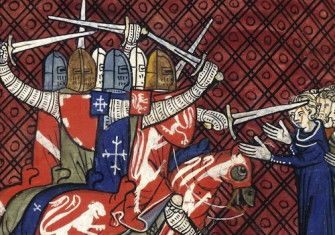
To justify the 13th-century Albigensian Crusade, waged against heretics in the south of France, its champions painted Toulouse as Sodom and Gomorrah reborn.
By the beginning of September 1212 the southern French town of Moissac had been under siege for a month. The populace was accused by Arnaud Amaury, the papal legate, of defending local heretics, which was enough for them to be branded enemies of the faith. The town was under interdict, cast from the Church by the pope himself. Any clergy who had not forsaken the town were forbidden from performing the sacraments. The mass went unobserved, infants went unbaptised, the Last Rites were not bestowed, and the dead went unburied.
There was violence on the part of both the crusading army and the defenders. The one recorded narrative of the siege details how the mercenaries in the town ‘dismembered and scattered the remains’ of the crusaders that they cornered and made a habit of firing their crossbows at any member of the clergy who came to encourage the besiegers. In retaliation, when the crusading army accepted the town’s surrender, the mercenaries supporting the defenders were put to death ‘with great enthusiasm’.
Register to read more articles for free.
When you register, you will receive the History Today newsletter. Click here to read our Terms of Use.
To justify the 13th-century Albigensian Crusade, waged against heretics in the south of France, its champions painted Toulouse as Sodom and Gomorrah reborn.
By the beginning of September 1212 the southern French town of Moissac had been under siege for a month. The populace was accused by Arnaud Amaury, the papal legate, of defending local heretics, which was enough for them to be branded enemies of the faith. The town was under interdict, cast from the Church by the pope himself. Any clergy who had not forsaken the town were forbidden from performing the sacraments. The mass went unobserved, infants went unbaptised, the Last Rites were not bestowed, and the dead went unburied.
There was violence on the part of both the crusading army and the defenders. The one recorded narrative of the siege details how the mercenaries in the town ‘dismembered and scattered the remains’ of the crusaders that they cornered and made a habit of firing their crossbows at any member of the clergy who came to encourage the besiegers. In retaliation, when the crusading army accepted the town’s surrender, the mercenaries supporting the defenders were put to death ‘with great enthusiasm’.
The most significant event of the siege of Moissac came towards its conclusion, when one of the defenders fired his crossbow at a monk who had ridden to the front lines to exhort the crusaders to greater efforts. The bolt pierced the monk’s robe and saddle, leaving him unharmed but shaken by his brush with death. It is he who recorded the events at Moissac, and, over the course of the next year, he would come to play a crucial role in justifying and advocating for the violence that he and his comrades were unleashing upon the south of France.
The siege of Moissac was part of the much larger and extremely violent Albigensian Crusade, waged by Innocent III against heresy in Languedoc between 1209 and 1229. Led by the northern French nobleman Simon de Montfort (c.1175-1218), crusaders from across Christendom conducted a series of savage campaigns. The year before Moissac’s fall, following the siege of Lavaur, the victorious crusaders were reported to have burned 300 townsfolk accused of heresy and stoned Giraude, the lady of Lavaur, in a pit. In 1210, at Minerve, 140 townsfolk had been burned on a communal pyre. The same fate had met the entire populace of Béziers in 1209.
Miniature of Simon de Montfort, from Grand recueil La Clayette, late 13th century. Bibliothèque nationale de France.
The justification for such horrors was the perceived presence of heresy in the region. The Albigensian heretics, more popularly known as Cathars today, had been a source of increasing concern for the Church since the mid-12th century, accused, among other things, of dualism (the belief in the existence of two deities, one good and one evil), and believing in John the Baptist’s status as a demon. In 1145 the most prominent preacher of the age, Bernard of Clairvaux (1090-1153), led a campaign to Languedoc to correct the errors of the populace. Following his preaching tour Bernard lamented the state of the southern Church, stating that:
[The] churches lack people; the people lack priests; the priests are not shown respect; Christians are without Christ; the sacraments are not revered – neither confession, nor the eucharist, nor baptism.
This condemnation prompted an increase in anti-heretical legislation and, admitting that the Albigensians had grown so ‘strong that they no longer practise their wickedness in secret, as others do, but proclaim their error publicly and attract the simple and the weak to join them’, the Third Lateran Council (1179) encouraged the faithful to take up arms against them.
The expulsion of the Albigensians from Carcassonne in 1209, from Les Grandes Chroniques de France, c.1415. British Library/Bridgeman Images.
When the papal legate, Pierre of Castelnau, was murdered by an unknown knight on the banks of the Rhône in 1208, the outraged Pope Innocent III demanded retaliation. Blame for the legate’s death was laid at the feet of count Raymond VI of Toulouse, the region’s chief nobleman and one already identified by the Church as opposed to their efforts to expel heresy from the south. Since 1204 Innocent had been appealing to the king of France, Philip II Augustus, to lead a military campaign against Raymond, who had been excommunicated in 1207. At the pope’s command a large army of northern French knights marched south under the leadership of Arnaud Amaury. The crusading army sacked Carcassonne and Béziers and placed them under the control of Simon de Montfort. He was a relatively minor baron whose conduct on the Fourth Crusade, in which he had forsaken the main army to travel to the Holy Land rather than sack Constantinople, had set him apart as a devout and capable warrior.
Following the departure of most of the crusading army, Simon and a small cadre of knights consolidated their control of the lands surrounding Carcassonne and Béziers and soon had a firm grip on the region. By Christmas 1212 Simon and his knights were in open conflict with Raymond of Toulouse and his allies. The brutality at Lavaur, Minerve, and Béziers had become indicative of the violence perpetrated on both sides. In 1209 a group of southern knights was accused of butchering the abbot of Eunes and his entourage. Giraud de Pépieux, a knight from the viscounty of Béziers, had mutilated 50 crusaders, blinding them, cutting off their ears, noses, and lips and sending them, naked, back to the crusading army. In retaliation Simon had ordered the blinding of more than 100 defenders of Bram, leaving one man with one of his eyes, so that he could guide his mutilated comrades.
History-maker
Against such savagery, the siege of Moissac is not worth more than a footnote in any history of the crusade. What sets this episode apart is the account of the monk who narrowly avoided death before Moissac’s walls. He was Peter of les-Vaux-de-Cernay, one of the most important chroniclers of the Albigensian Crusade. His work, the Historia Albigensis, provides a narrative for the Albigensian Crusade from its beginning through to 1219, a year after the death of Simon, the hero of the work. It provides an extensive prologue, detailing the preaching campaigns against the ‘Albigensian’ heretics of Languedoc from 1203 up until the murder of the legate in 1208. The Historia makes an impassioned defence of the crusaders. It justifies the crusade and presents its leaders as heroes, their deeds crucial to the survival of the faith.
Peter’s account of his run-in with an enemy crossbowman at Moissac offers the only point in the Historia at which Peter himself enters the record as a participant in events. It is likely that, either shaken, proud, or both, he could not help recounting his war story. He tells how he ‘went quite close to the castle to encourage the crusaders’ and that his would-be killer, ‘showing no respect’ for his calling, fired a bolt that ‘pierced [his] robe, missed [his] flesh by a finger’s width or less, and fixed itself in [his] saddle’. Reflecting on this near miss, Peter reasoned that ‘Divine clemency ensured the enemies of religion would not be able to rejoice in striking a monk’.
Elsewhere, he is a shadowy figure, only calling attention to himself as an overhearer or as an observer. There is a smugness with which he names his sources. He reports that he had learned about Albigensian beliefs from Fulk, bishop of Toulouse and had heard of miracles from ‘that most pious man’, St Dominic. The source that Peter seems to have taken most pride in was Simon de Montfort himself, whose frustrations with the crusading army’s delay before the Battle of Muret Peter claims to have ‘heard from his own lips’.
Scene from the ‘Siege Stone’, showing the death of Simon de Montfort during the siege of Toulouse, 13th century. Woodcut, 1873. Walker Art Library/Alamy.
Despite Peter’s involvement in the crusade, his close relationship with its leaders, and the evident value of his Historia as an important source for the crusade’s leadership, both have been underappreciated by scholars and Peter has widely been dismissed as a ‘second-rate spin doctor’. Part of the Historia’s dismissal is a result of its lionisation of Simon de Montfort, who, as leader of the Albigensian Crusade, is most often seen as the perpetrator of a cultural and physical genocide in which the unique Occitan culture of Languedoc was wiped out. One suspects that it is at least in part an underlying distaste for an author who characterises a ‘monster’ as a hero of Christ that has caused the work to be sidelined in modern scholarship in favour of near-contemporary works that have been perceived to provide a less partisan assessment of the crusade, such as William of Puylaurens’ Chronica.
Closer inspection reveals that the Historia offers significant value to understandings of the Albigensian Crusade. It is important to begin with the year in which Peter undertook his work, 1213, and his intended audience, Pope Innocent III. Even though Simon had successfully conquered most of Languedoc by the end of 1212, the surviving southern aristocracy had found an important ally in Pedro II of Aragon. Pedro was one of the three Spanish kings who had won an astounding victory against the Almohads at the Battle of Las Navas de Tolosa in July 1212. The victory had won him Innocent’s favour, which he used to advocate on behalf of the dispossessed nobility of Languedoc. Aragon’s kings had laid claim to the overlordship of the region since the 1170s and Pedro had inherited and continued to cultivate strong ties of patronage with its aristocracy. It was in this capacity that he sent embassies to Rome through the winter of 1212-13 to argue that the crusaders had exceeded their remit and that while it was their duty to chastise unrepentant heretics, it was also the role of the Church to display the ‘loving kindness of a mother’. Heresy had been eradicated from the south and the savagery of the crusaders was now being directed towards the faithful. In January 1213 Pedro undertook a northern progress to Languedoc in order to settle matters personally. He brought strength, legitimacy, and moral authority to the forces opposing Simon de Montfort. No longer were the lords of the south led by an excommunicate count appealing for support, they were led by a favourite son of the pope and the hero of Christendom.
The crusading cause was also undermined by Innocent’s increasing desire to launch a new crusade to the Holy Land. The victory at Las Navas had convinced him that Christendom had regained God’s favour and that he would surely deliver Jerusalem from the Islamic yoke. His reasoning was couched in apocalyptic theology. Innocent took the Spanish victory as ‘a good sign that the end of the beast was approaching’, and that Revelation was surely at hand. In such terms, continued efforts in Languedoc were a distraction from the far more important crusading endeavour to the east.
Nest of heretics
On 15 January 1213 Innocent sent letters to Simon de Montfort and Arnaud Amaury, demanding that Simon recognise Pedro as his lord and do homage to him, and cease campaigning. He reasoned that the ‘business of the faith had sufficiently prospered’ in the south and that Christendom’s focus should be turned to the ‘special business’ of recovering the Holy Land. The flurry of responses from prelates in the crusading camp, stressing the need for continued crusading, betrays the sense of panic that the leadership felt at this news. Bertrand, bishop of Béziers wrote that although the southern heretics ‘began to breathe in the light of peace and faith so successfully that the authors of errors and other perversions were disturbed … there still remained a great source of errors and all kinds of vices’. He informed Innocent that as long as Toulouse, where heretical perversity had gathered since ancient times, was not cleared then a new ‘generation of vipers and spurious calves’ would spring up again to jeopardise the southern Church. He even appears to have invented an episode of Toulouse’s history, telling his audience that the city has ‘been of old, a nest of heretics, with the result, it is said, that it was once utterly destroyed and even ploughed’ to cleanse it of wickedness.
Similarly, the archbishop of Bordeaux, alongside the bishops of Bazas and Périgueux, sent a letter that congratulated Innocent on his initial wisdom in calling the crusade and lauded Simon’s success before stressing the need for continued action. They beseeched the pope to adopt a sensible plan so that the potential for peace and justice would not be lost. They wrote: ‘That the flowers of peace, which already seem to be rising … were thus readily left unfinished, not only would the last mistake be worse than the first, but the clergy and the Church would be irretrievably threatened.’
The archbishop of Arles accused Innocent of being unable to look at the state of the Midi with a clear eye. If he could, he would see that the province of Narbonne:
Which had once been consumed by misery, darkness and the shadow of death and in which there was no order, but eternal confusion, had been sent labourers to tend to the field of the Lord to root out the infection.
Pope Innocent III, fresco, Monastery of San Benedetto, Italy, 13th century. Bridgeman Images.
He went on to echo Bertrand of Béziers in alerting Innocent to the continued danger of Toulouse. He feared that if the city, which should be ‘cut off like a rotten member’, endured, it would inevitably ‘infect and corrupt the places that had been fully cleansed’. The continued war in the south was just as important a task to the business of the faith as the ancient war against Sodom and Gomorrah, and like those cities, Toulouse needed to be uprooted and exterminated.
The authors of these letters were among the crusaders in December 1212 and are likely to have been present when Innocent’s letters to Arnaud Amaury and Simon arrived. The similarities that the letters share in theme and structure suggest a united front. The panic among the crusade’s leadership in response to this turn in papal policy is evident.
Innocent remained unmoved. In April he issued Quia Maior, his great crusade call, in which he commissioned a crusade to the Holy Land. Here Innocent made clear that there was ‘greater need than ever’ for a new expedition to Jerusalem, and that it was to be the only crusading effort, revoking the remission of sins and indulgences previously granted to crusaders in the Midi, stating that ‘they were given for reasons that are now entirely in the past’. Later that month he issued another letter, Vineam Domini Sabaoth, which convoked the Fourth Lateran Council and reaffirmed his commitment to all crusading efforts being directed towards the Holy Land.
The old adversary
It was in the face of this disavowal and the dangerous position in which it left Simon and his comrades that Peter began his Historia Albigensis. The work was intended to persuade the sceptical audience of the papal curia and Innocent of the need for the continued crusade against the southern heretics. His was not the only effort; the bishops who had supported the Albigensian Crusade all lobbied the pope in attempts to reverse the decision. The Historia was the most significant effort, however, and reveals the rhetorical tactics that the crusade’s leadership employed.
Throughout the Historia Peter continues the rhetorical policy that the crusading prelates had started to experiment with in January 1213. He argues that it was from Toulouse that heresy had spread, putting out shoots of unbelief that took root in the neighbouring cities and towns. Peter goes on to accuse Toulouse of ‘rarely, if ever’ being free ‘of the sin of heresy’, and that the ‘poison of unbelief was passed down from father to son’. Throughout the Historia Peter presents the city as the chief and oldest adversary of the business of peace and faith in the south.
On one occasion Peter echoes the prelates of Arles and Béziers by inventing a historical destruction of the city. Like the bishops, he writes that in punishment for their great sin the city ‘endured the destruction of her people, to the extent that the ploughed fields extended to the very centre of the city’. He adds a detail, though, relaying that at a similar time to the city’s destruction one of its kings, believed to be called Alaric, was hanged in a gibbet above the gates of the city. There is no historical record of Toulouse ever being destroyed, nor of one of its kings being executed by its people. The closest parallel to this tale is found in the great cities of the Old Testament: Sodom, Gomorrah, and Jerusalem, all of which were razed in punishment for renouncing God. Indeed, in its narration of the destruction of Jerusalem the Book of Jeremiah describes how the city was broken down and left to the ploughmen. Its king, Jehoiakim, was dragged to the gate and left there for his people to see in a similar way to Alaric in the Historia. Such parallels are further evidenced by the archbishop of Arles’ letter to Innocent, which referenced Sodom and Gomorrah and called for Toulouse, which had ‘fermented the filthiness of the wicked’, to share their fates, else the Church be completely overturned.
Miniature of the Battle of Muret, from Les Grandes Chroniques de France, 1375-80. akg-images/Album/AFO.
A case was thus made for Toulouse’s ultimate destruction and the slaughtering of its populace, justified by Biblical precedent. With the ancient evil of Toulouse at its centre, Languedoc was so infected by heresy that despite all the powers of orthodoxy, and God’s own judgement, the roots of heterodoxy endured and returned with each successive generation. The Albigensian Crusade needed to be continued until Toulouse was utterly eradicated.
Elsewhere, Peter took up a popular preaching technique of his age by describing the populace of Languedoc as animals, ‘the progeny of vipers, that even in our own times could not be torn from their deep-rooted wickedness’. In this, he echoed Christ, who refers to the Pharisees as the ‘progeny of vipers’, lamenting that he would send them ‘prophets and wise men and scribes who would be murdered, crucified, scourged, and persecuted from city to city’. He also echoed Bertrand of Béziers. Bertrand had warned Innocent that the ‘generation of vipers’ was at risk of making a resurgence of heresy far worse than before. The archbishop of Arles had also warned that those heretics who had fled the crusade and found refuge in Toulouse had withdrawn into the ‘belly of the viper’, thus casting the city as a womb out of which a new generation of heretical perversity would emerge.
In this, it is possible to see the Historia Albigensis as part of a unified rhetorical reaction to papal policy. Peter is revealed as one member of a group that surrounded the crusade’s leadership who wrote to the pope in order to persuade him of the crusade’s continued necessity. The context in which Peter was working and the shared authorial strategy with which he engaged, reveal the sense of urgency behind the Historia’s construction and the immediacy of its account. It was written in the thick of it, narrating and justifying the defence of the faith as it was happening but also while it was under threat. The Historia Albigensis stands as the most significant expression of ideology to emerge from the Albigensian Crusade.
By the sword
As it happened, the future of the Albigensian Crusade was not decided by debate and rhetoric but by the sword. On 12 September 1213 the crusading army met Pedro of Aragon in battle outside Muret. The crusaders were victorious and Pedro was left dead on the field. While Innocent was initially enraged by the death of his favoured son, the southern aristocracy had lost their chief advocate. At the Fourth Lateran Council in 1215 Simon de Montfort was confirmed in his holdings of Carcassonne and Béziers and also granted the county of Toulouse. Languedoc remained quashed beneath the crusading boot until Simon’s death before the walls of Toulouse during a siege in 1218. Peter described the event as a tragedy, lamenting that ‘With his death, all else died. He was the comforter of those beset by grief, a tower of strength for the weak, balm for the afflicted, a refuge for the wretched’. An anonymous troubadour, native to the south, composed a different epitaph, writing that:
If by killing men and shedding blood, by damning souls and causing deaths, by … kindling evil and quenching good, by killing men and slaughtering children, a man in this world can win Jesus Christ, certainly Count Simon wears a crown and shines in heaven above.
Louis Pulford is an early-career researcher based in South Wales. He recently completed a PhD at Lancaster University.