In the Shadow of Angkor
The ruined temples of Cambodia’s medieval empire became symbols of a people who had forgotten their history. In reality, they demonstrate an inherent continuity.
The ruined temples of Cambodia’s medieval empire became symbols of a people who had forgotten their history. In reality, they demonstrate an inherent continuity.
The ruined temples of Cambodia’s medieval empire became symbols of a people who had forgotten their history. In reality, they demonstrate an inherent continuity.
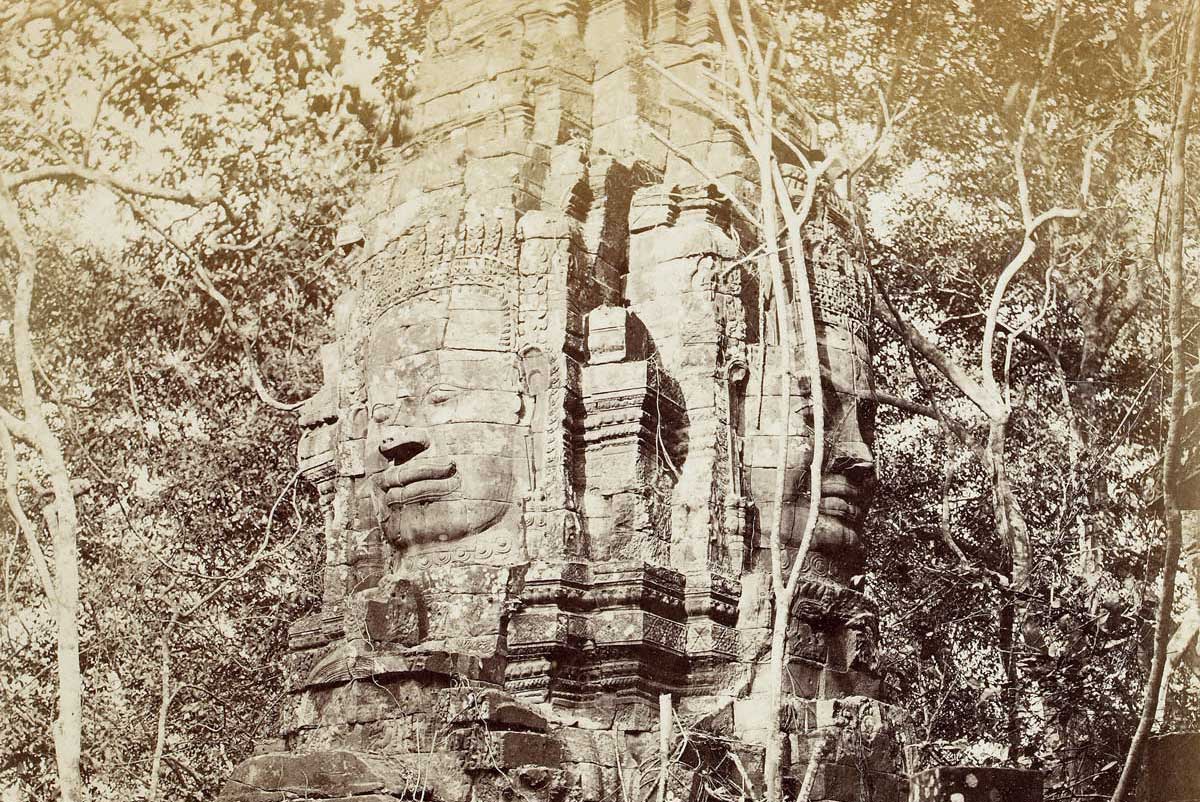
The Angkor empire was founded in AD 802 by King Jayavarman II, who, according to inscriptions written two centuries later, unified the disparate kingdoms of Cambodia and instituted a cult of the ‘god-king’. Thereafter, successive royal capitals were located in the Angkor region, which today is in northern Cambodia. A constellation of hundreds of temples, at its height the capital was probably the largest urban metropolis in the world, its territory spanning much of mainland South-East Asia. Eventually, its capital moved south, perhaps because of the rise of the neighbouring Ayutthayan empire, which conducted raids on Angkor in the 15th century, but also because an increase in maritime trade with China necessitated a move towards the coast. The demise of the Angkor empire coincided with the rise of Theravāda Buddhism, which replaced Brahmanism as the main religion in Cambodia.
When Europeans travelled to Angkor in the late 19th century, their descriptions of the site were characterised by confusion, disorientation and the dense jungle foliage that covered the temples. The French writer Pierre Loti described the Bayon Temple as a semi-obscured ‘jumble of rocks’. Soon, clearing the tangles of vines became a metaphor for the production of knowledge of this ‘forgotten’ empire. Inscriptions were gathered and translated. Statues were unearthed and stylistically assessed. Temples were dated and complex royal genealogies charted. History was written. The temples of Angkor would become symbols not only of a declining civilisation, but of a people who had ‘forgotten’ their own history.
The French botanist Henri Mouhot undertook lengthy expeditions into Siam, Cambodia and Laos between 1858 and 1861, funded by the Royal Geographical Society. Though his focus was the region’s flora and fauna, Mouhot achieved fame for his ‘discovery’ of the temples at Angkor, which he described thus:
In the province still bearing the name of Ongcor, there are ruins of such grandeur, remains of structures which must have been raised at such an immense cost of labour, that, at the first view, one is filled with profound admiration, and cannot but ask what has become of this powerful race, so civilised, so enlightened, the authors of these gigantic works?
Mouhot saw the temples of Angkor as evidence of a lost culture ripe for colonial resurrection. Cambodia became part of the French Protectorate in Indochina in 1863, after a century of invasions and occupations by the Siamese and Vietnamese caused King Ang Duang to seek French support in the mid-1850s. Over the following decades French control over Cambodia grew. While the administrative centre of French Indochina was in Vietnam, Angkor was a cultural bounty to rival British and Dutch archaeological sites in India and the Indonesian archipelago.
The idea of the ruins captured the imaginations of Europeans, who were fascinated and terrified by the fall of great civilisations and the collapsing monuments which symbolised cultural decay. To 19th-century French officials and scholars Angkor was a symbol of a degenerate and decadent civilisation. The narrative of ‘rediscovery’ was politically expedient for the French, for if the Khmer had forgotten and neglected their own patrimony then the way was free from political or moral impediments to colonisation.

Narratives of abandonment also allowed colonial authorities to reconstruct histories of Angkor. Such myth-making took place in many forms: in guidebooks and travel literature, tour guides, exhibitions and world fairs. It began in earnest when, two years after his death from malaria in Laos in 1861, Mouhot’s diaries were serialised over nine instalments in Le Tour du Monde, a Parisian travel journal which coincidentally was launched in the same year that Mouhot first set eyes on Angkor. The series was translated into English by the Royal Geographical Society in 1864 and published again in French in 1868.
Although feted as having ‘discovered’ the ‘lost’ civilisation of Cambodia, Mouhot made no such claim himself. His sketches are filled with locals in the temple grounds and he was curious about these people who, in his understanding, had left no historical record aside from ruined temples. In one passage, written after his exploration of Angkor Thom, Mouhot wrote:
Sad fragility of human things! How many centuries and thousands of generations have passed away, of which history, probably, will never tell us anything: what riches and treasures of art will remain forever buried beneath these ruins; how many distinguished men – artists, sovereigns, and warriors – whose names were worthy of immortality, and now forgotten, laid to rest under the thick dust which covers these tombs!
But in the 1863 French publication of his journal his own sketches were notably absent and his account of Angkor was instead illustrated by Parisian engravers who had never set foot in Cambodia.
Mouhot was followed by other Europeans, such as the Scottish photographer John Thomson, who took the first photographs of Angkor, and the French colonial officer, Louis Delaporte, who made his first trip to Indochina between 1866 and 1868 as part of the French Mekong Expedition, investigating possible trade routes into China. Delaporte’s sketches provided a vivid picture of abandoned jungle-covered temples largely devoid of human life and these became the foundations for many of the visual representations of Angkor. The removal of evidence of occupation suggested that there were no human impediments to the French presence in the region. Angkor, it implied, had been left to ruin. The need for French assistance in the resurrection of a lost civilisation was used to justify the continued and costly colonial French presence in South-East Asia.

Delaporte was also responsible for the first transportation of fragments of the temples from Cambodia to Europe. On an expedition in 1872 Delaporte received permission and financial backing from the Ministry of Public Education, Religion and Fine Arts to travel to Cambodia with the express intention of removing statuary from the temple sites and bringing them back to France for installation in French museums. These artefacts – along with Delaporte’s own drawings – were exhibited at the 1878 Exposition Universelle at Paris’ newly built Palais du Trocadéro and the collections went on permanent public display in 1882 at the Musée Indochinois at the Palais du Trocadéro, where Delaporte was chief curator until his retirement in 1924. In 1927 the Khmer art collection was moved to the Musée Guimet.
Increasing numbers of tourists visited Angkor from the 1920s onwards, playing out fantasies of being colonial explorers. Jean Commaille, the first curator of Angkor, with responsibilities for the conservation and restoration of the temples, ordered the jungle to be cleared from the principal temples, such as Angkor Wat, but decided to leave other temples, such as Ta Prohm, in a semi-ruinous state to preserve the effect of abandonment. Of the builders and inhabitants of Angkor, there was no representation. Cambodia, it was thought, had descended into creative stagnation, ignorant of the contours of its illustrious past.

European scholarly work in Cambodia began in the late 1870s and in 1898 the Governor of Indochina established the Mission Archéologique Permanente. Three years later this mission became the École Française d’Etrême-Orient (EFEO), which rivalled similar research institutions founded by the British and the Dutch in their colonies. With the EFEO the French took institutional control over the history of Cambodia. The EFEO’s first director, Louis Finot, outlined three primary objectives of this new organisation: to provide France with knowledge of the peoples of the colonies, such as their languages and traditions; to remind France of its obligations to study and conserve the monuments within the region; and, finally, to widen French scholarship on the Orient. Despite these aims, the focus of the EFEO in Cambodia was very much on antiquity, with emphasis placed upon archaeological and epigraphic research of the stone monuments. Far less attention was given to cultural innovation in the post-Angkorian era, or to contemporary anthropological studies.
Even today it is common to find Angkor positioned as the dominant era of Cambodian history, against which all other periods are defined. Since around 1850, the national flag has featured a depiction of Angkor Wat. The pre-Angkor period poses few problems; in scholarship it is usually viewed as a dynamic precursor to Angkor, in which the later period fully realised many of the artistic and politico-philosophical concepts expressed by the earlier period. But a perceived lack of continuity between the unclear end of the Angkor empire and the centuries that followed is inaccurate; much was preserved and modified. For this reason, many contemporary scholars use the term ‘Middle Period’ to describe Cambodia from roughly the 14th century through to the mid-19th century.

The Angkorian preference for constructing temples from durable stone and their early abodes – including the royal palace – from perishable wood, means the primary material artefacts available for study belonged to a complex divine world, while insight into the vernacular proved, and continues to prove, more difficult to access. The move to Theravāda Buddhism in the Middle Period heralded an end to construction in stone. The use of wood reflected the central Buddhist tenet of impermanence. It also requires fewer resources to quarry, transport and manoeuvre into position, making it a more economically viable material as the wealth of the empire diminished. Wood’s vulnerability to climate, insects and time, however, leaves a lacuna in the architectural record. Yet, although the Middle Period left no monuments to rival the complexity and scale of the temples of Angkor, this gap in architectural evidence should not be viewed as signalling an absence of religious construction.
That Angkor had been left discarded and uninhabited is a myth that has persisted for 150 years. Initially expedient to the needs of the Protectorate administration, it has flourished due to the ways in which Angkor was, and continues to be, depicted. Yet Cambodian concepts of history pose striking challenges to the dominant narratives about ‘abandoned and forgotten civilisations’ and inhabitants who do not understand their own history. If such colonial history was predicated on names and dates, then broadly speaking indigenous Cambodian historical understanding is based on citation and reinvention.
Despite being feted as the ‘discoverer’ of Angkor, Mouhot, by his own admission, was not the first foreign visitor to have written and published an account of the temples. In his diary he wrote, ‘am now about to go northward to visit the famous ruins of Ongcor’. The first European eyewitness account of Angkor comes from Antonio da Magdalena, who visited Angkor in 1586 and later described what he saw to Diogo do Couto, a historian of the Portuguese in the East Indies. There are further mentions of the temples in 16th- and 17th-century Portuguese and Spanish accounts but, as Angkor waned as a regional centre, traders and missionaries sought to reach the more economically powerful Ayutthaya via routes that went south of the Tonlé Sap, the large freshwater lake in central Cambodia, thus bypassing the temple region. Angkor appears again in Western accounts in the travel diaries of French missionary Charles-Emile Bouilleaux, who visited Angkor in 1850 and published his account eight years later. And, in 1859, D.O. King gave a paper to the Royal Geographical Society in London which described his travels in the region in 1857-58.

There is unambiguous evidence of continued occupation at Angkor Wat, as well as at other temples, which are often locally venerated as religious and spiritual sites. Angkor Wat was built in the 12th century during the reign of King Suryavarman II and is dedicated to his preferred Brahmanic deity, Visnu. Epigraphic and artistic evidence shows that it was modified to become a Buddhist temple in the Middle Period and has since been continually occupied by a monastery and by lay populations. Angkor had also been a site of Cambodian and international pilgrimage for many centuries. It was never forgotten or abandoned, by either Cambodians or other Asian communities. Middle Period epigraphy from Angkor testifies to significant royal patronage and pilgrimage at Angkor Wat from the 16th century onwards. Inscriptions provide evidence that Japanese merchants and pilgrims visited the temples and a stele found at Phnom Bakheng – a ninth-century temple originally dedicated to Shiva – is inscribed with Arabic verses, with phrases from the Quran.
The historian Ashley Thompson has argued that the narrative of Angkor’s abandonment and recuperation was not exclusive to French colonial conceptions of history, for it is identifiable in Khmer historiography of the Middle Period, too. A Khmer legend tells that the 16th-century king, Ang Chan, happened upon Angkor Wat while hunting elephants in the forest. On making this discovery, he reoccupied and restored the temples. In this way the ‘restoration of the monarchy thus found concrete expression in the restoration of ancestral heritage’. Restoration included the renovation of a number of Angkorian temples. Angkor Wat was modified to become a Theravādin site of worship, while its original Hindu orientation was preserved.

The use of artistic motifs originating in the 12th century provides evidence that this history was not ‘forgotten’ or ‘misunderstood’ by the Khmer. The Middle Period shows much evidence of appropriations and citations of motifs from the past. The Bayon Temple, for example, was constructed at the end of the 12th century during the reign of Angkor’s last great monarch and first Buddhist king, Jayavarman VII. The main body of the structure is composed of towers with two-metre-high faces on each side, producing a motif of four faces. Thompson argues that during Cambodia’s Middle Period, in accord with the shift to Theravāda Buddhism, the four-faced configuration became explicitly identified with the four historical Buddhas. The axis of the four faces comes to symbolise the future Buddha Maitreya, who currently dwells in the heavens, awaiting appearance on Earth.
The foundation of the Cambodian capital Phnom Penh is steeped in references to the four faces. According to legend, a woman named Penh saw a tree trunk in an eddy of the nearby Tonlé Sap river. She recruited some local men to haul the log out of the water and lodged in the wood they found a stone Visnu statue and a four-faced Buddha image made of bronze. To honour this discovery Lady Penh constructed a hill – phnom in Khmer – and installed the statues within Buddhist shrines. According to Middle Period chronicles, King Ponhea Yat, the historical and/or legendary founder of a royal capital at Phnom Penh, placed the four-faced Buddha inside a stupa (a Buddhist funerary monument), along with statues of Buddha retrieved from Angkor Wat. This act symbolised the birth of a new royal city, animated by statues from the ancient capital. The new capital’s builders understood the history of Angkor.
Indeed, in the post-Angkor era Angkor’s formal qualities were returned to and modified in order to suit new religious and political contexts, grounded in Buddhist conceptions of history being cyclical. The past was an integral part of Cambodia’s present, a truth that no amount of foliage should obscure.
Joanna Wolfarth is Visiting Lecturer in Southeast Asian Art at SOAS, University of London.