If the British Empire were to be saved, it would take a renewal of Britain’s youth. Robert Baden-Powell had the answer: self-reliance, patriotism and the Boy Scouts.
‘There suddenly appeared in my world – I saw them first, I think, in 1908 – a new sort of little boy, a most agreeable development of the slouching, cunning, cigarette-smoking, town-bred youngster, a small boy in a khaki hat, and with bare knees and athletic bearing, earnestly engaged in wholesome and invigorating games up to and occasionally a little beyond his strength – the Boy Scout. I liked the Boy Scout, and I find it difficult to express how much it mattered to me, with my growing bias in favour of deliberate national training, that Liberalism hadn't been able to produce, and had indeed never attempted to produce anything of this kind.’ H.G. Wells, The New Machiavelli (1911)
Register to read more articles for free.
When you register, you will receive the History Today newsletter. Click here to read our Terms of Use.
If the British Empire were to be saved, it would take a renewal of Britain’s youth. Robert Baden-Powell had the answer: self-reliance, patriotism and the Boy Scouts.
‘There suddenly appeared in my world – I saw them first, I think, in 1908 – a new sort of little boy, a most agreeable development of the slouching, cunning, cigarette-smoking, town-bred youngster, a small boy in a khaki hat, and with bare knees and athletic bearing, earnestly engaged in wholesome and invigorating games up to and occasionally a little beyond his strength – the Boy Scout. I liked the Boy Scout, and I find it difficult to express how much it mattered to me, with my growing bias in favour of deliberate national training, that Liberalism hadn't been able to produce, and had indeed never attempted to produce anything of this kind.’ H.G. Wells, The New Machiavelli (1911)
H.G. Wells’ The New Machiavelli faithfully recreates the social and political milieu into which the Boy Scout movement was born. The fictional narrator, Richard Remington, MP, is gradually abandoning the Liberal Party in favour of ‘imperial patriotism’, a viewpoint which, for all its vulgar ballyhoo, venerates ‘social efficiency’, a ‘well-fed, and well-exercised population in uniform’, and national preparedness for the day of reckoning with Germany. As the Year of the Scout gets under way, in commemoration of the 75th anniversary of the start of the Movement in Britain, we could do worse than to remind ourselves of the extent to which scouting was an authentic cultural expression of the pervasive Edwardian anxieties for the future of the British Empire.
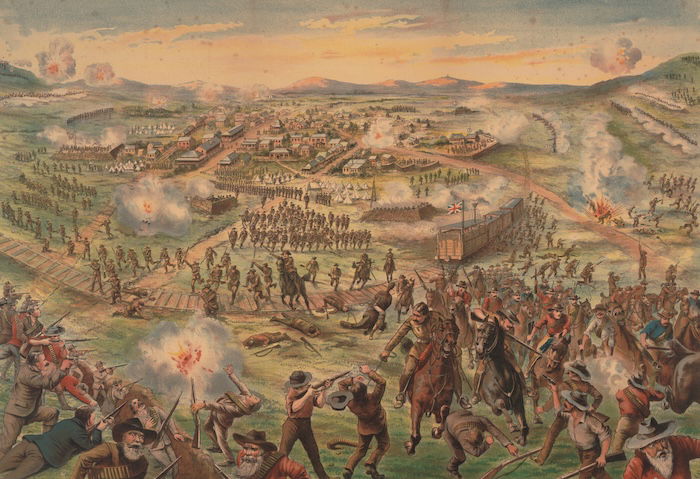
After more than twenty years of fighting, scouting and spying in a succession of colonial wars, Major Robert Baden-Powell unexpectedly became a popular hero and household name when, in 1900, he engaged the rapt attention of the British public during the siege of Mafeking. His reward was promotion, at the tender age of 43, to the rank of major-general. On his return from South Africa in 1903, Baden-Powell was surprised to find that his military manual, Aids to Scouting, written just prior to the Boer War, was being used by teachers and youth leaders in their educational work. Shortly afterwards, the Glasgow-based founder of the Boys' Brigade, William Smith, encouraged Baden-Powell to draft an aids-to-scouting specifically for young lads. The attraction of such a handbook would derive from the lore of the woodcraft movement: the body of traditions and knowledge on forest life. By providing instruction in the practical skills of hunting, cooking and finding shelter, urban youngsters would recapitulate the natural challenges faced by the frontiersman. Drawing upon the woodcraft scheme for youth training, pioneered by the American, Ernest Thompson Seton, and upon his own experience of outdoor life, which the experimental scout camp at Brownsea Island enlarged, Baden-Powell framed a code of conduct for adolescent boys, with the accent on patriotism and citizenship, along with an imaginative freemasonry of emblems, titles, camp-craft and the left-handed shake. All this was set down in the fortnightly parts of Scouting for Boys, which began to appear in January 1908.
The defence of Mafeking, a chromolithograph by A. Sutherland, 1899. Prints, Drawings and Watercolors from the Anne S.K. Brown Military Collection. Brown Digital Repository. Brown University Library. Public Domain.
The final handbook became a clarion call to adolescent boys. Scout troops sprang up like mushrooms across the country. By 1916 there were over 100,000 boy scouts, outnumbering all the other youth groups put together; by 1913 the total membership was pushing 140,000, exclusive of the 14,500 scoutmasters and assistants. As to the social composition of the movement, it is difficult to assess. The prevailing opinion is that it was a predominantly middle-class movement from the start. Yet Baden-Powell was of the view that a half or more of the 11,000 London scouts came from the lower middle class, with the rest from the ‘lowest class’. Recent research suggests, moreover, that in the early years, scouting grew most rapidly in the central working-class districts of large cities like Manchester, rather than in the suburbs. But of one thing there is no doubt, the blend of woodcraft, patriotism and imperial mission proved an irresistible concoction for a huge proportion of Edwardian youth. They seem to have discovered in the boy scouts a practical embodiment of both the Red Indian tales of Fenimore Cooper and the jingoist adventure stories of G.A. Henty.
Woodcraft and imperialism were not, however, particularly compatible, and there were many who criticised the resulting ambiguity in the aims and ideology of scouting. The movement’s primer, Scouting for Boys, elucidated the essential properties of ‘peace-scouting’: the open-air life, the campfire yarns, the code of moral and physical cleanliness, the ideal of public service, the duty to God and the King, and the games to develop character and initiative. From this perspective, scouting was meant to supply an equivalent training in citizenship to that provided by the public schools. Military drill, which Baden-Powell had repeatedly denounced for destroying initiative, was strongly discouraged. Wisely so, for had the scouts been merely a paramilitary body, it is unlikely that they would have attracted so many young recruits, or have gained the support of the nonconformist churches and of such patrons as George Cadbury, the Quaker philanthropist and pacifist. But if formal drill was shunned as a regular part of scouting, Baden- Powell’s writings leave no doubt that an equally crucial motive for the youth group's formation was to promote the defence of Empire.
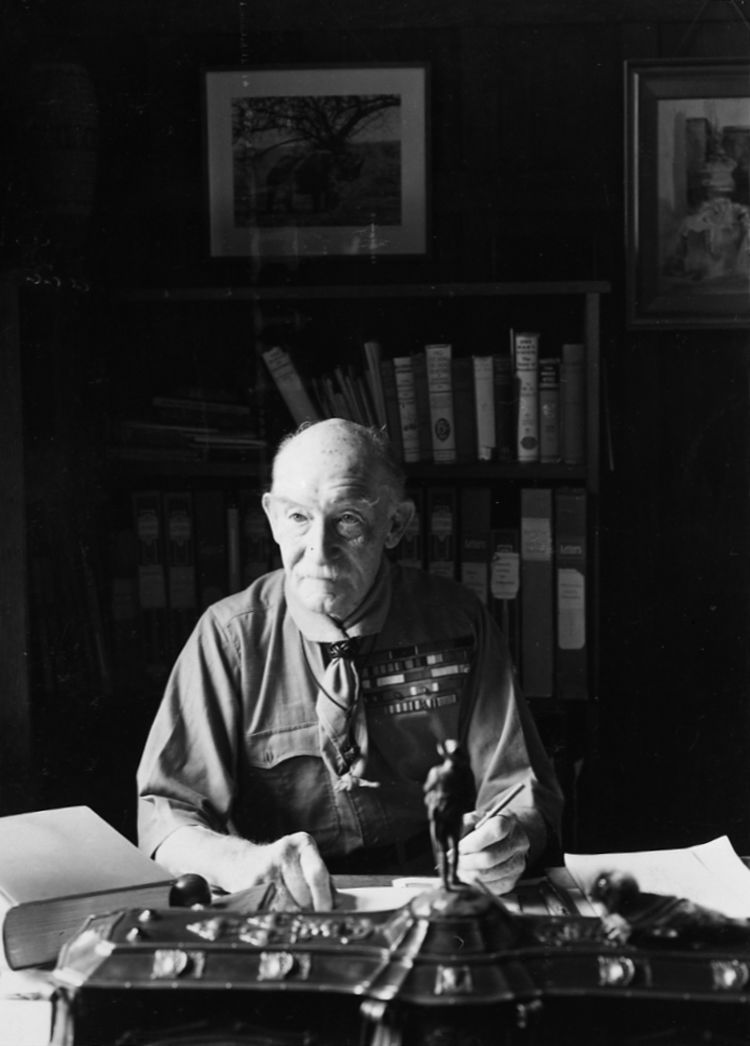
Sir Robert Baden-Powell in the uniform of Chief Scout, by John Dixon Scott, c. 1926-1939. The National Archives. Public Domain.
In Scouting for Boys, Baden-Powell instructed his young readers that national and imperial defence could best be guaranteed by showing all their rivals that Britain was more than ready for war. ‘Every boy should prepare himself’, the handbook decreed, ‘by learning how to shoot and drill, to take his share in defence of the Empire, if it should ever be attacked’. Similarly, the avowed aims of the Girl Guides, started by Baden-Powell’s sister in 1909, were to prepare girls for a colonial life and to make them of practical use in the event of invasion. Over and above this, it was recognised that a strong Empire required a strong Imperial race. Why else had the Roman Empire crumbled, Baden-Powell claimed, but that the Romans had abandoned ‘soldiering and manliness’ and had become mere spectators of their national games – much as the English working men had done with the rise of professional football. The way to reverse the onset of moral and physical decadence, to build up a ‘self-reliant, energetic manhood’, was not by ‘free feeding and old age pensions’ (here Baden-Powell was taking a side-swipe at the welfare reforms of Asquith’s Liberal government), but by bodily exercise, health-giving habits and the moulding of character. Thereby would all those lads in ‘blind alley’ occupations, at present deprived of leadership, be fitted as voters and soldiers to assume the responsibilities of Empire.
If that took care of the external danger, an internal threat to the survival of Empire existed in the conflict between classes. Baden-Powell was extremely conscious of this impediment to a united national effort and particularly of the aggravating presence, as he saw it, of the newly formed Labour party. Accordingly, under ‘citizenship’ in Scouting for Boys, he championed the virtues of class cooperation. Do not think of boys from other classes as your enemies, he advised his ‘tenderfoots’; whether from castle or slum, you are all Britons first. The lesson was reinforced by directing attention to examples of bad citizenship, notably those who allowed themselves to be duped by socialist agitators. Baden-Powell conceded that a fairer distribution of wealth was a valid aim, but he condemned the socialists for going the wrong way about it. ‘More thrift’, he said (and indicatively every scout worth his badge had to deposit at least a shilling in a bank account), ‘rather than change of government will bring money to all. And a strong united Empire, where all are helpful and patriotic will bring us power, peace and prosperity such as no Socialistic dream could do.’
Faced with such literary period- pieces, it would be remiss not to trace the source of scouting ideology, at least in its pre-1914 phase, to the junction of three overlapping Edwardian creeds: social Darwinism, national efficiency and social imperialism. Darwinism had taught that the fittest survived; social Darwinism elevated this to the level of the nation-state. The theory implied that if Britain was to weather the storm of economic competition and unchecked German naval expansion, an efficient workforce and army were essential. Yet the evidence, notoriously from the Boer War, pointed rather to military weakness and physical deterioration. Hence, the reversal of this decline became the manifesto of a heterogeneous political grouping under the banner of ‘national efficiency’.
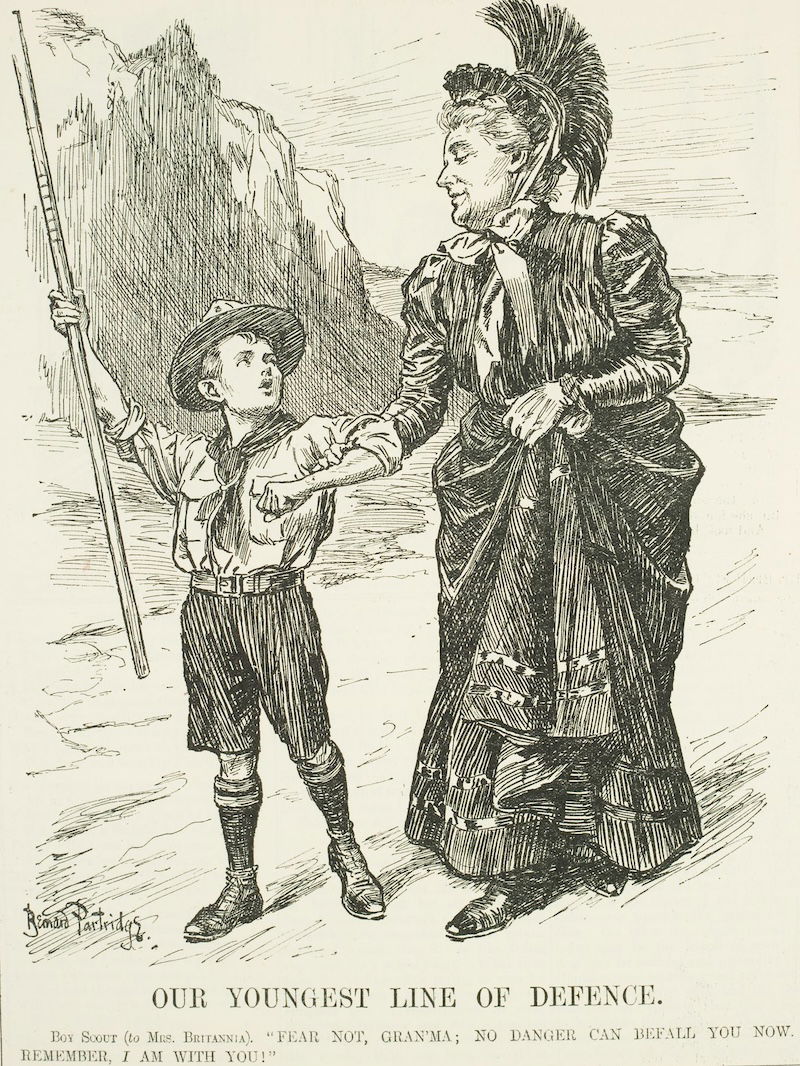
Marching behind the same standard was a more restricted political grouping, led by Joseph Chamberlain, whose watchword for national revitalisation was social imperialism. If the Empire were properly tilled, the thesis ran, it would finance domestic social reform and thus assist the nurture of a stout-hearted imperial race. These, then, were the fears and aspirations of many within the governing precincts of Edwardian Britain, giving rise to a climate of opinion which looked favourably on a scouting movement seeking to reconstruct youth on the lines of moral and physical efficiency, and to train it to be, as the Punch cartoon declared, ‘Our Youngest Line of Defence’.
‘Our youngest line of defence’, from Punch, 1 September 1909. Heidelberg University Library. Public Domain.
It is one thing to associate scouting with these Edwardian beliefs, another to document the marriage between them. Yet there is evidence of intimate links between the scout movement and such political and military causes as the Tariff Reform League (the Tory wing of social imperialism, advocate of protection for British industry), the Territorial Army and the National Service League. To start with, partisans of Chamberlain’s social-imperialist programme – Lord Kitchener, Field-Marshal Earl Roberts (‘Bobs’), Lord Haldane, the Earl of Meath and Sir Arthur Pearson – encouraged Baden-Powell to develop a scheme of youth training. During the promotional phase of the scheme, Baden-Powell was especially assisted by Sir Arthur Pearson, founder of the Tariff Reform League, friend and ally of Chamberlain, and owner of the Daily Express and Evening Standard. Pearson had a like-minded affection for country life and for games and sports, but he also saw the potential in the scouting idea for fostering class unity and strengthening imperial defences. To this end he footed the bill for a massive publicity campaign on behalf of scouting, including a national lecture tour by the founder himself, Pearson also wisely dissuaded Baden-Powell from adopting the title of ‘Imperial Scouts’.
Once the movement was under way, the Chief Scout turned to matters of central organisation. He immediately packed the Boy Scout Governing Council with serving or retired Army officers, including Lords Kitchener and Roberts. This offended a few of the early Scout Commissioners, notably John Hargrave and Sir Francis Vane, who began to attach the Council as a ‘military cabal’, and who eventually broke away to form their own non-militaristic variants of scouting. The last straw Vane had been Baden-Powell‘s appointment as Chief Scout Commissioner of Lieutenant-General Sir Edmund Elles. According to Vane, Elles regarded the scout movement as a mere recruiting ground for the Territorial Army. Sir Edmund Elles (as also Lord Roberts and the Earl of Meath) was certainly a leading light in the National Service League, an energetic pressure group dedicated to the introduction of compulsory military training for the young. At ground level, a number of scout troops arranged joint parades with the National Service League. A much larger number of local troops shared parades and field days, not to mention rifle ranges, with the Territorial Army. In fact, this link was stronger still, since Baden-Powell, through the offices of his friend, the War Minister, Haldane, was GOC of the Northumberland Territorial Division in the inaugural years of the scouting movement.
It was the spectacle of a movement dominated by a coterie of ex-soldiers and imperialists, linked with groups that were eager to mobilise youth for military ends, which led many to believe that the effect if not the aim of scouting was, as one critic charged, ‘to foster among the boys of Britain a bloodthirsty and warlike spirit’. When at last the Great War arrived, the scramble to join Kitchener‘s volunteer army confirmed their worst fears. Scouting, it was believed, had contributed to the material and psychological preparation for war in Europe.
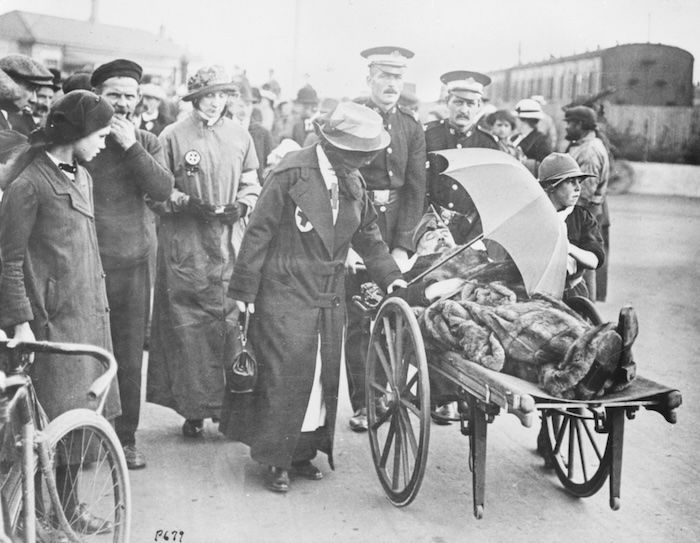
A wounded Belgian officer disembarks at Folkestone, assisted by a British Red Cross nurse and a Boy Scout, December 1917. Library of Congress. Public Domain.
The First World War, according to the movement‘s official history was scouting's ‘finest hour’. Along with other voluntary bodies, the scouts did much of the work which during the Second World War was performed by the auxiliary forces. They acted as messenger boys between government departments, served in first aid stations and soup kitchens, and helped to bring in the harvests. At Kitchener’s request, the sea scouts took over the duties of the coastguard. In the first few months of hostilities, Baden-Powell hurriedly put together the popular manual, Quick Training for War , to assist the rapid development of field efficiency. He also organised a Scouts Defence Corps to give drill and rifle practice to the older scouts, in case the age of conscription came down. It is unlikely, however, that he engaged in secret-service work, as was commonly believed. Indeed, one American newspaper in 1916 declared that Baden-Powell had been shot by soldiers on his return to England as a German spy.
But the war was to prove a major turning point for the outlook and ideology of scouting. The appalling toll of life which the 1914-18 war had taken, sent out waves of pacifist sentiment which forced the scouting organisation to alter course. The shift in the national mood was quickly sensed by Baden-Powell. Crude imperialism was thrown off and the scouting movement decked out instead in the robes of internationalism. Baden-Powell was soon a vice-president of the League of Nations Union; the highpoint of the scouting calendar became the ‘jamborees’ in the cause of international brotherhood. With an adaptability which remains scouting’s greatest strength, the movement turned from being almost exclusively associated with patriotism, militarism and Tory imperialism, and sped towards the centre ground of British cultural life.
For Further Reading:
John Springhall, Youth, Empire and Society. British Youth Movements 1883-1940 (London, 1977). John Gillis, Youth and History (London, 1974). Paul Wilkinson, 'English youth movements, 1908-30', Journal of Contemporary History , volume 4 (1969). Geoffrey Searle, The Quest for National Efficiency, a Study in British Politics and Political Thought, 1899-1914 (Oxford, 1971). Bernard Semmel, Imperialism and Social Reform (London, 1958).
Victor Bailey is a fellow in history at Worcester College, Oxford and is at present working on The Making of English Penal Policy 1914-1948: The Young Offender to be published by OUP.