Virgil’s epic poem the Aeneid was at the centre of the education system in the Roman Empire. The young boys of the ruling classes – and the occasional fortunate privately tutored girl – learned to read by sounding out lines from the poem; whole swathes of it were learned off by heart. As adolescents, boys would begin the rhetorical studies on which an imperial career was based by entering imaginatively into the lives of characters from the Aeneid; they would compose speeches for the characters to declaim at crucial moments of choice or crisis. Their schoolmasters would award prizes for the speech that was most convincing and most elegantly composed.
Register to read more articles for free.
When you register, you will receive the History Today newsletter. Click here to read our Terms of Use.
Virgil’s epic poem the Aeneid was at the centre of the education system in the Roman Empire. The young boys of the ruling classes – and the occasional fortunate privately tutored girl – learned to read by sounding out lines from the poem; whole swathes of it were learned off by heart. As adolescents, boys would begin the rhetorical studies on which an imperial career was based by entering imaginatively into the lives of characters from the Aeneid; they would compose speeches for the characters to declaim at crucial moments of choice or crisis. Their schoolmasters would award prizes for the speech that was most convincing and most elegantly composed.
The Aeneid took its name from Aeneas, the legendary founder of Rome. The poem tells the story of the city’s foundation as a mixture of visionary glory and human inadequacy. The first time we see Aeneas in the poem he is in tears of despair as his ships, fleeing Troy, are threatened by a storm. Later, an entire prophetic parade of Roman heroes marches past him as he visits his father in the underworld. But for Aurelius Augustinus, a young boy reading the Aeneid in a small town in North Africa in the AD 360s, Aeneas was not the most important person in the poem. Escaping his defeated hometown of Troy and sailing an erratic route across the Mediterranean to Italy, Aeneas and his fleet had been blown ashore near Carthage, on the coast of modern Tunisia. There he had met the city’s queen and founder, Dido, who fell passionately in love with him. When Aeneas left to pursue his destiny she killed herself – hoping that he would see the smoke from her funeral pyre and feel remorse.
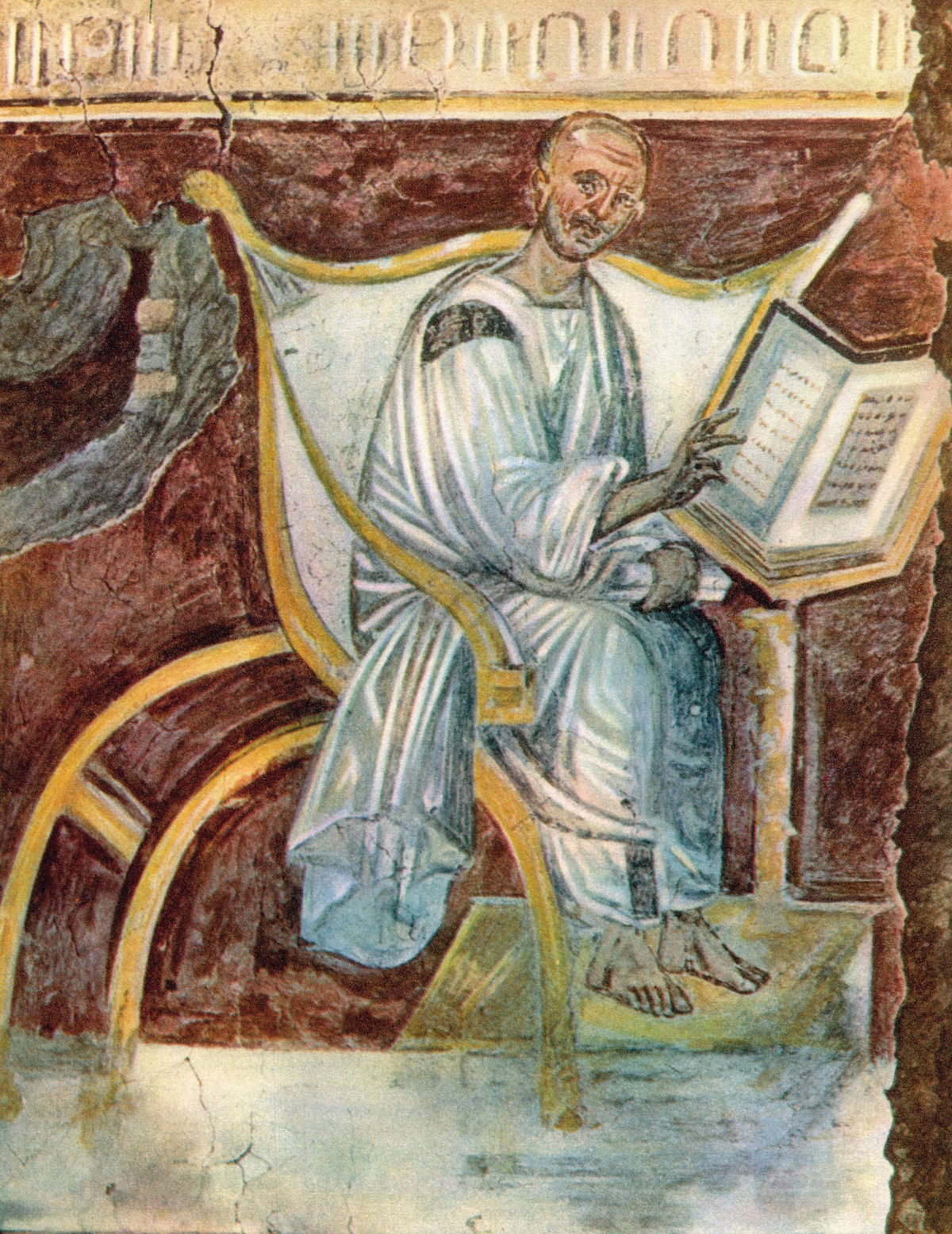
Aurelius Augustinus – who many years later would become bishop of Hippo, also in North Africa, and, eventually, Saint Augustine – was obsessed with Dido and her fate. In his autobiographical Confessions, composed after his turn to Christianity, he dwelt on the grief that, as a child, he had felt at her death:
I kept on weeping for Dido who had died, who had pursued her final end with the sword … and if I was prevented from reading the story, I was miserable, because I couldn’t read what made me miserable.
We might think that this was just the emotional response of a young boy, soon to be trained to a more conventional and disciplined set of Roman sentiments, were it not for two asides in other, very different works of his. In a later sermon Augustine introduced the theme of Carthage on the flimsiest of grounds, and then boasted that the city surpassed all other places for business and navigation, because it had been founded by Dido with merchant ships – ‘and even once Carthage was founded, the ships didn’t stop doing business’. More tellingly, in a dialogue that he wrote in 386, soon after his conversion, he talked about his brief period teaching in Rome, recalling that his students, when he tried to teach them rhetoric, mocked him for his African accent: ‘It’s one thing to be secure in my art, quite another to be secure in my descent.’
Augustine’s obsession with Dido was not just a matter of boyish sentiment. To him, she represented North Africa, and as an African himself he was loyal to her in the face of Roman disdain. He would grow up to be one of the most significant figures in the development of the Christian Church; his writings on grace, free will, and original sin became fundamental to its theology. Moreover, his works helped to shape the Western intellectual tradition: philosophy, political theory, psychology, hermeneutics, and the study of language are all indebted to him. Yet a part of him was always the loyal African who had once cried for Dido.
An African in Italy
Augustine was born in 354 and spent his childhood in a town called Thagaste, in the rocky lowlands about 60 miles inland from the North African coast in what is now Algeria. His parents sent him to be educated in the rhetorical schools of Madauros (modern M’Daourouch) a few miles away, and then –realising his talents, and ambitious for his success – to study in Carthage, the largest city in the region. The Romans had first gained a foothold in North Africa in 146 BC, when they obliterated Carthage at the end of the Punic Wars. By the second century AD they controlled the whole expanse from Mauretania (Morocco) in the west to Egypt in the east, and its principal cities for both trade and learning were Alexandria and Carthage. The southern border of Roman rule was shaky, maintained by widely spaced garrisons and ongoing pacts, negotiations, and trade agreements with the indigenous peoples of the region. But a wide band of fertile agricultural land along the coast was securely in their hands. Through Carthage, Alexandria, and other ports, it supplied grain and olive oil to the hungry cities of the Empire.
Augustine’s family background was modest. His father, a Roman citizen, was a small landholder and a member of the town council in Thagaste. The town was a municipium, fully incorporated and recognisably Roman with its theatre and baths; but even in the context of Roman Africa it was insignificant and marginal. Augustine’s mother was Amazigh, or Berber – or so we intuit from her name, Monnica, which is derived from the name of the North African god Mon. The best way for a talented boy to rise in the later Roman Empire was to excel at school and become a teacher of rhetoric or a civil servant, allied with the imperial court. Augustine achieved both.
After his schooling in Madauros and Carthage, Augustine began his teaching career, first in his home town and then in Carthage; but everything about his education and training, centred as it was on an idealised view of Rome, had conditioned him to look down on North Africa and seek out opportunities on the Italian peninsula. Carthage was significant as the long-ago enemy of Rome, destroyed in 146 BC and subsequently rebuilt by Augustus: ‘true’ Romans saw its subservience as the guarantor of Roman superiority. So in 383 Augustine set sail for Rome, the symbolic centre of the Empire, to take up a teaching position there.
Augustine’s brief time in Rome was not a success. Thanks to his pupils, it was probably the first time he had realised that he had an African accent. (Towards the end of his life, he was still aware of the distinction, observing that ‘African ears’ could not tell the difference between long and short syllables.) He felt alien and displaced, and quickly fell ill. But his talents had drawn the attention of a powerful patron, Symmachus, the urban prefect, who recommended him for a position at the court of the emperor, Valentinian II, in Milan. There, Augustine would continue to teach, but he would also be the orator whose job was to make official speeches in praise of the emperor. Augustine made the long journey north to Milan at public expense, a great honour. He had fulfilled the dearest wishes of his parents, patrons, friends, and, we might assume, himself. His mother, son, and other family members joined him in Milan: everyone was going to profit from his success.
Augustine’s departure from Carthage and arrival in Rome and then Milan. Attributed to Rossello di Jacopo Franchi, 1433. Photo Index Firenze/Bridgeman Images.
But in spiritual terms, Augustine was lost. Initially brought up in the simple Christianity of his mother, he had long been dissatisfied and questing. Endlessly concerned with the problem of truth and how, as he put it in the Confessions, to ‘do truth’, he underwent many ‘conversions’: first to philosophy as the study of wisdom; then to Manicheism, an outlaw, materialist religion that claimed to solve the problem of evil, with which he stayed for ten years; then to the astrologers and their claims about the future; then to a different sort of philosophy, the radical scepticism that asserted one could never know the truth, only something like it. As Augustine searched for spiritual direction, he came across the writings of the third-century Neoplatonist Plotinus, translated from their original Greek into Latin. Perhaps the fact that Plotinus came from Egypt was part of the attraction, although Augustine does not say. But the writings finally offered a way out of the materialism of Manicheism and helped Augustine envisage a truly non-material God. Neoplatonism took Plato’s idea of looking at earthly things and inferring the spiritual perfection of which they were an imitation, and made it into a complete system of spiritual descent from a single perfect being.
In Milan, Monnica came under the spell of the powerful, charismatic bishop Ambrose, whose sermons drew heavily on Neoplatonic ideas. Augustine went to hear Ambrose preach, ostensibly to study his powers of rhetoric, but Ambrose’s Christian message began to insinuate itself. He also met with Ambrose’s own spiritual father figure, a priest called Simplicianus, who gently nudged Augustine backtowards Christianity, telling him the story of the conversion of the Roman aristocrat, Victorinus, who had translated the Neoplatonic books into Latin, and who also came from Africa. Finally, Augustine was ready to return to Christianity. He had, in a sense, come full circle.
The moment of conversion famously took place under a fig tree in the garden of his lodgings in Milan. Augustine recounts it in vivid detail in the Confessions. In an agony of irresolution, he flung himself there, only to hear a child on the other side of the garden wall chanting: ‘Take it, read; take it, read.’ Pausing to reflect that he knew of no game with such a refrain, Augustine construed the chant as a divine message. He seized the copy of the epistles of Saint Paul that he had with him and took his cue from the first phrase he saw:
Not in revelling and drunkenness, not in debauchery and licentiousness, not in quarrelling and jealousy. Instead, put on the Lord Jesus Christ, and make no provision for the flesh, to gratify its desires.
With that, Augustine finally committed himself to a Christian life. He was baptised in Milan by Ambrose at Easter, 387. His son Adeodatus, about 14 or 15 years old, was baptised with him.
Augustine resigned his position at the imperial court and decided to return to North Africa. In Italy he had felt like an outsider, despite the presence of his son, his mother, and a small posse of friends; he wanted to go home.
While the whole party was at Ostia, the port of Rome at the mouth of the Tiber, waiting for a ship sailing back to Carthage to give them passage, Augustine shared with his mother Monnica an extraordinary experience. Leaning out of a window, chatting to each other, they gradually realised that earthly sounds were falling away and they attained together a moment of perfect silence and intense repose that they interpreted as a glimpse of God. ‘In a flash of thought’, wrote Augustine, ‘we touched that eternal Wisdom who abides above all things.’ The moment was made all the more poignant by the fact that Monnica died soon afterwards, and was buried at Ostia. She, like her son, came to be venerated as a saint, and in the 15th century her body was moved to the church of Sant’Agostino in Rome, the mother church of the Augustinian order.
Going home
This much we learn from the Confessions, Augustine’s most famous book, which he composed back in North Africa some ten years later. The work mixes the events of his life up until Monnica’s death at Ostia with prayer and philosophy, self-examination, and biblical interpretation. But by far the most important part of Augustine’s life – the part that left an indelible mark on Christian theology and the intellectual tradition of Western Europe – was yet to come.
When he finally returned to Africa in 388 – Christian, but without a job – Augustine planned to found a monastic community on his family estates at Thagaste. He would gather around him the friends who had accompanied him back from Italy, along with his son Adeodatus, and live a dedicated Christian life. But after five life-changing years it was hard to feel at home. Then, unexpectedly, his son died.
Augustine’s son had been at the centre of his plans for the future. Adeodatus had taken part in philosophical conversations about their Christian commitment while they were waiting to be baptised and, wrote his father fondly, ‘his intelligence was staggering’. Augustine was completely bereft, and his dream of a peaceful monastic life was over almost before it had begun. Derailed by grief, he could no longer bear to be in Thagaste. While he was casting about for another place to settle, he came to Hippo, now the city of Annaba, set on the flat fertile land between the mountains and the sea on the coast of Algeria. His reputation as an accomplished orator and committed Christian had preceded him: when he went to church, the congregation seized him, and he was forcibly ordained as their priest. ‘Augustine wept freely as they eagerly presented their request with loud shouting’, wrote Possidius, his acolyte and biographer. Four years later, in 395, he became their bishop. The course of the rest of his life was set, and he never left North Africa again.
The ‘Ecclesia Mater’ mosaic showing an early North African Christian basilica, Tabarka, western Tunisia, fifth century. Bridgeman Images.
He did not forget the sense of being an exile that he had experienced in Italy, though, and he remembered, too, how it had felt to come home and yet not be at home. He preached:
A person changes his country, and sometimes it goes well for him in his wandering: while he lives abroad, he finds the faithful friends he could not find at home. He had enemies who drove him out of his country … But the homeland of Jerusalem, where everyone is good, is not like that. It is a great home, and the people who wander away from it are miserable.
‘Jerusalem’ was heaven, the home to which the good are destined to go after death. Augustine had taken his own sense of homesickness and made it into a great theological vision. We are all wanderers, all the time, feeling that we have lost something – the place where we can feel truly at home, the heavenly Jerusalem.
The City of God
In August 410 a general called Alaric and a band of Goths from the far side of the Danube cut off the corn supply to Rome, besieged the city, and then sacked it. Alaric had originally been a mercenary in the Roman army but had become increasingly disaffected and, raising his own unit of loyal followers, had threatened the Roman emperors first in Greece and then in Italy. The sack of Rome was over in a few days, but its repercussions lasted far longer. The symbolic heart of the Roman Empire had been violated, and the Romans of Rome and the surrounding countryside were terrified.
Augustine soon felt the aftershocks in North Africa. Wealthy Romans, with their families and households of servants and slaves, left their estates around Rome and fled to their estates in Africa. Some, the more Christian ones, swept into the churches and destabilised their congregations, and Augustine preached sermons that tried to reassure the incomers while urging the residents not to resent them. ‘Do not let the lovers of this world disturb you’, he said to his congregation, ‘the people who … are being compelled to migrate whether they want to or not.’ Others, less Christian, settled in Carthage, muttering that such barbarous events would never have happened if the Empire had not committed to Christianity. The attack on the tempora Christiana, ‘Christian times’, reached Augustine’s ears, and two Roman aristocrats, Marcellinus and Volusianus, wrote to him to demand a defence of the Christian God and God’s providential plan for the world. Augustine’s response developed into one of his great masterpieces, The City of God. He dedicated it to Marcellinus.
Saint Augustine preaching to his disciples, from The City of God, Italy, 11th-12th century. Raffaello Bencini/Bridgeman Images.
Given that his first readers would have expected a reflection on what had happened at Rome, Augustine’s initial statement was provocative: ‘The most glorious city’, he wrote, was not Rome, but that ‘of God’. He announced immediately his project of showing that the people of that city spent their lives wandering here on Earth, only to find their real home in the kingdom of heaven. Only then did Augustine address directly what had happened at Rome, and it was to argue that, in God’s grand scheme, the events, though serious to those they affected directly, were insignificant. The City of God then proceeded to unfold on a grand scale: it was 22 books in length, and, in the midst of his other writing and episcopal duties, took around 15 years to compose.
The first ten books were devoted to disproving the claim that Rome had been secure under its old gods. Five books made mockery of the notion that the pagan gods could protect those who worshipped them while they were alive; the next five derided the idea that the gods would provide any haven after death. The books were larded with copious erudite examples, many drawn from the Antiquities of things human and divine by the first-century author Marcus Terentius Varro – whose work largely survives through Augustine’s quotations. Augustine tapped into the level of religious knowledge that devout Romans would have felt that they ought to have, but did not. No one knew the classics of Roman literature better than he. After all, he had excelled at the height of the Roman educational tradition before giving it up for a Christian life. But again and again, he questioned and subverted that tradition, needling his Roman audience by telling their favourite stories at a slant – clearly inspired by his view from Africa. He undermined the classic story of Regulus, Roman hero of the Punic Wars who had become proverbial for keeping an oath sworn to the enemy Carthaginians. Yes, Regulus was faithful, but misguided: what was the point of an oath sworn to the wrong gods? Augustine was quietly taking the side of Carthage once again.
The remaining 12 books developed the theme of God’s plan for the world, and the rewards of God’s ‘city’. Augustine took the narrative back to the creation of the world and the nature of God’s angels, and then retold the stories of Genesis at a leisurely pace, with expository commentary. The nature of the two cities – God’s city, and the earthly one – was explored at length. The theology of The City of God was imbued with the feeling of exile that Augustine had experienced in Italy and on his return to what he had thought was his home: God’s city, he wrote, lived in hope of the joy it would experience in the heavenly kingdom.
Out of Africa
Augustine was nearing the end of his long, distinguished life by the time he finished The City of God. In 429 an army of Vandals from the northern edge of the Empire, under their leader Gaiseric, marched down through Spain and crossed into North Africa at the Straits of Gibraltar. Augustine watched with dismay as they moved east: the ruin of the countryside he knew so well was a bitter contrast with the secure rural childhood he had sketched in the Confessions. No one could have predicted the speed with which North Africa was overrun by their forces. They defeated the Romans at Guelma, about 40 miles south of Hippo, around May 430. As Augustine lay dying, in August 430, the Vandals were besieging Hippo. The city fell later that year.
Augustine died on 28 August 430. The vast library of his works escaped the siege of Hippo, and the legacy of his writings was to be immense. Not just the ideas in his Confessions and The City of God, but on just war, on political organisation, on free will and God’s grace, on the interpretation of scripture: all have endured to this day. They emerged from North Africa, and were shaped by Augustine’s life there. He was loyal to the last to the African heritage that had enraptured him in the person of Dido all those years before.
Catherine Conybeare is Leslie Clark Professor in the Humanities at Bryn Mawr College and author of Augustine the African (Profile, 2025).