The advent of telecommunications in the 19th century gave rise to a new literary genre through which female telegraphers and writers found social freedoms.
In the 19th century the advent of steam power, electricity and the proliferation of print culture coalesced to produce a new kind of global communications-driven society. Accelerating across the world from the 1850s onwards, the electric telegraph produced new understandings of space, time and subjectivity. This proved fruitful material for literature: writers such as Charles Dickens and Thomas Hardy explored the impact of advancements in technology on society, landscape and human experience. There were stories focusing on the telegraphic workforce, too: Anthony Trollope’s The Telegraph Girl, published in 1877, dramatised the lives of young women working in the Telegraph Service in London. But electrical telegraphy also had an explicit material connection to print culture. The successful completion of the Atlantic cable project was achieved in 1866 by the SS Great Eastern, a ship with an on-board print shop.
Register to read more articles for free.
When you register, you will receive the History Today newsletter. Click here to read our Terms of Use.
The advent of telecommunications in the 19th century gave rise to a new literary genre through which female telegraphers and writers found social freedoms.
In the 19th century the advent of steam power, electricity and the proliferation of print culture coalesced to produce a new kind of global communications-driven society. Accelerating across the world from the 1850s onwards, the electric telegraph produced new understandings of space, time and subjectivity. This proved fruitful material for literature: writers such as Charles Dickens and Thomas Hardy explored the impact of advancements in technology on society, landscape and human experience. There were stories focusing on the telegraphic workforce, too: Anthony Trollope’s The Telegraph Girl, published in 1877, dramatised the lives of young women working in the Telegraph Service in London. But electrical telegraphy also had an explicit material connection to print culture. The successful completion of the Atlantic cable project was achieved in 1866 by the SS Great Eastern, a ship with an on-board print shop.
As a vessel at the forefront of new global media communications, the Great Eastern achieved a publishing first, printing live news from Europe in its publications which kept its crew informed on its long voyage. During the 1865 and 1866 Atlantic cable voyages, the Great Eastern was producing its own newspapers even as the telegraph cable was being laid, the focus of news stories around the world. The connection between ‘making news’ and the cable was established early in the history of telegraphy.
The telegraph generated other kinds of print too. During the course of the Atlantic cable project, which lasted for ten years, trade journals published by those working in the domestic telegraphic profession began to appear in America. These publications were designed to represent the interests of a growing workforce and to provide the latest updates on innovations in electrical science, but they also prompted the gradual emergence of a new genre of literature inspired by the telegraph and the telegraphers who worked on it. The first successful title of these publications was the Telegrapher, a journal published by the National Telegraphic Union, whose first volume came out in October 1864. It was followed by titles such as the Journal of the Telegraph, the Operator and Electrical World.
From the beginning, telegraph publishing looked to existing literary forms as a guide for representing the new technological world. Its literary pretensions are clear on the masthead of the Telegrapher’s first volume, which is inscribed with Puck’s seemingly prescient words from A Midsummer Night’s Dream: ‘I’ll put a girdle around about the earth in forty minutes.’ This quote gestures towards the present and future possibilities of electrical telegraphy: the ongoing project to install undersea cables and the broader aim of one day connecting the whole world through wired electrical impulses.
While sub-oceanic and international telegraphy employed an entirely male workforce, urban and suburban areas saw a new type of employee appearing on its domestic communication lines: the telegraph girl. She rapidly became a notorious figure in 19th-century popular culture.
‘Wooing by Wire’
The most prolific publisher of telegraph literature from the 1870s onwards was William John Johnston, a former Western Union telegrapher who became editor of the trade journal the Operator and, later, Electrical World. Alongside his editorial work, Johnston championed fiction written by telegraph operators, publishing Lightning Flashes and Electric Dashes, three volumes of ‘contributions from the pens of all the prominent writers in the ranks of telegraphic literature’. The term ‘telegraphic literature’ was coined by Johnston to refer to fiction written by telegraphers. This included a number of works written by female operators, including Ella Cheever Thayer’s novel Wired Love and shorter fictional texts such as Playing with Fire by Lida Churchill and Wooing by Wire by Josie Schofield. As the titles of these stories suggest, female authors were particularly interested in the anonymity afforded by the telegraph, with its erotic potential and reputation for deception. As increasing numbers of women entered the profession in the latter half of the 19th century, gender and sexuality were increasingly prominent in telegraphic literature.
As professional mediators and communicators, telegraph operators were uniquely skilled at representing the excitement and potential dangers of the technology in fiction. Telegraphy offered women opportunities to forge positions for themselves that resisted traditional conceptions of gender. As the historian Thomas C. Jepsen wrote, ‘telegraphy admitted women to its ranks before its gender roles had been solidified’. In addition, the technology’s most novel feature was immediate, text-based, faceless communication. Together, these two factors produced exciting possibilities for experimenting with gender identity and sexuality. Stories such as those written by Churchill, Schofield and Thayer feature romantic narratives of telegraph operators falling in love over the wire, but these romances are rarely straightforward and cases of mistaken identity and instances of same-sex desire abound.
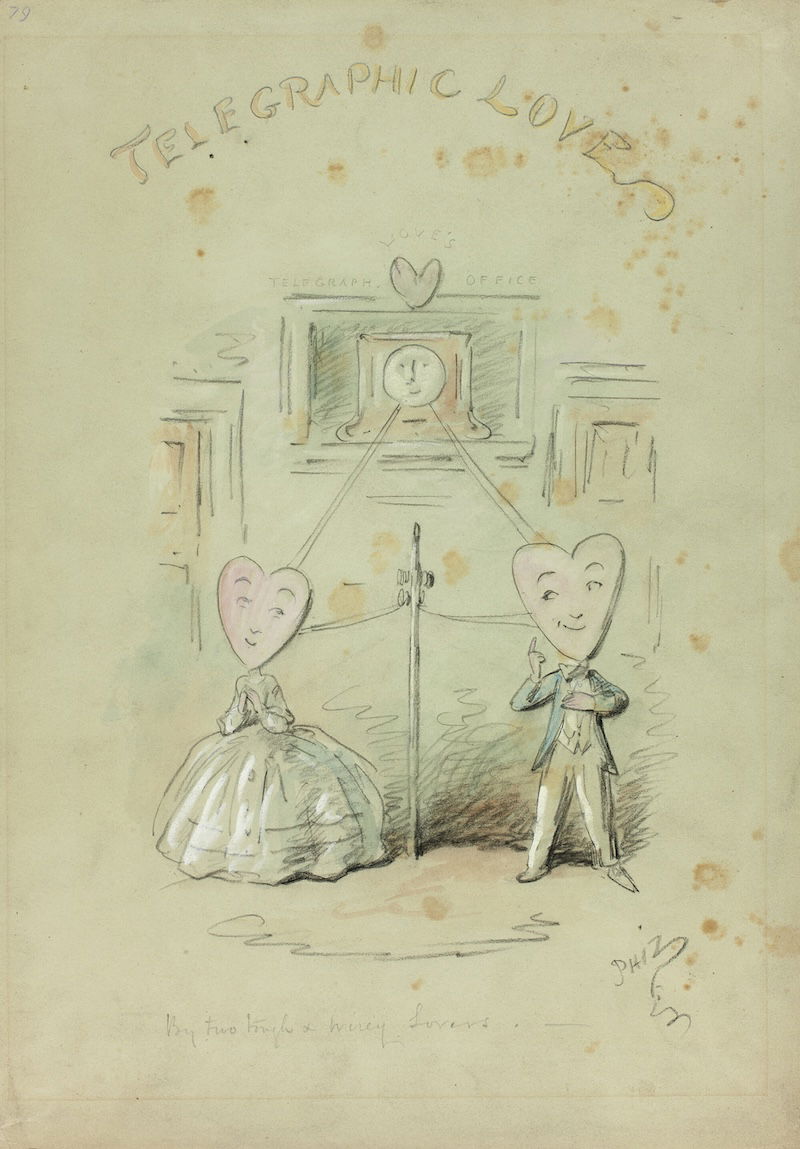
Telegraphic Love, Hablot Knight Browne, 19th century. Art Institute of Chicago. Public Domain.
The female protagonist in Thayer’s Wired Love develops a flirtation with another operator that is complicated by one of their jealous colleagues, who has overheard their romantic conversations on the wire and takes on the identity of her lover while he is away. In Churchill’s Playing with Fire a female telegrapher, sick of ‘stagnating in this dull office’, undertakes to fool a colleague working on her telegraph line by pretending to be a male operator called Isaac. Like many other workers in telegraph fiction, Rena is disillusioned with her repetitive work and boring office environment. However, she develops genuine feelings for her female colleague and feels guilty about deceiving her, until she realises that she has also been tricked and her correspondent is in fact a man pretending to be a woman. Schofield’s Wooing by Wire explores the threat of spinsterhood looming over a female telegrapher who is concerned she may be too old to find a husband at 30.
In these stories women frequently use their machines and the virtual telegraphic world they inhabit to escape the conditions of their work. With long working hours, low pay and little free time, meeting people ‘online’ while at the office seems the best chance of kindling a new romance.
These writers also explore the stylistic and generic opportunities offered by the technology. Churchill experiments with ways to represent telegraphic communication in literary form, using truncated words and abbreviations to mimic telegraphic speech in a style not dissimilar from forms of shortened text-speech which became common in the 2000s. Writers even made use of code within their texts. Wired Love is prefaced with an epigraph written in Morse code and concludes with a profession of love from the protagonist’s lover, both of which are left untranslated for the reader to decipher.
Freedom behind wire
During a period when women’s rights campaigns were gaining momentum and the female-fronted Spiritualist movement was spreading across America, young people were moving to cities to take up new job opportunities and to live communally in boarding houses, whose residents defied class categorisation. The domestic organisation of 19th-century America was largely predicated on family life, an aspect absent from this new kind of communal urban living. Telegraph writers took advantage of these social freedoms in their literary works.
Lida Churchill was a boarding-house lodger who eventually left the telegraph service in Massachusetts to pursue a successful career as a journalist and author in New York. She was also an ardent Spiritualist and wrote several books about self-improvement. Churchill never married and continued to live in communal lodgings until at least 1920. (The Census for that year lists her as a lodger aged 66 and her profession is given as ‘Writer’.) Like her protagonist, Churchill chose to remain single and dedicate her life to work; her relative freedom and professional success reflected the increased opportunities available to middle-class women during this period.
Ella Cheever Thayer was a Boston-based telegrapher employed at the luxurious Hotel Brunswick who, like Churchill, went on to make a living for herself as a writer. She also remained unmarried, and in the 1920 Census, produced five years before her death, is listed as a lodger in a boarding house. It is notable that these women, both fascinated with the romantic possibilities of the telegraph in their youth, never married and spent their adult lives in urban communal lodgings, a previously unthinkable freedom for a woman.
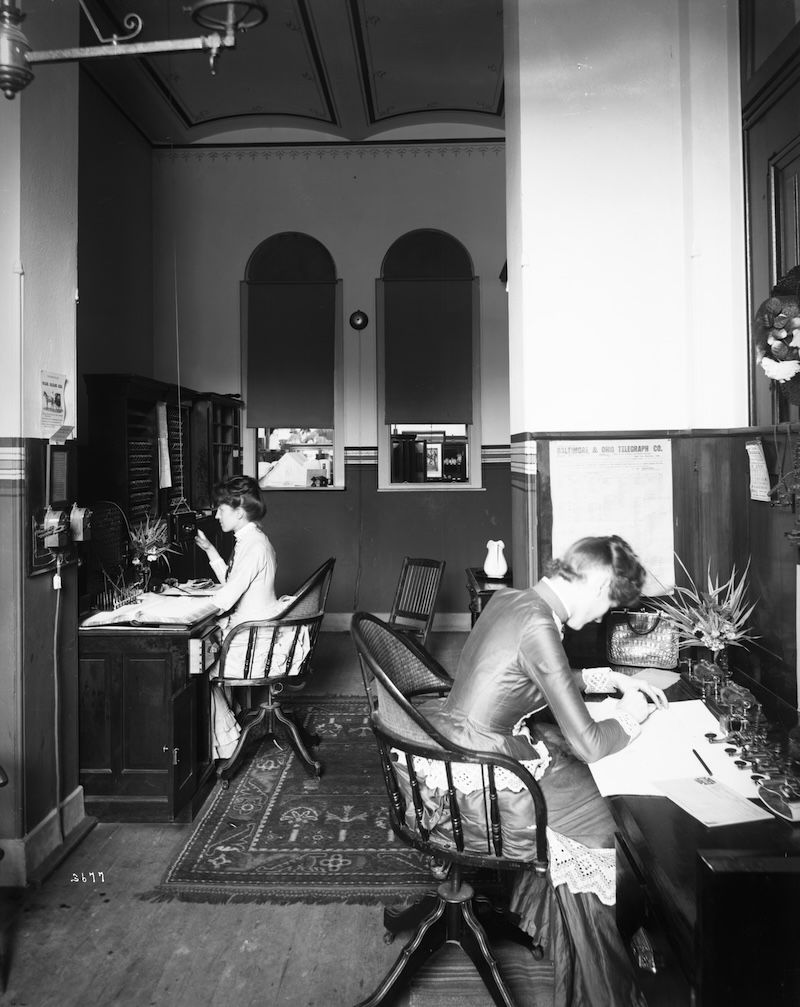
Female employees in the Telephone and Telegraph Office in the North Tower of the United States National Museum, c.1880s. Smithsonian Institution Archives. Public Domain.
Josie Schofield was a Canadian telegraph operator employed by the Dominion Telegraph Company and a regular contributor to the Telegrapher and the Operator during the 1870s. Wooing by Wire was first published in Toronto’s NewDominion in 1875 and was snapped up by the Telegrapher in the same year. It later appeared in W.J. Johnston’s anthology of telegraph literature, Lightning Flashes. In 1877 Schofield accepted a job at the Western Union office in New York, perhaps drawn to the city in the hope of attaining further success as a writer. Shortly after, however, Schofield died by suicide after throwing herself over Niagara Falls. Although her body was never recovered, she had left several personal items on the banks of the river including some books. An obituary that appeared in the Operator describes the events leading up to her death:
It appears that Miss Schofield arrived at Niagara Falls at seven o’clock on Monday evening, and immediately sent a telegram to Mr C. A. Kelly in Toronto, to whom she was engaged to be married this fall, saying: ‘Trains do not connect. Can’t get home tonight. Am going crazy.’
Schofield’s poignant last telegram reveals a metaphysical as well as a practical crisis. Her message that the ‘trains do not connect’ seems to suggest a failure of communication, an inability to translate or decode her feelings as she could a telegraphic message. Schofield’s death points to a broader challenge faced by women in this period: the tension between increased independence and social isolation, professional success and domestic responsibilities, and the desire to pursue their interests versus the social pressure to marry.
The literary works of these three female telegraphers may not be well known, but they reveal a great deal about the changing role of women in 19th-century America. At the forefront of telecommunications, these writers experimented with the exciting possibilities enabled by telegraphy, both in their fiction and in real life. Their stories are the beginning of a new chapter of technological history, with women as the main characters.
Harriet Thompson is an AHRC-funded PhD candidate in the English department at King’s College London.