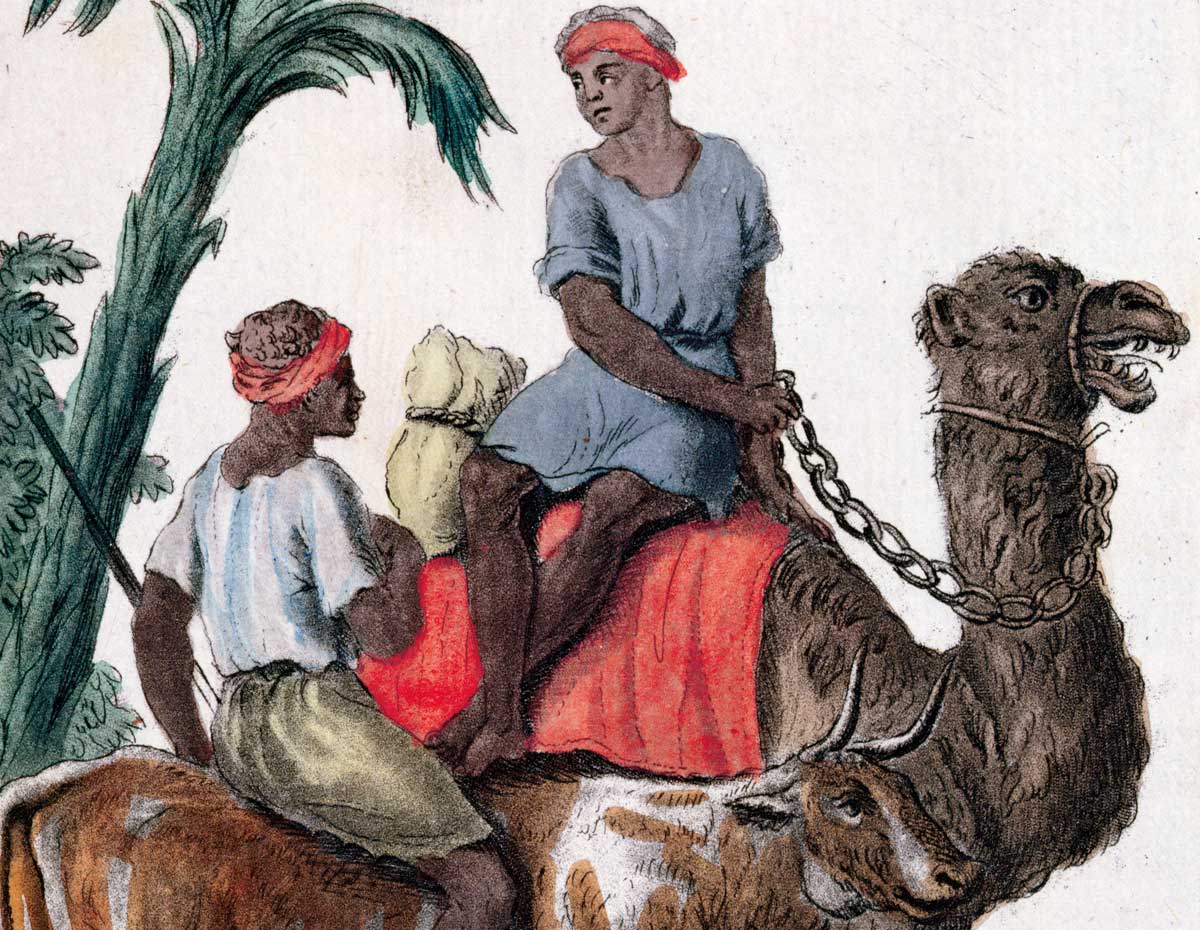
Africa’s continuing dependence on external credit is no accident. Today, it cripples the continent’s economy. From the 16th century, it funded the Atlantic slave trade.
Since the start of the Covid-19 crisis, historians have been quick to note apparent parallels between this pandemic and other moments of widespread disease in humanity’s past. Academic journals have devoted special issues to pandemics in history, relevant books have been reprinted and the history of medicine and health has never seemed more resonant. Yet the rush to focus on the history of science and disease means that other important parallels from the past are in danger of being overlooked.
Register to read more articles for free.
When you register, you will receive the History Today newsletter. Click here to read our Terms of Use.
Africa’s continuing dependence on external credit is no accident. Today, it cripples the continent’s economy. From the 16th century, it funded the Atlantic slave trade.
Since the start of the Covid-19 crisis, historians have been quick to note apparent parallels between this pandemic and other moments of widespread disease in humanity’s past. Academic journals have devoted special issues to pandemics in history, relevant books have been reprinted and the history of medicine and health has never seemed more resonant. Yet the rush to focus on the history of science and disease means that other important parallels from the past are in danger of being overlooked.
One important instance of this is the historical relationship of Africa to world credit markets and to the history of money, now in such short supply. No one doubts that the world economy is in a Covid-19-induced crisis. Yet the structure of the world economy means that, as the UN has stated, the impact of this is likely to be most severe in Africa. As global demand for raw materials and tourism collapse, and remittances from family members in the Global North dwindle, the continent faces devastating economic headwinds, with, by some accounts, almost half of Africa’s formal jobs due to vanish.
Why should the economic impact be so disastrous for Africa? Discovering the reason requires travelling back many centuries. Since the 15th century, capital has accrued outside Africa, as the continent’s people were forced to labour for free in the New World and as its gold was exported in exchange for less valuable currencies such as copper and cowrie shells. The 19th and 20th centuries saw the use of this capital by Western countries to finance a more intense extraction of African resources. And since the independence era, African economies have depended on global demand for their minerals, oil and timber, and on credit offered by the IMF and the World Bank.
Essentially, for 500 years there has been a steady growth in Africa’s dependence on foreign credit for finance. As that credit dries up, African economies are the most exposed. But how did this dependence on foreign credit emerge and what have its historical consequences been?
Bullionisation
In Angola in the early 1630s, there was no doubting the importance of foreign credit in providing finance. Luanda’s municipal council wrote that the foreign sailors who came to the port:
sold them goods on credit for one, two and three years … all the necessaries for their life and sustenance, sell them for very high and excessive prices as they all come from overseas.
The high prices were because, as one 1653 letter noted from the royal judge of Luanda, ‘everything is bought on credit’; or, to put it another way, African residents were already developing a pattern of debt structured by the world economy.
This system of credit economies was the norm in many places, certainly in Europe. With bullion hard to come by in the medieval era, most financial transactions had been done with credit. This changed with the European colonisation of the Americas and the vast increase in circulating silver that came with it. By the late 16th century the world had witnessed a global move from credit economies to bullion economies.
In Europe, this meant a huge increase in coinage, while the export of most of the Americas’ silver to China by Portuguese and Dutch traders saw rapid inflation of the silver standard in what was then the world’s most powerful economy.
In Africa, the bullionisation of the economy occurred with the importation of a variety of currencies: iron bars (in use especially in Senegambia), copper manillas (the Bight of Benin) and cowries (Dahomey and the Niger River). Nevertheless, the import of these currencies was done on a credit basis. They were traded by European merchants on credit, which of course then had to be repaid by their African interlocutors, as the debts racked up.
But how real were these debts? In the old paper documents in which they are recorded they mount up as very real figures of profit and loss in neatly drawn accounts. In reality, however, such debts could only be repaid through violence.
In Angola, for instance, by the first half of the 17th century currencies and trade goods (alcohol, cloth and firearms) were provided on credit to pombeiros (itinerant mixed-race traders) in Luanda, who took them on long journeys to the inland market fairs. There they were exchanged for captives, which were the only goods that were acceptable to Atlantic traders as repayment for the credit issued. Thus, perhaps the most important thing from the Angolan perspective was that financial credit could only be ‘cashed out’ through the violence associated with enslavement.
How this worked in practice was made clear in the will of Sebastião Pinheiro, who died in Luanda in 1665. At the time of his death, Pinheiro was owed 13 slaves by Cosme Carvalho, a resident of a Portuguese fortress far inland called Massangano, ‘on whose account I gave two boxes of goods from the sea, and a barrel of soap, which he took on account’. These goods on credit could only be paid back by Carvalho with the 13 slaves, the only ‘currency’ exchangeable. Enslaved persons had become a form of currency that could be transferred out into the imperial Atlantic economy.
What can be observed here is the fundamental connection between the development of modern systems of financial credit and the violence involved in the enslavement of human beings. The fact that financial credit always flowed from the imperial centres of Europe to the African coast, and thence inland, reflected the growth of the capital market in Europe and the process by which African societies became locked into a cycle of indebtedness and violence.
The credit cycle
The relationship between credit and the slave trade is fundamental to understanding world economic history from the 16th to the 19th century. The Angolan case was not an aberration. Credit financed the slave trade in Africa from Senegambia to Mozambique, via Dahomey and most of the regions in between. It was the lynchpin of a system in which ships might depart Bristol or Nantes and not return to those cities for two years to be able to ‘cash out’ the credit originally invested; and where those ships, arriving in Ouidah or Luanda, might then proffer that credit to Fon or Imbangala traders, who themselves would then disappear for long periods of time.
One of the regions in which some of the most detailed evidence remains for this process is ‘Greater Senegambia’, stretching from the Senegal River in the north to Sierra Leone in the south. Here, credit proffered by Atlantic traders usually came in the form of iron bars, or barafulas (cloth in the style of the Fula people) woven in Cape Verde. These currencies already existed in this region before the 16th century, but Atlantic trade greatly expanded their quantity and availability, stoking inflation. Through account books of the slave trader Manuel Bautista Perez, who lived at times in both Guinea-Bissau and Lima, we can trace the credit process and its impacts in West Africa.
For Bautista Perez’s network, the process began in Peru, seat of the Viceroyalty that controlled the Potosí silver mines. In a 1632 account book from Lima, Bautista Pérez listed 45 creditors who owed him more than 60,000 pesos; yet none of these slave buyers had paid anything down at all. The entire transaction, dependent on Bautista Pérez’s excellent contacts in Guinea-Bissau (where he had lived for many years), was based on credit, and on that credit being cashed out through the slave trade as practised in West Africa. Once the captives arrived in Lima, the credit could be ‘cashed out’ and Bautista Perez could cash in through the payment by residents of the colony of silver pieces for the captives that he sold.
As Greater Senegambia’s trade concentrated ever more closely on enslaved captives, systems of credit were developed for traders to be able to ply up and down the rivers and through the forests of the region with trade goods. As one writer noted in 1685 on the Gambia, the English and French ‘present them with merchandise to go and trade upriver and in the creeks, and then they return to sell them what they have brought back, making at least half of the credit back in profit’.
These trade goods, produced mainly in Europe (though much cloth was also imported from India), became fundamental to European economies, with the bulk of the profits on the trade in enslaved persons made through the purchase and sale of European manufactured goods. Incentives were created, therefore, for the overproduction of these goods, which were ‘dumped’ in West Africa. Indeed, these goods were more attractive to powerful traders on the coast as they enabled greater profits and interaction with the world economy in a way in which trading locally woven materials did not. Their trade required a greater volume of enslaved persons in exchange.
The sheer quantity of stuff being imported in the 17th century is enough to make the mind boggle. How not to embark on the historian’s traditional ailment of ‘listitis’? One example comes from a list of goods imported in a Dutch fleet of 1624. Iron was important as the financial core, with the fleet carrying 14,328 iron bars. But also on board were many different types of Indian cloths, as well as satin, silver and floral brocade, 264 pieces of English serge and 1,039 Irish blankets (not to mention copper basins and cauldrons and over 15,000 pounds in weight of copper bars, bringing another type of currency to the table). These goods were advanced to African traders on credit, and by and by these traders would return to port with human beings, as well as ivory, wax and other provisions. However, the weight of currencies such as iron bars as set against global currencies like silver and gold was in decline and, therefore, West African rulers did not have the economic power to resist the dumping of these increasing volumes of cheaply manufactured goods.
It is hard to look at this process and not see its echoes today. This cycle of credit from the Atlantic economy created growth – as economic credit does – but it could only be cashed out through political violence. And it could only persist through the manufacture of increasing volumes of goods to be sold to Africa on credit, destroying the African manufacturing base and producing the cycle of external credit dependency and indebtedness which, four centuries later, makes the continent so vulnerable to the Covid-19 economic crisis.
The Case of Ékpè
In the 18th century, Africa’s dependence on external credit for finance only grew. One of the major slave-trading kingdoms was Dahomey, where the main currency was the cowrie, imported in vast quantities from the Indian Ocean by their European trading partners. Credit retained its fundamental importance to trade, with the King of Dahomey, Agaja, able to demand as many goods on credit as he desired in 1733. Elsewhere, the way in which African rulers depended on (and took advantage of) credit offered by European traders is made clear by an account from Gambia, which describes how Atlantic creditors would send praise singers to harangue the king and embarrass him into repaying the debts that he had racked up, often returning there and then with the debts to the traders on their ships at sea.
The importance of credit as a financial lubricant was widely recognised in West African societies, far beyond the ruling elites. In Yórùba-speaking regions of Nigeria and Benin, a sort of credit union known as the esusu had developed, where money was pooled by a group of creditors, then paid out to each creditor in turn. These were capital market structures that emerged with monies such as cowries, iron and copper that were certainly not ‘primitive’, but were rather currencies which the structure of the global capital market had emptied of relative value by 1800.
Elsewhere, in Nigeria, other institutions emerged which reveal the clear relationship between the global credit market and social transformations in Africa. It was not, of course, that European traders themselves had any personal influence over West African institutions, but rather that West African societies responded to the global economic forces of which European traders were the willing representatives.
One of the major Atlantic trading centres in the 18th century was Calabar, in the Niger delta. The route into Calabar wound along creeks from the Atlantic shoreline, past a spot known by Atlantic traders as Parrot Island for the vast numbers of the birds to be found there. Calabar was a growing port which had been founded by the Efik traders of the region, who had formed themselves into a number of powerful ‘houses’ by the 18th century. In Calabar, and among the Efik, the most powerful institution of all was that known as Ékpè – and by this time Ékpè had become both a religious community in which there were both powerful masquerades and an institution of economic credit.
Written sources from the late 18th century provide a picture of Ékpè. One of these is the diary kept by the Efik trader Antera Duke. On the one hand, by the 1780s Ékpè was a cult with major social and political power in Calabar, so that if a son flouted the authority of Ékpè, the father ‘blows [unleashes the power of] Ékpè’ on them. In January 1786, Duke described how
the Bush Ékpè was being blown to keep anyone from coming to the house all day. After 5 o’clock we saw one King Tom Salt coming from Duke Ephraim with 2 canoes to stay here to settle an Ékpè dispute.
Once the dispute was settled, Duke and his fellow Ékpè men performed masquerades and ‘plays’ long into the night.
Yet beyond this function of resolving disputes and staging performances, Ékpè was fundamentally connected to credit and the slave trade. Duke describes how he and his associates worked to collect credit which could be used in the slave trade and:
began carrying the Ékpè money to Duke Ephraim’s house to share among all the old Ékpè men. I put in money for 3 men, Essien Duke put in money for 3 men, Egbo young for 2 men, Ephraim Aqua for 1 man, Hogan Antera for 1 man.
Where Ékpè had, in the 17th century, been a religious institution overseeing social relations, the emergence of problems of bad debt saw Ékpè expand and develop an economic function.
Until the 16th century, credit in Europe and Africa was closely associated with religious value (the extent of someone’s creditare, or belief). But during that century it developed an economic meaning which remains to this day. Credit had moved from being a moral concept to one associated with material value.
These patterns were exacerbated during colonialism and the post-colonial era. With the growing encroachment of modern empires, inflation undermined the value of the cowrie and Maria Theresa thaler currencies of West Africa in the 19th century, further weakening the capital base of West African industries. Exchange rate setting became the preserve of colonial powers in the first half of the 20th century, formalising the inequality of economic exchange which persists today. Once the independence era dawned, there was no alternative for African governments to access the capital that was required to build infrastructure but to turn to the foreign loan structure brought in by the IMF and the World Bank. These loans could only be repaid by the extraction of resources, through the external demand which had created the original ‘debts’ of African economies as far back as the 16th century.
The current African debt crisis is not ‘current’; it is historical. And it is only by understanding the historical roots of the reasons for the enormity of the crisis on the continent that some of the key issues can be addressed. Moratoria on repayments of debt, the rescheduling of loans and the provision of further loans will not resolve these problems. What is required is for the continent as a whole to work together to develop a different approach to the way in which it secures credit, one which no longer depends on external demand.
Toby Green is the author of A Fistful of Shells: West Africa From the Rise of the Slave Trade to the Age of Revolution (Allen Lane, 2019).