Oliver Cromwell’s desire to bring about the readmission of Jews to England was met with prejudice and opposition. But he succeeded, with help from powerful friends.
Members of the Anglo-Jewish Historical Society gathered in London in February 1906 to commemorate the 250th anniversary of the readmission of Jews into England, which took place during the Protectorate of Oliver Cromwell. The historian Lucien Wolf, the society’s founder, remarked that the gathering, which climaxed in a lavish banquet, honoured not just Cromwell, the ‘great-hearted Protector’, but also Menasseh ben Israel, the ‘devoted Jew’. These ‘twin champions of a wronged people’ had formed an unlikely partnership, but one of profound historical importance and lasting consequence, though little known today, despite the work of historians such as Barbara Coulton and Kenneth Austin.
Register to read more articles for free.
When you register, you will receive the History Today newsletter. Click here to read our Terms of Use.
Oliver Cromwell’s desire to bring about the readmission of Jews to England was met with prejudice and opposition. But he succeeded, with help from powerful friends.
Members of the Anglo-Jewish Historical Society gathered in London in February 1906 to commemorate the 250th anniversary of the readmission of Jews into England, which took place during the Protectorate of Oliver Cromwell. The historian Lucien Wolf, the society’s founder, remarked that the gathering, which climaxed in a lavish banquet, honoured not just Cromwell, the ‘great-hearted Protector’, but also Menasseh ben Israel, the ‘devoted Jew’. These ‘twin champions of a wronged people’ had formed an unlikely partnership, but one of profound historical importance and lasting consequence, though little known today, despite the work of historians such as Barbara Coulton and Kenneth Austin.
The Cromwellian idea of the British – and the English in particular – as a ‘chosen people’ still had resonance in Edwardian Britain, harking back to a puritan, providential ideal of the English as the chosen people of the New Testament, just as the Jews were those of the Old. In Cromwell’s world view, the two people’s destinies were entwined. The mission of the English was to convert the Jews to Protestant Christianity and, in doing so, bring Christ’s return ever closer. For Jews, England, with its nascent empire, was a means of accelerating Jewish messianism – and trade – on a global scale.
Godly people
Jews had been expelled from England and Wales in 1290 by the royal prerogative of Edward I, though a small and persistent Jewish presence came and went over the following centuries. There were Italian-Jewish musicians at the court of Henry VIII, for example, as well as, more enduringly, communities of merchants and traders in the City of London, with a tiny outpost in the port of Bristol.
The Reformation of the 16th century had led to a renewed interest in Judaism among Protestants, who emphasised the importance of scripture, including the study of Old Testament Hebrew. Yet it was a passage from the New Testament book of Romans – ‘and all Israel shall be saved’ – that inspired a great deal of speculative scholarship and millenarian thinking. When the chaos of the civil wars of the mid-17th century combined with a huge increase in the number of radical publications, a febrile atmosphere of free thinking and theological speculation took hold. Many radical groups identified with Jews, a people who had, like them, suffered persecution and exile. They believed that if Christ were to return, he was likely to choose England as his New Jerusalem. This was because it was there – ‘the only place’, in Cromwell’s words, ‘where religion was taught in its full purity’ – that Jews would be most likely to convert to Christianity, the prerequisite of Christ’s second coming.
As far back as 1649, in the wake of victory in the Second Civil War and the execution of Charles I, Cromwell had written to a fellow cavalry officer, Robert Hammond: ‘I have waited for the day to see union and right understanding between the godly people.’ Cromwell then proceeded to list those who came under this banner: ‘Scots, English, Jews, Gentiles, Presbyterians, Independents, Anabaptists, and all.’ It is a capacious list, at least by the standards of mid-17th-century Europe, emerging from the sectarian slaughter of the Thirty Years War, and reflects Cromwell’s commitment to religious liberty – though the absence of Catholics is telling.
Religious toleration was in the air. Just weeks before the king’s execution, two English Baptists, a mother and son living in Amsterdam, had petitioned Thomas Fairfax, the Commander-in-Chief of the Parliamentary army, to allow Jews to be ‘permitted to trade and dwell amongst you … as now they do in the Netherlands’. The Royalist weekly Mercurius Pragmaticus responded with a familiar trope: ‘No marvell that those which intend to crucifie their king, should shake hands with them that crucified their saviour.’
Hope of Israel
At the same time, a belief that some of the indigenous peoples of the New World were descended from the tribes of Israel was popularised by Puritans such as Thomas Thorowgood and a Scot, John Dury. The tale appears to have originated with a Portuguese Jew, Antonio de Montezinos, who had converted to Christianity. He had travelled to the Andean city of Quito, then part of Spain’s New World empire, where he claimed to have met a people who spoke Hebrew and were descended from Reuben, founder of one of the Twelve Tribes. Montezinos’ account had been adapted for publication by a learned rabbi: Menasseh ben Israel.
He had been born in Lisbon in 1604 into a family that, fleeing the Inquisition, had settled in Amsterdam. There, he had set up a Hebrew printing press while still in his early twenties, which targeted a readership both Christian and Jewish with texts in Hebrew, English, Latin, Dutch, Spanish and Portuguese. Increasingly wealthy and influential, he became preoccupied with finding a haven for Jews enduring a new round of persecution in Eastern Europe and in 1651 he had come into contact with John Thurloe, Cromwell’s future spymaster. The previous year, he had published his own work, Hope of Israel, published in Latin, English and Spanish, whose millenarian musings appealed to an English Puritan audience.
In December 1653 Cromwell became Lord Protector; in April 1654 the Anglo-Dutch conflict ended; and in October a Jewish delegation from Amsterdam, including Israel’s son Samuel, arrived in London. This trinity of events opened up new possibilities. The Jewish delegation had two petitions with them, which were met with approval by John Sadler, a Hebraist who was also Cromwell’s private secretary. One of these requested that Jews be given the opportunity to settle in England with the same rights as other residents.
Menasseh ben Israel came to England in September 1655, accompanied by Samuel, as well as his wife and other colleagues from the Jewish community in Amsterdam. Menasseh, described as of ‘awful reverence’ as well as a bit fat, was treated royally by Cromwell, who offered him rooms on the Strand, near to the centre of government in Whitehall. There he was visited by the likes of the sympathetic Sadler and, a couple of weeks after his arrival, Cromwell took a petition from him to his Council of State, in which he sought ‘graces and favours by which the re-admission of the Jews should be effected’.
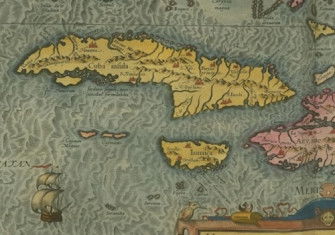
The community sought protection, rights of worship, burial grounds and the freedom to trade as equals. Cromwell demanded immediate consideration of the matter. Here was the opportunity to accelerate history. England, in its efforts to teach the true religion, would be the land most able to reveal the true faith to Jews. Cromwell was especially well disposed to such a request because of the help given to his regime by another Jew, Simon de Caceres, who had helped the Protectorate salvage something from the catastrophic attack on Hispaniola, known as the Western Design: Caceres, an old Caribbean hand, had offered Thurloe some ‘notes on Jamaica’, the island, then something of a backwater, which had been seized almost inadvertently in the aftermath of military disaster.
Accelerating history
A conference was convened at Whitehall in December and was documented by Henry Jessey, another distinguished Hebraist and preacher, who quoted Exodus 23.8 in recognition of the need to aid the Jewish people: ‘It is God’s will there be dealing courteously with strangers and persons in affliction.’ Emphasis was placed on the latest round of persecutions in Poland, Lithuania and Prussia and recognition was made, too, of the injustices perpetrated on Jews throughout English history: ‘Many cruel and inhumane injuries have formerly been done in our Nation against the Jews.’
Though many still considered the Jews to be ‘Christ killers’, cursed for eternity, most members of the committee did not. The clergy maintained its opposition to readmission, though Cromwell introduced Hugh Peters to the fray; a divine who had argued for the readmission of Jews as early as 1643. The arguments for readmission placed emphasis on a shared patriarchal descent, a common humanity and the suitability of England as a base for conversion.
On 18 December the debate was opened to the public, when it became evident that prejudice against Jews ran deep. The most significant opposition, however, came from merchants – ever worldly – fearful of competition from the business skills, experience and networks of Jewish traders. According to the sympathetic Jessey, City merchants claimed that ‘such an inlet would … enrich Foreigners, and impoverish English Merchants’.
Cromwell was not, however, in a position to turn down a new source of money, while spymaster Thurloe was eager to receive the intelligence on other states that Jewish merchants had access to from their wider European trading networks.
Cromwell declared, somewhat disingenuously, that he was concerned with ‘only what the Scripture holds forth’. But still opposition continued. The Admiral Commissioner expressed a widespread sentiment when he asked ‘whether a nation shall be suffered by a law to live among us to blaspheme Christ’. Even so, observers, including Royalist opposition, thought Cromwell would eventually get his way. The Jews, one Royalist newsletter wrote, ‘will be admitted by way of conniving, though the generality oppose’. Crucially, there was a legal ruling that, because of the use of the royal prerogative in 1290, no law existed which forbade the return of Jews into England. Cromwell, insistent again, asked ‘if it be lawful, then upon what terms is it meet to receive them?’
Deliverance
By spring, there had been no advance on the matter. Menasseh, in despair, prayed that God would strengthen the ‘mind of the prince’, though there was a hopeful portent: 1656 was a millenarian date. The Flood, it was claimed, had taken place 1,656 years after Creation. The Royalist John Evelyn writes of ‘an extraordinary event to happen in 1656 … possibly to convert the Jews by our saviour’s visible appearance’.
It was the Protector who would prove to be the saviour. The 20 or so Jewish families in London, all of whom were considered ‘Spanish merchants’ – though, trickily, Spain and Britain were at war – had Cromwell’s personal assurance of their safety and that they could worship in private. Their leaders, along with Menasseh, made a formal request to Cromwell for a burial place and permission to create a synagogue. Cromwell, frustrated by the indecision concerning the fate of the Jews, endorsed the petition on 24 March and confirmed it six months later. A burial ground was found for them in Mile End, in the grounds of what is now Queen Mary University of London, and a synagogue was created in a house on Creechurch Lane, near the Tower; the community would later establish the nearby Bevis Marks Synagogue, which still stands. The readmission of the Jews was Cromwell’s personal initiative. Sigmund Freud would not be alone among later beneficiaries in naming his son Oliver.
Menasseh died on 20 November 1657 at Middelburg, where he had returned to bury his son Samuel. Cromwell died on 3 September 1658 and there were concerns among the Jewish community at the death of the Protector – who, for them, had lived up to his title. A petition against the Jews was raised by the City of London Corporation in 1660: those jealous merchants again. But the Jews were to be beneficiaries of a continuity between the Protectorate and the Restoration. Charles II had been aided by Jews in his exile and he preserved the Cromwellian policy. ‘They may enjoy the same favour as before’, Charles proclaimed, ‘as long as they demean themselves peacefully and obey the laws.’ It was a moment of welcome accord between Cavalier and Roundhead.
Paul Lay is the author of Providence Lost: The Rise and Fall of Cromwell’s Protectorate (Head of Zeus, 2020) and Editor of History Today.