In late 1956 hundreds of thousands of Hungarians joined an uprising against the country’s Moscow-oriented government. 70 years on, the revolution’s meaning is still unclear.
From the first day of the Hungarian Revolution of 1956, which broke out on 23 October and was brutally repressed by Soviet forces on 4 November, a series of competing narratives attempted to explain what was taking place. This contestation has continued to the present day and helps explain the bitter ideological divides that have been one of the hallmarks of Hungarian politics since the collapse of the communist dictatorship in 1989.
Register to read more articles for free.
When you register, you will receive the History Today newsletter. Click here to read our Terms of Use.
In late 1956 hundreds of thousands of Hungarians joined an uprising against the country’s Moscow-oriented government. 70 years on, the revolution’s meaning is still unclear.
From the first day of the Hungarian Revolution of 1956, which broke out on 23 October and was brutally repressed by Soviet forces on 4 November, a series of competing narratives attempted to explain what was taking place. This contestation has continued to the present day and helps explain the bitter ideological divides that have been one of the hallmarks of Hungarian politics since the collapse of the communist dictatorship in 1989.
On the morning of 23 October a group of about 1,000 students and professors staged a protest outside their university in the eastern city of Debrecen at which they read out a list of demands for the reform of the country. That demonstration was violently broken up by the security forces. Later that afternoon, in Budapest, a much larger crowd of 20,000 students set off at 3pm from the main university on the eastern Pest side of the city to march to a statue of a 19th-century Polish revolutionary, Józef Bem, on the western Buda side of Hungary’s capital. There they read out their own list of radical demands. They then re-crossed the Danube and gathered outside the parliament building where their numbers rapidly swelled as factory workers and other residents joined the protest. That evening, after being denounced by the government as ‘scum’, the crowd moved to the headquarters of Magyar Rádió, the state broadcaster, which some attempted to storm at around 9pm. Chaotic fighting broke out and continued sporadically until 4 November when the Soviet Union’s armed forces advanced into the capital, crushed the revolution, and installed a new regime headed by János Kádár, who governed Hungary until 1988.
A new course?
At least as regards the causes of the revolution there is a solid consensus. Even resolute communists recognised that the Stalinist regime which had governed the country since 1948 needed to change. Under Mátyás Rákosi, known as ‘Stalin’s best student’, the Hungarian communist party, formally the Party of Hungarian Workers, had eliminated all rival parties and every independent form of civil society, and imposed a reign of terror on Hungary that was out of step even with the Soviet Union’s own slow break from Stalinism under Khrushchev from 1953. During the eight years of communist rule between 1948 and 1956, more than a quarter of all families in Hungary had at least one member arrested or deported. Although Rákosi was exiled to the Soviet Union in the summer of 1956 as a signal that the grim years of Stalinist terror were over, his replacement, Ernő Gerő, was hand-picked by Moscow and had been Rákosi’s right-hand man. Meanwhile, the Hungarian peasantry remained hostile to the ongoing process of collectivisation, the industrial workforce was infuriated by low wages, while the broader economy was stuttering after an initial spurt of postwar growth.
Hopes for reform were dealt a significant blow by the dismissal of Imre Nagy as prime minister in April 1955. Nagy was an unlikely standard-bearer for reform: he had escaped to Moscow after the first attempt to establish a communist dictatorship in Hungary failed in 1919. Unlike many of his fellow exiles, he managed to avoid being killed in Stalin’s purges. In 1945 he returned to Hungary and began to work closely with Rákosi, who had spent most of the interwar period in prison. Both men were determined to ensure that the second attempt to turn Hungary into a communist state would be successful. Nevertheless, whereas most of Hungary’s communist elite came from either the urban trade union or Budapest’s socialist intellectual circles, Nagy, who was appropriately portly, possessed a substantial moustache, and whose spoken Hungarian was clear, steady, and relatively free of ideological cliches, was clearly of peasant stock. This mattered in a country where, as late as the Second World War, half of the population worked in agriculture. He came across as more humane and more Hungarian than most of his fellow ministers.
Prime minister Imre Nagy, centre, facing the viewer, with members of his revolutionary government, October 1956. Fortepan/Album023.
The sense that Nagy was in touch with the popular mood was reinforced by his promise of a ‘new course’ when, in an attempt to shore up the party’s popularity, he was appointed as prime minister in 1953. At least some of the regime’s leadership were aware that the appearance of change was needed in response to the new mood in Moscow following the death of Stalin. East Germany, the ‘shop window’ of the Soviet bloc, had enacted limited reforms in response to its own brief and brutally put-down uprising in June 1953. Nagy was keen to follow suit.
In practice, his ‘new course’ addressed only the very worst features of Hungary’s version of Stalinism. There was no talk of democratisation, freedom of speech and association, nor of a break from the Soviet Union. Nevertheless, Nagy ended the obsession with industrialisation at any cost, the brutal pressure on the peasants to ‘voluntarily’ collectivise, and the network of camps for political prisoners that constituted a version of the Soviet gulag in Central Europe. Wage rises, price reductions, and an effort to build more flats to ease the chronic over-crowding (another grim consequence of the frantic postwar push for industrialisation and urbanisation) also boosted Nagy’s popularity.
Nagy’s cautious talk of reform resonated with some intellectuals, who began to publish guarded critiques of the regime and the damage it had wreaked, especially to the countryside. As had happened during earlier revolutions, such as in 1848 when the Hungarians revolted against the Habsburg monarchy’s conservatism, poets became the voice of resistance. Gyula Illyés, a poet who had come to prominence in the 1930s as the voice of peasant culture, but who had largely withdrawn from public life after 1948, began publishing a new wave of poems with electrifying effect. His ‘One Sentence About Tyranny’ captured the fear of his countrymen. Initially afraid to publish it, the poem became one of the anthems of the revolution. In response, Rákosi, who regarded any reforms as an admission of failure, ensured that the party first watered-down Nagy’s proposals and then removed him from government. All this explains why the re-appointment of the committed communist and former Stalinist minister Imre Nagy was among the first demands in October 1956.
Hungary demands
The demonstrators were also inspired to take to the streets by reports from Poland of the brutal repression of the June 1956 protests in Poznań, in which factory workers had taken the lead in protesting against austerity that had resulted in food shortages. The savagery of the Polish authorities, who shot dead more than 50 people and arrested and tortured hundreds more, elicited a wave of sympathy, particularly from Hungary’s students. The choice to march to the statue of Józef Bem, a Polish general who had helped lead the Hungarian uprising in 1848 before seeking refuge in the Ottoman Empire, was not accidental. That revolution had been crushed when a Russian army invaded Hungary to assist the Habsburgs in restoring their authority.
As any legal gathering throughout the communist bloc required official permission, the demonstrators who marched on 23 October were aware that they were carrying out an illegal and potentially revolutionary act. Nevertheless, the 16 demands, hastily drafted on the previous day and read out at Bem’s statue, were vague about what their collective act of disobedience actually sought to achieve. These students still regarded themselves, on the whole, as committed socialists. Their demand for the reinstatement of Nagy suggested that they supported the relaunch of his programme of moderate reform under the auspices of the communist party.
Students marching towards Bem Square, 23 October 1956. Fortepan/Horváth János és családja.
Among the initial 16 demands were, however, more radical ambitions: an investigation into the ‘criminal activities’ of Rákosi’s regime, complete freedom of speech and association, radical economic reform of industry and agriculture, and free multi-party elections, alongside the withdrawal from Hungary of the various Soviet military units garrisoned across the country. There was even a sprinkling of overt nationalist demands, including the restoration of Hungary’s historic coats of arms (first used by the revolutionaries in 1848), new patriotic army uniforms, and the establishment of new national holidays to commemorate the 1848 revolution.
The students in Debrecen, who had drafted their own overlapping set of demands, also called for renewed attention to the grim fate of the substantial Hungarian-speaking minorities in neighbouring countries. In the aftermath of the First World War the old kingdom of Hungary, along with the entire Habsburg monarchy, had imploded. Around two-thirds of Hungary’s population, and one-third of ethnic Hungarians, found themselves living in the new or expanded hostile neighbouring states. These lost lands had been an obsession of Hungary’s old conservative regime which had, during the Second World War, briefly reincorporated around half of this territory as a reward for waging war on the side of Nazi Germany. These lands were again lost at the end of the war, while their Hungarian minorities were subject to a new wave of brutal treatment and deportations. Following the communist party’s takeover, the topic became another in a long list of taboo subjects, which also included the maltreatment of Hungary’s own minorities – such as the postwar expulsion of 250,000 German and Slovak speakers. There were, therefore, no public protests by the Hungarian government in response to renewed efforts by neighbouring states to assimilate their Hungarian minorities. For example, in Romania the governing regime increasingly fused together intolerant communism and intolerant nationalism, and abolished the self-governing Hungarian region in eastern Transylvania in 1955. It is unsurprising that the students in Debrecen, located only 30 kilometres from the Romanian border, paid particular attention to the fate of the Hungarian minority there and demanded that a reinstated Nagy government do likewise.
Soviet response
On the evening of 23 October, after the attempt to storm Magyar Rádió, violent clashes ensued involving the secret police (Államvédelmi Hatóság, ÁVH), hastily dispatched units of the regular Hungarian army, and some of the demonstrators, who had begun forming military detachments and establishing a network of independent councils to coordinate the revolution from below. These were an echo of the soviets (councils) that had sprung up to coordinate earlier socialist revolutions, including in Russia in 1917. One can still come across the claim that the 1956 revolution was an authentic Marxist uprising against the Stalinist perversion of communism and the new ‘red bourgeoisie’, a claim first made by the Marxist philosopher György Lukács, who served in Nagy’s revolutionary government as minister for culture.
The revolution certainly attracted immense support. By the evening of the first day somewhere close to 200,000 people had joined the protests in Budapest alone. Violence surged, claiming the lives of almost 3,000 Hungarians and 700 Soviet troops over the 12 days of the revolution, and more than 20,000 Hungarians and 1,500 Soviet troops were wounded. Student demonstrators had already clashed with the security forces in Debrecen, where the first shots of the revolution were fired, and factory workers protested in the eastern industrial city of Miskolc, although most of the countryside remained curiously quiet, and the regular army largely remained confined to barracks.
In the days following 23 October a wide range of prominent personalities, including the head of the Catholic Church in Hungary Cardinal József Mindszenty and the dedicated communist János Kádár (both of whom had been imprisoned by the Rákosi regime), gave radio speeches in support of the revolutionaries. Kádár first privately denounced the demonstrators as ‘counter-revolutionaries’, then publicly lauded what he called the ‘people’s uprising’, before absconding to Moscow on 1 November. Three days later he returned to Budapest with the invading Soviet army, and oversaw the repression of the revolution, including the execution of Nagy and 340 other revolutionaries, and the imprisonment of another 20,000 Hungarians. He would insist until the end of his life that Hungary had no other choice but to remain obedient to the Soviet Union.
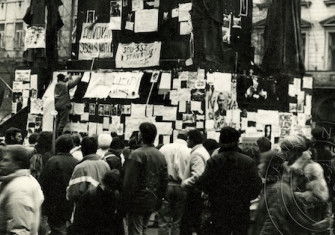
Protesters burn images of Mátyás Rákosi, Budapest, October 1956. akg-images/ErichLessing.
Before that, however, Nagy was appointed as the head of a reconstituted government on 24 October in a misguided attempt by Moscow to restore order. Having first urged the demonstrators to return home, appealing for an end to the ‘useless bloodshed’ of ‘innocent working people’, he changed tack on 28 October, declaring his full support for the revolution which he now described as a struggle ‘to ensure our national independence’.As well as appointing non-communists as ministers and promising free elections, he also negotiated the temporary withdrawal of the Soviet army from Budapest on 30 October and pledged that Hungary would henceforth be a neutral state.
Nagy was, however, ill-suited for the near-impossible task of keeping both the revolutionaries and the hard men in the Kremlin onside. Moscow could not tolerate an independent, democratic Hungary, even if for a while it dithered about how to respond to the chaos in the country. We still cannot be sure when the Soviet Union decided to send its armed forces back into Budapest. Critical documents related to the role of the Soviet intelligence services have never been made public. Soviet decisions were often made informally, through unminuted telephone conversations and even in the sauna.
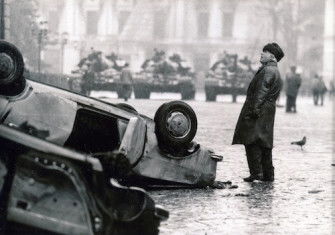
What is certain is that by 31 October the Kremlin had decided on a military solution and the installation of a new regime to be headed by Kádár who was whisked out of Hungary the following day, without having the time to pack a suitcase or inform his wife. When the Soviet Union re-invaded the country on 4 November with 15 divisions and thousands of tanks, Nagy’s naivety was confirmed; he sought refuge in the Yugoslav embassy which subsequently handed him over to the new and vengeful communist regime headed by Kádár. Nagy had initially signed the collective declaration of the government that ordered Kádár’s removal from his post as minister of the interior in 1951 and paved the way for his subsequent imprisonment as a victim of the Rákosi regime’s paranoid purges, but he had also permitted Kádár’s release from prison during his first stint as prime minister in 1954. The favour would not be returned. Nagy was hanged in Budapest in June 1958.
The outside view
Outside Hungary audiences were gripped by reports and a stream of compelling photos and newsreels (some staged) which reinforced the Cold War narrative that communist regimes were devoid of popular support and reliant on repression. In Britain a huge fundraising effort was launched, supported by Winston Churchill, and both the government and the Labour opposition lauded the revolutionaries. The British ambassador, Leslie Fry, summed up the mood in Parliament and beyond when he informed MPs that the British people were watching events unfold in Budapest ‘with profound sympathy and admiration’. Britain initially took in the second largest share of the 200,000 Hungarians who fled their country after the revolution was crushed. As many of these refugees came from Hungary’s professional classes, their subsequent contribution to Britain and other host countries was immense. More than 500 of them were hired by British universities as researchers and lecturers.
Both Britain and continental Europe’s communist parties were particularly shaken by the scenes of Hungarians unleashing their pent-up anger by toppling communist statues, lynching secret policemen and party functionaries, and tearing out the red star emblazoned on the national flag. That they were then silenced by the columns of Red Army tanks proved even more agonising to supporters of the Soviet Union – up to a third of Western Europe’s communists resigned their party membership in the wake of the Soviet invasion.
Soviet tanks on József Boulevard, Budapest, October 1956. Fortepan/Marics Zoltán.
In response, Kádár’s regime insisted that it had won back the support of its population pointing, for example, to the huge numbers of Hungarians who participated in the May Day celebrations of communist rule. Although in practice semi-obligatory, the regime made much of the fact that in 1957 some 400,000 people took part in these celebrations in Budapest, a larger number than had joined the revolution. On the rare occasions that it discussed the revolution, Kádár’s government insisted that legitimate Hungarian grievances had been hijacked by a small group of ‘counter-revolutionaries’ emboldened by Nagy’s treachery, a nostalgia for ‘capitalists and landlords’, and, implausibly, residual antisemitism. It was not until 1989 (the year in which Kádár died) that the communist party in Hungary officially acknowledged that the 1956 revolution was not a ‘counter-revolution’ but a legitimate ‘popular uprising’. The subsequent reburial of Imre Nagy and his executed associates in Heroes’ Square, Budapest, with an official televised state funeral, was another defining moment at a time when the communist dictatorships across the region began visibly imploding.
Some Hungarian refugees also promoted their own distinct narrative of the revolution. It had, they argued, been betrayed by the West, which had promised, supposedly via Radio Free Europe, that it would provide military assistance. In reality, only the Free Russia Radio Station in Munich, a tiny and entirely unofficial operation, had made such fantastical promises. Even if the West had not been distracted by the Suez fiasco there was no appetite to risk a ‘hot’, and potentially nuclear, conflict with the Soviet Union. Soviet troops had been withdrawn from eastern Austria in 1955 but Hungary was different, as both Moscow and Washington recognised. As the prime minster Anthony Eden noted in a private letter to President Eisenhower on5 November, not a single member of the United Nations favoured intervening in Hungary.
Awkward legacy
Even after the collapse of communism in Hungary the events of 1956 remained bitterly contested. Since 1990 the outbreak of the revolution has been commemorated as a national holiday. Memorials to the courage of the revolutionaries have been erected across Budapest. However, the annual commemorations have been persistently marred by various political parties holding rival commemorations while denouncing their opponents for having betrayed the revolution.
One of the hallmarks of right-leaning parties in Hungary is their claim to be the true heirs of 1956, an event they venerate as one in a series of glorious attempts by Hungarians to regain their freedom from foreign powers and alien ideologies. That Imre Nagy, the nominal head of the revolutionary government, insisted up to his execution in 1958 that he remained a communist, proved awkward for former prime minister Viktor Orbán, who first came to prominence for a speech he gave at Nagy’s reburial in 1989 in which he made the first public call since 1956 for the withdrawal of the Soviet Union’s armed forces from Hungary. In power, Orbán removed Nagy’s statue, insisting that the site, a short distance from the Hungarian parliament, needed to be restored to its historic appearance before the communist dictatorship took over the country. Even some liberal politicians have joined in the denunciation of their socialist opponents as the ideological heirs of the repression that followed the crushing of the revolution.
Protesters hold the Hungarian flag from which the Soviet star has been removed, October 1956. akg-images/ErichLessing.
That charge was reinforced by the election of Gyula Horn as the socialist prime minister of Hungary in 1994: Horn had been a member of the communist militia that assisted the Soviet army in the revolution’s aftermath. The radicalised rhetoric of heroes and traitors then reached a new fever-pitch in 2006, on the 50th anniversary, when right-wing protesters, demonstrating against what they regarded as a treacherous socialist government, waved the national flag replete with its iconic hole in the centre, and attempted to storm the headquarters of the state broadcaster.
But Horn’s electoral triumph also suggests another narrative, albeit one which is rarely expressed publicly: that the 1956 revolution, and its contested pantheon of heroes and villains, was no longer relevant in post-communist Hungary. This apathetic view of the revolution, intensified by the communist regime’s earlier attempt to erase its memory, has also found its echo in the fact that many Hungarians are evidently ambivalent towards, or even repelled by, attempts to harness the legacy of 1956 for partisan political advantage.
Most left-leaning politicians in Hungary have, since 1989, emphasised the progressive demands of the 1956 revolutionaries, their supposed aspiration to reintegrate Hungary into the family of liberal and democratic European states, and, above all, the tragedy of both the revolution in general and of Nagy in particular. The largest of the monuments to the revolution in Budapest, erected by a socialist government in 2006, is sobering rather than celebratory. Both Orbán and the new prime minister Péter Magyar have chosen other sites for their own commemorative speeches in which they have denounced both the Soviet invasion and, pointedly, ‘Hungarian traitors’.
In reality, the Hungarian revolution was too brief, too chaotic, and too contested from the very moment it broke out to fit into any single narrative. That has allowed different ideologies, political parties, and historians to offer their own contrasting interpretations of what actually occurred and the lessons subsequent generations should draw from these events. For Hungary, the unfolding story of how the 1956 revolution has been interpreted has arguably been as consequential as the revolution itself.
Thomas Lorman is Associate Professor of Hungarian History at UCL’s School of Slavonic and East European Studies.