People talked about the ‘Great War’ before Britain had even declared war on Germany in August 1914. On the 2nd Robert Saunders, a schoolmaster at Fletching in Sussex, told his son living abroad about the war plans being made in southern England: ‘Everything points to the Great War, so long expected, being upon us, so you can picture the restless excitement among all classes.’ Winifred Tower, at Cowes for the annual yachting festival, left a vivid diary account of her state of mind on the day, August 4th, that war was actually declared on Germany. She had been to a Red Cross meeting and the territorials there were mobilising. The declaration at midnight was ‘almost a relief’:
Register to read more articles for free.
When you register, you will receive the History Today newsletter. Click here to read our Terms of Use.
People talked about the ‘Great War’ before Britain had even declared war on Germany in August 1914. On the 2nd Robert Saunders, a schoolmaster at Fletching in Sussex, told his son living abroad about the war plans being made in southern England: ‘Everything points to the Great War, so long expected, being upon us, so you can picture the restless excitement among all classes.’ Winifred Tower, at Cowes for the annual yachting festival, left a vivid diary account of her state of mind on the day, August 4th, that war was actually declared on Germany. She had been to a Red Cross meeting and the territorials there were mobilising. The declaration at midnight was ‘almost a relief’:
But it was impossible to believe that ‘the Day’ had actually come. We had talked about it, argued about its possibilities, volumes had been written about it, it had been a sort of nightmare, always hanging over us, and yet I don’t suppose many of us thought that it would become a reality in our time and that we were destined to live in the stirring days of our history … suddenly it seemed like a bad dream that we should wake from to find our world unchanged.
This article explores the many emotions – apprehension, anxiety, shock, disorientation and fear – experienced by the British people in a month when family and personal lives were ripped apart by an unprecedented international crisis. Investigating the national mood, it argues that already, in August 1914, a new moral order was replacing the carelessness of the long Edwardian peace. The outline and chief features of this new moral order, fully apparent by the end of the year, were being established.
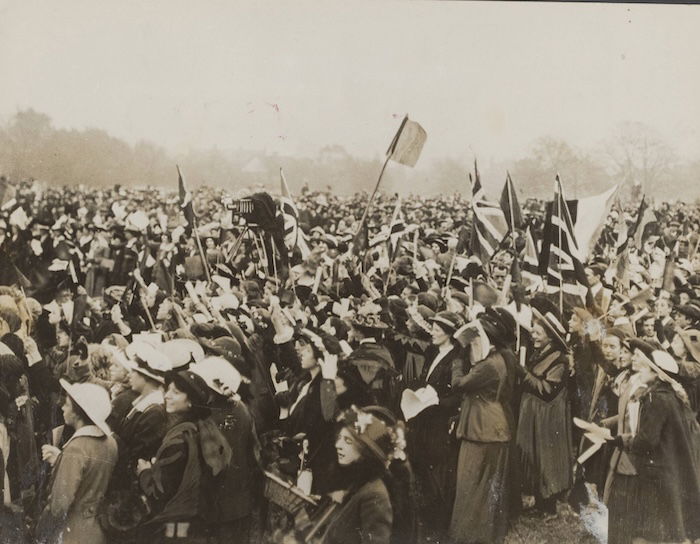
The jingoism and war fever of August 1914 have been shown to be a myth. The crowds outside Buckingham Palace in the first week of the month were mostly middle-class young men in straw boaters, drawn there by uncertainty and the search for news. The ultimatum to Germany expired on the evening of the day after a Bank Holiday. This was picnicking time in the London parks. More people were out on the streets than usual in other towns, too. Vera Brittain recorded that she was part of an ‘excited little group’, which gathered on August 4th to watch the territorials mobilise at Buxton in Derbyshire. But for many, like the MP Holcombe Ingelby, that day was sombre. Because of Belgium, he declared to his son, ‘we must go the whole hog … in fact we are in for the biggest thing in wars that the world has ever seen’.
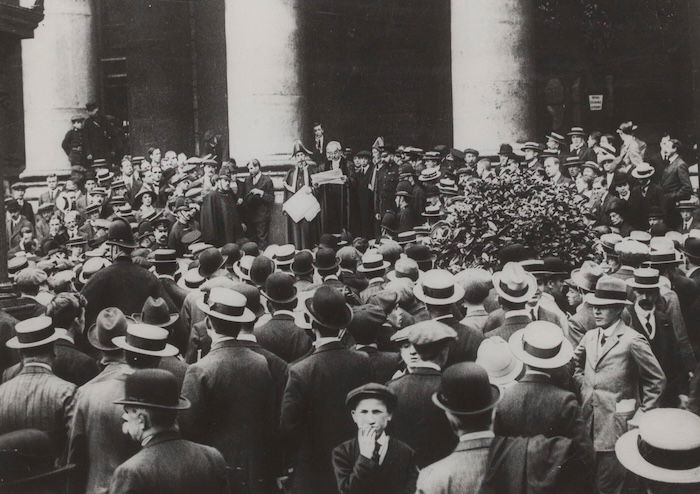
A London city councillor reads the declaration of war to a crowd, 4 August 1914. Nationaal Archief. Public Domain.
How people discovered that Britain was at war depended on where they were. Alice Remington, in a Lancashire village, heard the noise of lorries going down the main road with lots of men in them. The news drifted through ‘that all these lorries were going overseas … and then it brought the war home’. Many heard about the declaration of war from the shouts of newsboys. A notice on the church board announced the war, recalled Grace Whitham, a mill worker in North Yorkshire. George Ewart Evans discovered his country was at war when a motor car, with a newspaper placard blaring out ‘WAR DECLARED’, passed through his South Wales village. At first rural England remained quiet but anxious. ‘Everyone restless and ready to discuss war news on the slightest provocation’, noted Robert Saunders in Sussex on August 15th. ‘Poor Mr Fenner’, he reported, ‘was awfully cut up as they came round and commandeered his black horse Kitty.’
There was virtually no opposition to the war. The general commitment meant that those who had reservations quickly put them to one side. ‘The simple Suffolker doesn’t panic’, wrote Rudyard Kipling, away from home on holiday, ‘he just carries on all serene.’ Each evening, recounted Robert Saunders at Fletching, ‘the doctor and his wife come in to compare notes and discuss the war generally’. The strong lead given by the national press was important in rallying the middle and upper classes. The centre pages of The Times on August 7th were taken up by a powerfully argued leading article, ‘In Battle Array’. Kitchener’s ‘Call to Arms’ was prominently displayed under the royal crest. The famous words ‘Your King and Country need you’ were beginning to be burned into the minds of all men over 19 and under 30.
It is striking how clear-headed people were about the perils of war. Newspapers in northern and midland towns were gloomy about a collapse of credit and trade. There was some panic in London. The Daily Mail reported a rush to buy food, clearing out many shops on August 3rd. One London lady noted in her diary how ‘the well-to-do people’ there had ‘lost their heads’: ‘They are buying enormous stores of food, as if for siege provisions … taxis today are laden … some of the big stores have run out of fish.’ On August 4th the artist Augustus John urged his partner to ‘get in at once a supply of flour and potted goods, tea etc for a month or two. It looks as if we’ll need them’. Urban and rural industries suffered dislocation. There was immediate depression in the three main industries of Cornwall, china clay, tin mining and fishing. On August 12th the author and joiner George Sturt commented on his business difficulties at Farnham in Surrey, through disruption of supplies and commandeering of horses.
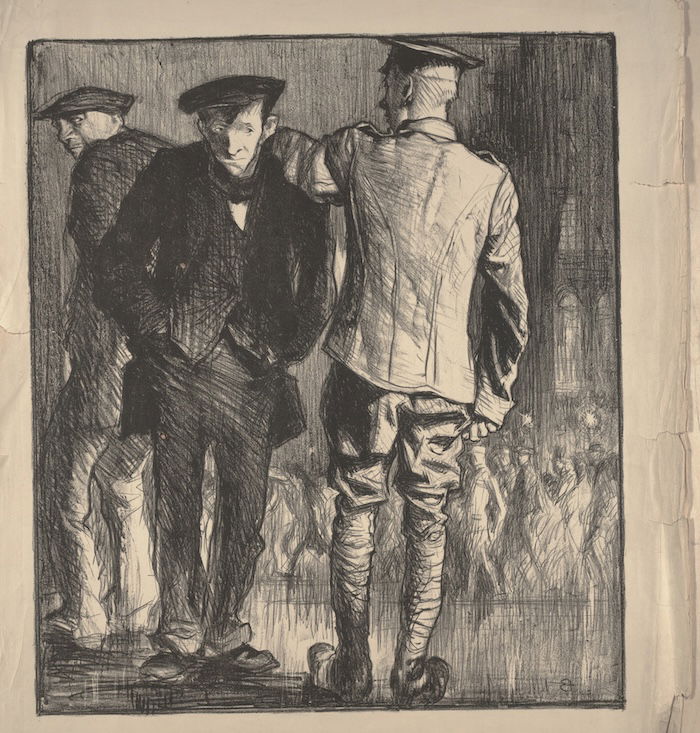
A reluctant recruit, by Frank Brangwyn, 1914. Prints, Drawings and Watercolors from the Anne S.K. Brown Military Collection. Brown Digital Repository. Brown University Library. Public Domain.
The chronology of recruitment tells a different tale from the conventional story of a rush to the colours, for it was only 100,000 men that Kitchener asked for on August 7th. Many found it hard to decide quickly on how to act. George Singles, a regular soldier working at the Whitehall recruiting office, noted that straggling volunteers were ‘all grumbling as most of them had to leave good jobs’. The lowest daily national returns were August 22nd and 23rd, at which time many still believed 100,000 men was the total required. On the 25th it was announced that objective had been almost reached.
There was little bad news in the press during the first three weeks of the war. It was the ‘Mons Despatch’, in The Times of August 25th, that electrified the nation. ‘I have seen the broken bits of many regiments’, wrote Arthur Moore. ‘We have to face the fact that the British Expeditionary Force, which bore the great weight of the blow, has suffered terrible losses and requires immediate and immense reinforcement.’ This had an instant effect. On the 29th The Times carried Kitchener’s appeal for a further 100,000 men. Two days later daily enlistment topped 20,000 in a single day for the first time. September 1914 became the strongest recruitment month, not just in 1914, but during the whole war. It was entirely predictable that it took men time to turn their shock into decision making. The consequences of enlistment for individuals, families and careers were far reaching.
Impetuosity was most common among very young men. Graham Greenwell was 18 that month and had just left Winchester, planning to go up to Christ Church, Oxford in October. Instead he joined the Public Schools Camp at Tidworth on Salisbury Plain. On a Sunday break from training he walked over for a meal with friends at the Dog and Whistle pub in the village of Netheravon, telling his mother ‘everyone was most respectful to the King’s uniform’. Wilbert Spencer enlisted on impulse, on his way home from school at Dulwich College to Highgate. His father, a professional man, seeing his son’s insistence on leaving school early, persuaded him to take a crash course at Sandhurst. ‘My word you do have to drill smartly here’, Wilbert wrote to his parents on August 14th. But he found life there ‘very healthy and extraordinarily interesting’. He needed his dressing gown, he added, and sent a kiss to his baby sister. Lance Spicer, 21 years old, was accosted early in August by a woman in Jermyn Street in London’s West End and felt ‘a pin being stuck into the lapel of my jacket’. He looked down and found ‘a white feather on me’, which hastened his plans for getting a commission.
Prognostications about how long the war would last were rare in August. Harold Cousins wrote in his diary on the 9th: ‘England now involved in what will probably be known as the First World War of 1914 – probably 1915.’ For the whole idea of trench warfare simply had not yet entered British consciousness. The letters of Clare Howard, to her fiancé Reggie Trench, who was training officers for the Western Front in Richmond Park and on Wimbledon Common, reveal the total incomprehension about what kind of war this was going to be. Trench digging had not yet begun on the Western Front. The Expeditionary Force started landing in France on August 7th. But this all remained secret from the public. The vacuum was filled with rumours. There was a sense that the war was slowly but inevitably taking over people’s lives: Lydia Middleton, the wife of a civil servant, declared on the 21st that it was ‘hard to believe that the war has only lasted for 17 days’. It felt ‘like 17 weeks at least’.
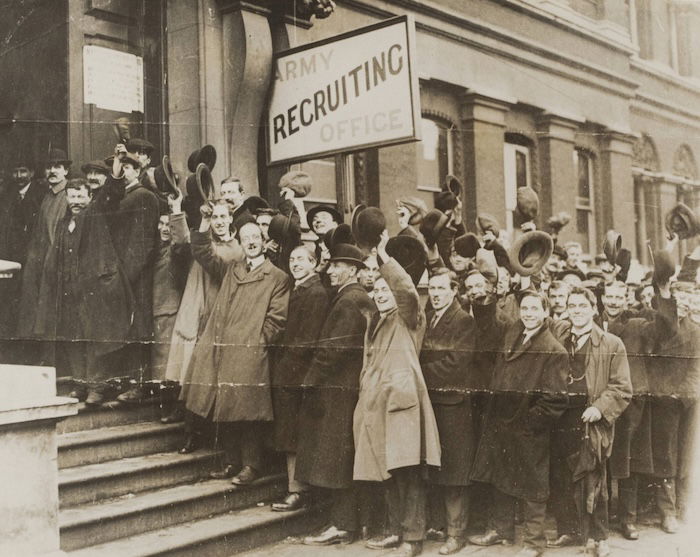
Recruits waiting to join up, 1914. Nationaal Archief. Public Domain.
Living at Orpington in Kent, Clare Howard had access to local information. She knew by the 11th of nightly troop sailings to the Continent from Dover and Newhaven. That day Reggie told her the Royal Surrey Regiment was certainly in Belgium. She understood the developing Western Front geography from maps that quickly became available. She checked the story of Waterloo, more than a hundred years before, the only evidence at hand about conflict in Europe. ‘The line of battle was two and a half miles as compared to the 220 miles of today’, Clare believed; a million men, not 72,000 English plus 52,000 Prussians like then, were involved this time. Yet she concluded on August 14th: ‘I suppose this battle will begin at any time now’, thinking it might be decisive. Following the news of the German advances through northern Belgium, on August 21st she guessed perceptively: ‘I suppose it cannot now be more than a day or two before our troops are engaged.’ In fact, it was the next day that the first shots were fired, just outside Casteau, north of Mons, in a conflict that was to last for four years and nearly three months.
The strength of the Trench-Howard correspondence, 37 letters to and fro during August, is that it indicates how a single family based in the south-east, where things moved fastest, responded to the war. Clare echoed many women in her initial panic at the idea of her man being in danger. Since he was an officer in the Inns of Court Training Corps, she trusted he would be kept to instruct recruits: ‘Is it very cowardly of me?’. As the war took Reggie over, he gradually became more candid. Encouraging her Red Cross work at Orpington, on August 6th he predicted: ‘We shall have a good deal of casualties before we are through with this show.’ Within a few days, wounded Belgian soldiers were being cared for in the 50-bed hospital Clare and her sisters had helped set up in the village hall at Orpington. She worked there daily from August 12th.
In these hectic days men and women fell into traditional roles. Females were at once the carers. The Howard girls fed the local East Kent territorials, 90 of them just back from Salisbury Plain ‘absolutely done’. Their captain was ‘too hungry to eat a mutton chop’. Clare’s brother Edgar had ‘gone in the ranks with them … there was a large crowd at the station to cheer them off’ when they were ordered to Dover. Masculinity was suddenly at a premium. Clare was delighted that Reggie had begun growing a moustache. Spotting him on a visit to her home, the chauffeur there told her he had the right ‘martial bearing’, requesting ‘a photograph of him in uniform’. Khaki fever was beginning to turn female heads. Reggie’s brother Herbert crossed the channel on an abortive motor cycle dash to assist the French army. They were ‘rather fed up’, noted Reggie; ‘of course they will get something if they hang about long enough but it is rather trying’. He agreed with Clare that her brother Walter, hampered by a stammer, would find his special constable job ‘dull and pretty long hours’. ‘Perhaps it is the same as the rest of us’, he declared, ‘days and weeks of routine to fit one for other duties’. The watchwords were ‘doing your bit’.
Everywhere some kind of disruption brought the war home to the British people. ‘Everyone’s plans are cancelled – everything is suddenly changed’, recorded Beatrice Trefusis in her diary in London on the 5th. In Plymouth, W. Eaves told in a letter on the 8th of being ‘confronted by a barbed wire entanglement and a redoubt of sandbags’. Virginia Woolf, visiting Lewes from her home at Rodmell, found sentries all over the place, which gave a sense of ‘martial law’. An American visitor to London reported territorials marching, confiscated horses and motor cars, ‘long lines of artillery and ammunition wagons with their horses picketed near’. The Bishop of Galloway circulated a prayer to be said at all masses about the suffering and upheaval caused by the war, urging calm in the ‘common calamity’. In Glasgow, Thomas Macmillan tossed a coin with his brother about which of them should enlist and which stay to care for ageing parents. A vicar in Lechlade agreed to his son’s joining the Royal Naval Division, then confessed how he found the decision ‘rather a wrench’. Mothers at Little Crosby on Merseyside were said on the 25th to be ‘up in arms against the idea of enlistment’.
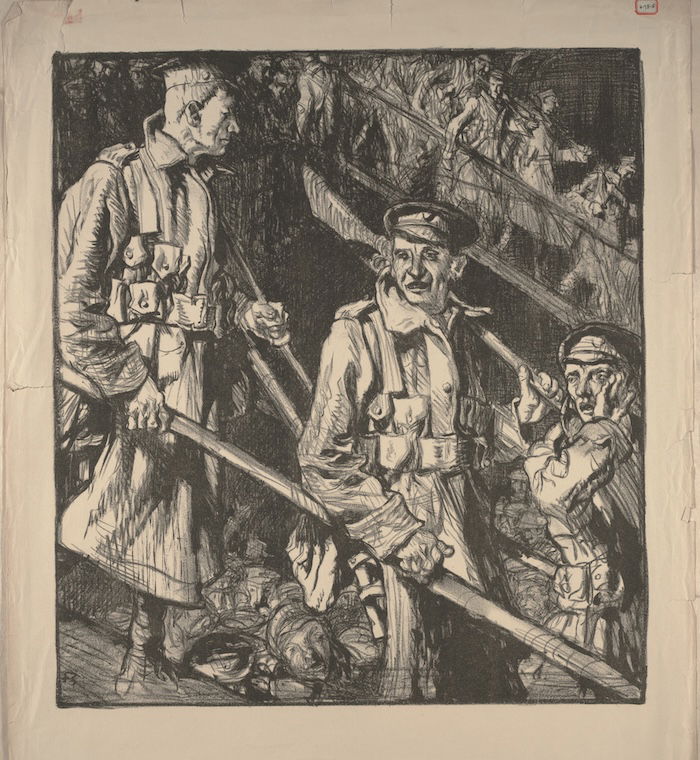
‘Good-Bye’, British soldiers disembarking, Frank Brangwyn, 1914. Prints, Drawings and Watercolors from the Anne S.K. Brown Military Collection. Brown Digital Repository. Brown University Library. Public Domain.
Mary, Countess of Wemyss and Lady Ettie Desborough, each with three boys grown up or almost so, had a ‘sad and serious confab’, trying to ‘keep quiet and calm’, on August 4th. Mary’s son Ego went off to join the Gloucestershire Hussars; on the 9th she saw them parade in the cathedral, noting in her diary how moving she found this. It was only years later that she recalled how this was the moment, watching the ‘quiet earnest faces’ of his troop in prayer, that ‘it sank into my heart for the first time that they were going to fight’. She had kept a diary since she was 16 but briefly abandoned it that month, with the explanation: ‘shall we put it down to the war which has caused so much misery and infinite sorrow and loss to so many nothing seems to matter when so much is amiss’. As the Prime Minister Herbert Asquith wrote to his wife Margot on August 18th, no one could ignore the fact that ‘the curtain is lifted’.
Early morning rides on the Cotswold edge lifted Mary Wemyss’s heart: the countryside was ‘magically silent, waving corn and misty distances, the world had a strange unreal look’. Mostly we do not know what the British people were thinking and feeling, but occasionally there is a sharp insight into the emergence of patriotic commitment. In the last two weeks of the month everyone had at least a hazy awareness that there were countrymen now in Europe under arms to defend their island. The poet Edward Thomas was at Dymock in Gloucestershire in August, walking and talking with his close friend and fellow poet, the American Robert Frost. He wrote in his notebook on August 26th about ‘a sky of dark rough horizontal masses in the north-west … I thought of men eastward, seeing it at the same moment. It seems foolish to have loved England up till now without knowing it could perhaps be ravaged and I could and perhaps would do nothing to prevent it.’ This was when his idea of defence of the English landscape, for which he would in time enlist, came to him. His article ‘This England’, published in November, included a crucial passage: ‘All I can tell is, it seemed to me I had never loved England or had loved it foolishly, aesthetically, like a slave, not having realised that it was mine unless I were willing and prepared to die rather than leave it as Belgian women and old men and children had left their country. Something I had omitted. Something I felt had to be done before I could look composedly again at English landscape …’
Some had experienced patriotic feelings with a surge of insistency earlier. Siegfried Sassoon, after a cycle ride in the sunny Kentish countryside, volunteered on August 1st and was in khaki by the 3rd. ‘The Weald’, he declared, ‘had been the world of my youngness and while I gazed across it now I felt prepared to do what I could to defend it. After all, dying for one’s native land was believed to be the most glorious thing one could possibly do.’ Rupert Brooke was a Warwickshire man. ‘I know the heart of England’, he told a friend on August 2nd, ‘ it has a hedgy, warm, bountiful dimpled air. Baby fields run up and down the hills and the roads wriggle with pleasure.’ Soon after, he wrote an autobiographical piece, contemplating ‘with a tightening of his heart’ a raid on the English coast. He was coming to understand the holiness with which he perceived ‘the actual earth of England’.
Brooke was an unusually specific spokesman for the new mood that was taking hold of the nation, intent, determined, uncompromising. He summarised it in his Five Sonnets of 1914, the words of which, forming in his mind during August, were written down in October and published in December:
Honour has come back, as a king to earth And paid his subjects with a bounteous wage; And nobleness walks in our ways again; And we have come into our heritage.
Couples drawn in to the war badgered each other about driving themselves too hard. ‘Do rest when you can’, Clare Howard urged Reggie on the 3rd. ‘I am sorry that you must work on Sunday too’, she commiserated on the 27th, ‘but I know that you will rest as much as you can.’ Besides her hospital work, working parties organised by the womenfolk in her family started on the 14th, focused on making vests and splint padding. It was being in it together that mattered: ‘Remember I love to hear how you spend every minute of your day’, Reggie insisted.
Women and childred wave goodbye to the British Expeditionary Force, August 1914. Nationaal Archief. Public Domain.
There were plenty of people ‘longing to do something’, Clare’s sister told her on the 19th. So, she confessed, she cut the next working party and went off for tennis in a nearby village. She was back on their tennis court, after a full day of hospital scrubbing out, the next evening. But the news over the weekend of August 22nd and 23rd, when Reggie joined the family for tennis, left him feeling guilty and alarmed. ‘My weekend was simply priceless’, he told Clare. But, now Namur had fallen, it all looked ‘very serious – and think of it, our men were fighting all yesterday while I was slacking at Bark Hart – that hot day – and fighting for their lives indeed’.
Clare resumed her protector role: ‘My own, it is no good being perturbed because our troops are fighting and you are here slaving for the very same army all the week … so think of that, Darling, and don’t think that the fighting line is the only place where you will be any use.’ Tennis, with all its connotations of relaxed country house life, became a kind of metaphor for the past. In a new world young people took intensely the seriousness of their country being at war. Young lovers threw themselves into unexpected roles: Reggie learnt the strong voice he needed for the parade ground, Clare revelled in the physical work of making beds and cleaning wards. She even coped with watching wounds being dressed, which she ‘rather disliked’. ‘Our troops have done splendidly’, Clare asserted on August 26th in a fog of confused reports from the Front. ‘How awful it is now for those who are waiting for the casualty list’, she went on. These were the personal realities of war in London and Kent in August 1914.
The first of Rupert Brooke’s war sonnets he called ‘Peace’. He felt nostalgia for careless years gone by but no regret that peace was over:
Now, God be thanked who has matched us with His hour, And caught our youth, and wakened us from sleeping, With hand made sure, clear eye and sharpened power, To turn, as swimmers into cleanness leaping, Glad from a world grown old and cold and weary.
He put it more starkly than most would have done. But it was Brooke, perhaps, who best summarised Britain’s response to the Great War, as people felt it in the depth of their hearts. This was a quite extraordinary month, a month unlike any before that the British had lived through, in a country they had grown up to think of as an unthreatened ‘green and pleasant land’.
Anthony Fletcher’s most recent book is Life, Death, and Growing Up on the Western Front (Yale University Press, 2013).