On Her Most Serene Republic’s Secret Service
Venice developed the most sophisticated intelligence network in Renaissance Europe, securing it from enemies within and without.
In the early 1570s, as the Ottoman Empire and the Republic of Venice were on the verge of the Fourth Ottoman-Venetian War, the Venetian authorities received alarming news. A slave who had managed to escape the Ottoman yoke reported that a Turkish armada was amassing munitions and disgorging large warfare reserves in Anamur, a fortress on the south coast of Turkey. It was feared that these military preparations were intended for an attack on Cyprus, th crown jewel of Venice’s Mediterranean colonies. In response to this imminent threat, the Council of Ten – the government committee responsible for the security of the Venetian state and its sprawling dominions across Northern Italy and the Levant – decreed the following actions: first, as a matter of urgency, they posted the fugitive slave’s written declaration to the Venetian governor of Cyprus, ordering him to dispatch spies to Anamur to corroborate the increasing Ottoman military presence. The governor was asked to report the findings of his investigation officially, through coded letters to be sent by both land and sea. Second, in an attempt to ensure whether the informant could be trusted, the Council instructed the Venetian ambassador in Constantinople (the bailo) to identify and interview other slaves in the Ottoman capital about him and his claims. The Council also notified the bailo that the Venetian ambassador to the Holy Roman Emperor had, via his own spies, received similar intelligence of an imminent Ottoman invasion of Cyprus. Through this web of intelligence collection and exchange, the Council of Ten was soon certain that the Ottomans were, indeed, preparing to invade Cyprus. Now on a war footing, the Ten contacted their ambassador in Spain to solicit support from Phillip II and issued a string of regulations to protect the Serene Republic.
Intelligence and organisation
This episode brings to the fore two significant concepts that are central to the political, economic and even social conduct of the Venetian Republic in the early modern period: intelligence and organisation. First, in early modern Venice, the word intelligentia meant ‘communication’ or ‘understanding’ between a minimum of two people, sometimes in secret. In the context of state security, the word encompassed the plethora of ways in which sensitive information – primarily of military and political value – was communicated in a clandestine manner between the authorities and their formal state representatives overseas. Accordingly, in the early modern world, ‘intelligence’ was a multivalent term, implying all kinds of information worthy of secret collection and analysis and for covert – at times, even overt – action by the government in the name of state security.
The second significant concept is organisation. As seen in the Anamur episode, in early modern Venice the collection, analysis, evaluation and communication of sensitive information was conducted by the Council of Ten, who created one of the world’s earliest centrally organised state intelligence organisations. The Council operated with remarkable complexity and maturity, serving prominent intelligence functions, such as operations (intelligence and covert action), analysis, cryptography and steganography, cryptanalysis – even the development of lethal substances to be used against the enemy.
Territorial expansion
Unlike most early modern European states, Venice was a water-locked metropolis, confined and protected by its lagoon. By the 13th century, Venice had started to expand its territory, both on the Italian terraferma and overseas, in the Adriatic and the Mediterranean. Venice’s Mediterranean expansion, in particular, developed from the Fourth Crusade, beginning in 1204, which culminated in the sacking of Constantinople and the subsequent distribution of Byzantine territories to the Crusade’s participants. For Venice, this marked the start of substantial territorial growth, especially in the eastern Mediterranean, which granted it control of strategic commercial routes between the East and the West. By the mid-16th century, aside from vast parts of northern Italy, this expansion included several Greek islands in the Aegean and Ionian seas, as well as a large portion of the Greek Morea, the Balkan peninsula and the Adriatic coastline. Venice had, therefore, assumed territorial control over the most strategic Mediterranean and European commercial routes and dominated the trade of luxury items, such as silk and spices from India and Egypt, controlling their distribution to the rest of Europe. Inevitably, this gradual commercial sovereignty became dependent on the effective administration of both long-distance trade and Venice’s overseas possessions. Venetians, therefore, did not see a clear-cut distinction between politics and commerce: political affairs could affect one’s business and livelihood and commercial pursuits could have political and, by extension, diplomatic implications.

For a maritime empire relying on international trade for its politico-economic supremacy, commerce became a fundamental matter of both domestic and foreign security in Renaissance Venice. The Venetian authorities prioritised the protection of the eastern Mediterranean and the Adriatic Sea, infiltrating those areas with a large number of spies and informers. By the 16th century, while the Portuguese had established a direct maritime route to Asia, transforming the landscape of Eurasian trade, the English, French and Ottomans joined in the competition for territorial expansion and, by extension, commercial domination. At the same time, wars of religion for Catholic or Protestant dominance compounded this highly competitive international environment. Venice’s territorial – and, therefore, commercial – supremacy was challenged, especially by major rivals such as the Ottoman Empire. In 1571, the beleaguered Venetian navy succumbed to the Ottomans and finally forfeited Cyprus. As several historians have argued, the fall of Cyprus led to major structural transformations, both in Venice and the Mediterranean, and marked the decline of the Venetian Republic’s economic and political influence in Europe. As a consequence, Venice was forced to base its foreign policy on a stance of continuous defence of its possessions. This had political repercussions for the Venetian Republic’s diplomatic conduct and intelligence policy.
The rules of the Ten
The Council of Ten comprised 17 men, including ten ordinary members serving annual terms, the Venetian Doge’s six ducal councillors and the Doge himself, who acted as the Council’s ceremonial figurehead. When it was established in 1310, the Council was responsible for protecting the government from the threat of coups d’état. Over time, however, its political and judicial powers increased so much that, by the mid-15th century, it was responsible for overseeing the Republic’s diplomatic and military operations, domestic and foreign policy and secret affairs and intelligence operations within and beyond the Venetian dominion, across Europe, the Near East and even North Africa. By the first decade of the 16th century, the Council resembled what has been termed a ‘crypto-oligarchy’.

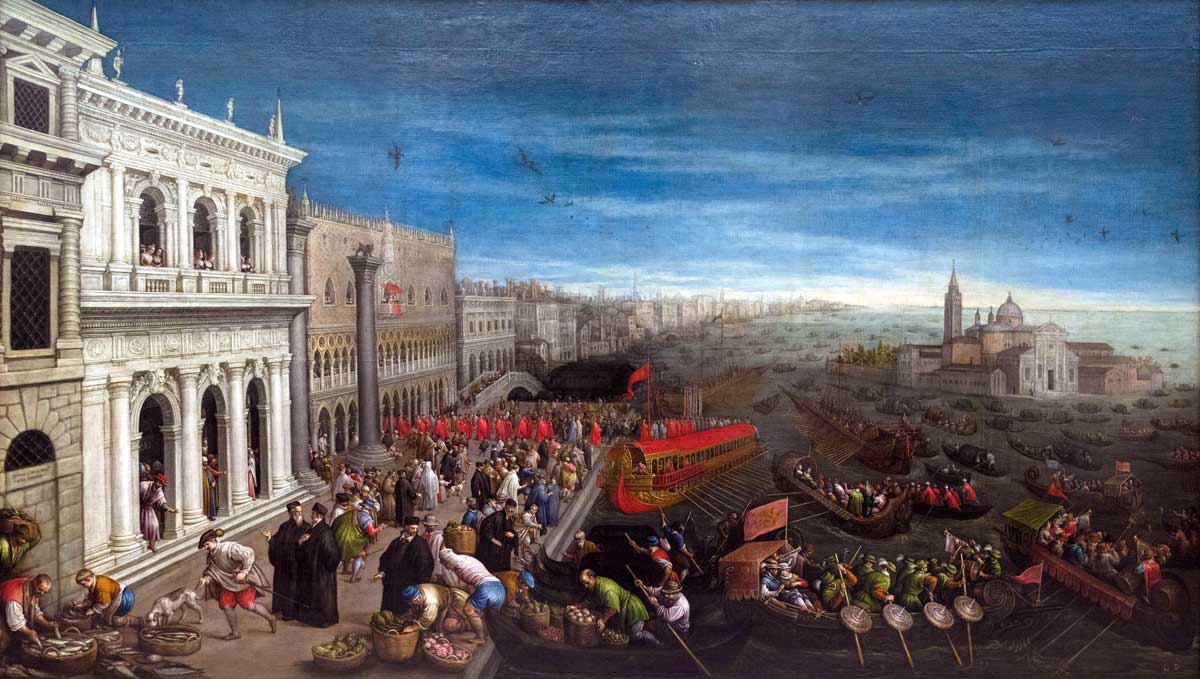
The Council centralised Venice’s intelligence operations. It achieved this via a string of measures, which included a distinct and continuous funding line and a composite, yet efficient, administrative system that supported the Venetian state’s central intelligence organisation. This was housed in one of the most impressive state intelligence headquarters of the early modern (even the modern) world, the Doge’s Palace, overlooking the Venetian lagoon from the Piazza San Marco. There, the Council masterminded, organised and administered one of the world’s first centrally organised state intelligence services, supported by several other state institutions. These included the Senate, the Venetian government’s debating committee and primary legislative organ, especially up until the mid-16th century, the Collegio, the Senate’s steering committee, the office of state attorneys and the local authorities of the Venetian territories throughout the Italian mainland, the Adriatic and the Mediterranean.
The Council’s authority stemmed from two virtues that were deemed fundamental to the security of the Venetian state: order that was achieved through secrecy; and maturity that was guaranteed by gerontocracy. There was no cult of youth in the Most Serene Republic. Most importantly, the Council’s authority was enacted through rules and regulations. In order to make decisions, it engaged in official deliberations, the outcomes of which were expressed in formal decrees and regulations, recorded in official secret registers. Throughout the 16th century, for instance, the Ten introduced a slew of regulations on the value and function of official state secrecy; on the use of methods of encryption; on the appointment of formal informers and casually paid spies; and on several other issues relating to official espionage and intelligence operations. These regulations had two distinct functions: first, they determined uniform and interdependent ways of working across all operations of Venice’s state bureaucracy and intelligence apparatus. Second, transcending the purpose of mere administrative orders to their formal representatives and state officials, these regulations assumed a managerial overtone, even an outright managerial function. Accordingly, the Ten had the legal authority to oversee Venice’s intelligence operations – and, by extension, its domestic and foreign policy. This convention departed from more traditional forms of power and control that were imposed primarily by hereditary right or charisma, as in the case of other Italian and European states.
The Council’s rules and regulations were applicable to everyone, including its own members. Those failing to act swiftly on issues that posed a security hazard, for example, were liable to a 1,000-ducat fine: a huge sum, considering that a Venetian patrician serving as an ambassador in the 16th century earned 200 to 600 ducats annually.
By the beginning of the 16th century, the need for the protection of state secrets intensified, due to several significant developments: continuous wars with the Ottoman Empire and, on the economic front, the threat of the new Portuguese spice route. In 1539, therefore, the Council, in collaboration with the Senate and the Great Council – the assembly of all male Venetian patricians – established the counter-intelligence magistracy of the ‘Inquisitors against the Disclosures of Secrets’, most commonly known as the Inquisitors of the State. The Inquisitors (not to be confused with the Venetian Inquisition) were a special counter-intelligence committee made up of three men who held annual terms: two members of the Council and one ducal counsellor. While their primary responsibility was the protection of state secrets, several aspects of state security, such as conspiracies, betrayals, public order and espionage, gradually fell under their jurisdiction. All these activities, in which both the Council of Ten and the State Inquisitors engaged, were subject to a thick mantle of secrecy.

Beyond organising and managing Venice’s intelligence infrastructure, the Council of Ten and the State Inquisitors were also responsible for military preparedness and defence, both within and beyond the city of Saint Mark. This involved building, reinforcing and occasionally repairing the city walls and fortifications. They also conducted regular inspections of the Venetian Arsenal, the centre of Venetian shipbuilding and navigation.
Spy networks
Early in 1576, the Venetian ambassador to Madrid asked the Council of Ten for a ‘good old’ painting of Titian’s, for Antonio Pérez, Philip II’s secretary of state. The painting was to be offered in exchange for ‘great benefits’ for Venice, implying Pérez was willing to supply the Venetian authorities with vital Spanish intelligence. The Council agreed to the request and the gift must have borne fruit: two years later the Ten doubled its spending on Titian’s art, in order to keep Pérez gratified.
In a separate incident, a few years earlier, the Venetian governor of Trau (now Trogir in Croatia), at the time a Venetian colony, was instructed by the Ten to employ a Turkish spy, who would travel to Constantinople in order to deliver a letter to the Venetian bailo, who was under house arrest. The commission came with detailed instructions: the spy was to hide the letter in a piece of waterproof cloth, which had been supplied by the Ten, which was to be stitched in such a way that it created a secret compartment inside the spy’s clothes. Upon arrival in Pera, the suburb of Constantinople where the Venetian embassy was situated, the spy was to hand the letter to the bailo through a window and wait for the reply, which he would take back to Trau. To ensure that the job was carried out in full, the governor was ordered to pay the spy only part of his fee, which would cover his travel expenses to Constantinople. The rest was withheld until his return.

Antonio Pérez and the Turkish spy are only two examples of the variety within Venice’s intelligence networks. The secret service developed three distinct networks: formal expatriate personnel; travelling merchants and mariners; and mercenary spies who were either hand-picked or who volunteered to participate in espionage operations.
The formal expatriate personnel was composed of diplomats and state servants, including ambassadors; officially appointed governors in the Venetian colonies; and Venetian representatives such as consuls in other Mediterranean regions where there was notable Venetian merchant presence but no formal diplomatic representation. Acting as spy chiefs in the area of their jurisdiction, these individuals were granted a budget for ‘secret expenses’ in order to employ subordinate networks of spies and informants.
These state officials’ work was then supported by Venetian merchants stationed in commercial hubs of strategic significance, such as the territories of the Levant, or travelling seamen who were commissioned to deliver correspondence and individuals who, in one way or another, were involved in Venice’s intelligence operations. Venetian merchants and ship’s captains crossing the Mediterranean, for instance, considered it their duty to report any suspicious activity by enemy vessels.
The bulk of Venice’s intelligence organisation, however, consisted of amateur intelligencers and spies who were assigned daring espionage missions for a fee or some other type of compensation. These were usually banished criminals who chose missions in exchange for their punishment, or locals hailing, mainly, from Venetian strongholds in the Balkans and the Mediterranean, appointed due to their knowledge of native customs and languages.

Supporting these intelligence networks was a large corps of white collar civil servants, responsible for transcribing, indexing and archiving all documents relating to the security of the Venetian Republic – documents that would today be termed ‘classified’. This professional group also included the famed Venetian cryptographers and cryptanalysts who, working in the Doge’s palace, organised the endless stream of coded messages.
A question that remains to be asked here is why Renaissance Venice was unique in developing such an organisation? How did it become the republic of secrets par excellence? While surviving records fall short of providing a definitive answer, we might find the cause in Venice’s territorial expansion as a republic which had created – and by the 16th century, was striving to defend – a vast maritime empire. The diverse geopolitical, linguistic, cultural and even religious traits encompassed in this expanse may have played a significant role in its intelligence pursuits. In other words, Venice’s empire-like configuration, in combination with its highly developed and much-discussed republican politics, was amenable to state intelligence organisation, especially due to the necessity for centralised control during times of political and economic instability.
Conventional wisdom, that organised intelligence services responsible for the surveillance of internal and external threats are a 20th-century phenomenon, no longer stands on firm ground. Instead, the challenge for the historian of early modern intelligence is to recognise the contemporary in the primordial and the primordial in the contemporary. It is only by doing so that historians will be able to understand the ways in which organised intelligence and espionage evolved through the centuries, with Venice as its spearhead.
Ioanna Iordanou is Reader in Human Resource Management at Oxford Brookes University and the author of Venice’s Secret Service: Organizing Intelligence in the Renaissance (Oxford, 2019).