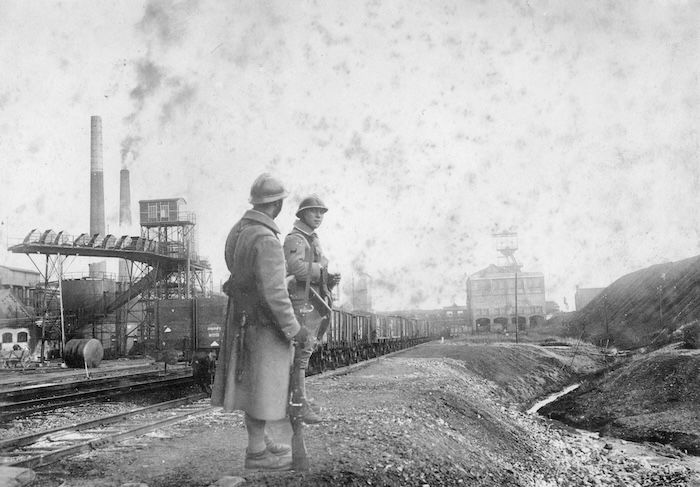
Gustav Stresemann became Chancellor of Germany in August 1923 at a time when it seemed as though the state was about to break up in chaos. With the French occupying the Ruhr coalfield, the mark suffering hyper-inflation to the point where it ceased to be a viable currency, separatists active in the Rhineland, Hitler in Bavaria and Communists in Saxony plotting different versions of revolution, the army wavering in its loyalty and Stresemann’s own party far from united behind him, it was a desperate time. He wrote to his wife Käte that to become Chancellor in such circumstances would be ‘all but political suicide’.
Register to read more articles for free.
When you register, you will receive the History Today newsletter. Click here to read our Terms of Use.
Gustav Stresemann became Chancellor of Germany in August 1923 at a time when it seemed as though the state was about to break up in chaos. With the French occupying the Ruhr coalfield, the mark suffering hyper-inflation to the point where it ceased to be a viable currency, separatists active in the Rhineland, Hitler in Bavaria and Communists in Saxony plotting different versions of revolution, the army wavering in its loyalty and Stresemann’s own party far from united behind him, it was a desperate time. He wrote to his wife Käte that to become Chancellor in such circumstances would be ‘all but political suicide’.
By a mixture of courage, skill and luck he steered Germany over the next six years to a remarkable recovery. His government lasted only until November 1923 but he remained as foreign minister in successive coalitions until his death in October 1929. As Chancellor he took the crucial step of ceasing financial support to the general strike against the French in the Ruhr, making possible the introduction of a new and stable currency. He authorised the army to intervene against the extreme left in Saxony but refused to give in to pressure from the chief of the army command, General von Seeckt, to make way for an authoritarian regime of the right. With Ebert, the Social Democratic (SPD) President of the Republic, he faced down the threat from Hitler and his Bavarian allies, watching with relief as their divisions ended in the fiasco of the Munich Putsch.
As foreign minister over the next six years he consolidated these achievements: under Anglo-American pressure the French withdrew from the Ruhr and accepted the recommendations of the Dawes Committee for an interim settlement of reparations underpinned by American loans. In 1925 he took the initiative which led to the Locarno Pact under which Germany, France and Belgium mutually recognised their Rhineland frontiers with Britain and Italy as external guarantors. In September 1926 Germany joined the League of Nations with a permanent seat on the Council in recognition of its status as a great power. To allay Soviet suspicions that Germany would join a capitalist crusade of the League powers against it, Stresemann also concluded the Treaty of Berlin in May 1926 by which both states promised to remain neutral in the event that either was the victim of aggression.
Stresemann’s diplomacy paid off. He earned the respect of his French and British counterparts, Aristide Briand and Austen Chamberlain, who were prepared to make concessions to Germany to win its co-operation. The first of the three Rhineland zones, which had been put under Allied military occupation by the Treaty of Versailles, was evacuated in January 1926 and in 1927 the Inter-Allied Control Commission to supervise German disarmament was withdrawn. In 1929 a conference at The Hague agreed a ‘final’ reparations settlement with annual payments to continue until 1988, though in fact the scheme lapsed in 1931 as a result of the Depression. As part of the settlement Stresemann won complete allied evacuation of the Rhineland by June 1930 (instead of 1935 as stipulated in the Versailles Treaty).
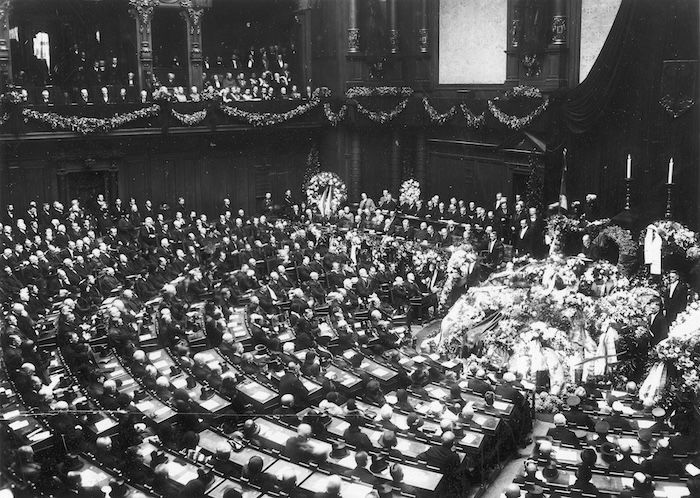
The funeral of Gustav Stresemann in the Reichstag, with Streseman’s coffin on the president’s tribune, 8 October 1929. Narodowe Archiwum Cyfrowe. Public Domain.
It is hardly surprising that when he died of a stroke in October 1929 at the early age of fifty-one, Stresemann’s reputation stood very high. The British ambassador in Berlin Sir Horace Rumbold described him as Germany’s ‘greatest statesman since the days of Bismarck’, adding that Stresemann’s task had been ‘infinitely the more difficult of the two’. In Paris, the German author Count Kessler noted:
It is almost as if an outstanding French statesman had died, the grief is so general and sincere ... The French feel Stresemann to have been a sort of European Bismarck.
From a different standpoint even Hitler, according to Ribbentrop, acknowledged that in Stresemann’s position ‘he could not have achieved more’.
Though Stresemann’s achievements were not in doubt, controversy soon raged about his intentions. Was he a ‘European Bismarck’ leading Germany gradually to accept its place within what Thomas Mann called ‘a European society of nations’ or was he simply, in the words of the left-wing British journalist Claud Cockburn, ‘one of those Germans who had, at a fairly early date, discovered that the way to get away with being a good German was to pretend to be a good European’? And what did it mean to be ‘a good German’? If he offered an alternative to Hitler, what kind of alternative was it? Was Locarno a first step in a policy of European security or was it a screen to enable Germany to rebuild its strength until it could force a revision of its eastern frontiers, especially the bitterly resented frontiers with Poland?
To answer these questions one has to place the development of Stresemann’s ideas in the changing contexts of both domestic politics and Germany’s international position. Stresemann was both a German nationalist and a liberal. His inspiration as a young man was the literature of the 1848 revolutions which had shaken Europe a generation before his birth.
The values of liberalism and nationalism remained central for him but the way he applied them varied with time and circumstance. In the first phase of his career, from 1901–14, he built up a highly successful organisation representing the small scale, export industries of Saxony and launched himself into politics in the National Liberal party. His organisation opposed the dominant lobbies of heavy industry and agriculture. They were protectionist whereas Stresemann’s clients depended on imports of raw materials and exports of their finished goods and were therefore generally in favour of lower tariffs. Stresemann believed passionately that the only way Germany could support its rapidly expanding population was by the growth of its export trade which provided most of the new jobs.
Taking the British empire as his model he wanted to see an expansion of Germany’s overseas colonies to reduce its dependence on imports. He urged the National Liberal Party to distance itself from the Conservatives and become a truly ‘people’s party’ winning over the working class by appealing to its interest in imperialism. His politics were distinguished by the belief that by using constitutional methods the groups he represented could defend their interests and help the German empire to become a fairer and less divided society. He rejected both the revolutionaries of the left and the counter-revolutionaries of the right. From the antisemites on the right he was also separated by his marriage in 1903 to Käte Kleefeld because she was of Jewish descent.
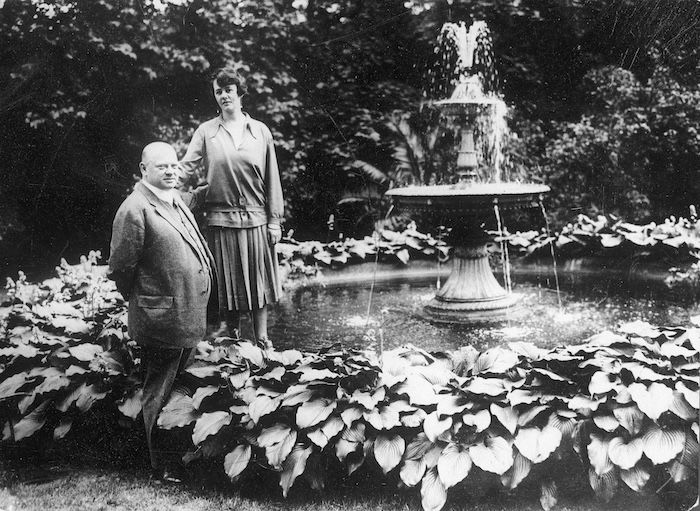
Gustav Stresemann with his wife Käte, c. 1928. though raised Lutheran, Käte was of Jewish ancestry and in 1939 she fled to the United States with her son and his family. Narodowe Archiwum Cyfrowe. Public Domain.
The context changed again with the advent of the First World War. Unfit for military service, Stresemann threw himself into the debate over war aims with the abandon of the true believer. Seeing the war as the inevitable challenge by the powers – especially Britain – who felt threatened by the rising power of Germany, he wanted above all to secure Germany’s continental base so that it could challenge Britain’s maritime supremacy. ‘Now’ he wrote in December 1914:
... the great moment of world history has arrived, we will advance to the sea lanes of the world and create for ourselves a German Gibraltar in Calais.
Stresemann pushed for the adoption of unrestricted submarine warfare as the only means to defeat Britain. This proved to be the single most disastrous decision of the war for Germany – countered in time by the convoy system and helping to bring the United States into the conflict.
The war also saw an important development in Stresemann’s liberal views. He recognised that all sections of the community had proved their patriotism and that the discriminatory ‘three class’ franchise in Prussia had become indefensible. He also blamed the civilian government for failing to give leadership at home and losing the propaganda war abroad. Even in arms production Germany had been less efficient than Britain, and when he asked a departmental official the reason he was told ‘we have not had a Lloyd George’.
All this convinced Stresemann that parliamentary government on the British model was not only a more liberal but also a more successful way to govern a modern state. He led the National Liberal Party in the Reichstag in 1917–18 to support constitutional reform. He hoped that victory and reform would come together allowing an imperial Germany to achieve both a dominant position on the continent and unity at home.
This was a vain hope. A German empire on the European continent could never have been sustained by liberal principles. The parallel with the British empire was misleading and in any case its days, too, were numbered. It was also unrealistic because in the last two years of the war Germany’s precarious unity broke down: the right wanted victory and no reform, the left wanted reform and a negotiated peace. As the two sides pulled apart, Stresemann found himself stranded in the middle. With the German defeat in October 1918, the National Liberal Party – whose Reichstag leader he had become the previous year aged only thirty-nine – broke up. The bulk of the party defected to join the Left Liberals in a new Democratic Party from which Stresemann was excluded because of his reputation for extravagant war aims. His political career appeared to be over.
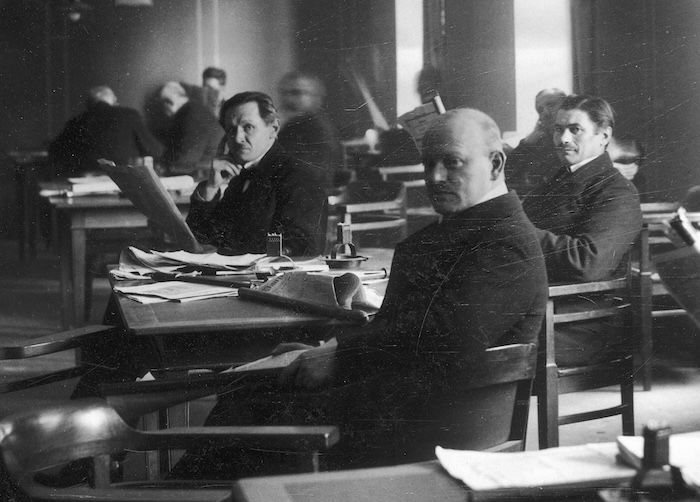
Gustav Stresemann at the Paris Peace Conference, by Robert Sennecke, 1919. Narodowe Archiwum Cyfrowe. Public Domain.
In the years immediately following the revolution of November 1918 and the foundation of the Weimar Republic, Stresemann was torn by contradictory feelings. He resented the way in which, as he thought, he had been made a scapegoat by the Democrats for views which had been widely shared. He fought back by founding a new party, the German People’s Party (DVP), with the rump of mainly right-wing National Liberals. He felt no particular loyalty to the Republic, seeing it as the result of an unnecessary revolution – since Germany had already achieved parliamentary government in October 1918 – and fearing it might degenerate into Bolshevism. When a military revolt broke out in Berlin in March 1920 – the Kapp putsch – he did not at first condemn it but instead tried to mediate to find a peaceful solution.
Stresemann was, however, impatient with the role of opposition and as early as April 1919 he made clear his intention to recapture the old National Liberal constituency and become a party of government. There were several reasons for his attitude. He believed that the National Liberal tradition was best suited to government, as in the days when it had supported Bismarck. He saw his party as providing, like the Catholic Centre Party, an essential element of balance between the Conservatives, re-grouped as the German National People’s Party (DNVP) on the right, and the Socialists on the left. Without that balance, Germany would be governed from the extremes with the danger that it would slide into civil war.
But the nature of politics had also changed with the arrival of the Republic. Stresemann may be seen as an example of the new type of ‘professional politician’ described by the sociologist Max Weber. Professional politicians used modern forms of political organisation and sought power unlike the nineteenth century ‘notables’ who were content to represent their communities while governments were appointed by the crown. There was now the opportunity for politicians like Stresemann to participate in government.
In the years leading up to his appointment as Chancellor in August 1923, Stresemann acquired a unique reputation. He made his peace with the Republic, advocating the ‘great’ coalition from the SPD to the DVP to consolidate democracy against the extremes of left and right. In foreign affairs he showed a new realism: arguing that revision of the Versailles Treaty could come only from the mutual recognition of common interests between Germany and its former enemies. Germany still had one great asset, the importance of its market to the exports of other European states. If Germany collapsed it would drag France down with it. They shared a common destiny. Therefore, he predicted in 1921, ‘The day of understanding will come because it must come.’ Stresemann started to talk the language of statesmanship: the shared values of ‘national community’ (Volksgemeinschaft) at home and economic interdependence abroad.
It was Stresemann’s good fortune to be able to see his ideas put into practice while he was in government. The Republic was never truly consolidated, the divisions were too deep and the economic revival too weak, but by 1928 it no longer appeared threatened by its enemies on the left or the right. And its international position had been transformed by the intervention of Britain and the United States to reverse the Ruhr occupation, and the flow of American loans that followed.
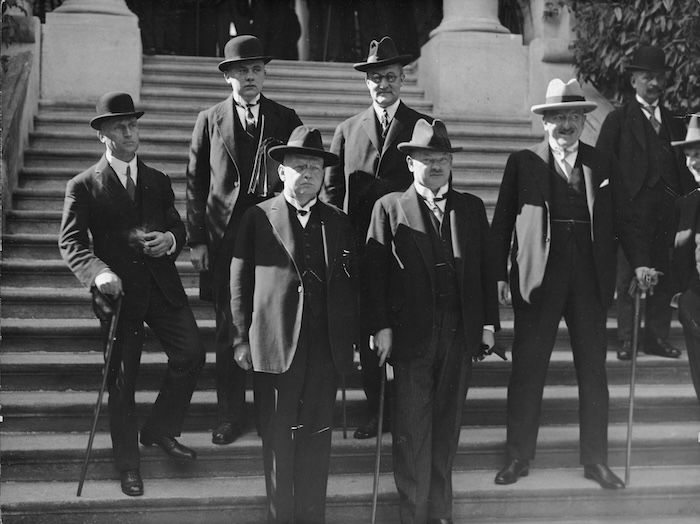
The German delegation at Locarno, with foreign minister Gustav Stresemen and chancellor Hans Luther at the front, 1925. Narodowe Archiwum Cyfrowe. Public Domain.
How did Stresemann’s ideas develop in these years? In 1924–26 during the domestic battles over the Dawes Plan, Locarno and the League, he had a particular strategy in mind. He hoped to win over the nationalist DNVP, which had become a mass party. Alternatively, he thought he might be able to force a division between its pragmatic sections – who understood the importance of American loans – and its ideologues. If the DNVP broke up, he reasoned, and its moderates joined the DVP, which would then become the main party of the Protestant middle class, the Republic would gain stability and legitimacy.
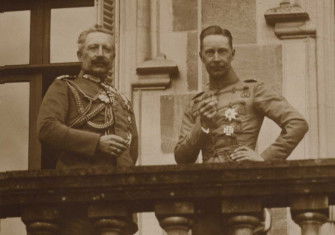
As a nationalist himself Stresemann was able to talk the language of the DNVP. He shared their anger at the way Austria had been prevented from joining Germany (in violation of the principle of self-determination), at the mistreatment of German minorities by Poland or by Fascist Italy in South Tyrol, and at the loss of colonies. To his nationalist critics, he defended his policy as a tactical necessity. He argued that his purpose in accepting international obligations in the form of loans or membership of the League was that ultimately Germany should be ‘independent and free’. In a letter to Crown Prince Wilhelm in September 1925 he defended joining the League, saying that the first objective was to free the Rhineland from foreign occupation, ‘getting the strangler from our neck’, and that this could be done by a policy of ‘finesse’ as Austria and Prussia had once manoeuvred to liberate themselves from Napoleon.
Once the main lines of Stresemann’s policy were established and it became clear that the DNVP would neither be won over nor broken up, the emphasis of his arguments shifted. From 1926–29 he became increasingly preoccupied with the preservation of peace, not simply as a tactical necessity but in the wider interests of both Germany and Europe. War, he wrote in 1928:
... would mean that the old Europe with its deep-rooted national conflicts would inevitably tear itself completely to pieces and destroy its economy and civilisation. This destruction would be above all Germany’s destruction.
Stresemann worked to achieve what he called:
... the securing of a free Germany with equal rights and the inclusion of such a Germany together with all other states in a stable international structure.
In practice, this meant that Germany would not give up what it saw as its legitimate claims to revision of the treaty: the Polish frontier, union with Austria, colonies. However, Stresemann knew that the prospect of achieving these goals peacefully was remote. He also became increasingly sceptical about union with Austria (which would change the balance of German politics by adding to it substantial numbers of Socialist and Catholic voters) and the value of colonies which were already beginning to challenge European rule. The Polish frontier remained a serious problem. Stresemann was not prepared to give up the demand for the return of Danzig (a German port made a ‘Free City’ under the League of Nations by the Treaty) and the northern half of the Polish ‘corridor’ to the sea which separated East Prussia from the rest of Germany. He regarded the frontier as the worst mistake of the Treaty and a threat to peace. But he had no realistic way of changing it. In 1925 he suggested that if Germany first established good relations with Britain and France one day peaceful revision might be possible, perhaps as a result of Polish economic collapse or of Soviet pressure for revision of Poland’s eastern frontier. But by the end of his life he seems to have accepted the ideas of his envoy in Warsaw, Rauscher, who recommended a policy of détente and trade in the hope that eventually Poland’s economic dependence on Germany might make frontier revision possible. In effect this meant putting the issue on ice.
French troops in the Ruhr, 1925. Narodowe Archiwum Cyfrowe. Public Domain.
What was the purpose, then, of Germany’s secret re-armament in co-operation with the Soviet Union, which had started unofficially in the early 1920s but was continued with cabinet approval after 1927? Different groups had different ideas: General von Seeckt thought in terms of a war of revenge against France; Colonel von Blomberg, later to be Hitler’s war minister, thought Germany should prepare for an offensive against Poland. But in the 1920s the priority was defensive. A war game in 1927 showed that Germany would be unable to defend East Prussia from Polish attack, even if France remained neutral. The defence minister General Groener persuaded the cabinet that rearmament beyond the limits imposed at Versailles was necessary.
Stresemann was sceptical of the military value of ‘old, buried guns’ but he was prepared to tolerate limited rearmament provided it did not interfere with his foreign policy. In his last months he floated the idea that Germany should be allowed some rearmament since the international disarmament foreseen by the League Covenant had become deadlocked. He told a French journalist that he dreamt of a ‘close political, economic and military alliance’ between their two countries. Would he ever have considered an attack on Poland? The necessary conditions would have been the evacuation of the Rhineland and a rearmed Germany, the cancellation of reparations and freedom from American loans. Even if all these had been in place, he would still have had to accept the danger that a full-scale European war would break out with Germany as the battleground, and that the fragile consensus behind the Republic would be shattered. After his experience of division and defeat in 1918 and near breakdown in 1923, it is inconceivable that he would have taken such a risk.
By 1929 Stresemann was forced to conclude that there was no ready answer as to how to achieve further revision of the Treaty. German expectations for new concessions were matched by French fears of a resurgent Germany. Stresemann looked to economic co-operation as the way to bridge the differences. The prospects appealed to his imagination – he drew a parallel between the divisions of Europe and the petty states of pre-unification Germany. Echoing French fears he suggested that for Europe to be able to resist American competition, it would have to achieve greater economic integration. In his last speech to the League, he even raised the question of a single European currency. This was a far-sighted strategy but it had made little headway before it was interrupted by the Depression.
It was obvious in 1929 that Germany was on the brink of a financial crisis. Stresemann knew that the DNVP under its new leader Hugenberg was drawing closer to the Nazis to take advantage of the crisis and bring down the Republic. He warned that ‘the end may be civil war’. He hoped, however, that Hugenberg’s extreme tactics would alienate the more moderate members of the DNVP and that they would finally combine with the DVP and the Democrats into a new Protestant bloc in defence of constitutional government, national unity and civilised values.
Could Stresemann have prevented the disastrous developments that followed his death? He was the one person who might have given effective leadership to a new Protestant party of the middle ground, but given the trend to the extremes, as the Depression deepened, the prospects of success were slight. He would also have been the person best able to maintain co-operation with France, and in particular to take advantage of French offers of long-term loans albeit with political strings. But again even Stresemann would have found it difficult to manage the tensions which had mounted on both sides of the Rhine.
However, Hitler’s appointment as Chancellor by President Hindenburg in 1933 was, even without Stresemann, far from inevitable. And there is one intriguing possibility that might just have made a crucial difference. Before Stresemann died, the idea was discussed that he might contest the elections for the Reich Presidency when Hindenburg’s term ended in 1932. In fact Hindenburg was seen as the candidate to stop Hitler, and was re-elected with the votes of the democratic parties. If one could imagine Stresemann being elected instead of Hindenburg, then German and European history might well have taken a different course.
By the end of his life Stresemann had come to occupy a unique place in German and European politics. At root he was still both a liberal and a nationalist. But the values of liberalism, above all toleration, had enabled him to build bridges: between right and left, Protestant and Catholic, the lower middle class of his parents and the Berlin society of often Jewish intellectuals, journalists, musicians and theatre directors which he frequented in the 1920s. He had also become a focus for hopes of European peace. When Stresemann died on October 3rd, 1929, Briand is reported to have said: ‘Order a coffin for two. We have two deaths to lament.’ For many contemporaries his memory mattered not only for what he had achieved but for the way he symbolised what might have been, in contrast to the terror and tragedy of the Third Reich.
Further Reading:
A.J. Nicholls, Weimar and the Rise of Hitler (4th edn., Macmillan, 2000)
Dieter Langewiesche, Liberalism in Germany (Eng. edn., Macmillan, 2000)
Marshall Lee & Wolfgang Michalka, German Foreign Policy 1917-1933: Continuity or Break? (Berg, 1987)
Henning Tewes and Jonathan Wright (eds.), Liberalism, Anti-Semitism and Democracy (Oxford University Press, 2001)
Jonathan Wright, Gustav Stresemann: Weimar’s Greatest Statesman (OUP, 2002)
Jonathan Wright is a Tutorial Fellow at Christ Church, Oxford, and a University Lecturer in Politics.