

The General Strike
Martin Pugh revisits one of the most bitter disputes in history and assesses its impact on industrial relations and the wider political landscape of the twentieth century.
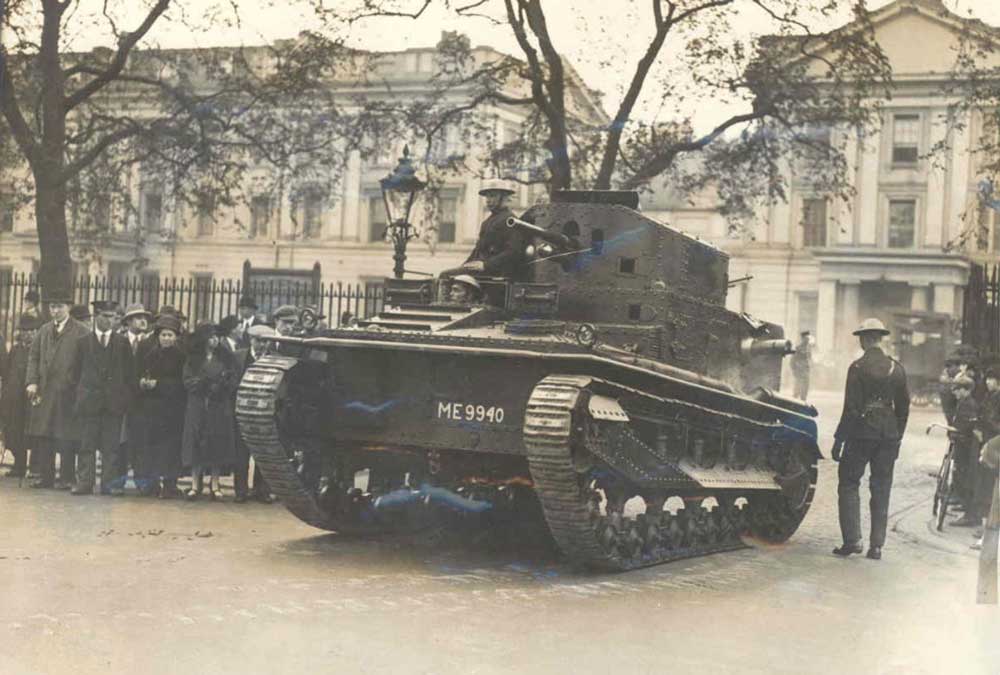
In 1926 Britain experienced a unique event in its history. From May 4th to 12th of that year the General Strike largely paralysed the economy and threatened to bring down the elected government. Called to defend the miners from drastic wage reductions and longer hours, the strike involved over three million workers in printing, transport, iron and steel, gas, electricity, building, engineering and shipbuilding as well as coal. Yet it has generally been seen in much less apocalyptic terms. Despite the involvement of millions of strikers, troops, police and volunteers it passed off in nine days with remarkably little violence and no deaths; the most famous incident was the football match played at Plymouth between police and strikers which appears to corroborate our picture of the strike as a very British affair. ‘Our dear old country can be well proud of itself’, wrote a relieved George V in his diary when the strike ended, ‘it shows what a wonderful people we are.’
As a result the strike has attracted surprisingly little research; until this anniversary year, the most recent book had been published in 1993. It has become an isolated episode rather than an integral part of our wider history. This is partly because most historians regard the General Strike as an affair without major implications; skilfully handled by the authorities, it represented an obvious failure for the labour movement. Given the attachment of both the Labour Party and the trade unions to parliamentary politics and constitutional methods it has been difficult to see the strike in ideological terms. In fact it has been regarded as an aberration in labour history.
The causes of the General Strike lay in the politics and economics of the coal industry. By 1914 coal output had expanded to nearly 300 millions tons a year of which a third was exported. But coal thrived on the demand of other countries not on the basis of its own efficiency. During the war, coal was desperately needed and more men were employed, but after 1918 the export market collapsed leaving the industry with around a quarter to a third surplus capacity, which meant falling prices and squeezed profit margins.
Adjustment to this situation proved difficult. Government control over the industry during wartime had given the miners a valuable gain: national wage settlements instead of wages that varied widely according to the profitability of each coalfield. Subsequently the miners sought to retain this advantage by promoting the nationalization of coal. Lloyd George sidestepped this pressure by appointing a Royal Commission under Lord Sankey in 1919, but then ignored Sankey’s conclusions and returned coal to private control in 1921 when the industrial crisis had passed. The 1922 coal strike in America, and the French occupation of the Ruhr in 1923 boosted the market for coal temporarily. But by June 1925 it had become impossible to evade the problem any longer. The Conservative government elected in November 1924 decided to return Britain to the Gold Standard. In effect this meant revaluing the pound, making exports more expensive in the process. In this situation the coal owners argued that, as labour comprised 70 per cent of their costs, they would have to cut wages; moreover, the reductions would reflect the varying profitability of the coal fields: national wage settlements were to be abandoned.

But why should another coal strike have precipitated a general strike? Simply because the rest of the union movement was willing to back the miners. In response to the return of a Conservative government the unions agreed in 1924 to give the General Council of the TUC the role of a general staff – to lead a general strike. The record of co-operation was not good. As recently as 1921 the miners had been left in the lurch when the other members of the ‘Triple Alliance’, which threatened sympathetic action by coal, railway and transport workers withdrew at the last minute. By 1925 things were different. After a period of rapid growth from 1916 to 1920, high unemployment and a falling membership had put the trade unions on the defensive. Government economic strategy, based on an over-valued currency, implied the need for general cuts in wages to maintain the competitiveness of British exports. For the unions, then, participation in a general strike was not an unselfish action, but an attempt to protect the wages of their members, not just those of the miners.
The miners’ leaders, Herbert Smith and A.J.Cook wanted TUC backing to defeat the proposed wage cuts and the return to an eight hour working day. They thus had reason to believe the TUC would support the strike this time and not leave them in the lurch as had happened before. However, although the TUC agreed to lead the strike in July 1925 its members were never really comfortable with the idea. A general strike was the key weapon of the syndicalists who aimed at the overthrow of parliamentary government and its replacement with workers’ control. Almost no union leaders subscribed to syndicalism. They simply hoped that the threat of a general strike would be sufficient to force the Government to back down and meet their demands.
Yet although the strike was not driven by ideological motives it had serious political implications in the sense that the unions assumed the crisis would be resolved when the Baldwin government felt obliged to resign or to call a general election. Something similar occurred in the clash between the miners and Edward Heath in 1973-74. As a result of the slowdown in the economy caused by the miners’ actions the cabinet reluctantly decided their only option was to call an early election, hoping that the voters would over-rule the union. Heath’s defeat put him out of office and completely destroyed his reputation in his own party – with dire consequences.
... the Socialist Party [i.e. Labour] fights with two weapons. Having been defeated in the political field [the 1924 election] they can bring the alternative of industrial warfare into play.
The Duke of Northumberland, himself a coal-owner and fascist sympathizer, dismissed the Labour Party in September 1925 as a ploy ‘to camouflage this design until the time is ripe for a revolutionary strike on a gigantic scale.’
What alarmed many on the right was the perception that the Conservative Government, led by the amiable and conciliatory Baldwin, was totally unprepared to meet this threat. For his part, determined to avoid a general strike, Baldwin managed to delay the crisis for nine months by granting a subsidy to maintain miners’ wages, from September 1925 to May 1926, while a royal commission under Herbert Samuel investigated the industry. It was expected that either Samuel would find a compromise or that the non-mining unions would back away from the strike as they had previously. A number of Conservative journals and politicians saw the subsidy as a surrender. In November 1925 Cuthbert Headlam, Tory MP in the north-east, thought that Baldwin had been intimidated by the miners and ‘it would be no exaggeration to say that the future of constitutional government may be at stake during the coming months’. The same alarmist diagnosis was expressed in extremist and fascist circles: Northumberland described Baldwin’s policy as ‘drifting helplessly towards the abyss, hoping until the last moment that something will turn up to avert the inevitable catastrophe.’ He anticipated that a general strike would bring down the government, followed by a Labour administration and a sweeping programme of nationalization which would itself be overtaken by chaos and violent revolution along the lines of events in Russia in 1917. In fact, Baldwin’s motivation was tactical. He bought time because he hoped to avoid the strike, but by May 1926, when £23 million had been spent on the subsidy to the industry, his hard-line colleagues including Winston Churchill, Austen Chamberlain, Joynson -Hicks and Lord Birkenhead, rejected any further concessions. On May 3rd, the compositors working on the Daily Mail stopped work and the Government broke off negotiations.
The ultimate ‘failure’ of the General Strike has been widely attributed to the careful preparations on the government side and to the absence of preparation by the TUC. Some have argued that the authorities were not ready either in 1925 or in 1926, others that they were as ready as they could reasonably have been.
The authorities actually had preparations well in hand, but they felt reluctant to make too much of them because they didn’t want to provoke the unions into precipitate action by brandishing a strike-breaking machine. Following the intense militancy of the post-1918 period an emergency organization had been in place since 1923; even the Labour government had contemplated using it during a dock strike in February 1924. Baldwin inherited these plans but his Home Secretary, William Joynson-Hicks, pushed them nearer to completion. In the event of a general strike the Cabinet’s Supply and Transport Committee would meet daily in London but delegate responsibility for supplies and transport to civil commissioners in each region. However, this had to be operated by a large body of volunteers. Some 85,000 were to be recruited by a semi-private body, the Organisation for the Maintenance of Supplies (OMS) announced in September 1925. It was hailed by the Daily Mail as the ‘Defence Against the Reds’ and denounced by the Communist Party as ‘the most definite step towards organized Fascism yet made in this country.’

The General Strike played an important part in the early fortunes of fascism in Britain. The British Fascists had been founded in May 1923 by Rotha Lintorn-Orman, and a splinter group, the National Fascisti, emerged in 1924. Though fascists were officially banned from enrolling in the OMS or as Special Constables (temporary police reinforcements), some chief constables allowed them to do so. The fascists claimed that while the feeble politicians prevaricated, they alone would be ready to save the country from chaos caused by the Jewish-
Bolshevik conspiracy. The British Fascists organized their own ‘Q Divisions’ of men available to undertake strike-breaking activities who were offered to businesses requiring lorry drivers. They expected to gain kudos by playing a patriotic, high-profile role in the affair. Joynson-Hicks met the fascist leaders several times in the run up to the strike and the Cabinet accepted that fascists would be at their disposal to deal with the emergency.
But in the event, the issue of preparation was not central to either the strikers or the government. Ernest Bevin, a member of the General Council, admitted that the TUC had made no plans until April 27th, 1926, but local strike committees and Councils of Action quickly improvised an organization. Initially around 2.75 million workers were called out, followed by a second line of engineers, ship-builders and textile workers a week later. The response proved very solid and even the Government reports suggested that there was no significant return to work after nine days; the strike was becoming more general not less and could have been extended. In this sense it was a success.
This sits uncomfortably with received views that the Government victory was bound to win. Keith Laybourn’s 1993 book suggested that law and order was maintained and the Government was in control. However, the daily reports complied by the civil commissioners (now available in the National Archives), underline that the nine days saw serious violence especially in the North, in Scotland and in London, south of the Thames and in the East End. A typical outbreak occurred at Leeds on May 5th where 5,000 people threw coal and other missiles at trams, smashing windows and injuring passengers. In Glasgow on May 7th, men attacked trams and the depots where they believed volunteers were waiting, throwing stones and breaking shop windows. Police used truncheons in an attempt to disperse the crowd and later charged eighty-nine people with riotous conduct and a breach of the peace. On May 9th, a 5,000-strong mob attacked the police station in Preston trying to release a man arrested for throwing missiles at a bus; it was only dispersed after two hours of fighting, three baton charges and the arrival of reinforcements. By the end of the nine days the violence was clearly growing worse despite all the efforts of the authorities.
Things may have been worse had not both sides showed great restraint. The TUC advised strikers not to arm themselves, while Baldwin overruled his more excitable ministers who wanted to close the labour newspaper The Daily Herald and seize union funds. Above all, though troops were used judiciously to escort essential food convoys, the Government tried to follow the King’s advice not to put them in positions in which they might shoot strikers. The workers, who did not interfere with convoys under military escort, regarded the soldiers and even the police as doing their job – unlike the volunteers and the Specials who were disliked as strike-breakers. The real danger for the authorities was of fraternization between troops and workers, as occurred in the North-east, which strained the loyalties of the soldiers.
As for the volunteers, they were hailed as heroes once the strike was over, but their effect during the nine days was minimal. While students, clerks and gentlemen indulged childhood fantasies about driving steam engines, few had the skill to do so. Alan Lennox Boyd turned up at Paddington Station to work as a guard, resplendent in top hat, tailcoat and white trousers. One eager youth arrived at Waterloo to assist Southern Railways who equipped him with an oil can with instructions to walk the line oiling the points as he went. Three days later he cabled: ‘Have arrived at Brighton. Send more oil’. Only three per cent of trains ran during the nine days. Churchill even admitted that with some £400 million-worth of trade lost in just nine days, the Government could not have weathered the strike much longer.
Whether or not the General Strike should be seen as an unqualified failure depends on how one defines its aims. Considered purely from the miners’ point of view the outcome was certainly negative. Miners lost their national minimum wage until after the Second World War and suffered extensive cuts in the meanwhile. They were also divided from the wider union movement and split by the creation of the breakaway Nottinghamshire Miners' Industrial Union under George Spencer in November 1926. However, for the trade unions as a whole the picture is one of continuity rather than change. There was, surprisingly, no great reaction against the leaders who might have been discredited by their inept handling of the strike. They called off the strike suddenly with no consultation and no attempt to negotiate a return to work, leaving strikers liable to the sack. Though union membership fell until 1934 this was largely a continuation of the decline during the five years before 1926 – a reflection of long-term unemployment.

Given that the object of the Strike was to check general reductions in wages, in these terms it was not a total failure. The miners apart, workers suffered only minor wage cuts after 1926: even in the worst of the slump from 1929-31 the cuts averaged four per cent. As this was less than the fall in prices, the real value of wages increased. Behind this lay a certain mutual agreement between the unions and the employers who were keen to avoid further industrial action. In effect unions acquiesced in the laying-off of some workers while management largely maintained wage levels for those in work. This outcome had major implications because Government economic policy for tackling unemployment and restoring British export markets had been based on the assumption that wages must fall substantially in order to maintain the value of the pound. However, their aims were largely frustrated. By 1929 unemployment was still at 1.1 million, and as a result of the crisis of 1931 sterling was devalued to a more realistic level.
In many respects, the General Strike had greater political than industrial significance. Initially Baldwin basked in praise for his handling of the situation. However, this mood quickly passed as critics demanded drastic legislation to curb the powers of the unions. Although Baldwin had previously vetoed such ideas he was now too weak within his party and in Cabinet to resist. The upshot was the 1927 Trades Disputes Act which made sympathetic strikes illegal, banned civil servants from joining unions, and substituted a system of contracting in to pay the political levy for one of contracting out. This was widely seen as vindictive towards the unions and as a blatantly partisan measure aimed at reducing Labour Party funds; it also undermined Baldwin’s efforts to present the Conservatives as being fair towards all sections of society. Subsequently Conservative candidates confirmed that this perception handicapped them in urban constituencies.
the services of the OMS had been of no appreciable value [and were] not of such importance as to justify the Government’s encouraging them to maintain their organisation.
The Labour leaders had shown a notable lack of sympathy for the Strike because they feared it would damage them electorally; Ramsay MacDonald especially resented any assertion of union power as a threat to his own leadership. But MacDonald and his colleagues were surprisingly out of touch with grass-roots sentiment. In most working-class communities the General Strike had been solidly supported, and the subsequent six-month miners’ strike generated immense sympathy for the men and their families who were driven to the poor law authorities for assistance.
Although Labour had been gaining support since the war, by 1926 it had not yet won a majority of the working-class vote. However, the strike strained the loyalties of the large numbers of working-class men and women who still voted Conservative and Liberal. This began to become clear when Labour made extensive gains in local government elections from 1927 onwards. Although the Liberals enjoyed a revival in the later 1920s, they continued to lose seats and votes to Labour in urban areas. The acceleration of the working-class move towards Labour was helped by the determination of the unions to treat the Trades Disputes Act as a symbolic blow against their movement and to unite behind MacDonald to get it repealed by returning Labour to power. Thus, at the general election of 1929 MacDonald’s fears about the General Strike were shown to have been baseless. Labour managed to increase its vote from 33 to 37 per cent and its seats from 151 to 288, not far short of an overall majority. In this outcome lay the political paradox of the General Strike: although its immediate outcome had presented Baldwin with a great triumph it actually damaged him and his party far more than the opposition.

