

Fostering the Foundlings
The governors of the London Foundling Hospital recruited an external network of nurses to care for children. For many, the bonds established endured.
The governors of the London Foundling Hospital recruited an external network of nurses to care for children. For many, the bonds established endured.
The governors of the London Foundling Hospital recruited an external network of nurses to care for children. For many, the bonds established endured.
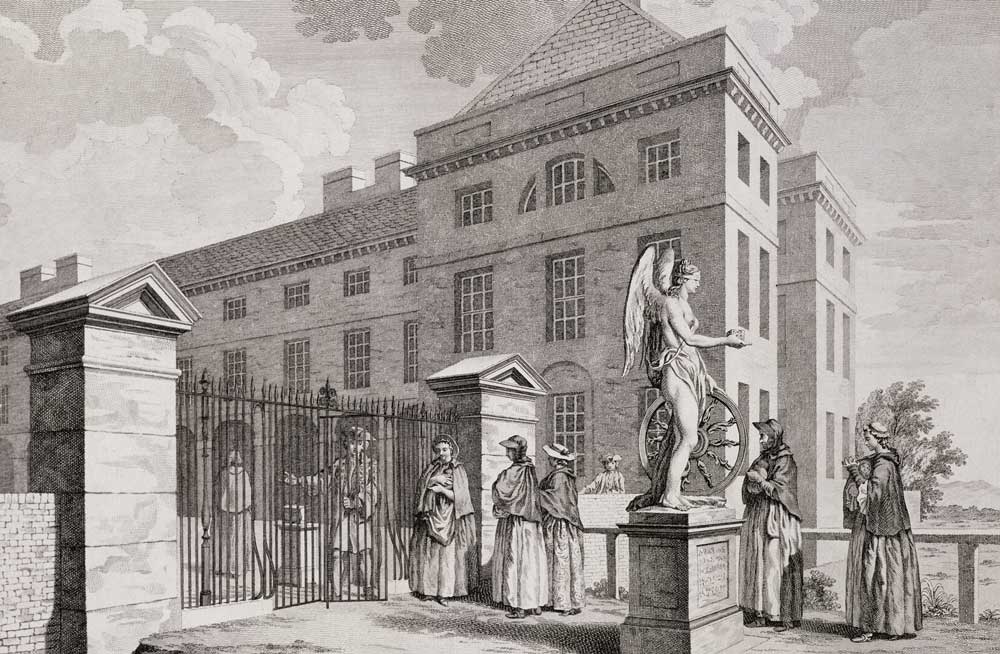
In the middle of the 18th century one charity supervised a mass system of childcare, designed to bring up thousands of vulnerable children. Opened in 1741, the London Foundling Hospital took in babies whose parents were unable to care for them. Fearing the risk of infectious diseases in an institutional environment, the governors decided to recruit a network of nurses outside the hospital to care for children. Babies left at the hospital were assessed, and those deemed well enough to travel were immediately sent to hundreds of towns and villages across rural England, to be cared for in ordinary families. Although their carers were referred to by the governors and inspectors as ‘nurses’, their role was more similar to what would now be called a foster parent. Nurses brought up the children until they were between three and five years old, when they were sent back to the London hospital or one of its branch hospitals. Here, the children received a rudimentary education before being apprenticed (for the boys) or found a place in domestic service (for the girls). The governors were motivated by a humanitarian impetus to save lives, but also by a commercial and patriotic desire to produce industrious, obedient workers who would drive Britain’s economy and fight in its wars.
Nurses were vital to ensuring that the maximum number of children successfully survived the dangers of infancy. They were supervised by local inspectors, often parish clergyman or benevolent gentlewoman, described by the governors as, ideally, ‘ladies and gentlemen of easy fortunes & humane dispositions’. Inspectors monitored the children’s care, paid the nurses’ wages, treated minor illnesses and reported serious health problems or deaths to the governors. The role was voluntary but could involve considerable work, with inspectors responsible for anything from two to over 100 children. At its height in 1759 the nursing network was caring for more than 5,500 children. Evidence of this bureaucratic, mass childcare system is documented in the immense archive of the Foundling Hospital. Preserved in over 240 metres of shelving are letters from inspectors, nurses and governors documenting the early lives of the foundlings they were trying to save.
Nurses had to be recommended by local clergy, the inspector or parish officials. In 1756 the parish officers of Langley in Berkshire recommended four nurses as ‘Clean Motherly Women’, language echoed by Mr Bayley, a surgeon from Tring who attested that ‘the two Women that petition for Children are of a sound habit careful & clean’. The social historian Alysa Levene has found that nurses were drawn from across the rural labouring class, usually married women with children of their own. Their husbands had a variety of occupations, ranging from agricultural labourers to shoemakers and tailors.
Nurses were not the very poor, as the hospital ruled that no family receiving parish poor relief was eligible, but they would have considered nursing as a significant part of their family income. From 1756, they earned two shillings and sixpence per child per week, the equivalent of a day’s wages for a skilled tradesman. Nurses were paid an extra ten shillings if their foundling lived past the age of one, and inspectors regularly gave bonuses to nurses who cared for children during serious illnesses such as measles, in recompense for their ‘extraordinary care and trouble’. It was not unusual for nurses to have several foundlings at once, allowing them to earn significant sums of money. In a society where most of the work available to women was temporary and poorly paid, nursing foundlings could be a stable option that women could do while raising their own children.
The inspectors’ opinions of the nurses varied. Many of the middle-class inspectors were sceptical of the nurses’ medical knowledge or ability to manage money, and kept a close eye on them. However, working women’s ability to care was less often doubted. Care was a commodity that was valued and seen to a certain extent as skilled. Several inspectors preferred to avoid wet nurses, whom they saw as ‘young, inexperienced & wrong headed’ in favour of older dry nurses, who could be ‘well recommended for their care, sobriety & experience’.
Inspectors regularly picked specific nurses to care for children with disabilities or poor health. The apothecary and inspector John Heaviside recommended Mary Piper to take two children, ‘she being particularly carefull & understanding in all the disorders of Children, & one whom I can safely rely on’. When trying to think of what was best for one ill child, inspector Mrs Clarke ‘consulted Lucy Osborn the Nurse I would recommend … as I have a great Opinion of her tenderness’. The importance of care in saving children’s lives was summed up by inspector Elizabeth Burgess: ‘a good nurse will help & restore a bad Constitution while a bad nurse will soon Destroy a good one’. The bonus given for nursing children through serious illnesses was in part a recognition of this effort and skill, but also ensured that good nurses would not be put off from accepting further foundlings after an especially traumatic death. When John Heaviside reported the death of George Newport only five days after his arrival from the hospital, he stated it was ‘notwithstanding all that the nurse (who sat up three whole nights with it) & myself cou’d do to save it’. The governors replied: ‘Thank Mr Heaviside, Allow the Nurse 12d a Night that sit up if he will take ano[ther] child under his Care. Explain the utility of good Nurses, one Child saved.’

The whole system of inspections, evidenced by the thousands of letters between inspectors and governors that criss-crossed the country for most of the 18th century, was designed to ensure that any neglect would be discovered. If an inspector found evidence of mistreatment, the child would be removed immediately. In 1759 inspector Joseph Law of Redbourn in Hertfordshire removed a child from a nurse on the grounds of ‘Uncommonly Barbarous’ behaviour, including starvation and broken bones. Another child was removed at the age of two because its nurse had taught it ‘to swear and talk Bawdry as roundly as any Streetwalker in London’. Inspectors were also alert to nurses who did not show affection. A child was removed from a Sarah Allen because: ‘She went out to work and left the child with any body she could, and when she had it at home did not use it well … She always seem’d to me to want the money more than to take care of the child.’
Most inspectors visited children regularly and would report any accidents or illnesses. Alysa Levene has found that under five per cent of children were removed, suggesting that inspectors judged the majority of nurses to be doing a good job. There was also some community oversight of the children, in part because they all wore grey uniforms made of linsey, a mixture of wool and flax, that identified them as foundlings. Inspector Daniel van de Wall of Welwyn noted that the foundlings ‘are known by their Dress & then it is allmost impossible for one of them to be ill used without being known to the Neighbours & of course must come to the Knowledge of the Inspector’. Nurses and other inspectors could, and did, write to the governors if they suspected that an inspector was not sufficiently careful of their charges, in which case they were investigated and relieved of their duty.
We have considerable evidence that children were well treated and cared for by their foster families. Inspectors regularly described the distress of nurses whose children died; when Mary Colton reported that: ‘Not withstanding all our hopes and all our care, pore John Giles departed in a fit this morning about 6 or 7 a clock’, she added that his nurse ‘is inconsolable’. The bonds of nursing endured even when children had been taken back to the hospital. Nurse Anne Cordery travelled 50 miles to the London hospital at her own expense to check that her former foundling Abraham Voyce was alive and well. One nurse, Elizabeth Saxby, contacted the hospital ten years after being separated from her foundling George Ware to find out what had happened to him. She had heard a rumour that he had been conscripted into the army and placed in a nearby military training camp, now aged about 20, ‘and was Two Days endeavouring to find him but in Vain’. Some letters from the nurses themselves survive among the letters written by inspectors. Elizabeth Grout of Wokingham, appealing directly to the committee, asked to keep James Creed ‘upon any terms so that I might not part with him’ as ‘he is to me as tho’ he had been my own natural born son, and my love and affections to him is so great that to part with him will be as to part with my life’.
Throughout the 1750s and 1760s the governors tried various methods for caring for the children, including removing them from their nurses at the earlier age of three and sending them to the newly opened branch hospitals, such as Ackworth in Yorkshire. The hospital sent a ‘Caravan’ – a type of covered cart – to collect the children from a particular area in one group. This sometimes caused traumatic separations. The driver of one caravan reported that the children ‘for 3 days & 2 nights never ceas’d crying for their Mammys as they call their nurses’. In 1759 one child was ‘stole away’ from the caravan by its nurse’s husband, who stated ‘that it would be the Death of her if the Child should be then taken from her’. This reluctance only increased in 1760, when some nurses heard rumours that the children in Yorkshire were mistreated. Joseph Weston’s nurse and her husband asked to keep him on reduced wages rather than send him away, as their inspector reported, ‘out of fondness for the Boy, who they are informd will be half starved and go naked when he goes farther into the Country’. The hospital governors and inspectors anticipated nurses’ reluctance, withholding wages and in extreme cases getting warrants from Justices of the Peace to force them to relinquish the children.

In general, though, the governors and inspectors were sympathetic to nurses’ and children’s attachment to each other, and allowed some nurses to keep children permanently. As adoption was not a legal concept in England before 1926, the best alternative was for a nurse or her husband to apprentice the child. This provided both parties with legal rights, ensuring that the foster family had legal responsibility for the child’s welfare until they reached the age of 21. Crucially, apprenticeship gave the child a legal settlement, which entitled them to parish poor relief if they fell into difficulties in later life. Nurse Jane Sarson and her husband Thomas, ‘a heel and pattin maker’, asked to keep their foundling William Stanley in 1760. Their inspector noted that ‘both he and his wife are very fond of the foundling child whom she has nursed for 4 years so that the child would be very happy with them’. The governors granted the request, and two years later the inspector reported that ‘William Stanley … is very well and goes on well with his master, Sarson’.
The governors did not grant all requests, as they felt it was their duty to make sure that children were only apprenticed to families with a trade who could afford to keep them and train them. Nurse Sarah Cordery was refused permission to keep Luke Bowzer, despite being ‘almost distracted least the boy should be sent into Yorkshire’. The committee replied that they were ‘sorry to hear of the affliction of the nurse and wish she was in a proper situation in life to take him apprentice’. Inspector H.B. Legge campaigned for Nathanial Dimes ‘an honest Labourer’ and his wife to be allowed to keep their foundling, as they ‘are grown so fond of him & so unhappy in the thoughts of his being taken away’. The Dimes’ distress, Legge continued, ‘goes to such a length as to convince me that, in this case at least, Adoption is as powerfull as Nature’.
The thousands of letters kept in the Coram Foundling Hospital archive are a fascinating insight into ordinary people’s lives in 18th-century Britain. The care of children keeps families and societies functioning, but people in the past rarely talked about it on paper. This archive is, therefore, a vital piece of evidence in the history of care. The letters show that care work was a valued resource, which allowed women to earn good money while raising their own children. Although the system sometimes failed, governors, inspectors and nurses tried hard to keep children safe and prevent neglect. It is clear that many foster families cared deeply for the children they looked after and wanted to keep them permanently. The hospital governors’ main priority, however, was not necessarily the happiness of the children, but rather that they become useful members of society. For many, this meant education in the hospital institution followed by an apprenticeship which many foster parents were unable to provide.
Kate Gibson is the author of Illegitimacy, Family, and Stigma in England, 1660-1834 (Oxford University Press, 2022).
Coram is looking for volunteers to transcribe documents from the Foundling Hospital. To find out more, visit: coramstory.org.uk/get-involved/volunteer-with-us/become-a-transcriber


