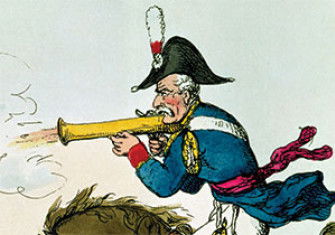
First step on the road to Waterloo
Marisa Linton explains how Jacques-Pierre Brissot helped to initiate the French revolutionary wars, as he and Robespierre debated whether conflict with Austria should be a ‘crusade for universal liberty’.

There will be many occasions in 2015 to recall the conflict that culminated in the Battle of Waterloo, but it is equally worth remembering how that conflict originated. Waterloo was the final step in a war that dragged on almost continually for more than 23 years and whose origins lay in the turbulent politics of the French Revolution. One man played a key role in unleashing that war: the revolutionary leader, Jacques-Pierre Brissot. Few people now know much about Brissot; there has been no full-length biography of him since that by the US historian, Eloise Ellery, a century ago. When Brissot is remembered it is either as a struggling pre-revolutionary political thinker and writer, or as the leader of the ‘moderate’ Girondin faction that perished under the Terror in October 1793. Brissot’s apologists state that his nemesis was Maximilien Robespierre. Like many historical narratives, accounts of Brissot as the ‘moderate’ victim of a ‘bloodthirsty’ Robespierre have been simplified: the reality was more complex. Between the winter of 1791 and spring 1792 these two men were locked in a war of words over whether France should go to war with its neighbours. The parts that both men played in this debate were very different from the choices they made once the war had begun.

The downward spiral that led to war began when many French nobles, opposed to the Revolution of 1789, emigrated beyond France’s borders. The émigrés, as they became known, put pressure on Austria and other leading powers to make war on France and restore the old regime by force of arms. In June 1791 Louis XVI and Marie-Antoinette attempted to become émigrés themselves, when they fled towards the Austrian border in what became known as the Flight to Varennes. Though they were intercepted and brought back to Paris, for many revolutionaries the king’s action was a rejection of the constitutional monarchy established in 1789 and a betrayal of his people. Suspicion about the loyalty of the king and his Austrian queen overshadowed the new Legislative Assembly that met in October 1791.
It was as a speaker in that Assembly that Brissot emerged to national prominence. Before the Revolution Brissot had pursued a varied career as a pamphleteer and man of letters on the fringes of the elite milieu of the Enlightenment salons. He had spent time in the notorious Bastille prison, accused, probably on false charges, of having written and circulated libellous pamphlets against Marie-Antoinette. He had a cosmopolitan outlook, had spent years living in London, campaigned against slavery and was a founder of the Society of the Friends of the Blacks. Inspired by the ideals of the American Revolution, he visited America and planned to live there. The Revolution in France changed his mind; now his own country was transformed into a world of new possibilities. He seized with both hands the opportunities that opened up before him. He was elected to the Paris municipality and started an influential paper, Le Patriote français. He became a member of the Jacobin Club, where revolutionaries gathered to debate politics, devise strategies and form networks. Here he befriended some of the leading radicals, including Robespierre, who was, like Brissot, a democrat and opponent of slavery, and Camille Desmoulins, a talented but volatile journalist. These men formed part of a network drawn together by political sympathies and reinforced by ties of friendship. When Desmoulins married in December 1790, he invited many of these Jacobins to the festivities and Robespierre and Brissot were his official witnesses.

Brissot lacked presence as an orator, but he was energetic and excelled at bringing people together. In the Assembly he surrounded himself with a group of ambitious, like-minded friends, including Vergniaud, Guadet and Gensonné, deputies from the Gironde region, who became known as the Girondins. Friends of Brissot outside the Assembly included the political couple, Monsieur and Madame Roland, and the Genevan financier, Clavière. Madame Roland was clever, articulate and opinionated. Her memoirs give a vivid, if partisan, picture of her political salon, which became a regular meeting place for Brissot’s group. The Genevan radical, Étienne Dumont, another member of their circle, was a more dispassionate observer. The Girondins were not an organised party, said Dumont; there was ‘more chatter and party gossip’ than clear strategy. What united them was their keen support for the war and their friendship with Brissot: ‘Brissot became the doer. His activity sufficed for all.’
***
From the first weeks of the Legislative Assembly the atmosphere was overshadowed by fears of an invasion by a coalition of foreign powers led by Austria and Prussia. In August 1791 the Austrian emperor, Leopold II, issued the Declaration of Pillnitz, threatening to intervene militarily in France, if the royal family was endangered. Pillnitz was a bluff to appease the émigrés; though the foreign powers disliked and feared the Revolution, there was little unity among them and small appetite for a war. Even though Marie-Antoinette was his sister, Leopold was unwilling to wage war on behalf of the French monarchy. Yet Austria’s aggressive rhetoric had a disastrous effect, for it gave credibility to the argument that France should pre-empt attack.
Over the winter Brissot and his faction spearheaded the drive for war both in the Assembly and the Jacobin Club. In the Club their principal opponent was Robespierre. In a succession of speeches Robespierre and Brissot confronted one another. Brissot explained his strategy: his plan was to destabilise the political situation, forcing the French monarchy to take sides. Either Louis XVI would capitulate and accept the new revolutionary regime, or he would emerge as its open enemy, at which point both the monarchy and the constitution could be brought down in a renewal of revolution. Brissot hoped that the king would turn traitor: ‘I have only one fear, that we shall not be betrayed. We need great treasons, our safety lies there, because there are still great doses of poison within the heart of France and violent explosions are needed to expel them.’ It was a high-risk strategy, one that depended on the assumption that the war would end quickly with France victorious.
Brissot could not see that war might unleash terror. Rather, he claimed that war would end terror and extolled its beneficial effects:
This war is necessary to France for her honour … to put an end to terrors, to treasons, to anarchy … This war would be a real benefit, a national benefit, and the only calamity that France has to dread, is not to have war.
Robespierre had a more realistic – and grimly prophetic – grasp of the relationship between war and terror. He warned of the dangers of escalation and the loss of life that would result: ‘A war gives rise to terrors, to dangers, to plots, to reciprocal struggles, to treason, finally to casualties.’ In two key speeches, on January 2nd and 11th, Robespierre developed his reasons for opposing the war. He was not a pacifist, was not opposed to war on principle and shared the anxiety regarding the monarchy’s secret intentions. But he was appalled at the idea of endangering the Revolution on the unpredictable consequences of a war. He warned that the French armies were in disarray and in no condition to fight and that the loyalty of their officers (many of whom came from the former nobility) was doubtful. Brissot’s strategy would put France – and the Revolution – at the mercy of the military elite.
Brissot spoke of war as a ‘crusade for universal liberty’, a means both of purging the nation and of exporting the Revolution to other countries. He claimed that the revolutionary armies would be welcomed with open arms by benighted peoples, grateful for the introduction of French ‘liberty’. Robespierre’s more realistic judgement was that ‘no one welcomes armed missionaries’. He opposed the expansionist side of Brissot’s military plans, thinking that the need was to secure the Revolution within France, without seeking to export it abroad.
Robespierre found some sympathetic hearers, especially among the women in the audience. Desmoulins described to his father the scenes in the Jacobins when Robespierre addressed them on January 2nd: ‘You could not imagine with what abandon, with what truth he threw himself into his argument. He reduced the audience to tears, not just the women on the benches, but half the members of the assembly.’ Yet Robespierre’s warnings of impending doom had less appeal for many spectators than the dashing defiance of Brissot’s group. For all the logic of Robespierre’s cautious rationale, he was outplayed by Brissot’s recourse to the patriotism card.
***
Brissot invoked the spectre of conspiracy as a principal justification for war. All the revolutionaries were haunted by fear of conspiracies. An ‘Austrian Committee’ was said to be nestling at the heart of the French state and there were rumours that Marie-Antoinette, dressed as a man, crept out from the palace at night to deliver her instructions to the Austrian Committee in the shadows of the Bois de Boulogne. Though the stories of midnight rendezvous were far-fetched, there was some substance to these fears. Louis XVI, overwhelmed and depressed, was relying on his wife to make political decisions and Marie-Antoinette was playing a double game. In private correspondence to her allies the queen rejoiced in the short-sightedness of the war policy, anticipating that if France went to war it would result in military defeat and lead to a restoration of the old regime by force: ‘The imbeciles!’, she wrote. ‘They cannot see that this will serve us well, for … if we begin it, all the powers will become involved.’
Brissot failed to appreciate that the queen viewed his tactics as strengthening her hand. He asserted that the monarchy did not want war. Madame Roland cautioned that the court was making fools of them – but her warning fell on deaf ears. In her memoirs she admitted that she had come to appreciate that Brissot was a political lightweight.
During the early stages of the debates between Brissot and Robespierre their relations continued to be courteous, if not warm, but matters took a downturn at the end of December, when Brissot called Robespierre’s motives into question, saying that he was being divisive and should ‘submit to the law’. Brissot depicted himself, by contrast, as a man of good faith and probity. On January 20th he stated: ‘If I am deceived on the necessity for war at least it is in accordance with my conscience.’ This was making a case for war based on Brissot’s own integrity. Robespierre took offence at the insinuation that he himself was not committed to the public good and the conflict between the two men became increasingly personal.
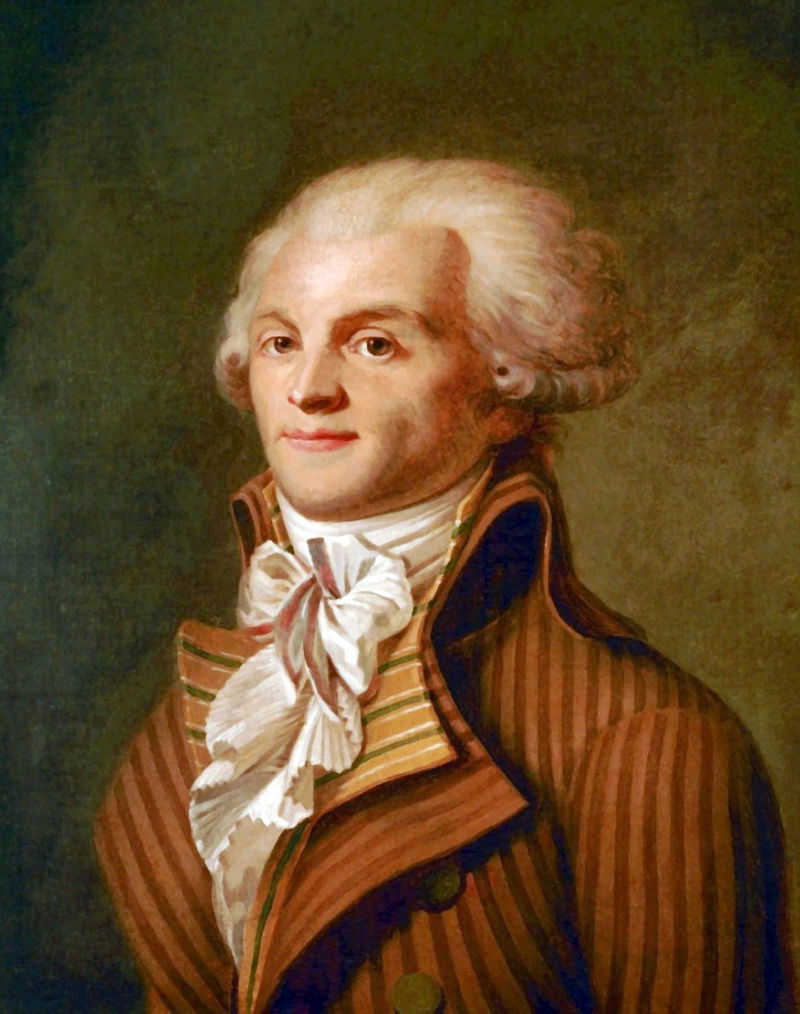
The debate spilled over into the pages of the revolutionary press. Brissot’s group controlled a number of newspapers, as well as the Corresponding Committee of the Jacobin Club, which handled communications with provincial Jacobins. Brissot’s faction turned Robespierre’s argument, that the French armies were unprepared to fight, against him, intimating that he was no patriot. One of Brissot’s supporters, Louvet, denounced Robespierre on the floor of the Jacobins, saying that his opposition to war cloaked his political ambition to achieve personal power: ‘You despair of the patrie, your doubts insult the nation … You are almost alone, and almost alone … you still hold in suspense the opinion of a great number of the people.’ As Brissot’s group became ever more dominant in the Jacobins, they tried to block Robespierre from speaking at all and he became an embattled and marginalised figure.
Robespierre’s remaining supporters retaliated in kind. The journalist, Jean-Paul Marat, another former friend of Brissot, now bitterly opposed to him, regularly attacked Brissot in his populist newspaper, L’Ami du peuple, claiming that Brissot’s group was out for itself. Robespierre himself set up a new newspaper, Le Défenseur de la Constitution, partly to publicise his case against Brissot. But the most comprehensive attack appeared in February, with Brissot Unmasked, a pamphlet by Desmoulins, who used his insider’s knowledge to mount a wickedly humorous discrediting of his former friend. Desmoulins claimed that Brissot was ready to sell himself to the highest bidder and to undermine the Revolution from within. Desmoulins satirised Brissot’s penchant for dressing like an ‘American Quaker’, with his flat hair and round head, and compared him with the religious hypocrite, Tartuffe. Desmoulins repeated an allegation that, even before the Revolution, Brissot’s bad faith had been evident through his taking bribes to act as a spy for the police chief, Lenoir. Even Brissot’s republicanism was used against him: wiser heads than his – including Robespierre – thought that a republic was not appropriate for France and would only endanger the Revolution and precipitate conflict. The pamphlet injured Brissot’s reputation with radical Jacobins and militants on the streets of Paris, but his star was still in the ascendant at the Legislative Assembly, where the popular mood was to defy the foreign powers.
The heady atmosphere in the Assembly intensified on January 14th, when Gensonné declared to an enthusiastic audience that anyone who sought reconciliation with Austria by means of a diplomatic concert was guilty of ‘treason against the nation’: such a crime warranted the death penalty. Deputies, ministers, ushers, spectators (including women) all rose to swear an oath to maintain the constitution, amid cries of: ‘Live free or die.’ A new kind of revolution was born, one in which opponents were cast as traitors, ‘the enemy within’.
***
On March 10th Brissot denounced Delessart, the Minister for Foreign Affairs, in the Assembly, accusing him of treason. Brissot admitted that he lacked substantive proof for this accusation, but maintained that ‘moral proofs’ were sufficient. One of the minister’s offences had been to write to Leopold saying that France wanted peace in a way that Brissot maintained was humiliating: ‘This thirst for peace is dishonouring for a nation that has been outraged, insulted by a prince who raises all the powers against her.’ Brissot intimated that Delessart was part of the alleged Austrian conspiracy. Vergniaud followed Brissot and reinforced his message: to repeated applause he indicated the royal palace, whose windows were visible from the tribune, and issued an ominous warning:
Let everyone who lives there know that we accord inviolability only to the king. Let them know that the law will fall without distinction on all the guilty, and that there will not be a single head, convicted of being criminal, which can escape its blade.
Brissot and Clavière prepared the formal act of accusation against Delessart. According to Dumont, he strongly disapproved of this document and told Brissot to his face that it consisted of vague, unsubstantiated and insidious allegations, designed to whip up hatred and prejudice against the disgraced minister. To Dumont’s horror, Brissot laughed mockingly: ‘It’s a party tactic’, he said. He explained to Dumont that such fabrications were necessary to outflank Robespierre’s Jacobins, who wanted peace, and to prevent the king recalling Delessart, whom Brissot assumed would eventually be found not guilty. From that moment Dumont said that he ‘no longer saw Brissot with the same eyes’. Dumont later wrote a damning account of Brissot’s motives and what he had become:
Brissot was faithful to his party and faithless to probity. He manoeuvred through a kind of enthusiasm to which he was ready to sacrifice himself; and, because he felt in himself neither the desire for money nor ambition for place, he believed himself to be a pure and virtuous citizen … He did not see that zeal for his party, love of power, hatred, and self-love are corrupters as dangerous as the thirst for gold, ministerial ambition and the taste for pleasures.
Delessart was sent for judgement on the basis of Brissot’s indictment. He was subsequently murdered during the September Massacres, when groups of militants, fearful that invading armies were about to overrun Paris, killed ‘counter-revolutionary’ prisoners in Paris and Versailles.
Brissot reaped the rewards of his strategy by gaining the decisive voice in the formation of the new ministry to succeed that of Delessart. This became known as the ‘patriot’ or Girondin ministry. As a deputy, Brissot himself was barred from ministerial office, but his friends took key positions. Clavière was elevated to Minister of Finance, while Roland became Minister of the Interior. Servan, a favourite with Madame Roland, became Minister of War. The key appointment of Minister of Foreign Affairs went to Dumouriez, a close friend of Gensonné. Dumouriez’s alliance with Brissot’s group was tactical, rather than ideological: his interest lay in furthering his own military and political career. The Girondin ministry offered confirmation that Brissot and his friends were motivated by personal ambition and began the process that saw them move into the moderate camp, leaving the remaining Jacobins to lead the radical wing of the Revolution.
Leopold died in March and was succeeded by Francis II, who was only 24, more bellicose and less cautious than his father. The ascendancy of Brissot’s faction intensified the pressure for an immediate declaration of war. In the Assembly the leadership provided by this group influenced waverers and the risks involved in standing out against a tide of militarist rhetoric and in being identified as ‘unpatriotic’ brought almost all the rest on board. On April 20th, 1792 the 768 deputies of the Legislative Assembly voted overwhelmingly for France to declare war on Austria: only seven men resisted the pressure of their peers and voted against.
As Brissot anticipated, the declaration of war led to a second revolution and the overthrow of the monarchy in France, but the fallout from these events went far beyond anything he had anticipated. Contrary to his expectations, France did not win the war in a matter of months. The conflict went badly and invading armies were soon threatening Paris. Popular fear and anger over the volatile situation led to renewed crisis.
Brissot, Madame Roland and their friends would be among the first victims of the legalised terror which was adopted by the Jacobins, largely in response to the war. When the war went badly, people looked to blame the Girondins, seeing them, not as irresponsible and incapable but, using the language of terror which the Girondins had done much to initiate, as the treacherous ‘enemy within’. The turning point came in March 1793 when Dumouriez, who was by then entrusted with the generalship of the revolutionary army, lost the Battle of Neerwinden. He responded by trying to lead the soldiers to overthrow revolutionary government, before defecting to the émigrés. The Girondins had continued up to the last moment to give Dumouriez their trust and support and their association with him helped to condemn them.

Brissot has long been associated with political moderation. Yet, in the spring of 1792, buoyed up by his own conviction that he was right, he represented extremism versus Robespierre’s voice of caution. It may well be that Brissot believed his own rhetoric and thought that the French army would be welcomed abroad as ‘armed liberators’. But by choosing war, Brissot and the Girondins – whether they understood the risks or not – were taking a path towards internal terror.
Ironically, it was Robespierre, who had opposed war, who took on political leadership at the height of the conflict as a member of the Committee of Public Safety to defend the embattled Republic. Like Brissot, Robespierre would become a victim of the Terror that war unleashed. The total number of casualties of the revolutionary and Napoleonic wars, military and civilian, French and non-French, amounted to several million, far more than died in the Terror, even if we take into account the civil war in the Vendée – which itself broke out as a rejection of mass conscription to fight in the revolutionary wars. Brissot envisaged none of that, nor could he be expected to. Yet for his recklessness in helping to precipitate a ‘crusade for liberty’, he bears a share of responsibility for the outbreak of a conflict that brought grief, misery and death to a generation of people in France and beyond.
Marisa Linton is Reader in History at Kingston University.