The Fall of Isfahan
In March 1722 rebellious Afghan forces laid siege to the Safavid capital. Was the great Iranian empire on the brink of collapse?
In March 1722 rebellious Afghan forces laid siege to the Safavid capital. Was the great Iranian empire on the brink of collapse?
In March 1722 rebellious Afghan forces laid siege to the Safavid capital. Was the great Iranian empire on the brink of collapse?
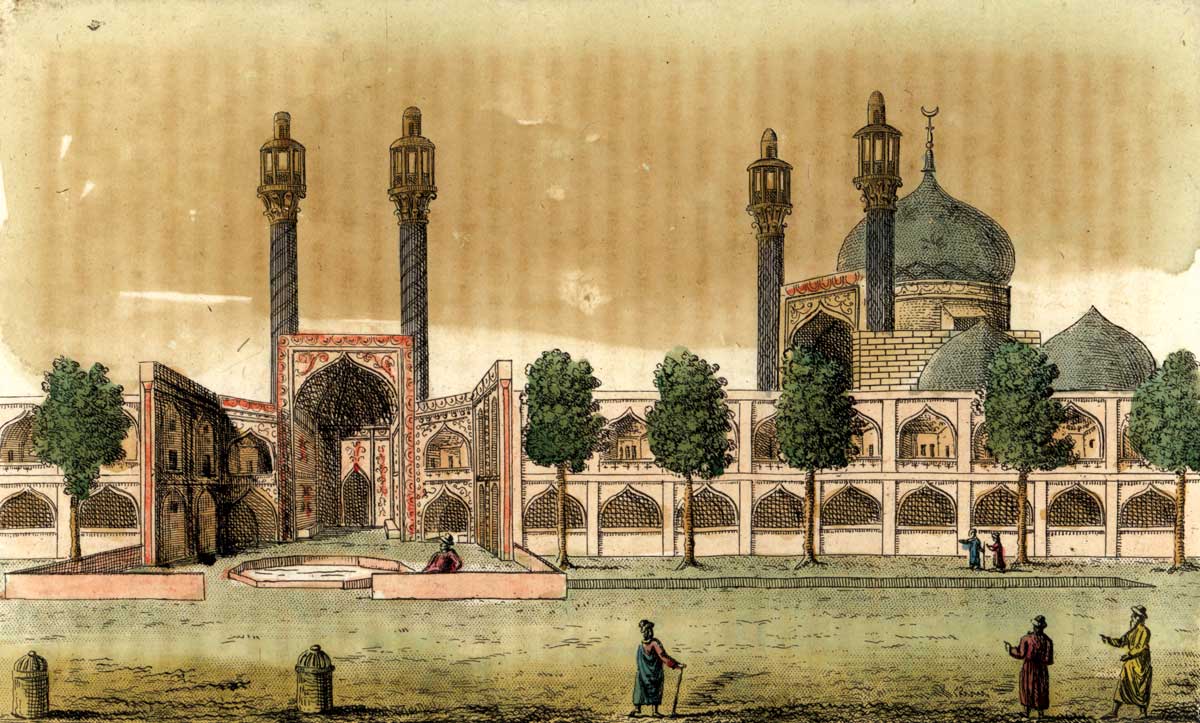
On 23 October 1722, following a six-month siege of Isfahan and devastating famine, Shah Sultan Hussein, the hapless Safavid monarch, took leave of his subjects and proceeded towards the camp of his tormentor, Mahmoud. The Afghan rebel who had managed – beyond all expectations – to bring the Safavid empire to its knees was suitably contemptuous of his royal guest, forcing him to stop some way from his encampment on the pretext that he had yet to rise from his bed. When he finally condescended to greet Shah Sultan Hussein it was to acknowledge not only the transfer of power, but the transfer of authority. Having abdicated his throne, Shah Sultan Hussein had come to convey the throne to his ‘successor’: ‘Son, since the great Sovereign of the Universe does not will that I should reign any longer, and the moment has come which he has appointed for thy ascending to the throne of Persia, I resign my empire to thee. May thy reign be prosperous!’
He then took the ceremonial plume of feathers from his turban – the signifier of royalty – and handed it to his vizier to pass onto Mahmoud, who refused to accept it from anyone other than the monarch himself. Sultan Hussein retrieved the plume and set it upon the seated Mahmoud, who, after refreshments had been served, reflected ‘on the instability of human grandeur’, adding that, ‘God disposes of empires as he pleases: he takes them from one to give to another’. Sultan Hussein’s humiliation was complete. Led off into captivity, Mahmoud assured him he would treat him as a father and seek his advice, for he had not come to bury the Persian empire but to inherit it.
Sultan Hussein had acceded to the throne in 1694 on the death of his father Soleiman I, whose reign, according to European observers at least, had become a byword for decadence. Soleiman had famously told his courtiers on his deathbed, ‘If you desire ease, elevate Hussein Meerza. If the glory of your country be our wish, place Abbas Meerza on the throne’. Under Soleiman, the peripatetic monarchy of the Safavids had settled into a sedentary existence with the shah rarely leaving his palace, let alone Isfahan itself. A notorious bon viveur, Soleiman was fortunate not to be confronted with any serious political challenges, so that his inactivity was regarded by many around the court as a virtue. Yet, while his careful avoidance of conflict, not least with his Ottoman rivals, ensured a lengthy period of peace, it also brought complacency. His judgement on his death bed was, therefore, prescient.
The household – or harem – which had expanded substantially over the years had grown used to the inactivity. The eunuchs, in alliance with some of the key women of the household, notably the new king’s maternal grand-aunt Maryam Begum, decided on Sultan Hussein. He had begun life showing the same attitude as his father towards the strictures of religion, but soon found himself persuaded that the problems which beset the kingdom could only be reversed by a ‘return’ to strict moral and religious values.
The Safavids had originated as a Shia millenarian movement but had long since set aside their zeal for more traditional Persian kingship. Under Sultan Hussein much of the religious cosmopolitanism that had come to characterise the Safavid court was curtailed. Alcohol was banned, Hindus were expelled from Isfahan and the rules against ‘peoples’ of the Book more rigorously enforced. The shah meanwhile resorted to prayer, as centrifugal forces that tended to emerge with the assumption of a new reign arose to test the mettle of the new king. In this case the inattentiveness of his father, along with his own indecisiveness, ensured that the problems became more severe.

In 1701, the most serious challenge by far emerged from one of the ‘Sunni’ margins of the empire in Kandahar. The local population rebelled under their leader Mir Vais and refused to pay the tribute due to the crown. Shah Sultan Hussein resorted to sending Gorgin Khan, a Georgian prince and one of his more colourful and intrepid officials, to quell the uprising. Gorgin Khan enjoyed what might best be described as a disputatious relationship with the court (his recent conversion to Islam had earned him some royal approval), but he appeared to be someone with the requisite military skills to get the job done. He had first been appointed governor of Kerman, where he had successfully suppressed Baluchi incursions. Having achieved this, he was then dispatched as governor of Kandahar, where he swiftly brought the rebellion to heel, constraining any possibility that they might turn to the Mughals for support.
Despite being described in John Malcolm’s The History of Persia (1815) as ‘one of the ablest and bravest military leaders in Persia’, Gorgin Khan proceeded to antagonise his new subjects, whose repeated attempts to alert the shah of their woes fell on deaf ears. Gorgin Khan then arrested their erstwhile leader, Mir Vais, and sent him as a prisoner to Isfahan. This decision would prove fatal. Far from languishing in incarceration, Mir Vais soon became intimate with the sheer ineptitude of the court and the gullibility of the shah, whose favourite he quickly became. Thus positioned, he swiftly poisoned the king’s mind against his Georgian vassal and persuaded him to allow him to return to Kandahar.
Gorgin Khan was not pleased with the return of Mir Vais but a cautious truce developed between the rivals, which swiftly ended when Gorgin Khan took an apparent fancy to Mir Vais’ daughter and demanded that she be brought to him in ‘an opportunity at once favourable to gratify his passion, and to humble a proud enemy’. As British political officers were to discover a century later, such interests were prone to igniting dangerous indignation among the Afghans. Mir Vais was no exception. Reportedly sending an imposter in place of his daughter, Mir Vais succeeded in lulling Gorgin Khan into a false sense of security. Several months later he invited him to feast at his house. There, Mir Vais struck, murdering his guest and triggering a massacre of the unwary troops. So it was that in 1709 Safavid control of Kandahar was abruptly terminated. Mir Vais now determined to make this state of affairs permanent by turning a ‘tax’ protest into a fully fledged jihad against his Shia masters.
Shah Sultan Hussein’s immediate response was to seek diplomatic solutions, but these were swiftly – and in one case, humiliatingly – dismissed as the hapless Persian ambassador was flung into jail. There followed a succession of military missions to bring the recalcitrant Mir Vais to heel, one of which might have succeeded but for the want of supplies.

Then in 1715 Mir Vais died. One of his sons, Mahmoud, however, was determined to fulfil his father’s ambition. By 1719, with problems besetting the Safavid state from all sides, Mahmoud decided to launch an invasion of the heartlands by marching a rumoured force of some 2,000 warriors towards Kerman. That such a modest force should have elicited panic in court circles was indicative of the feeble state of affairs. In the event most of the citizens of Kerman along with its soldiers fled, leaving Mahmoud to occupy the city by the end of the year, plundering much of the environs before departing to quell a revolt in Kandahar early in 1720. Once again the relief force sent for the defence of Kerman was starved of resources as the result of court intrigue. Nonetheless, Mahmoud’s withdrawal offered some respite and the hope that his invasion was only a raid.
Unfortunately for the Safavids, Mahmoud returned later that year, proceeding against both Kerman and Yazd. Finding in both cases that he was unable to breach the fortifications, he accepted payment to circumvent these cities and moved towards the capital Isfahan. His army had grown to 20,000, but was composed in the main of light troops with little capacity for siege warfare. Yet the mood in Isfahan was chaotic with indecision and intrigue competing with fatalism and superstition. Shah Sultan Hussein, the lynchpin of the state, had squandered his power and dissipated what authority he had left. Wiser counsel urged the shah to sit out the Afghan threat behind his walls. Without siege equipment they would soon have to leave. Others, however, protested that it was beneath the dignity of the monarch not to take the fight ‘to a few despicable Afghans’.
An army of 40,000 was mustered to intercept Mahmoud some 20km outside Isfahan at the town of Gulnabad, where, despite superior odds and equipment, it met with a resounding defeat. Yet, as the historian Rudi Matthee notes: ‘Lack of unity and coordination rather than military weakness per se accounted for the Iranian defeat.’ This was a political not a military failure. Rivalries among the commanders, caused and compounded by the collapse in Shah Sultan Hussein’s authority, resulted in a defeat that simply reinforced and accelerated the sense of foreboding. In March 1722 Mahmoud invested the suburbs of the capital, repulsed a succession of relief forces and settled down to starve the city. Six months later, after a terrible famine in which the city’s population resorted to cannibalism, Shah Sultan Hussein left his capital to transfer the royal authority to the Afghan usurper, who, like most observers, could not quite believe what was happening.
Mahoud’s victory was made possible by the fact that most people considered it unthinkable. Astonished European observers were moved to write about the dramatic nature of the ‘revolutions’ in Persia, one, an Isacus Isacsson, even producing what might be considered the first European dissertation on Persia. Russia and the Ottoman Empire promptly took advantage of the situation. Although Europeans were quick to see in the collapse of the dynasty the hallmarks of ‘oriental’ decadence and decline, projecting this back to lend it an increasing air of inevitability, the truth was that the Safavid ‘state’ was to prove remarkably resilient. Within three years Mahmoud was dead (murdered by his own cousin), the charisma of Safavid kingship rebounded on the back of rapacious Afghan rule and Sultan Hussein’s son claimed the throne as Tahmasp II, relocating to Tabriz and securing the services of one Nader Afshar. By 1730, the Afghan interlude was at an end and a new imperial polity was taking shape under the shadow of a dynasty whose ignominious end belied its enduring influence. But that, as they say, is another story.
Ali Ansari is Professor of History at the University of St Andrews.