Care in the Community
Though often constrained by limited medical knowledge, 18th-century communities offered practical and emotional support to those experiencing mental distress.
Though often constrained by limited medical knowledge, 18th-century communities offered practical and emotional support to those experiencing mental distress.
Though often constrained by limited medical knowledge, 18th-century communities offered practical and emotional support to those experiencing mental distress.
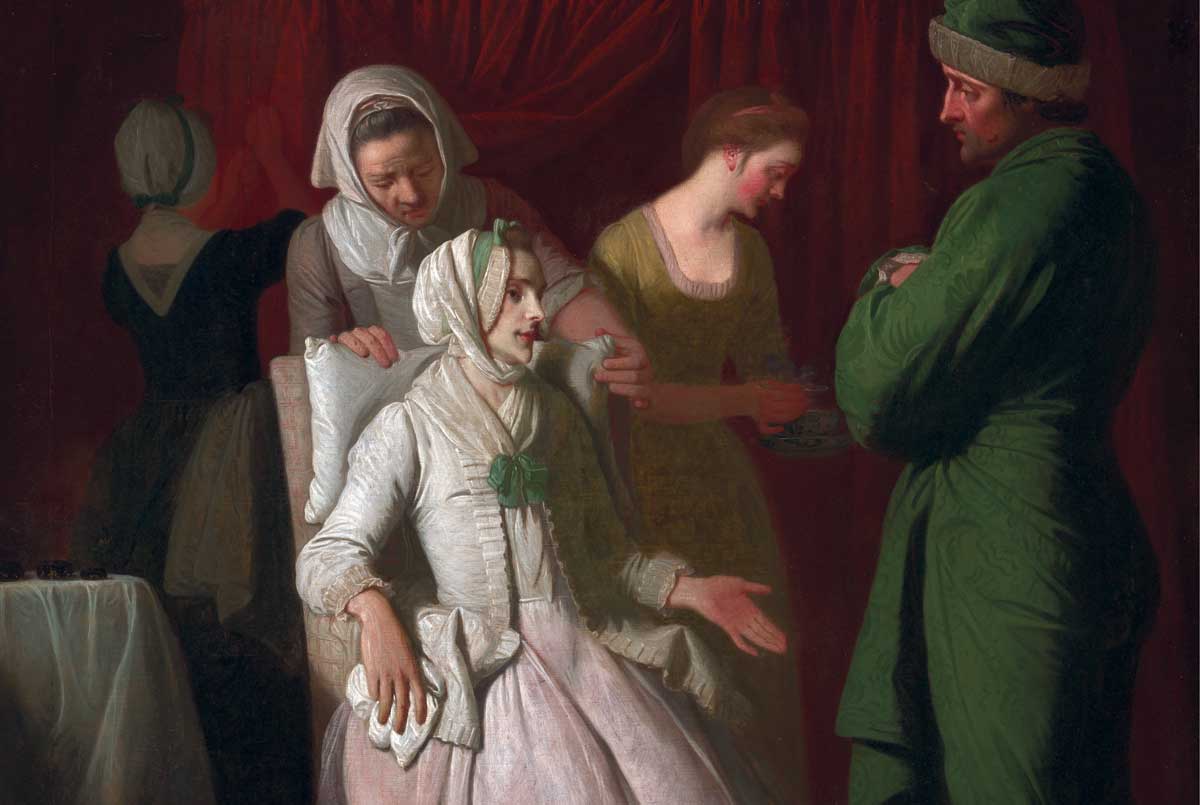
In 1806, John Edward Maddocks seemed agitated and distressed. To everyone’s confusion, he was paranoid that the Bow Street Runners, an early incarnation of the London police, were trying to find him. His close friend, Richard Daleton, was concerned. He encouraged Maddocks to take a ride in his coach with him to ‘divert’ his mind and inspire pleasant thoughts. Later that day, Maddocks’ brother also tried to help. Finding Maddocks alone, he persuaded him to come to his room to enjoy some cheering conversation with himself and another friend. Maddocks sat with them, but only for a moment, before rushing away. Shortly after, to the shock and anguish of his friends, Maddocks killed himself.
In their testimonies, delivered at the inquest into Maddocks’ death, his friends and family can be seen trying to care for a man in deep distress: restless, paranoid and suicidal. Maddocks lived at a time when so-called ‘self-murder’ was illegal and when suicidal feelings could be deeply taboo. Mental health was poorly understood and ‘mad-doctors’ often prescribed treatments that would today be deemed inhumane. The popular image of mental health care in 18th- and 19th-century England is one of patients incarcerated in ‘madhouses’ and lunatic asylums. But the vast majority of those suffering from mental illness – ranging from milder forms of melancholy to so called ‘manic’ or ‘raving madness’ – lived in the community. Though cruelty and mistreatment sometimes occurred, sufferers were thus fully embedded in their neighbourhoods and interacted daily with friends, family and colleagues who would often try to care for them. Maddocks, who lived among well-wishers who attempted to lift his spirits, was not an unusual case. By using fewer institutional sources, and swapping asylum casebooks for coroners’ inquests and letters, we can gain a far better sense of this community care.
For many, spiritual succour was the first form of support they could offer to those suffering from mental ill-health. These efforts did not always prove helpful and they demonstrate an ambivalent mix of love and discomfort. In 1793 young Dinah Harryman, living in the Cumbrian village of Portinscale, was suffering from severe melancholy. Harryman approached her aunt, hoping that she might be able to help ‘have her mind eased’. Her aunt, an extremely religious woman, replied that Harryman must ‘take God in her mind and apply to him and God would help her through her Troubles’. She added that she, a mortal creature, ‘co’d do no more for her, for [applying to God] was the only way to her mind eased’. At the inquest into Harryman’s subsequent suicide her aunt explained her response with confidence: she had thought her reply would be helpful. Her niece probably felt differently. She had ‘made no Reply’ to her aunt and silently headed home.
However, even if people’s support was not helpful nor well received, it often came from a sincere belief that spiritual advice or actions would bring comfort and relief. Long before his suicide in 1734, Abraham Banks had fallen into a great melancholy. Jennet Millfell, his elderly neighbour, was concerned. She regularly went to his house, ‘in order to read to him out of the Holy Scriptures & other good books & to sing Psalms & pray to him, to try if she c’d by that means drive off his Melancholy humour & thoughts’. It is very possible that Banks found some comfort in Millfell’s efforts, as he accepted her visits for a long time.
Sometimes, friends and neighbours offered spiritual support for those troubled by religious concerns; they tailored their responses to people’s specific anxieties. In 1849 Edward Hayman, a student at Cambridge, was suffering from so-called ‘religious melancholy’, a mixture of despondency and anxiousness that arose from fears that God had abandoned the sufferer, or that they had committed great sins. At first, Hayman’s university friends were puzzled by his melancholy and failed to offer much help. Greatly distressed, Hayman explained to his close confidant, Joseph Luxion, that he was ‘guilty of gluttony’, which he believed was a terrible sin. At first, Luxion ‘laughed at him aloud’ – he found Hayman’s consternation absurd. But Hayman told his friend that ‘he wanted to be comforted, not to be laughed at’ and Luxion quickly changed his behaviour. He sat up with Hayman for much of the night, trying to explain that gluttony was not a serious offence. He also ‘read some of the church prayers to him’ to calm him. A few days later Hayman complained of the same feelings and Luxion responded with sympathy. He ‘again read the psalms’ and tried gently to persuade Hayman that he had done nothing wrong and that God loved him. When he appreciated the gravity of his friend’s distress, Luxion swapped his surprised laughter for compassion and prayers.
Support for those suffering from poor mental health could be practical as well as spiritual. In 1808, John Place was suffering from melancholy and anxiousness. One night, feeling lonely and fearful, he walked over to the house of George Gillon, his neighbour. As Gillon later explained, Place ‘requested me to go with him to his house to sit up with [him]’. Gillon followed Place home with a candle and accompanied him up to his room, where he fetched some food, ‘shook up his pillow and tucked in his bed cloathes’ and helped Place into bed, trying to reassure and calm him. Gillon left late to return home and came back the next morning at 6am to ask if Place needed anything else. Such a response was common: witnesses often reported that suicidal people had asked for others to ‘sit up’ with them at night when they felt fearful or anxious. Inquest records show that anyone – from close family members to acquaintances at the same inn – might comply with these requests, with virtual strangers sometimes disrupting their own sleep and comfort to watch over an anguished soul.

Sometimes people offered more continuous help. William Lake had been a revenue officer but was addicted to alcohol and dismissed for ‘intoxication’, leaving him with no money and nowhere to live. His brother, John, recognising that William was not ‘of sound mind’, took his sibling to live with him in his house and ‘supplied him with money’ for food and clothes. When William killed himself in February 1816, he had been living with his brother for eight months. Testifying at William’s inquest, John expressed some frustration at the arrangement – it had gone on for ‘a considerable time’ and at considerable expense – but, despite his mixed feelings, John had ensured that his brother was cared for in his home and had not been reduced to living in the workhouse or a ‘madhouse’.
Some people, particularly women, offered long-term support by moving in with those for whom they cared. In inquests and letters, there are multiple examples of women moving into the houses of parents, aunts, cousins and even neighbours, in order to cook and clean for people suffering through months, or sometimes years, of mental ill-health.
In addition to such practical support, some of the most pre-eminent medical writers of the day stressed the importance of uplifting conversation and ‘diverting’ amusements. In The English Malady (1733), Dr George Cheyne wrote that melancholic or anxious people could ‘divert’ their minds with ‘Works of Imagination’ and ‘rous[e] Nature by agreeable Company and good Cheer’. He stressed that they should always ‘have some innocent entertaining Amusement to employ themselves in’ and should aim to cheer themselves with ‘easy and agreeable’ conversation.

People experiencing mental distress sometimes knew that they needed the presence and conversation of friends, and tried to reach out to those around them. In 1811, William Platt was extremely melancholy. He wrote to his friend John Read that ‘I have been in a state of despondency of Mind not to be described … I can neither eat or sleep – pray come to me and comfort your afflicted Friend’. Read hurried to Platt’s house and tried to settle his spirits with friendly conversation. Platt appreciated his attentiveness and was comforted, at least momentarily, by the company of his friend. Similarly, in 1831 Arthur Browne, a student at Cambridge, was suffering from severe melancholy. His college chaplain, the Reverend Charles Allfice, reported that Browne told him that ‘he was unwell and much depressed in spirits for last week he had been attending the funeral of his father’. A few days later, Browne came to Allfice’s rooms. He explained that it was ‘painful’ that he had to come back to Cambridge while he was feeling so miserable. Allfice noticed that Browne ‘seemed to linger a good deal’ in his rooms and realised that he was in need of company; while Browne was not as specific as Platt in asking for help, he indicated that he needed a friend. Allfice talked to Browne at length about ‘books’ and offered to lend him whatever ones he fancied. Believing that sorrow could best be alleviated by diverting the mind, people often turned to books, poetry and music to distract friends from their sadness.
Inevitably, such attempts were not always effective. Before her suicide in 1772, Sarah Reeve’s neighbour, Elizabeth Chubb, explained that Reeve had been ‘delirious’. Chubb tried to ‘read books to her’, but Reeve ‘has got away from her and has said she believed the Devil had got the upper hand of her’. Clearly, diverting forays into literature provided little assistance for Reeve, who was experiencing paranoia and delusions. Equally, people were not always able to offer conversation that was consoling or diverting and their attempts at support could be clumsy or awkward. In Bath in 1824, John Barnes was suffering from severe melancholy. His friend, John Witton, ‘endeavoured to cheer up his spirits’ by ‘begg[ing] him not to be so depressed’ and telling him to be hopeful. Unsurprisingly, such efforts were not particularly helpful to those in severe distress, who could not merely turn off their melancholy.
Regardless of whether they were successful, these attempts attest to the efforts of hundreds of ordinary people who endeavoured to understand and provide comfort to those experiencing mental health difficulties. The help they could provide was constrained by limited knowledge of, and resources for, treating mental illnesses. While their attempts may not have always worked, they bear witness to everyday instances of sympathy and affection as communities tried to alleviate the mental suffering of the people they lived with. In the reading of a psalm or the cooking of a meal was a deceptively simple attempt at human understanding.
Ella Sbaraini is a junior research fellow at St John’s College, Cambridge.