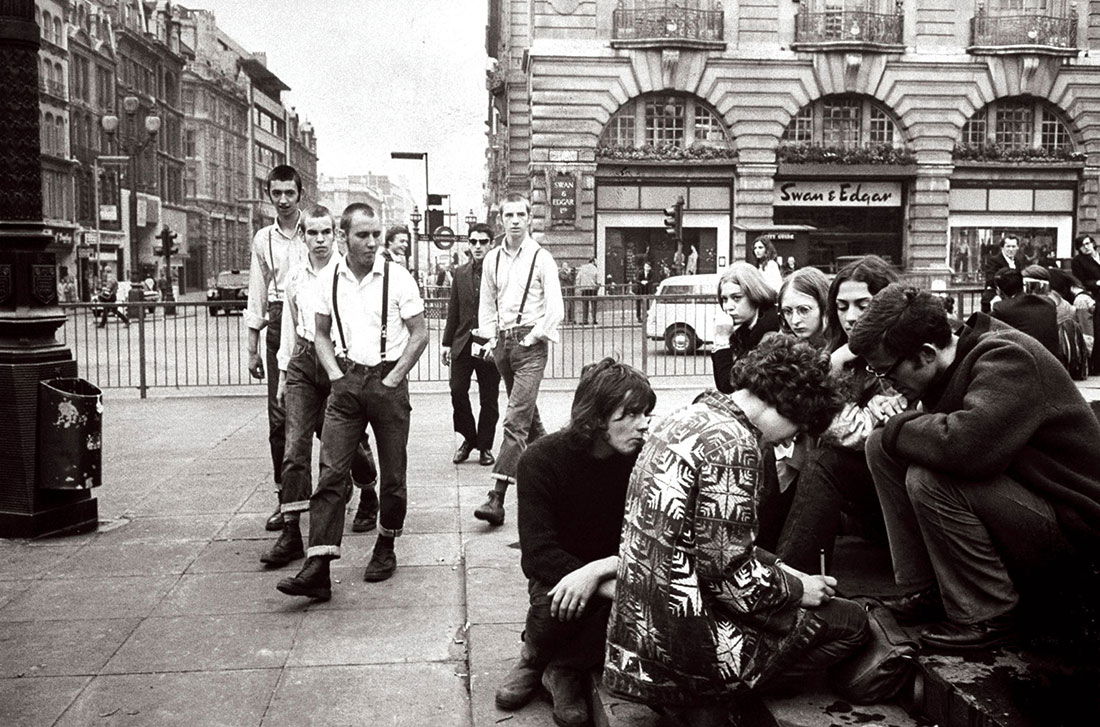
Published in May 1959, Colin MacInnes’ Absolute Beginners was the first novel to capture the new youth culture of coffee bars, jazz clubs and record shops centred in and around London’s Soho. Set in the previous year, MacInnes’ fast-paced prose conveyed the restless energy of this postwar ‘youthquake’, which divided society into teenagers on one side – the absolute beginners – and, on the other, the outdated adult world of ‘squares’.
The white-haired MacInnes was an unlikely chronicler of this underground scene. He was already 44 and so 25 years older than the teenagers he was trying to give voice to. He was also from a privileged social background; his relatives included the Conservative prime minister Stanley Baldwin and the Pre-Raphaelite painter Edward Burne-Jones. Yet, as Tony Gould underlined in his 1983 biography, MacInnes must be understood as a classic example of the anti-bourgeois bourgeois. Although born in London, his itinerant early life, growing up in Australia during the 1920s, followed by a five-year stint in Brussels, left him estranged from the upper echelons of British society. He was also openly bisexual at a time when homosexuality was illegal, another factor that led to his self-identification as an outsider who obsessively sought out those marginalised from mainstream society.
For this reason, despite the age difference, he identified with teenagers because their rebellious attitude provoked so much panic among the Establishment. He rejoiced at how, in 1956, The Times spoke in apocalyptic terms of youths who, fresh from seeing the film Rock Around the Clock in Manchester, ‘terrorised pedestrians, obstructed traffic and were jigging to “Rock and Roll” rhythm’. The other outsiders he embraced were Britain’s new African and Caribbean inhabitants, who had arrived over the past decade either to work or study. For MacInnes, they brought ‘an element of joy and fantasy and violence into our cautious, ordered lives’. Like teenagers, they were agents of change, transforming a tired, white London into something altogether more colourful, creative and energetic.
Upwardly mobile
The novel’s central character is a white, unnamed, upwardly mobile 18-year-old photographer. Variously referred to as ‘blitz baby’, ‘teenager’ and ‘son’, everything is told through his first-person perspective as he criss-crosses London with his Rolleiflex camera. In thrall to the new and contemptuous of the old, he is dismissive both of his father’s stories of the hungry 1930s and his brother’s socialism. When the latter accuses him of being a ‘class traitor’ and claims that it was ‘the Attlee administration that emancipated the working man, and gave the teenagers their economic privileges’, the narrator replies:
You old prehistoric monster I do not reject the working-class, and I do not belong to the upper-classes … I’m just not interested in the whole class crap that seems to needle you and all the tax-payers.
He is similarly scathing about the obsession with Britain’s role in the Second World War:
All you oldies certainly try to keep it well in mind, because every time I open a newspaper, or pick up a paperback, or go to the Odeon, I hear nothing but war, war, war. You pensioners certainly seem to love that old, old struggle.
This old Britain is contrasted with the economic power of the ‘un-silent teenage revolution’. For the narrator, teenage cool cuts across class, gender and race. An ‘absolute beginner’ is part of a select few who rise above the system:
It seems to me this being a mug or a non-mug is a thing that splits humanity up into two sections absolutely. It’s nothing to do with age or sex or class or colour – either you’re born a mug or born a non-mug, and me, I sincerely trust I’m born the latter.
The novel confronts youth culture’s unsavoury side. In February 1958 MacInnes was already writing about how ‘the teenage neutralism and indifference to politics’ could provide ‘the raw material for crypto-fascisms of the worst kind’ and this is a key theme in Absolute Beginners. At the beginning of the novel a character known as ‘Wizard’ personifies youth rebellion, at every turn mouthing hostility to ‘oldies’. Yet, by the end he is giving a fascist salute and shouting ‘Keep Britain White’, as white youths set upon black men in and around Notting Hill; a warning of how young white anger could so easily be directed into racist hostility, as the Notting Hill Riots in 1958, recreated in the novel, powerfully demonstrated.
Absolute Beginners was the middle part of MacInnes’ ‘London Trilogy’, which began with City of Spades (1957) and ended with Mr Love and Justice (1960). The common thread is the new London. If Absolute Beginners shines its light upon teenagers, City of Spades focuses on the new migrant communities, whose main protagonist is Johnny Fortune, recently arrived from Nigeria, while Mr Love and Justice deals with the criminal underworld. Collectively they portray a city brimming with conflict – generational, cultural, racial – but also open to new possibilities as absolute beginners seek to escape the long aftermath of the war.
More generally, though, Absolute Beginners must be understood as the starting point for one specific youth culture: ‘Modernism’. Abbreviated to ‘Mod’, the movement began, as the novel testifies, among a few hundred style-conscious young men and women who frequented Soho around 1958. For this reason it was an exemplar of what the art critic Kenneth Coutts-Smith identified in 1970 as an unprecedented phenomenon: working-class bohemia. Here, Teddy Boys were in the vanguard, but they were soon displaced by Mods, whose sense of style meant they were incomparably smarter than their middle-class and upper middle-class counterparts.
Jewish influence
Captured by a generation of photographers such as David Bailey, Don McCullin and Roger Mayne in the magazines Vogue, Town and Nova, the Mod style of sharp, well-cut lines drew on many influences. The look was rooted in the influx of Jewish tailors in the later 19th century, escaping persecution in the Russian Empire. By 1901, 60 per cent of Jewish men in Britain were working in this industry and the result was a revolution: the establishment of the ready-to-wear industry for the middle and working classes by the likes of Montague Burton, Ben Sherman and Moses Moss. The boutiques that sprung up from this wardrobe revolution were crucial to the invention of Mod. They were conduits for all that was adventurous in the late 1950s, whether it be Cecil Gee with his Italian box jackets, coloured knitwear, pointed shoes; Michael Fish, known as Mr Fish, who championed the ‘kipper tie’ and dressed the likes of Mick Jagger and David Bowie; or John Simons, who introduced the US Ivy League look of loafers and chinos popularised by the jazz musician Miles Davis on the cover of his 1958 LP Milestones.
Mod’s two other reference points were the stars of French New Wave cinema and the language of 1920s’ German Bauhaus modernism. In Jean-Luc Godard’s 1960 film Breathless, Jean-Paul Belmondo’s bum-freezer jacket was especially eye-catching, while three years later in Contempt, also directed by Godard, Brigitte Bardot invented a signature look with the wide headband, the off-the-shoulder Breton top and the beehive hairstyle. By contrast, Bauhaus came via the hairdresser Vidal Sassoon, born into a family of Jewish migrants in West London in 1928. Drawing upon the Bauhaus principles of the golden mean, symmetrical and asymmetrical balance, his mantra of ‘no fuss, no ornamentation, just a neat swinging line’ led to ‘The Shape’, ‘The Five-Point Cut’ and ‘The Clean Bob’, exemplified by the haircut he gave British fashion designer Mary Quant in 1963.
This European dimension was further complemented by the impact of the Jamaican ghetto gangster look, known as rude boy. This showy, intensely masculine look, comprised of pork-pie hats, slim fitting suits and skinny ties, came to the fore after Jamaican independence in August 1962, when an upsurge in rude boy violence became a frequent topic of ska songs, such as the Wailers’ Simmer Down in 1964 and Dandy Livingstone’s A Message to You, Rudy in 1967, both pleas for rude boys to turn away from fighting. Their violence was associated with ska dances, when rude boys were hired either as protection or trouble makers.
In London, the rude boy look arrived through clubs such as the Roaring Twenties in Carnaby Street, where the resident DJ was the Jamaican-born Count Suckle, one of the first purveyors of a sound system in London: a club culture documented by the photographer Charlie Phillips, who had arrived from Jamaica in 1956. Specifically, Suckle was instrumental in launching the British career of Prince Buster, ‘the godfather of ska’, playing his records and then bringing him over in 1964 for a British tour when Mods gave him a scooter escort out of every town he played. The rude boy influence was palpable, even if there were no black Mods, as John Paul Jones, then in a ska band before playing bass in Led Zeppelin, later recalled: ‘All the Mod style was from Jamaica, string brims and high buttons.’
Smashing it up
The Mod look went national through the medium of television and, in particular, the TV series Ready Steady Go!. Beginning with the declaration ‘The weekend starts here!’, it was broadcast every Friday evening from 9 August 1963 until 23 December 1966. What marked it out as fresh and innovative was the way in which musicians appeared on mini-stages, gantries and even stairs, often surrounded by the audience, who were hand-picked from clubs in London. Moreover, beyond appearances of burgeoning British talent such as the Beatles, the Rolling Stones and the Small Faces, RSG featured the likes of Sylvie Vartan from France, Otis Redding from the US and Millie Small from Jamaica, whose My Boy Lollipop reached number two in 1964. The face of the show was 19-year-old Cathy McGowan, with her sharp dress sense and catchphrases ‘fab’ and ‘smashing’.
Yet, if glamour was one side of the story, the other was violence, as Mods clashed with Rockers, a rival youth culture into motorbikes, black leather and rock ‘n’ roll, who saw their rivals as effeminate, weedy and posh. The first major confrontation came at Margate on Whitsun weekend, 18 May 1964, followed by similar outbreaks in other south coast resorts, such as Brighton, Clacton, Broadstairs, Bournemouth, Southend and Hastings, which produced lurid headlines about uncontrollable youth. The press speculated whether this aggressive behaviour was tied to the demise of military service, formally ended in December 1960, while in the courts one judge, when passing sentence, underlined the need to bring these ‘Sawdust Caesars’ to heel.
Such clashes had died out by 1966, at which point Mod began to morph into something different: skinhead. Here the fascination with Caribbean culture was even more explicit, as skinheads took their fashion cue from the Jamaican singer Desmond Dekker – whose song Israelites went to number one in 1969 – with his short haircut and high-cut trousers. Culturally speaking, skinheads identified with the new form of Jamaican protest music – reggae – that emerged from the slums of Kingston in 1968, seeing in these songs an expression of their own working-class alienation. This connection was explored in Horace Ové’s 1971 documentary Reggae. The 21-year-old Ové had arrived from Trinidad in 1960 to study painting, photography and interior design. In Reggae, he interspersed footage of Millie Small, the Pyramids and Desmond Dekker from a 1970 concert at Wembley, alongside interviews with young black Britons, skinheads and the owners of Trojan Records, a record label specialising in the genre. The film documents the complex, multicultural beginnings of skinhead culture, although Paul Gilroy, author of Ain’t No Black in the Union Jack (1987), guards against any romanticisation when talking about his early teenage years in north London:
We did not call them Skinheads. We called them Moddies. We avoided them because they would attack us if they saw us. Every Friday night Skinheads from across London would assemble in a local club near where we lived. You knew that public transport would be full of them and that you had to watch out. I was never fooled by the idea that skinheads weren’t really racist against black people. That is a revisionist idea that appeared later. Skinheads did not have an unquenchable thirst for Jamaican culture. They were violent, racist and frightening.
Such hostility was a reflection of a new racist politics, targeting the white working class, which saw the formation of the neo-fascist National Front in 1967 and was compounded by Enoch Powell’s ‘Rivers of Blood’ speech of 20 April 1968. Powell was the Conservative Shadow Minister of Defence who, just days before Parliament discussed the Race Relations Bill, which sought to make it illegal to refuse housing, employment or public services on grounds of ethnicity, portrayed a Britain poised on the edge of a precipice. Such legislation, he argued, was akin to ‘throwing a match on to gunpowder’ because it would fuel ‘resentment’ among white Britons. Calling for a halt to immigration, Powell conjured up a future torn apart by racial bloodshed: ‘In numerical terms, it will be of American proportions long before the end of the century.’
Equating Britishness with whiteness, Powell’s words charged the immigration debate for the next decade. For Don Letts, a filmmaker whose parents arrived from the Caribbean in 1955, the speech changed everything:
Even in the school playground, I wasn’t ‘Lettsy’ their mate any more. I was ‘you black bastard’ … When I was walking to school, the graffiti would be six feet, sprayed-white letters: ‘KBW. Keep Britain White’.
Rock Against Racism
During a concert in Birmingham on 5 August 1976, Eric Clapton, drunk and angry, harangued the crowd for around 14 minutes. Britain, he claimed, was in danger of becoming ‘a black colony’. Calling on people to vote for Powell, Clapton complained: ‘Jamaicans don’t belong here, we don’t want them here. This is England, this is a white country.’
Angry at the vitriol and hypocrisy (Clapton had just registered a worldwide hit with a cover of I Shot the Sheriff, written and performed by the Jamaican reggae star Bob Marley), a photographer, Red Saunders, and other signatories penned a letter published in the New Musical Express, Melody Maker and Sounds: ‘Come on Eric … Own up. Half your music is black. You’re rock music’s biggest colonist … We want to organise a rank and file movement against the racist poison music.’ The letter also announced the launch of a new movement, Rock Against Racism (RAR) and included an address in East London for people to contact. Within a week RAR had received 300 replies – the first political movement to emerge directly from British youth culture
RAR’s high point came on 30 April 1978 with a Carnival in Victoria Park in London’s East End. Organised in conjunction with the Anti-Nazi League (ANL) – formed by the Trotskyist Socialist Workers Party after violent clashes with the National Front in south London in August 1977, and which gathered support from the Labour Party and trade unions – the Carnival was the largest anti-fascist demonstration in Britain since the 1930s, attracting 80,000 people. Starting at Trafalgar Square behind truckloads of steel-pan orchestras, punk bands and reggae musicians, the rally began at 11am with the first marchers arriving at Victoria Park at 1.30pm. MacInnes had been dead for two years, but Absolute Beginners continued to resonate with the RAR generation. The subject of a 1981 song by The Jam and adapted as a film by Julian Temple in 1986, the novel was the harbinger of a new, youthful, multicultural London.
Martin Evans is Professor of European History at the University of Sussex and co-curator of Paris-Londres. Music Migration 1962-1989 at the French National Museum of the History of Immigration in Paris, until 5 January 2020.




