In the first millennium BC the Brahmin class organised as a community and assumed responsibility for learning the sacred Vedas. What are the origins of India’s priestly caste?
As an ancient Indian hymn proclaims, at the beginning of all things there was one singular being. The hymn calls him Purusha, and he encompasses all that there is:
Thousand-headed is Purusha, thousand-eyed, thousand-footed. He covered the earth on all sides and stood above it the space of ten fingers. Purusha alone is all this, what has been and what is to be, and he is the lord of the immortals, who grow further by means of food.
To create the world, the hymn continues, the gods (somewhat paradoxically) conducted a sacrifice of Purusha. From his body emerged its essential elements – the moon from his mind, the sun from his eyes, the wind from his breath – and, so too, came humans:
When they portioned out Purusha, in how many ways did they distribute him? What is his mouth called, what his arms, what his thighs, what are his feet called? His mouth was the Brahmin, his arms were made the Rajanya, what was his thighs was made the Vaishya, from his feet the Shudra was born.
Register to read more articles for free.
When you register, you will receive the History Today newsletter. Click here to read our Terms of Use.
In the first millennium BC the Brahmin class organised as a community and assumed responsibility for learning the sacred Vedas. What are the origins of India’s priestly caste?
As an ancient Indian hymn proclaims, at the beginning of all things there was one singular being. The hymn calls him Purusha, and he encompasses all that there is:
Thousand-headed is Purusha, thousand-eyed, thousand-footed. He covered the earth on all sides and stood above it the space of ten fingers. Purusha alone is all this, what has been and what is to be, and he is the lord of the immortals, who grow further by means of food.
To create the world, the hymn continues, the gods (somewhat paradoxically) conducted a sacrifice of Purusha. From his body emerged its essential elements – the moon from his mind, the sun from his eyes, the wind from his breath – and, so too, came humans:
When they portioned out Purusha, in how many ways did they distribute him? What is his mouth called, what his arms, what his thighs, what are his feet called? His mouth was the Brahmin, his arms were made the Rajanya, what was his thighs was made the Vaishya, from his feet the Shudra was born.
Unlike the Judeo-Christian account of creation found in Genesis, humanity did not arise gendered in Hinduism; it came into being organised by social class. According to the hymn and others like it, there were four such classes, or varna, ranked by status. Accordingly, the Shudras, the lowest group, derive from Purusha’s feet; the Vaishya class from his thighs; the ruling warrior class or the Rajanya from his arms. And it is the Brahmin class – teachers, priests, and scholars – who emerged from the deity’s mouth.
Pages of the Rig Veda, beginning with a hymn to the fire god Agni, 19th-century manuscript. CPA Media Pte Ltd/Alamy Stock Photo.
This story appears in a huge compilation known as the Rig Veda Samhita, a collection (samhita) of some 1,028 hymns (rigs) composed in Vedic Sanskrit which date, roughly, to 1300-1000 BC. It is a monumental composition, roughly equal in size to the complete works of Homer, and quite a bit older. The Rig Veda is certainly one of the most ancient large works of religious poetry in the world, and in many ways it forms the foundation for the main religious developments in early South Asia. But while historians assign this early date of composition to the Rig Veda, there is no written evidence to corroborate it. Writing did not develop in India until centuries later (unless we count the still-undeciphered script of the Indus Valley civilisation). We owe the existence of this hymn-book to the dedicated effort of many generations of Brahmins, who took it upon themselves to transmit the hymns orally, with astonishing exactitude, for centuries. Even when writing became available, perhaps as late as the third century BC, the Brahmin class chose to continue with oral transmission, for they considered the power of the hymns to reside in their sacred sounds, which they called the brahman. As the medieval Vedic exegete Kumarila Bhatta decreed, the hymns of the Veda were useless if acquired from a written source.
Sacred sounds
Today, Brahmins are considered a caste within the caste system of India. The historical origins of caste in India are complex, but the Vedic hierarchy of four classes – as established in the hymns found in the Rig Veda – is often taken as a starting point. The original four classes have given rise to around 3,000 castes, by some counts. According to the most recent census data, there are 56 million Brahmins in India, constituting about five per cent of the total population. Members of the Brahmin class – which retains its position at the top of the social hierarchy – reside in every part of India, and around the world.
In historical surveys, the Brahmins are often identified as the ‘priestly’ class, as its members claimed the privilege of officiating at sacrifices and all sorts of ritual ceremonies. It might be more accurate, however, to think of them as the ‘reciting’ class. In the first millennium bc the Brahmins organised themselves as a community and took on three primary responsibilities: to officiate at public sacrifices, to learn and transmit the oral scriptures of the great corpus of texts known as the Veda (‘truth’), and to interpret these works. We know of their activities thanks to their great success as a community of reciters.
Learning to recite the Vedas was a daunting task. The Rig Veda Samhita was itself a significantly lengthy work. But around the same time that the rigsof the Rig Veda were compiled into a single samhita, other Vedas were also being put together. Within a couple of centuries there was an accepted canon of four Vedas: the Rig Veda, Yajur Veda, Sama Veda, and Atharva Veda. The Rig Veda contained the most sacred hymns used in sacrifice. The Yajur Veda dealt principally with the proper actions of sacrifice, while the Sama Veda set out the musical performance of the hymns. The Atharva Veda contained a potpourri of hymns and materials pertinent to rites and practices not addressed in the first three Vedas. To these four, the Vedic corpus later expanded to include interpretive works, known as the Brahmanas, which dealt with the sacred sounds, or brahman, of the Vedas.
To remember accurately this full library of verbal works was well beyond the mnemonic ability of even the most gifted memoriser. To deal with this problem, Brahmins devoted to the Vedas divided themselves into shakhas, or recitative branches. This division of labour began in northern India during the period 1000-500 BC, but eventually the Vedic shakhas spread throughout India. Each branch would dedicate itself to the memorisation of one recension of one particular Vedic samhita.The Shakala shakha – the oldest shakha – took on the Rig Veda Samhita, along with the accompanying Brahmana. The Vajasaneyin shakha memorised one recension of the Yajur Veda. Still other shakhas took on the other Vedas.
Water purification ceremony, performed on the preparatory day for the ceremony of investing the boy, aged seven. British Library/Bridgeman Images.
The Vedic Brahmins organised an education system around the task of memorisation and oral transmission. At the age of seven or eight, young Brahmin males would be initiated into the Veda. During this rite of passage they would receive their first Vedic hymn, known as the Gayatri. So important was this initiation that it was considered a ‘second birth’ – a birth into the Veda. For this reason, members of the Brahmin class were often referred to as ‘twice born’. Once initiated, the young Brahmin male would become a Brahmacharin, ‘one who practises the sacred sounds of the Vedas’. He would then move to the home of a teacher or guru, where he would spend six to ten years mastering the Veda of his particular shakha.
The curriculum of these home-schools consisted primarily of face-to-face oral memorisation. We often think of oral transmission as inherently inaccurate, or at least prone to distortions, but since the Vedic Brahmins considered the words of the Veda to be powerful and efficacious as sound, they dedicated themselves to accurate recitation of the highest fidelity. This required sophisticated methods of recitation.
The same text can be learned in multiple ways. The young Brahmacharin would first learn the samhita of his shakha in its standard form, reproducing the work the way it would normally be recited. In Sanskrit, words are often conjoined and modified through a process called sandhi, or euphonic combination. The second way the Brahmacharin would learn the same samhita would involve separating each word, removing those euphonic modifications, and making a brief pause between each word. This was called the ‘word recitation’ method. A third way to learn the same samhita was the ‘step recitation’. The Brahmacharin would recite the first two words, then the second and third words, the third and fourth, and so on. In order to ensure absolute accuracy, more complex methods were added, such as the ‘twisted-hair recitation’ and the ‘dense-recitation’ methods. If we understand the ‘word recitation’ method to be analogous with learning the alphabet through the repetition of individual letters (‘a b c d e’), ‘step recitation’ would learn the same letters in the format ‘ab bc cd de’. ‘Twisted hair’ would learn the letters through a more complicated pattern (‘ab ba ab bc cb bc cd dc cd de ed de’), while ‘dense-recitation’ is more complicated still: ‘ab ba abc cba abc abc bc cb bcd dcb bcd’. Later texts codified 11 such methods in all.
The Brahmin life
‘He who enters on a Brahmacharin’s life’, says the Shatapatha Brahmana, an eighth-century BC commentary on the Yajur Veda, ‘enters into a long sacrificial session’. What we know about the organisation of the young Brahmins’ education comes from the Dharmasutras, another genre of texts written and transmitted from 500 to 100 BC, that outline best practices (dharma) for members of the Brahmin class.
As the Dharmasutras tell us, the rite of initiation separates the young Brahmin from his family until his Veda education is complete. As a Brahmacharin, the student adopts the physical signs of his status. He wears a belt made of munja grass and carries a staff of palasha wood. He covers his body in deerskin. He shaves his head or leaves just a tuft of hair on top. While a student, he adheres to an austere code of conduct: he begs for his food and does not eat spices, sweets, or meat; he sleeps on the ground. He abstains from all sexual intercourse – so important was this provision that the word brahmacharya came to be used in Sanskrit as a synonym for sexual abstinence, and continues to be used this way in modern Indic languages. He comports himself with self-restraint. He is ‘gentle, calm, mild-mannered, modest, resolute, energetic, free of anger, and free of spite’.
Ceremony performed on the first day of the upanayana, the initiation into the Veda. British Library/Bridgeman Images.
The main purpose of this period in a Brahmin’s life, however, is to learn the Veda. Through concentrated effort, perhaps over a 12-year period, the Brahmacharin memorises the Veda, or, better, incorporates that Veda into his own body. As the Shatapatha Brahmana puts it: ‘all the Vedas enter’ the successful Brahmacharin, and he blazes up ‘just as a fire blazes up with kindling fuel’. The Vedic fire inside the Brahmin glows and emanates outward – an appropriate metaphor, since it suggests that the Brahmacharin, through his study of the Veda, becomes an embodiment of the priestly god Agni. Fire can be passed on to light a new fire without extinguishing itself, as the teacher has kindled his Vedic knowledge within the student. To keep a fire burning requires regular kindling, and in his future life the Brahmin would need to maintain his continuing discipline of Veda recitation.
At the completion of studentship, the young adult returns to his parental home, receives a ceremonial bath of reincorporation, and gains a new status as a ‘bath graduate’ (snataka). His rite of passage into adulthood is complete. He is now ready to take a wife and become a householder (grihastha). From that point on he should follow the code of conduct proper to his station. This code is set out in elaborate detail in the Dharmasutras, which he would have learned during his Veda studies. ‘Those who know dharma and follow it are righteous’, says the Dharmasutra of Vasishtha, composed sometime between 300 and 100 BC. ‘Such a person becomes preeminent in this world and gains heaven after death.’
Five great sacrifices
Brahmin females did not undergo an initiation, as they were not eligible to receive or transmit the Vedas. For a Brahmin woman, the texts say, marriage is equivalent to initiation for a male. When the bride is removed from her parents and transferred to a new home she becomes a moral agent, responsible for observing stri-dharma, or ‘female dharma’. As one half of a new married couple, the wife will also become a ritual actor – albeit not the one officiating or reciting Vedic words – in shared domestic rites.
Certain activities were of paramount importance in the Vedic Brahmin household. These were codified as the ‘five great sacrifices’ (mahayajna). They were not, it needs to be said, the great public sacrifices spelled out in the older Vedas, lasting days or weeks, requiring substantial resources, employing multiple Brahmin priests, and often involving the sacrificial slaughter of domestic animals. Rather, the ‘five great sacrifices’ are small, daily affairs. Nevertheless the Dharmasutras insist that they are equal to the great public sacrifices of ‘earlier times’.
Every day the householder should make sacrificial offerings to five categories of beings: gods, ancestor-spirits, semi-divine spirits, humans, and the sacred words of the Veda. The sacrificial actions could themselves be minimal. To offer a daily sacrifice to the gods, for example, one must ritually add at least one piece of firewood to the domestic fire. A daily sacrifice to the ancestor-spirits – three generations of the householder’s male ancestors – could be completed by presenting one cup of water along with the ritual utterance: ‘svadha’. For the semi-divine spirits, the minimum sacrifice involves offering flowers with hands folded in reverence. A sacrifice to humans entails respectful hospitality to worthy guests (atithi). The sacrifice to the Veda requires the recitation or repetition of its sacred words: ‘Even if one is anointed with oil, relaxed, lying on a couch, if he recites the Veda mantras of a sacrifice, just by that he performs the sacrifice’, says the Shatapatha Brahmana.
The death bed ceremony. The dying man is being supported by a friend. The eldest son brings in a cow and its calf which are to be given to the Brahmin. In the sky are two messengers of Yama, god of death and justice, each equipped with a mace and a noose.British Library/Bridgeman Images.
Brahmins organised themselves as an endogamous class of religious specialists, and applied themselves to the priestly tasks of maintaining the sacred texts of the Vedas. But in early India there were many paths open to individual Brahmins. They could take up everyday non-religious ways of life, becoming farmers, merchants, or artisans. They could become specialists in new disciplines of knowledge, such as grammar and astronomy, that had grown out of their inquiries into the Veda. They could become forest-dwelling philosophers, along the path laid out in the Upanishads, the fourth and final strata in the Vedic canon, which dealt with philosophical and ontological matters. But those who remained loyal to the Vedic order dedicated themselves to learning and transmitting the sacred texts and carrying out the sacred practices prescribed in them. These Vedic Brahmins lived in family units, often in small Brahmin communities. In early India, Brahmin villages became common in the Gangetic plain, often the result of royal gifts of tax-free land to Brahmins in exchange for ritual services. They lived austere lives, following the prescriptive code of dharma, and diligently continued the immense task of memorising, reciting, and transmitting the Vedic scriptures.
Buddha and the Brahmins
The hymn of Purusha’s sacrifice is an origin myth that gives the Brahmin a special status at the apex of the social hierarchy. Such myths, as Roland Barthes would later observe, serve ‘the task of giving an historical intention a natural justification, and making contingency appear eternal’. It reifies a social claim as something ordained at the beginning of things. Vedic Brahmins asserted a special authority through their intimate association with the Vedas. But not everyone accepted these claims. Around the fifth century BC, religious communities such as the Buddhists and Jains began to call into question the most crucial presuppositions of the Vedic worldview: the authority of the Vedas as sacred works, the efficacy of Vedic sacrifice as the preeminent form of ritual practice, and the innate privilege of the Brahmin atop the social hierarchy based on birth and exclusive command of the Vedas.
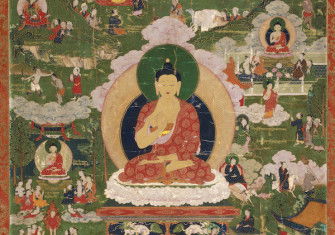
The earliest Buddhist works often portray the Buddha in debates with Vedic Brahmins. In these dialogues, Brahmins enjoy comfortable lives in their substantial settlements on tax-free lands. The Buddha disparages their newfound luxury and contrasts it with an older way of Brahmin life when, he says, Brahmins lived in the forest and led modest lives. In a dialogue of the Sutta Nipata, one of the earliest collections of the Buddha’s discourses dating perhaps to the fifth century BC, the Buddha converses with two young Brahmin students, Vasettha and Bharadvaja, who live in a prosperous Brahmin settlement. The students have different teachers, both experts in the Veda, who have taught them diverging views. They get into an argument over what makes one a Brahmin. Vasettha holds that good action and observance of duties confers Brahmin status. Bharadvaja argues that it is family descent: one who is born into a pure family of Brahmins is a Brahmin. Unable to resolve the issue, they put the matter to a renouncer in a nearby forest, about whom they have heard good things. That renouncer happens to be the Buddha.
A Buddhist frieze with the lower panel showing the story of Sumati, a wealthy Brahmin who turns renunciant, laying down and spreading his matted hair across a puddle for the Buddha to walk across. Art Institute of Chicago. Public Domain.
When Vasettha explains the disagreement the Buddha takes up the question of birth status. One can immediately recognise that different kinds of living things belong to different species (jati, literally ‘birth-group’), with defining characteristics. But among humans, he continues, there are no distinct species. Human differences are simply conventional. Contrary to Bharadvaja’s view, the Buddha insists that we designate human identities according to one’s activities or occupations. One who keeps cows and lives off their produce we call a farmer, and one who makes a living practising a particular craft we call a craftsman. ‘No one is a Brahmin by birth, and no one is not a Brahmin by birth. One becomes a Brahmin through actions, and one becomes a non-Brahmin through actions.’
This leaves the Buddha free to consider what it is that a Brahmin does to gain Brahmin-hood. It is not memorising Vedas or performing sacrifices that grants one the status of Brahmin, he claims. Rather, one becomes a Brahmin by living a renunciatory life as the Brahmins of old did. The Brahmin should be one who is without attachment, restrained, nonviolent, without possessions, and so on. ‘One becomes a Brahmin’, the Buddha concludes, ‘through austerity, abstinence, self-control, and moderation. This is the best Brahmin.’ The true Brahmin, the Buddha explains to his two young interlocutors, looks exactly like a Buddhist monk. The Buddhist Sangha (congregation of followers) would soon develop its own monastic community of reciters, to learn and transmit what they defined as dharma – the teachings of the Buddha. But that is another story.
Anti-Brahmins
Of course Vedic Brahmins did not cede the title of their birth class to the Buddha. They continued with their enterprises of education, Veda-transmission, and ritual performance. They reiterated their claims to exalted status. Composed around the second century AD in implicit response to Buddhist critiques, the Dharmashastra of Manu proclaims, alluding back to the sacrifice of Purusha:
It is declared that a man [Purusha] is purest above the navel. And on that principle, the Self-Existent One states that the mouth is the purest part of that. Since the Brahmin emerged from the highest part of the body [of Purusha], since he was the first to emerge, and since he is the carrier of the brahman, the Brahmin is certainly the lord of the entire creation, according to dharma.
But the critique of Brahmin status never abated. The descendants of the Buddha, in opposing the high status of the Brahmin class, may be seen in 20th-century critics such as the Tamil anti-Brahmin movement led by E.V. Ramasamy Nayakkar, and the Dalit movement led by B.R. Ambedkar, who had been born into the Dalit – or ‘untouchable’ – caste in 1891, and later became a minister in Nehru’s first independent government. Speaking to a World Fellowship of Buddhists in 1950, Ambedkar set out his critique:
The Brahmins divided society into four sections – Brahmin, Kshatriya, Vaishya, and Shudra. The division of the society into four varnas created great inequalities. They said that the Brahmins were born of the Brahma’s mouth and Shudras from his feet. Can anybody believe that the basic principle of any religion could be to divide the society? Yet, this is what Brahmanism has perpetrated. On the other hand, equality is the main feature of Buddhism.
In 1956 Ambedkar applied this analysis to himself and converted to Buddhism in a grand public ceremony.
Richard H. Davis is the author of Religions of Early India: A Cultural History (Princeton University Press, 2025).